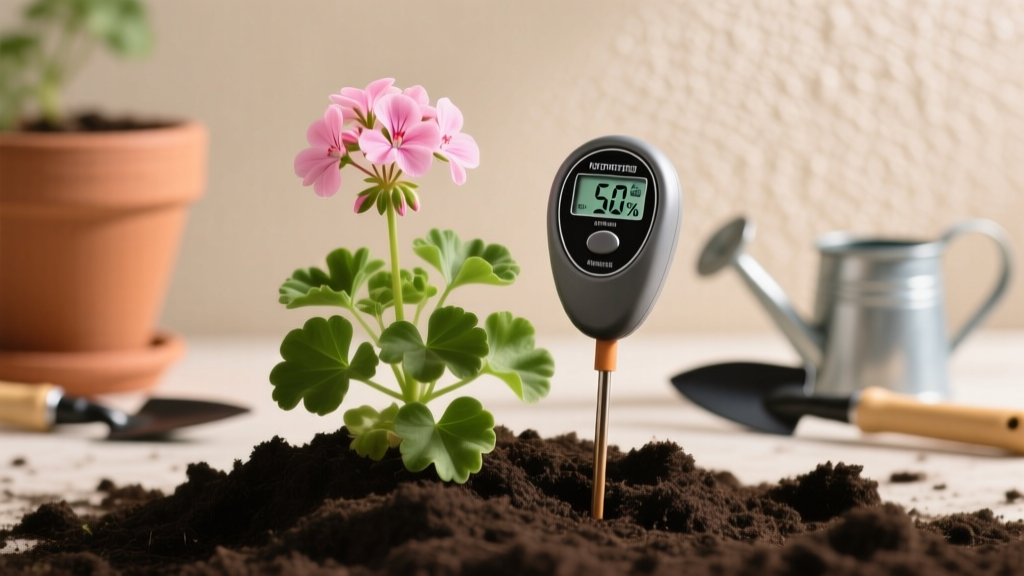
How to Read Soil Moisture Meter for Geraniums
You water your geraniums on Saturday, and by Tuesday the leaves are yellowing. So you water again—because dry leaves must mean dry soil, right? Then the pot starts to smell sour, a few stems go mushy at the base, and suddenly you’re on a fast track to root rot. I’ve seen this exact spiral happen more times than I can count, especially with container geraniums (Pelargonium) on hot patios where the top inch dries fast but the root zone stays wet.
A soil moisture meter can stop that guesswork—if you read it correctly for geraniums. The trick is that “moist” on the meter isn’t always “good” for this plant. Geraniums want a wet-dry rhythm: water thoroughly, then let the root zone dry down to a specific point before watering again. This guide will show you exactly how to use a moisture meter for geraniums, what numbers to look for, and what to do when meter readings don’t match what you’re seeing above the soil line.
What a soil moisture meter is really measuring (and what it isn’t)
Most inexpensive soil moisture meters used by home gardeners are electrical resistance meters. They measure how readily electricity passes between the probe tips—water conducts electricity, dry soil resists it. More water (and more dissolved salts) generally reads “wetter.” That means:
- Fertilizer salts can make soil read wetter than it actually is.
- Peat-heavy mixes can read oddly because they shrink and pull away from the pot edge when dry.
- Chunky bark or perlite can create air gaps around the probe, giving a falsely “dry” reading if the probe isn’t well-seated.
Still, for geraniums in pots, a meter is extremely useful—because the biggest problem is usually not underwatering, it’s watering too often in a mix that stays wet longer than you think.
Good practice: wipe the probe after every use and avoid leaving it in the pot permanently. Many manufacturers warn that prolonged insertion can corrode probes and distort readings.
How to read the meter for geraniums: the numbers that matter
Many meters use a 1–10 scale (1–3 dry, 4–7 moist, 8–10 wet). For geraniums, I treat the scale like a “traffic light,” with slightly drier thresholds than houseplants like peace lilies.
Target readings (1–10 meter scale)
- Water now: meter reads 2–3 in the root zone
- Wait: meter reads 4–5 (still enough moisture for geranium roots)
- Risk zone (too wet): meter reads 6+ for more than a day or two after watering
Concrete rule I use in containers: after a thorough watering, the meter might briefly show 7–9. That’s fine on watering day. But if you’re still reading 6–8 72 hours later in average conditions, the mix is staying too wet for geraniums and you’re likely headed toward fungal problems.
Where to insert the probe (depth and location)
Probe placement is the whole game. Geranium roots occupy the middle of the pot, not the surface. Use these placements:
- Depth: insert the probe to about 1/2 to 2/3 of the pot depth. In a 10-inch pot, that’s roughly 4–6 inches.
- Distance from stem: place the probe 2–3 inches away from the crown/stems to avoid damaging the main root mass.
- Take 2–3 readings: one near the edge, one midway, one opposite side. Average them mentally.
If the meter has a “moisture only” function, use that. If it’s a combo meter (moisture/light/pH), don’t over-trust the pH reading on cheap models; moisture tends to be the most reliable function.
Real-world scenarios: how the meter saves geraniums (and when it misleads)
Scenario 1: “My geranium wilts every afternoon—meter says wet”
This is classic heat wilt. In bright sun and temperatures above 85°F (29°C), geranium leaves can droop even when soil is adequately moist. If your meter reads 5–7 mid-day but the plant perks up by evening, don’t water. Shade the pot temporarily, and check again early morning. Overwatering heat-wilted geraniums is a common mistake.
Scenario 2: “Top inch is bone dry, meter reads 6 at root level”
Totally normal in containers, especially with airy potting mix. The surface dries quickly from sun and wind, but the lower root zone can stay wet for days. Trust the root-zone reading, not the crusty top. If you water every time the top inch looks dry, you’ll keep the root zone in the danger zone (6+).
Scenario 3: “Meter always reads dry (1–2), but the pot feels heavy”
Two common causes:
- Air gap around the probe from barky/perlite-heavy mixes. Reinsert in a different spot and gently firm the mix.
- Hydrophobic peat (peat that’s dried and repels water). Water runs down the pot sides, leaving the center dry. The pot feels heavy because water is pooled or trapped in pockets, not evenly distributed.
Fix: bottom-water for 15–20 minutes, then let drain thoroughly. Repeat once if needed. After that, the meter readings usually start making sense again.
Watering geraniums using the meter: a simple routine that works
Geraniums like a soak-and-dry approach. The meter tells you when you’ve reached the “dry enough to water” point, and it also tells you when your mix is holding water too long.
Step-by-step: container geranium watering (meter-guided)
- Check moisture in the root zone first thing in the morning (not during peak heat).
- If the meter reads 2–3, water. If it reads 4–5, wait a day and re-check.
- Water thoroughly until you get steady drainage from the bottom holes (not just a few drops).
- Wait 10 minutes, then empty saucers so the pot isn’t sitting in water.
- Re-check 24 hours later. If you’re still at 7–9, your mix is waterlogged or drainage is poor.
How much water is “thorough”? For a typical 10–12 inch patio pot, it’s often around 0.5–1.0 liters depending on mix and dryness. For a 6-inch pot, it may be 150–300 mL. Use runoff as your real indicator, not a fixed volume.
Timing: how often you’ll usually water
Frequency depends on weather, pot size, and mix. Here’s a realistic range I see in home gardens:
- Summer, full sun, 10–12 inch pot: every 2–4 days
- Mild weather (65–75°F / 18–24°C): every 4–7 days
- Cool, overcast weeks: every 7–10 days
Use the meter to confirm the rhythm. Geraniums tolerate being a bit dry far better than staying wet.
Soil and potting mix: getting readings you can trust
If your geranium soil stays above 6 for days, don’t fight it with “less water.” Fix the conditions that hold moisture too long: mix structure, pot size, and drainage.
Best potting mix characteristics for geraniums
- Fast drainage with enough water-holding to last between waterings
- Air space so roots can breathe
- Consistent wetting (doesn’t repel water when dry)
A practical home blend: quality peat/coco-based potting mix plus 20–30% perlite for extra aeration. If you already have a dense mix, top-dressing with perlite won’t fix the lower root zone—repotting is the real solution.
Pot and drainage rules that affect meter readings
- Use pots with at least 1 drainage hole (more is better).
- Avoid “cachepots” (decorative outer pots) unless you empty them after watering.
- Don’t oversize the container. Jumping from a 6-inch to a 14-inch pot can keep soil wet far too long.
Extension guidance consistently emphasizes well-drained media for geraniums. For example, North Carolina State Extension notes geraniums perform best in a “well-drained” growing medium and suffer in poorly drained conditions (NC State Extension publication, 2020). The University of Minnesota Extension also stresses that overwatering and poor drainage are common causes of houseplant decline (University of Minnesota Extension, 2022).
Light: using light levels to interpret moisture readings
Light changes how fast geraniums use water. If your meter reads the same number week to week but the plant behaves differently, check the sun exposure.
- Best flowering: about 6+ hours of direct sun for most zonal geraniums.
- Hot climates: afternoon shade can prevent stress when temps run above 90°F (32°C).
- Low light indoors: water use drops sharply; meter will stay higher longer.
Practical read: in bright sun, a reading of 3 may happen quickly and it’s safe to water. In low light, that same pot might take twice as long to reach 3, and watering earlier often leads to soft growth and disease.
Feeding: how fertilizer affects moisture meter readings (and geranium health)
Here’s the sneaky part: fertilizer salts can increase conductivity and make some meters read “wetter.” So if you just fed and the meter seems oddly high, take an extra reading in a different spot and use the pot-weight method as a cross-check.
A feeding schedule that pairs well with meter-guided watering
- During active growth (spring through early fall): feed every 14 days with a balanced liquid fertilizer at 1/2 strength, or use a slow-release product per label rates.
- When temperatures stay below 60°F (16°C) and growth slows: reduce feeding to monthly or pause (especially indoors).
If you see leaf edges browning and the meter reads wet all the time, consider salt buildup. Flush the pot with clear water equal to roughly 2–3x the pot volume (letting it drain freely). After flushing, readings often drop to more realistic levels within a day.
“Overwatering is not about the amount of water applied at one time—it’s about watering too often and depriving roots of oxygen.” — University of Minnesota Extension houseplant water management guidance (2022)
Moisture meter vs finger test vs pot weight: a comparison with real data
I use all three methods, but not equally. The meter tells you what’s happening at root depth; the finger test tells you about the surface; pot weight tells you the overall water load. Used together, they’re hard to beat.
| Method | What you learn | Best depth | Typical accuracy for geranium pots | Time required |
|---|---|---|---|---|
| Moisture meter (1–10 scale) | Root-zone wetness trend; helps avoid “always wet” conditions | 4–6 inches in a 10-inch pot | Good if you take 2–3 readings; can be skewed by salts | 30–60 seconds |
| Finger test | Surface dryness; detects crusting and hydrophobic mix | Top 1–2 inches | Fair; often misleading for geraniums because top dries fast | 10 seconds |
| Pot weight (lift test) | Total water held; catches “meter lies” from salts | Whole pot | Very good once you learn the “just watered” vs “needs water” feel | 5–10 seconds |
Comparison analysis: method A vs method B (with actionable thresholds)
If you want a simple two-method system, pair the meter with pot weight:
- Water only when both agree. For example: meter reads 2–3 and the pot feels clearly lighter than it did after watering.
- If the meter reads 2 but the pot still feels heavy, suspect probe placement, air gaps, or salts; recheck in two more spots.
- If the pot feels light but the meter reads 6, suspect a perched water table in the bottom of the pot (common in tall pots with dense mix). Consider repotting into a better-draining mix.
Common problems and troubleshooting (symptoms + meter readings + fixes)
Geraniums are honest plants. When something’s off, they show you—if you know what to connect. Here are the issues I see most often, with the meter clues that help you act fast.
Problem: Yellow leaves, soft stems, musty soil smell
- Likely cause: overwatering and low oxygen at roots; early root rot
- Meter pattern: stays 6–10 most days, even before watering
- Fix:
- Stop watering until meter drops to 2–3.
- Move pot to brighter light and better airflow.
- If soil is dense or drainage poor, repot into a mix with 20–30% perlite and ensure free drainage.
- Remove any mushy stems at the base with clean snips.
Problem: Crispy leaf edges, flower buds dropping
- Likely cause: inconsistent moisture (too dry between waterings) or heat stress
- Meter pattern: swings from 1 (very dry) to 8 (very wet) repeatedly
- Fix:
- Water when meter hits 2–3, not 1.
- In heat over 90°F (32°C), provide afternoon shade and consider a larger pot or thicker mulch layer to slow drying.
- Avoid tiny sips; water thoroughly with runoff so the whole root ball is rewetted.
Problem: Plant looks wilted, but meter says 7–9
- Likely cause: roots are damaged (rot), so the plant can’t take up water; or heat wilt
- Meter pattern: high readings persist; wilting does not improve after sunset (rot) or improves after sunset (heat)
- Fix:
- If it perks up in the evening: don’t water; cool the plant and reduce afternoon sun exposure.
- If it stays limp: unpot and inspect roots. Healthy roots are firm and pale; rotted roots are brown/black and slough off. Trim, repot into fresh fast-draining mix, and water lightly once (then let it dry to 2–3).
Problem: White crust on soil, slow growth, leaves paling
- Likely cause: salt buildup from fertilizer or hard water
- Meter pattern: may read artificially high because salts conduct electricity
- Fix:
- Scrape off the top 1/2 inch of crusted soil.
- Flush with clean water (about 2–3x pot volume), ensuring free drainage.
- Resume feeding at 1/2 strength and avoid fertilizing a dry pot.
Seasonal adjustments: the meter numbers stay, but the timeline changes
Your target “water at 2–3” doesn’t change much, but how long it takes to reach that number changes dramatically with season.
- Spring: increasing light and growth means faster dry-down; check the meter every 2–3 days.
- Summer: in full sun, check every 1–2 days during heat waves; don’t panic-water mid-day wilts.
- Fall: cooler nights slow water use; expect longer stretches between watering.
- Indoors wintering: low light + cooler temps = slow dry-down. You might water only every 10–21 days depending on conditions. Always verify with the meter at root depth.
If you overwinter geraniums indoors, keep them on the dry side. Aim to water when the meter reaches 2, not 3–4, because evaporation is lower and roots stay colder longer.
Quick reference: my “no-drama” moisture meter rules for geraniums
- Insert the probe 4–6 inches deep for a 10-inch pot; take 2–3 readings.
- Water when the root zone reads 2–3.
- If it reads 6+ for 3 days after watering, improve drainage or repot.
- Cross-check with pot weight after fertilizing (salts can skew readings).
- Don’t water based on afternoon wilting alone when temps are above 85°F (29°C).
Once you get comfortable with the meter, you’ll notice a calmer pattern: fewer emergency waterings, sturdier stems, and better flowering because the roots are breathing. That’s the real win—your geraniums stop living in a constant damp fog, and you stop guessing every time a leaf droops.
Sources: North Carolina State Extension geranium culture guidance (2020); University of Minnesota Extension houseplant watering and root oxygen management guidance (2022).