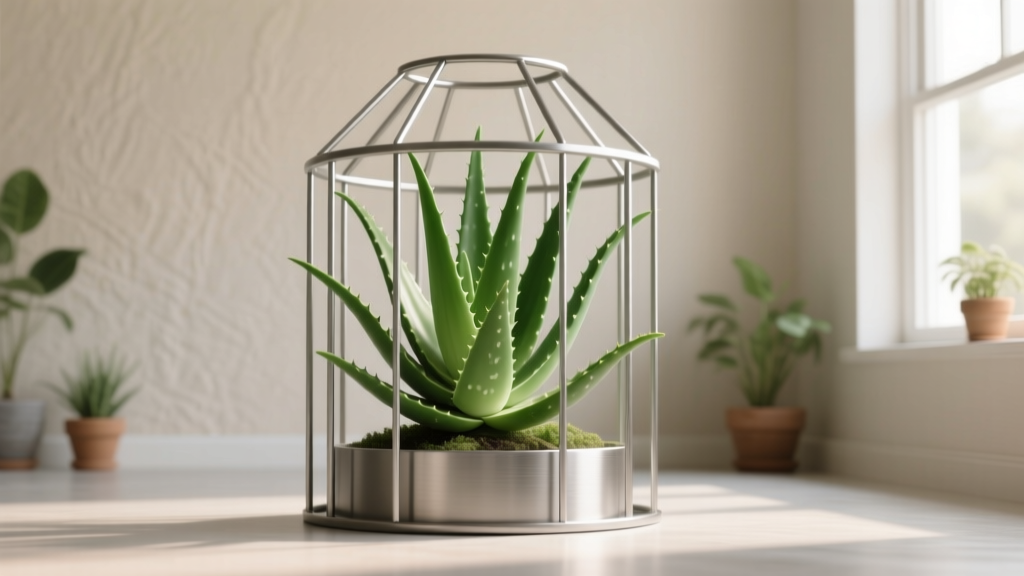
Building a Cage for Aloe Vera
The first time I “caged” an aloe vera, it wasn’t for looks. It was because my healthiest plant kept getting snapped in half by a curious dog that treated the fleshy leaves like chew toys. Another time, a porch aloe took a hard hit from a windstorm and toppled off a stand—pot shattered, plant bruised, and a month of recovery ahead. Aloe is tough, but those thick leaves are basically water balloons on a stem: one bad bump and you’re trimming, rooting, and starting over.
A simple cage—built to the size of your pot, your plant, and your conditions—solves a lot of real problems: pets, kids, wind, leaning rosettes, and even sunburn when you use the cage as a frame for temporary shade cloth. The trick is building it so it protects without trapping moisture or blocking light. Below is exactly how I build aloe cages that actually work, plus the care basics (watering, soil, light, feeding) that keep your plant sturdy enough to need less “babysitting” in the first place.
When an Aloe Actually Needs a Cage (and When It Doesn’t)
Aloe doesn’t need to be coddled, but it does need stable conditions. A cage is most useful in these common home-garden scenarios:
- Pet pressure: cats rubbing, dogs chewing, or wildlife nibbling.
- Wind exposure: balconies, patios, porches, and outdoor steps where gusts can tip pots.
- Top-heavy plants: mature rosettes that lean, or pups pulling the clump off-center.
- High-traffic areas: narrow walkways, kids’ play zones, crowded plant shelves.
- Temporary shade needs: using the cage as a frame to hold 30%–50% shade cloth during heat spikes.
If your aloe is indoors, on a stable surface, away from pets, and not leaning, you may only need a heavier pot and a good light source. But for outdoor pots and pet homes, a cage is cheap insurance.
Design Rules: What Makes a Good Aloe Cage
Every good aloe cage follows three rules: air, access, and stability.
Rule 1: Keep airflow wide open
Aloe hates staying wet around the crown. A cage should be open enough that you can see the soil surface and feel if it’s damp. Avoid solid sleeves or anything that wraps tightly around the plant.
Rule 2: Make it easy to water and inspect
You should be able to stick a finger 2 inches (5 cm) into the soil, check for mealies, and remove dead lower leaves without dismantling the whole thing.
Rule 3: Anchor it to the pot or a base
A cage that isn’t anchored becomes a sail in the wind. The best cages attach to the pot rim, sit inside the pot (in the soil at the edge), or anchor to a heavy base plate.
Materials That Work (and Ones I Avoid)
Here’s what I reach for depending on the situation:
- Hardware cloth (galvanized wire mesh): Great for pet protection. Use 1/2 inch (13 mm) mesh for most cases.
- Welded wire fencing: Good for larger outdoor pots; sturdier than chicken wire.
- Bamboo stakes + jute twine: Best for gentle support (leaning aloe) rather than bite-proof protection.
- Tomato cage (cut and customized): Quick option, especially for big patio pots.
What I avoid: tight plastic guards that trap humidity, and untreated steel that rusts quickly around wet soil. Also, be cautious with copper wire directly against leaves—sap and moisture can stain or react on contact over time.
Step-by-Step: Build a Simple, Strong Aloe Cage
This design works for most potted aloes from 6-inch to 14-inch pots and takes about 20–30 minutes.
Measurements to take first
- Pot diameter: measure across the top rim (example: 10 inches / 25 cm).
- Plant spread: measure the widest point of the rosette (example: 14 inches / 36 cm).
- Plant height: from soil to highest leaf tip (example: 16 inches / 41 cm).
Build the cage at least 2–3 inches (5–8 cm) wider than the plant spread so leaves don’t press against wire. Make it 2–4 inches (5–10 cm) taller than the leaf tips if wind is your main issue.
Tools and supplies
- Hardware cloth, 1/2 inch (13 mm) mesh (a piece about 24 in x 24 in for a medium pot)
- Wire cutters or tin snips
- Gloves (cut wire is sharp)
- Zip ties or galvanized wire for fastening
- 3–4 bamboo stakes (optional, for extra rigidity)
Build steps
- Cut the mesh: For a 10-inch pot, cut a rectangle roughly 24 inches wide x 18 inches tall. Wider gives you overlap to fasten.
- Roll into a cylinder: Curve the mesh into a tube. Overlap the edges by 1–2 inches.
- Fasten the seam: Use zip ties every 2–3 inches vertically. If outdoors in full sun, use UV-rated zip ties or galvanized wire.
- Create “feet”: Leave an extra 2 inches of wire at the bottom and bend prongs outward. These hook under the pot rim or sit against the pot for stability.
- Anchor it: Push the cage slightly into the soil at the pot edge (not through the root crown). Or tie the cage to bamboo stakes pushed down along the inside of the pot wall.
- Check clearance: Make sure no leaf tips are rubbing. If they are, widen the cylinder.
If pets are the issue, add a simple top “lid” with a flap you can open for watering. Cut a circle of mesh slightly larger than the cage diameter and attach with two zip ties as hinges. Keep it loose and airy—never seal an aloe in like a terrarium.
Method Comparison: Cage Options That Gardeners Actually Use
| Method | Best For | Typical Cost (USD) | Build Time | Airflow | Pet Resistance |
|---|---|---|---|---|---|
| Hardware cloth cylinder (1/2" mesh) | Pets + wind + general protection | $10–$25 | 20–30 min | Excellent | High |
| Tomato cage (modified) | Large patio aloe, quick support | $5–$15 | 5–15 min | Excellent | Medium |
| Bamboo stakes + soft ties | Leaning aloe indoors/outdoors (no pets) | $3–$10 | 10–20 min | Excellent | Low |
| Solid decorative plant guard | Looks only (not recommended) | $15–$40 | 0–10 min | Poor to fair | Varies |
My take: if you’re dealing with animals or outdoor weather, hardware cloth wins because it’s stiff, breathable, and can be anchored properly. Tomato cages are fine, but they’re easy to tip unless you secure them to the pot.
Watering: The Care Detail That Makes or Breaks a Caged Aloe
A cage changes how you move around the pot, but it shouldn’t change your watering logic. Aloe roots rot when they stay wet, especially in cool weather. The general rhythm is “soak, then dry.”
How often to water (realistic home conditions)
- Spring/summer (active growth): about every 14–21 days, depending on heat and pot size.
- Fall/winter (slower growth): about every 21–35 days.
Don’t water by the calendar alone. Check the soil: if the top 2 inches (5 cm) are dry and the pot feels lighter, you’re probably in the right zone.
How much water
Water until you get a steady trickle from the drain holes, then stop. For a typical 10-inch pot, that’s often 2–4 cups (500–950 mL), but it varies wildly by soil and root mass. The important part is drainage, not volume.
“Allow the potting medium to dry between waterings; overwatering is the most common cause of failure with succulents.” — University of Florida IFAS Extension publication on succulents (2022)
Cage tip: If your cage blocks your watering can, switch to a long-spout can or water through a funnel. Aim water at the soil, not into the crown.
Soil: Build a Mix That Prevents Rot (Even If You Get Heavy-Handed With Water)
Aloe wants fast drainage and enough grit to keep air around roots. Bagged “cactus mix” is a starting point, not a finished recipe. Many are too peaty and hold water too long.
A reliable aloe potting mix
- 2 parts cactus/succulent mix
- 1 part pumice or perlite
- 1 part coarse sand or fine gravel
If you only change one thing, add more mineral material (pumice/perlite). Aim for a mix that dries in 7–10 days after a thorough watering in warm weather.
Use a pot with drainage holes. If your decorative pot doesn’t have drainage, treat it as a cachepot: keep the aloe in a plastic nursery pot inside it.
Texas A&M AgriLife Extension notes that succulents perform best in well-drained media and are sensitive to waterlogged soils (Texas A&M AgriLife Extension, 2021). That matches what I see in home pots: the plant looks “fine” until one cool, wet week, then it collapses fast.
Light: The Cage Should Protect Without Shading Too Much
Aloe grows best with strong light. Indoors, low light produces soft, stretched leaves that flop and break—exactly what makes people think they need a cage in the first place.
Indoor light targets
- Place within 1–2 feet of a bright south- or west-facing window.
- Rotate the pot a quarter turn every 7–10 days for even growth.
- If using a grow light, aim for 12–14 hours per day and keep the light roughly 8–14 inches above the plant (depending on fixture strength).
Outdoor light targets
Give morning sun and afternoon protection in hot climates. If you move an aloe outdoors, harden it off over 7–10 days so it doesn’t sunburn. A cage makes an excellent frame to clip shade cloth for that transition.
Temperature edges
Aloe vera is not frost-hardy. Protect it when nights drop below 50°F (10°C). Actual tissue damage can happen near freezing; don’t gamble if frost is in the forecast.
Feeding: Less Fertilizer, Better Structure
Aloe doesn’t need heavy feeding. Too much nitrogen makes fast, weak, watery growth that bends and snaps more easily—another reason a cage becomes “necessary.”
Simple feeding schedule
- Feed 1–2 times during spring and summer only.
- Use a balanced fertilizer diluted to 1/4 strength (for example, a 10-10-10 or similar).
- Do not fertilize in winter.
If you repot into fresh mix, you can usually skip fertilizer for the first 8–12 weeks.
Common Problems (and How a Cage Helps or Hurts)
A cage is a tool. Used well, it prevents mechanical damage; used poorly, it can hide problems until they’re advanced. Here are the issues I see most often with caged aloes.
Problem: Leaves turning mushy at the base
Likely cause: overwatering and poor drainage; sometimes cold + wet together.
What to do:
- Stop watering immediately.
- Remove the plant from the pot and inspect roots. Trim black, slimy roots with clean snips.
- Let the plant air-dry out of soil for 24–48 hours (shaded, warm spot).
- Repot into a grittier mix and a pot with drainage.
Cage note: If your cage makes it hard to lift the plant out, redesign with a hinged seam or removable top. You need access when rot shows up.
Problem: Leaves getting thin, pale, and stretched
Likely cause: not enough light.
What to do:
- Move closer to a brighter window or add a grow light.
- Increase light gradually over 7–10 days to avoid sunburn.
- Reduce watering slightly until the plant firms up.
Cage note: A thick or decorative cage can shade the plant. Keep wire thin and openings large.
Problem: Brown or white sunburn patches
Likely cause: sudden exposure to hot direct sun, especially after being indoors.
What to do:
- Move to bright shade immediately.
- Use 30%–50% shade cloth for 1–2 weeks while it adapts.
- Don’t remove damaged tissue unless it turns mushy; scarred leaves still photosynthesize.
Cage note: Clip shade cloth to the cage as a temporary awning.
Problem: Sticky residue, cottony tufts, or tiny bumps on leaves
Likely cause: mealybugs or scale insects.
What to do:
- Isolate the plant.
- Dab pests with 70% isopropyl alcohol on a cotton swab.
- Repeat every 7 days for 3 weeks to catch new hatchlings.
- Improve airflow and avoid overfeeding.
Cage note: Make sure you can inspect the leaf bases; cages that block visibility let infestations build.
Three Real-World Cage Setups I Use (and Why)
Scenario 1: Balcony aloe in gusty wind
Balconies create wind tunnels. For a 12-inch pot aloe, I use welded wire formed into a cylinder, then anchor it with three bamboo stakes pushed down near the pot wall. The cage height is about 4 inches taller than the plant. This prevents the classic “lean and tip” problem and keeps leaves from snapping when the rosette rocks back and forth.
Scenario 2: Indoor aloe with a cat that won’t quit
Cats love to rub and nibble. I build a hardware cloth cylinder with a loose hinged lid. The lid isn’t to seal the plant—it’s to stop the cat from reaching down into the center. I keep the cage diameter at least 3 inches wider than the leaf spread so the cat can’t press leaves against the wire and bruise them.
Scenario 3: A top-heavy aloe clump full of pups
When pups crowd one side, the whole plant shifts and can crack at the base if bumped. Here I use a “support cage,” not a barrier cage: three bamboo stakes in a triangle with soft ties (old T-shirt strips work) holding the clump upright. Then I remove a few pups and repot them once they’re about 4–6 inches tall and have their own roots. The cage is temporary—just until the mother plant re-centers.
Troubleshooting Your Cage: What to Fix When the Fix Causes Problems
Symptom: Leaves are scarred where they touch the wire
- Cause: cage is too tight or shifts in the wind.
- Fix: widen cage diameter by 2–3 inches; add anchors; pad a single contact point with a short piece of foam pipe insulation if needed (but don’t wrap the whole cage).
Symptom: Soil stays wet longer after adding the cage
- Cause: cage blocks sun/air, or you’re watering less precisely.
- Fix: switch to a more open mesh; water with a narrow spout aimed at soil; increase mineral content in mix so it dries in 7–10 days.
Symptom: Cage rusting or leaving stains on the pot
- Cause: untreated metal, frequent wetting.
- Fix: use galvanized mesh or plastic-coated wire; keep the cage seam above the soil line; avoid splashing water onto the cage base.
Symptom: Aloe still tips over even with a cage
- Cause: cage isn’t anchored, or pot is too light for plant mass.
- Fix: move to a heavier terracotta pot; add a wider base; anchor cage to pot rim with wire ties; keep the plant centered when repotting.
Repotting and Cage Timing: When to Rebuild
Expect to adjust the cage as the aloe grows. Repot most potted aloes every 2–3 years, or sooner if roots are circling tightly and water runs straight through. The best time is late spring to early summer when the plant heals quickly.
If you’re repotting, remove the cage first. After repotting, wait 5–7 days before watering to let any root nicks callus—especially important for succulents.
One last practical note: don’t let a cage trick you into thinking the plant is “handled.” A cage prevents physical damage, but the plant still tells you what it needs. Firm leaves, steady color, and slow, compact growth are your signs you’ve got the balance right—light strong, soil fast, water spaced out, and just enough protection to keep accidents from becoming disasters.