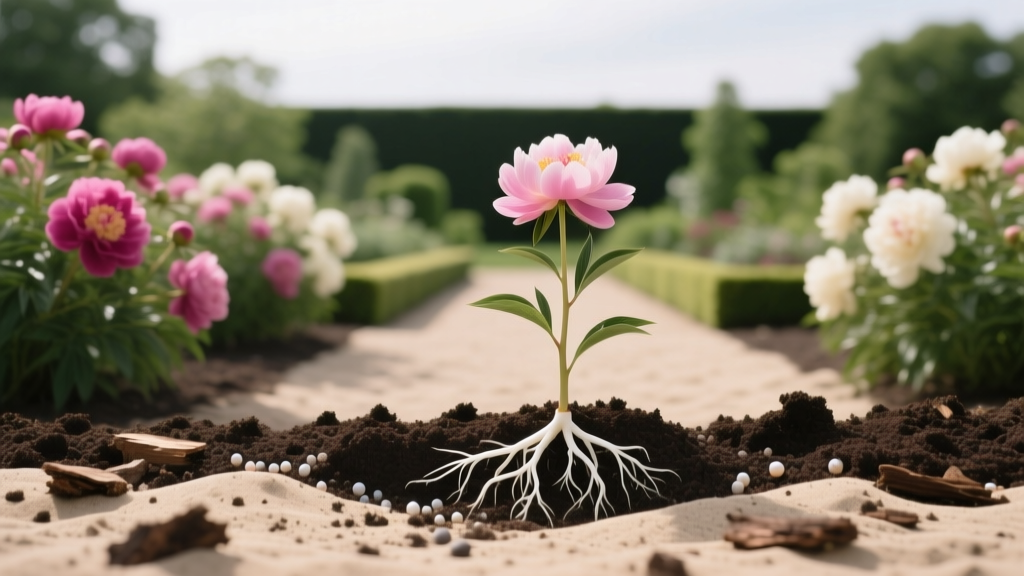
Amending Sandy Soil for Peonies
If you’ve ever planted a peony in sandy soil and watched it struggle—thin stems, few buds, flowers that flop or never show up—you’re not imagining it. Sandy soil can grow peonies, but it asks you to manage two things sand does poorly: holding water and holding nutrients. I’ve seen gorgeous peonies in beachy soils, and I’ve also seen “peony sticks” that never get past a handful of leaves. The difference is almost always what happened before planting: how the soil was amended, how deep the eyes were set, and how the first two seasons were watered.
Here’s the surprising part: peonies don’t actually want “rich, wet” soil. They want even moisture, air around the roots, and steady fertility. Sandy soil can provide the air—but it can’t provide the steady part unless you build it in.
What Sandy Soil Does to Peonies (and What You’ll Notice)
Sandy soil drains fast. That sounds good until you realize peonies put on most of their growth in spring, when they’re trying to build stems and buds quickly. In sand, the root zone can dry out between rains in 24–48 hours—and fertilizer can leach right past the roots before the plant uses it.
Common sandy-soil peony symptoms I see in real gardens:
- Lots of leaves, few flowers: stress during bud formation (often late spring dryness).
- Short stems and small blooms: inconsistent water + low organic matter.
- Yellowing lower leaves in early summer: nitrogen and potassium leaching, especially after heavy irrigation or rain.
- Plants “stalling” for years: eyes planted too deep while trying to “protect” them from drying out.
Peonies are long-lived perennials; it’s worth doing the soil work once, correctly, because a good peony planting can run 20–50 years without being moved.
Soil Goals for Peonies in Sandy Ground
Your target is a loamy, moisture-buffering root zone that still drains well. For peonies, aim for:
- Soil pH: about 6.5–7.5
- Organic matter: roughly 5–10% (sand is often 1–2%)
- Planting depth (eyes): 1–2 inches below the soil surface in cold-winter regions; closer to 1 inch in warmer zones
University guidance aligns with this “well-drained but moisture-holding” approach. The University of Minnesota Extension notes peonies perform best in full sun and well-drained soil and emphasizes correct planting depth to ensure flowering (University of Minnesota Extension, 2023). Iowa State University Extension also emphasizes good drainage and appropriate soil preparation for long-term success (Iowa State University Extension, 2022).
“Most peony failures trace back to site preparation—either the crown is planted too deep, or the root zone swings between drought and saturation.” — Cooperative Extension horticulture guidance summarized from multiple state extension recommendations (2022–2024)
Don’t “Turn Sand into Potting Mix”
A common mistake is trying to make sandy soil feel like bagged garden soil. If you overdo fine materials (especially peat or compost) in a small hole, you can create a bathtub effect where water behaves oddly at the interface between amended and native soil. With sand, the bigger issue is the opposite—everything drains too fast—so your goal is to amend a wide area, not just a narrow planting hole.
Amending Sandy Soil: What to Add (and How Much)
For peonies, I like amendments that build structure, feed soil life, and hang onto nutrients without making the root zone soggy.
Best Amendments for Sandy Soil Peonies
- Compost (finished, dark, earthy): improves water-holding and nutrient retention.
- Well-rotted manure: adds organic matter and slow fertility (avoid hot manure).
- Leaf mold: excellent moisture buffer; gentle and long-lasting.
- Pine bark fines (small, partially composted): adds long-term structure without turning mushy.
- Optional: biochar (charged first): can improve nutrient holding in sandy soils, but use modestly.
How Much Amendment to Use (Concrete Recipe)
For an existing sandy bed (best approach), amend a space at least 3 feet wide per peony plant.
- Mark a circle about 36–42 inches across.
- Loosen soil to 12–15 inches deep (a garden fork works well in sand).
- Work in 3–4 inches of compost over that whole area (not just the hole).
- If you have it, add 1 inch of leaf mold or aged manure as part of that 3–4 inches total.
- Optional: mix in 1–2 cups of a balanced organic fertilizer (something like 4-4-4) for the entire amended circle, not right against the roots.
If you’re planting into pure sand and you want a “stronger” build, you can go to 5 inches of organic material worked into the top 12–15 inches—but I’d rather see you amend wider than deeper. Peony roots explore laterally, and wide amending helps them ride out summer heat.
A Quick Comparison: Two Amending Methods (with Real Tradeoffs)
| Method | How it’s done | Amendment amount | Pros | Cons | Best for |
|---|---|---|---|---|---|
| A: Wide bed amendment (recommended) | Amend a 36–42" circle, 12–15" deep | 3–4" compost over entire circle (about 7–10 cubic feet total depending on diameter) | Even moisture, roots expand naturally, fewer stress swings | More labor up front | Long-term plantings (20+ years) |
| B: “Improved hole” only | Dig a hole ~18–24" wide, amend heavily inside | Often 50% compost in the hole (2–4 cubic feet) | Faster, uses less compost | Roots may stall at boundary; moisture can be inconsistent in surrounding sand | Temporary plantings or when compost is limited |
Numbers in plain terms: Method A might use roughly 2–3 bags of compost at 1.5–2 cubic feet each per plant (sometimes more), but it buys you stability. Method B saves compost, but you’ll compensate later with more frequent watering and feeding.
Planting Peonies Correctly in Sandy Soil
Peonies hate being planted too deep. In sandy soil, gardeners often bury them extra to “protect” from drying out—then they don’t bloom.
Step-by-Step Planting (Works for Bare-Root or Divisions)
- Plant in fall when soil is still workable—often 6–8 weeks before hard freeze.
- After amending, dig a planting spot in the center wide enough to spread roots without bending.
- Set the crown so the “eyes” sit 1–2 inches below the final soil surface.
- Backfill and water deeply to settle (don’t stomp hard; you want air space).
- Mulch lightly with 1–2 inches of shredded leaves or fine bark, keeping mulch pulled back from the crown by a couple inches.
Scenario #1 (Coastal sand bed): In a beach-adjacent yard with constant wind, I’ve had best success planting slightly closer to 2 inches deep (still not deeper), then using a wider mulch ring (but not piled on the crown) to reduce evaporation.
Watering: The Make-or-Break Factor in Sandy Soil
If you only change one habit for peonies in sand, change how you water. Sandy soil doesn’t need frequent sprinkles—it needs deep, scheduled soaking so roots go down and stay hydrated during bud set.
How Much to Water (with Timing)
- Year 1: aim for about 1 inch of water per week total (rain + irrigation). In hot, windy spells above 85°F, you may need 1.5 inches weekly.
- Year 2: similar, but you can stretch intervals as roots expand—deep watering every 5–7 days is often better than every other day.
- Established plants: deep water during dry springs and during bud swell/flowering; many established peonies can coast in average summers if soil was amended well.
Practical method: set a tuna can or rain gauge near the plant when watering. When you’ve applied 1 inch, stop. Then wait and check the soil: dig a small hole with a trowel. You want moisture down at 6–8 inches, not just a wet surface.
Three Watering Mistakes I See All the Time
- Daily light watering: encourages shallow roots and more stress.
- Watering the crown at night: can worsen botrytis in cool, damp springs.
- Skipping water right after bloom: peonies form next year’s buds soon after flowering; drought in early summer can reduce next year’s show.
Scenario #2 (Raised bed with sandy mix): Raised beds dry faster than in-ground sand. In a raised bed, I plan on watering every 3–5 days during spring growth unless rainfall is steady. A 2-inch mulch layer becomes less optional and more mandatory.
Light: Don’t Compensate for Sand by Giving Shade
Peonies bloom best in full sun—think 6+ hours of direct light. In very hot climates, a little afternoon shade can prevent flower scorch, but too much shade trades blooms for foliage.
- Cool/temperate climates: full sun is ideal.
- Hot summer climates: morning sun with light afternoon shade can help, but keep at least 5–6 hours of sun.
Remember: in sandy soil, shade won’t “fix” dryness—it often creates weaker stems that flop more easily when flowers finally arrive.
Feeding Peonies in Sandy Soil (Without Overdoing It)
Because sand leaches nutrients, feeding is more about small, consistent inputs than one big dump of fertilizer.
Simple Feeding Schedule
- Early spring (shoots 2–4 inches tall): scratch in a balanced fertilizer around the drip line (not on the crown). A common rate is 1/2 cup of an organic granular fertilizer per plant, or follow label rates.
- After bloom: top-dress with 1 inch compost in a ring around the plant (again, keep off the crown).
- Fall: skip high nitrogen. If soil tests low, use a light application aimed at potassium/phosphorus per soil test recommendations.
If you have access to a soil test, use it. Sandy soils can be deceptively “clean” but low in potassium. Correcting that (rather than pushing nitrogen) often improves stem strength and flower quality.
Scenario #3 (New build, stripped topsoil): In subdivisions where topsoil was removed, you may have sand + construction fill. In that case, I strongly recommend testing for pH and nutrients before planting. If pH is below 6.0, you may need lime per test results to bring it into peony range.
Common Problems in Sandy Soil Peonies (and How to Fix Them)
Troubleshooting: Buds Form but Don’t Open (or Turn Brown)
Symptoms: Buds enlarge, then dry out, turn brown, or fail to open; sometimes sticky buds.
Most likely causes in sandy soil:
- Drought stress during bud swell
- Botrytis blight in cool, wet springs (less about sand, more about airflow and wet foliage)
- Thrips or other minor pests can scar buds
Fix:
- Water deeply so moisture reaches 6–8 inches during bud swell.
- Avoid overhead watering in evening; water at soil level.
- Cut off and trash affected buds/stems (don’t compost) if botrytis is evident (gray fuzz, blackened stems).
- Improve airflow: stake and thin nearby crowding plants.
Troubleshooting: Lots of Leaves, No Flowers
Symptoms: Healthy foliage, but no blooms year after year.
Likely causes:
- Planted too deep (most common)
- Not enough sun (under 6 hours)
- Too much nitrogen (lush leaves, weak bloom set)
Fix:
- In fall, gently excavate to check eye depth—aim for 1–2 inches below surface.
- If deeper than 2 inches, lift and reset at correct depth.
- Move to a sunnier site if needed.
- Switch from high-nitrogen feeding to compost top-dressing + balanced fertilizer in spring.
Troubleshooting: Yellowing Leaves Starting at the Bottom
Symptoms: Lower leaves turn yellow in early-to-mid summer; growth looks “washed out.”
Likely causes in sand:
- Nutrient leaching (nitrogen and potassium are common)
- Irregular watering (feast/famine cycles)
Fix:
- Add a 1-inch compost top-dress after bloom.
- Mulch 2 inches deep to slow evaporation and reduce leaching splash.
- Use smaller, split fertilizer doses: for example, half in early spring and half right after bloom (within label guidance).
Troubleshooting: Flopping Stems
Symptoms: Flowers tip over, especially after rain.
Contributors in sandy soil:
- Fast growth from high nitrogen
- Low potassium
- Too much shade (stems stretch)
- Flowers simply too heavy (some cultivars do this)
Fix:
- Stake early—use a peony ring when shoots are 8–12 inches tall.
- Avoid lawn fertilizer drift (high nitrogen) near peonies.
- Consider a soil test; correct potassium if low.
- Grow sturdier cultivars if your site is windy and sandy.
Mulching and Long-Term Soil Building (Your Secret Weapon)
In sandy soil, mulch isn’t just for weeds—it’s your moisture regulator. A consistent mulch routine is how you turn “sand that dries by lunch” into “soil that carries the plant between waterings.”
- Apply 2 inches of shredded leaves, fine bark, or composted wood chips around the plant.
- Keep mulch pulled back 2–3 inches from the crown to prevent rot and discourage botrytis.
- Refresh annually after bloom or in early fall.
Every year you do this, the interface between mulch and sand becomes darker, more crumbly, and more forgiving. That’s the soil you want peony roots exploring.
Common “Amending” Mistakes to Avoid
These come up constantly in sandy-soil gardens:
- Adding straight peat moss as the main amendment: it can be hard to re-wet once it dries, and it breaks down fast. Compost and leaf mold are more forgiving.
- Over-fertilizing to “make up” for sand: you get tall soft growth and fewer blooms. Feed modestly and top-dress with compost.
- Burying the crown deep: you’ll get leaves and no flowers, then you’ll blame the soil.
- Amending only a narrow hole: roots hit the edge and the plant acts droughty again.
Season-by-Season Checklist (Practical Rhythm)
Early Spring
- Remove winter debris to reduce disease carryover.
- Apply fertilizer when shoots are 2–4 inches tall.
- Set stakes or rings by the time shoots reach 8–12 inches.
Late Spring (Bud Swell to Bloom)
- Maintain consistent moisture: aim for 1 inch/week.
- Water at soil level; avoid soaking foliage late in the day.
After Bloom
- Deadhead to keep the plant tidy (don’t cut foliage down yet).
- Top-dress with 1 inch compost.
- Keep watering through early summer so next year’s buds set well.
Fall
- Cut stems to the ground after frost and remove debris (helps reduce botrytis).
- Assess whether the crown has heaved or sunk; correct planting depth if needed.
- Light mulch for winter protection in cold regions, but keep crowns from being buried.
If you take nothing else from this: amend a wide area, plant shallow (eyes 1–2 inches deep), water deeply on a schedule during spring growth, and build organic matter every year with mulch and compost. Sandy soil doesn’t have to limit peonies—it just demands that you create a steadier root environment than nature gave you.
Sources: University of Minnesota Extension (2023) peony growing guidance; Iowa State University Extension (2022) recommendations on peony siting, drainage, and planting depth.