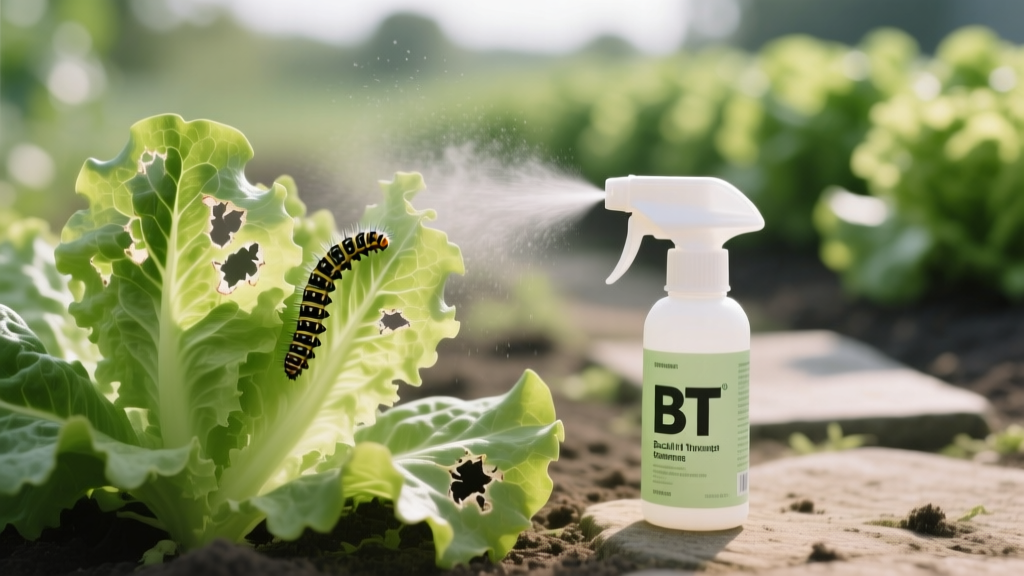
BT Spray for Caterpillar Damage on Lettuce
You walk out to pick lettuce for dinner, and the heads look fine from a distance—until you lift a leaf and find “windowpane” damage, ragged holes, and little black pellets (frass) tucked into the folds. By tomorrow, that damage can double. In warm spells, caterpillars can go from “barely noticeable” to “crop failure” fast—especially on tender lettuces where one chew ruins the whole leaf.
For home gardeners, Bacillus thuringiensis var. kurstaki (BT or Btk) is one of the most reliable tools for stopping caterpillar feeding without resorting to broad-spectrum insecticides that can knock back beneficial insects. The trick is using BT at the right time, in the right way, and pairing it with solid lettuce-growing basics so plants rebound quickly.
This guide is written the way I’d explain it to a neighbor at the fence: what to look for, exactly when to spray, how to keep lettuce growing steadily, and what to do when BT “doesn’t work” (because that happens too).
What Caterpillar Damage on Lettuce Really Looks Like (and Why It Gets Worse Overnight)
The usual culprits are imported cabbageworm (from the white cabbage butterfly), cabbage looper, and armyworms. They don’t always start on the outer leaves. On romaine and heading types, they tuck deep into the crown where it’s humid and protected—exactly where spray coverage is hardest.
- Early signs: tiny pinholes, pale “windowing” where the leaf surface is scraped but not fully eaten, and scattered frass.
- Escalating damage: ragged holes, chewed ribs, and contamination in the heart (unwashable if it’s deep in a head).
- Time-of-day clue: feeding often spikes at dusk and overnight; you may see more caterpillars with a flashlight after 9 p.m.
One surprising fact: BT doesn’t need to “hit” the caterpillar like a contact poison. It needs to be eaten. That’s both the strength and the limitation—great for safety and selectivity, but it demands good timing and coverage.
How BT Works (Plain-English Version)
BT (Btk) is a naturally occurring soil bacterium. The formulations sold to gardeners contain spores and crystalline proteins that are toxic to many caterpillars (larvae of butterflies and moths). Once a susceptible caterpillar eats treated leaf tissue, it stops feeding quickly—often within hours—and dies in the next day or two.
“B.t. must be eaten by susceptible larvae to be effective; thorough coverage is essential, and applications may need to be repeated.” — Penn State Extension, Bt (Bacillus thuringiensis) (2023)
BT is considered compatible with many beneficial insects because it targets specific larval groups rather than acting as a broad-spectrum nerve poison. For home lettuce beds where you want pollinators, lacewings, lady beetles, and parasitoid wasps hanging around, that selectivity matters.
Real-World Scenarios: What Usually Happens in Home Gardens
Scenario 1: “I sprayed BT once, and I still see caterpillars.”
Totally common. If you sprayed in the morning, then had overhead watering or rain later, the BT film can wash off. Also, caterpillars won’t necessarily drop dead instantly. What you should see first is reduced feeding. If fresh holes appear 24–48 hours later, it’s usually a coverage or reapplication issue.
Scenario 2: “My lettuce heads are tight—how do I get spray into the heart?”
This is where most failures happen. The caterpillars hide where the spray doesn’t reach. You need to angle the nozzle and physically open leaves gently with your hand while spraying (or use a directed-stream setting).
Scenario 3: “It worked last month, but now it’s not working at all.”
Often it’s not resistance—it’s larval size and weathering. BT performs best on small larvae (newly hatched to early instars). Big loopers can keep chewing long enough to ruin lettuce before they die. Hot sun, heavy dew, and frequent irrigation can also break down residues faster.
When to Use BT on Lettuce (Timing That Actually Works)
If you want BT to feel “miraculous,” don’t wait until you see heavy damage. Start when you first notice moths/butterflies fluttering low over the bed or when you find the first tiny holes.
- Best target stage: small caterpillars under 1/2 inch long.
- Spray interval: every 5–7 days during pressure, or after rain/overhead watering.
- Best time of day: late afternoon/evening (UV light breaks BT down; dusk gives it more time on leaves).
- Temperature reality: lettuce grows best around 60–70°F; caterpillar pressure often spikes when evenings stay above 55–60°F.
University guidance consistently emphasizes repeat applications and thorough coverage. For example, the University of Minnesota Extension notes BT is most effective on small larvae and needs to be applied when larvae are actively feeding (University of Minnesota Extension, 2020).
Step-by-Step: How to Spray BT on Lettuce Without Wasting Your Time
Read your product label first—concentrations vary. But the process is consistent across brands.
- Mix fresh. Only mix what you’ll use that day. In a 1-gallon sprayer, add water first, then the BT concentrate or powder per label.
- Add a spreader-sticker if allowed. A few products allow a mild spreader to improve leaf coverage. If you use one, make sure it’s labeled for edibles and follow rates exactly.
- Spray in the evening. Aim for 6–9 p.m. when UV is low and caterpillars begin feeding.
- Coat both sides of leaves. Get the undersides—caterpillars often feed there. Spray to a “glistening wet” look, not runoff.
- Open the lettuce. On romaine and heading types, gently pull outer leaves aside and direct spray into the crown.
- Recheck in 24 hours. You’re looking for less fresh chewing and sluggish larvae.
- Reapply in 5–7 days. Or sooner if you had 1/2 inch (or more) of rain or you overhead-watered heavily.
Harvest note: Many BT products have short pre-harvest intervals for leafy greens, but always follow your label for harvest timing and re-entry guidance.
Watering: Keeping Lettuce Growing While You Fight Caterpillars
Stressed lettuce is slower to outgrow damage. You’ll get better results from BT when the plant is producing steady new leaves.
- Target moisture: evenly moist soil, not soggy. Lettuce has shallow roots and wilts fast.
- Typical need: about 1–1.5 inches of water per week from rain + irrigation (more in heat/wind).
- Best method: drip irrigation or a soaker hose under mulch to avoid washing BT off leaves.
- Morning watering: if you must overhead-water, do it early (before 10 a.m.) so leaves dry quickly and you can spray BT later in the evening.
If you’re currently watering with a sprinkler every evening, that’s a double hit: it encourages disease and rinses off BT residues right when you need them to stay put.
Soil: The Quiet Factor That Determines How Much Damage You Can Tolerate
Lettuce grows fast in soil that’s fertile, moisture-retentive, and well-drained. When soil is poor, every chewed leaf is a bigger setback.
- Soil texture: aim for a crumbly loam with organic matter mixed in.
- Compost rate: work in 1–2 inches of finished compost before planting.
- Preferred pH: roughly 6.0–7.0.
A simple “master gardener” trick: if your lettuce looks pale and thin even before caterpillars show up, fix the growth problem first. BT stops chewing, but it can’t make weak plants recover quickly.
Light: Enough Sun for Growth, Enough Shade to Keep Lettuce Tender
Lettuce will grow in part shade, but too little light slows growth and makes the plant less able to replace damaged leaves.
- Ideal: 4–6 hours of sun, especially morning sun.
- In warm climates: provide afternoon shade or use 30–40% shade cloth to reduce stress and bolting.
Healthy, steady growth is your “background defense.” Fast-growing lettuce can tolerate a small amount of damage; slow lettuce gets wrecked.
Feeding: Fertilizer That Helps Lettuce Recover (Without Making It Floppy)
Lettuce is a leafy crop, so it responds to nitrogen—but too much makes soft growth that pests love and can increase tip burn risk.
- Before planting: compost plus a balanced organic fertilizer if needed.
- Mid-season boost: side-dress with a nitrogen source when plants are 3–4 inches tall.
- Practical rate: apply about 1 tablespoon of a granular organic nitrogen fertilizer per plant (or follow your product’s label), scratched lightly into the soil and watered in.
If you’re growing in containers, use a diluted liquid feed every 7–14 days because nutrients leach faster—just don’t overdo it.
BT vs Other Caterpillar Controls (What Works Best on Lettuce)
Here’s a practical comparison using numbers you can plan around. Always follow labels and local rules; these are typical home-garden patterns.
| Method | How it works | Typical reapply interval | Best on larvae size | Risk to beneficials | Notes for lettuce |
|---|---|---|---|---|---|
| BT (Btk) spray | Must be eaten; stops feeding | Every 5–7 days; after rain | Small (< 1/2 inch) | Low (selective) | Needs excellent coverage inside heads |
| Spinosad | Ingested/contact; affects nervous system | Often 7 days (label-dependent) | Small to medium | Moderate to high for some beneficials if misused | Effective, but avoid spraying when pollinators active; follow label closely |
| Hand-picking | Remove larvae directly | Daily during outbreaks | Any size | None | Best for small beds; use at night with flashlight |
| Floating row cover | Physical barrier prevents egg-laying | Install at planting | Prevents all sizes | None | Highly effective if edges sealed; remove for weeding/harvest |
For many home gardeners, the most dependable combination is row cover early plus BT as soon as you see damage. That’s a one-two punch: prevent most egg-laying, and handle the few that slip in.
Common Problems (and How to Tell What You’re Actually Dealing With)
Problem: Holes, but no caterpillars visible
- Likely cause: feeding at night; larvae hiding in the crown; or slugs/snails.
- Check: go out after dark with a flashlight. Look for frass (caterpillars) vs shiny slime trails (slugs).
- Fix: if you find caterpillars, spray BT at dusk and reapply in 5–7 days. If it’s slugs, BT won’t help—use iron phosphate bait and reduce hiding spots.
Problem: BT sprayed, but fresh damage continues 2 days later
- Likely cause: larvae too large; missed coverage inside heads; wash-off from overhead watering; or you used the wrong BT type (not Btk).
- Fix:
- Re-spray at dusk, focusing on undersides and the crown.
- Switch to a tighter spray pattern and slow down—coverage beats speed.
- Check irrigation: keep water off foliage for 24 hours if possible.
- If larvae are large (over 1/2–3/4 inch), consider hand-picking plus BT, or a labeled alternative like spinosad as a last resort.
Problem: Lettuce has brown edges (tip burn) along with pest damage
- Likely cause: uneven watering and rapid growth swings, often in warm weather.
- Fix: keep moisture steady; mulch lightly; harvest earlier. Tip burn is physiological—BT won’t affect it, but stressed plants show worse pest impact.
Problem: Leaves are chewed and also sticky with clusters of small insects
- Likely cause: aphids plus caterpillars.
- Fix: BT handles caterpillars only. Blast aphids off with a firm water spray in the morning, or use insecticidal soap (label for edibles). Keep ants controlled—they “farm” aphids.
Troubleshooting by Symptom: Fast Diagnoses and Fixes
Symptom: “Windowpane” translucent patches on leaves
Diagnosis: early caterpillar feeding (often small larvae).
Action: Spray BT within 24 hours. Recheck in 1 day for reduced feeding. Reapply in 5–7 days.
Symptom: Perfectly round holes, mostly on outer leaves
Diagnosis: could be flea beetles (tiny shot holes) or small caterpillars; check for frass.
Action: If frass present, BT. If not, use row cover and manage weeds; flea beetles don’t respond to BT.
Symptom: Big chunks missing, frass everywhere, larvae hard to find
Diagnosis: loopers/armyworms hiding deep in the crown or soil surface by day.
Action: Night patrol + hand-pick for 2–3 nights, then BT spray. Consider a cardboard collar/mulch cleanup to reduce daytime hiding.
Using BT Safely and Effectively in an Edible Garden
BT is widely used in edible production, but “safe” doesn’t mean “careless.” Treat it like any garden input: targeted, timed, and label-following.
- Don’t spray open flowers. Lettuce rarely flowers before harvest, but nearby blooming herbs can get overspray—aim carefully.
- Store properly. Keep BT out of heat and direct sun; a hot shed can shorten shelf life.
- Rotate tactics. Use row cover, crop rotation, and scouting so you’re not relying on one tool every season.
For research-based guidance on BT use, Penn State Extension emphasizes ingestion and coverage (Penn State Extension, 2023). The University of Minnesota Extension also notes the importance of timing against small larvae and feeding activity (University of Minnesota Extension, 2020). These points match what we see in home beds: BT works best when you treat early and spray thoroughly.
Prevention That Makes BT Almost Boring (Because You Need It Less)
If you’ve fought caterpillars on lettuce for a few seasons, prevention is what changes your life.
- Install floating row cover at planting. Seal edges with soil, boards, or pins. Even a small gap can let moths in.
- Scout twice a week. Flip leaves and look into the crown. If you catch the first hatch, one BT spray often solves it.
- Keep brassica weeds down nearby. Mustard and wild radish can host the same caterpillars that move to lettuce.
- Stagger plantings. Sow smaller batches every 2–3 weeks. If one planting gets hit, the next may miss the peak.
And here’s the hard-won gardener truth: lettuce is a short-season crop. Sometimes the smartest move is to harvest what’s clean, compost what’s too damaged, and re-seed in a slightly different spot under row cover. You can go from bare soil to baby leaves in days, and to a full harvest in a few weeks—especially in that sweet 60–70°F weather window.
If you keep your lettuce growing steadily (even moisture, decent soil, reasonable feeding) and you use BT early with good coverage, caterpillar damage becomes a manageable annoyance instead of a constant heartbreak. That’s when you know your system is working—not because pests disappear, but because your garden stays one step ahead.