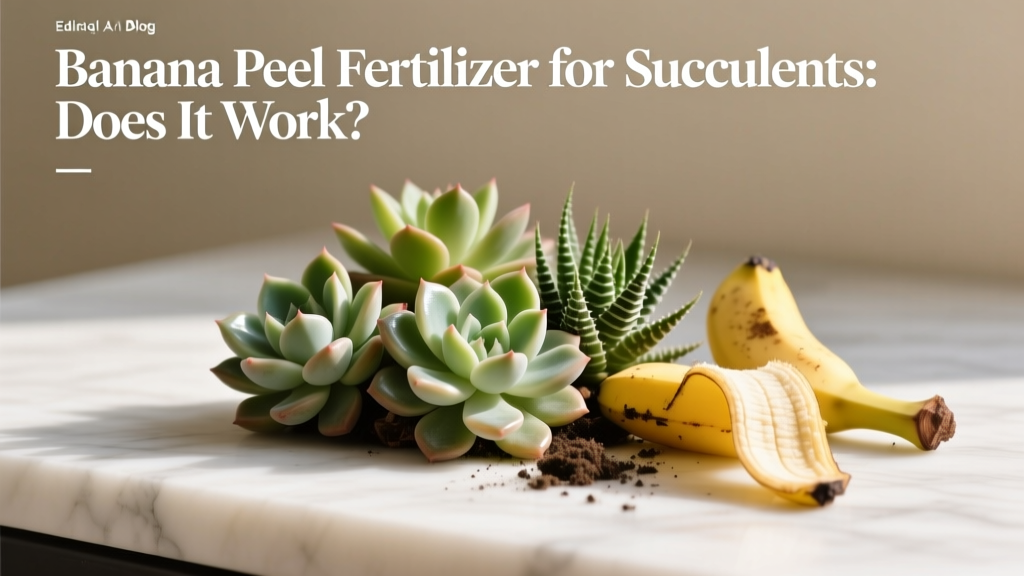
Banana Peel Fertilizer for Succulents: Does It Work
You finish a banana, toss the peel in the kitchen bin, and then remember that viral tip: “Banana peels = free fertilizer.” Next thing you know, you’re eyeing your jade plant and thinking, Can I just bury this peel in the pot? I’ve watched plenty of good succulents decline from well-meant kitchen-scrap experiments—usually because the “fertilizer” fed fungus gnats and rot more than it fed the plant.
Banana peel fertilizer can play a small supporting role for succulents, but it’s not a magic potion—and it’s easy to do in a way that causes real problems. Let’s walk through what banana peels actually contain, how succulents really feed, and how to use peels (if you insist) without turning your pots into a compost bin.
What banana peels really offer succulents (and what they don’t)
Banana peels are best known for potassium (K). Potassium supports overall plant function—water regulation, enzyme activity, stress tolerance. Peels also contain small amounts of phosphorus (P), calcium, magnesium, and micronutrients. The catch: those nutrients are mostly locked up in organic form and aren’t immediately available to plants until microbes break them down.
That breakdown is the problem inside a succulent pot. Succulents are adapted to lean, mineral soils with fast drying. A moist, microbe-rich environment (needed to “unlock” banana peel nutrients) is exactly what encourages root rot and gnats.
“Compost and organic amendments improve soil health, but in containers they must be used carefully—too much undecomposed organic matter can reduce aeration and increase water-holding, raising the risk of root diseases.” — North Carolina State Extension, Container Gardening guidance (2022)
Also important: banana peels do not provide nitrogen in meaningful, predictable amounts. Nitrogen is the nutrient most commonly limiting for potted succulents (when they’re actively growing). So even if you add banana peel “fertilizer,” your plant may still look hungry because you didn’t supply what it actually needs.
Before feeding: get watering, soil, and light right
I’m putting this up front because most “my succulent looks sad” situations are not fertilizer problems. They’re water/soil/light problems. Feeding a struggling plant in bad conditions often makes things worse.
Watering: the fastest way to ruin a succulent (or rescue it)
Succulents do best with a soak-and-dry rhythm: water thoroughly, then let the mix dry out deeply before watering again.
- Water depth: Water until it runs out the drainage hole for 5–10 seconds.
- Dry-down target: Wait until the pot is dry at least 2 inches down (use a chopstick or moisture meter).
- Typical timing indoors: Every 10–21 days in bright light; more often in heat, less in winter.
- Winter adjustment: Many succulents slow down below about 55°F (13°C). Water less and fertilize less (often none).
If you bury banana peel pieces or pour banana “tea” frequently, you tend to water more often—keeping the mix damp longer. That’s the straight line to mushy stems and leaf drop.
Soil: the potting mix matters more than the “fertilizer”
A succulent mix should drain fast and stay airy. If you use banana peels, you’re adding organic material that holds moisture and collapses pore space as it decomposes.
A practical home mix that performs consistently:
- 50% cactus/succulent potting mix
- 50% pumice or perlite (pumice is heavier and more stable)
If your current soil is peat-heavy and stays wet more than 4–5 days after watering, don’t add banana peel products. Fix the mix first.
Light: more light = better growth, safer feeding
In low light, succulents grow slowly and use less water and nutrients. Fertilizing low-light succulents tends to produce weak, stretched growth.
- Bright window goal: At least 4–6 hours of strong light daily (south or west window in many homes).
- Grow light goal: 10–14 hours per day, positioned close enough to prevent stretching (often 8–14 inches depending on the light).
Feeding succulents: what “works” in a pot
Succulents aren’t heavy feeders. Most do well with a modest, predictable fertilizer during active growth. The key words are modest and predictable.
For many common succulents (Echeveria, Haworthia, jade, aloe):
- Timing: Feed in spring and summer, about every 4–6 weeks.
- Dilution: Use a balanced liquid fertilizer at 1/4 strength (or follow label guidance for succulents/cacti if provided).
- Skip feeding: During winter dormancy or whenever the plant is stressed (recent repot, rot recovery, pest outbreak).
Extension guidance consistently warns against over-fertilizing container plants. The University of Minnesota Extension notes that excess fertilizer salts can build up in pots and damage roots (University of Minnesota Extension, Fertilizing Houseplants, 2020).
Banana peel fertilizer methods: what to avoid and what’s reasonably safe
There are a few common banana-peel approaches floating around. Some are harmless but ineffective; others actively cause trouble.
Method 1: Burying banana peel pieces in the pot (not recommended)
This is the one that causes the most heartbreak. In a small pot, peel pieces stay wet, rot, and attract fungus gnats. As decomposition accelerates, oxygen drops around the roots. Succulents hate that.
When it goes wrong, you’ll see:
- Sudden appearance of tiny black gnats hovering near soil
- Sour or “fermented” smell from the pot
- Lower leaves yellowing, then dropping
- Stems softening at the base
If you really want to use banana peel as a soil amendment, compost it fully first. Composting transforms it into stable organic matter that won’t rot in the pot.
Method 2: Banana peel “tea” (limited use, must be done carefully)
People soak peels in water and use the liquid. The problem is that nutrient levels are inconsistent and generally low, while the liquid can become a microbial soup if left too long.
If you want to try it, do it like a cautious gardener—not like a social media dare.
- Use 1 banana peel in a clean jar with 2 cups (475 mL) of water.
- Soak for 24 hours only (not 3–7 days).
- Strain well. Do not pour solids into the pot.
- Dilute the strained liquid 1:1 with water.
- Use it once per month at most, and only during active growth.
If the mix is already staying wet too long, skip banana tea entirely. And never use it on a plant showing signs of rot.
Method 3: Dried banana peel powder (the “least risky” peel option)
Drying reduces the rot/gnat risk because you’re not burying wet material. It’s still organic matter, so use it sparingly.
- Dry peels until crisp (air dry several days or oven dry at about 200°F (93°C) for 2–3 hours with good ventilation).
- Grind into a powder.
- Use 1/8 to 1/4 teaspoon for a 4-inch pot, sprinkled lightly on the surface.
- Water normally and watch for any gnat activity.
This is still not a complete fertilizer. Think of it as a tiny potassium supplement—not a feeding program.
Comparison table: banana peel methods vs standard succulent fertilizer
| Approach | Nutrient reliability | Rot/gnat risk in pots | Best timing | Practical result for succulents |
|---|---|---|---|---|
| Bury fresh peel pieces | Low (nutrients locked until decomposition) | High (wet organic matter in small volume) | Almost never appropriate | Often causes gnats and soggy soil; benefits rarely show |
| Banana peel “tea” (24-hour soak, diluted) | Low to moderate (variable concentration) | Moderate (extra moisture + microbes) | Spring/summer, monthly max | Occasional mild boost; easy to overdo watering |
| Dried peel powder (tiny dose) | Low (still incomplete) | Low to moderate (depends on dose + soil) | Spring/summer, light top-dress | Small potassium supplement; subtle changes only |
| Balanced liquid fertilizer at 1/4 strength | High (known N-P-K) | Low (if soil drains well and watering is right) | Every 4–6 weeks in active growth | Predictable growth and color without chaos |
Real-world scenarios: what happens in actual homes
Scenario 1: The gnat explosion after burying a peel
A homeowner tucks banana peel strips into a 6-inch pot with an Echeveria. Within 10 days, fungus gnats appear. The soil stays damp longer, the rosette loosens, and lower leaves become translucent.
What’s happening: peel decomposition fuels microbes; moisture stays high; gnat larvae feed in the damp mix; roots lose oxygen.
What fixes it:
- Unpot the plant, remove all peel remnants and mushy soil.
- Trim any black, slimy roots; let the plant air-dry for 24–48 hours.
- Repot into a gritty mix (at least 50% pumice/perlite).
- Pause watering for 5–7 days after repotting (longer if cool/dim).
- Use yellow sticky traps and let soil dry deeply to break the gnat cycle.
Scenario 2: A jade plant that looks pale even with banana tea
Someone uses banana tea weekly, hoping for shinier leaves. The jade stays pale and slow, and internodes stretch.
What’s happening: low light is limiting growth; banana tea doesn’t supply reliable nitrogen; frequent watering encourages weak growth.
Better plan:
- Increase light: a brighter window or grow light 12 hours/day.
- Switch to a balanced fertilizer at 1/4 strength every 4–6 weeks.
- Water only when dry at least 2 inches down.
Scenario 3: Outdoor potted aloe in summer heat
An aloe in a terra-cotta pot outside dries quickly in summer. The gardener wants an organic boost and tries a monthly diluted banana tea.
When it can work: outdoor heat and airflow mean pots dry faster, and microbial growth is less likely to create constant sogginess—if the mix is gritty and the pot has good drainage.
Guardrails:
- Only feed when nights are consistently above 60°F (16°C) and the aloe is actively growing.
- Don’t combine banana tea with other fertilizers the same month.
- If the center stays wet more than 3–4 days, stop banana tea.
Common problems tied to banana peel “fertilizer” (symptoms and fixes)
Symptom: Fungus gnats (tiny flies, worse after watering)
Likely cause: decomposing peel pieces or frequent organic liquid feed keeping the top layer damp.
Fix:
- Stop banana products immediately.
- Let soil dry hard between waterings.
- Top-dress with a 1/2-inch layer of coarse pumice to keep the surface drier.
- Use sticky traps; for persistent infestations, apply BTI (Mosquito Bits) as directed.
Symptom: Mushy base, black roots, leaf drop
Likely cause: rot from prolonged moisture and reduced aeration (often from buried peels).
Fix:
- Unpot and remove all wet organic material.
- Cut away rotten roots/stem tissue with a sterile blade.
- Let wounds callus in dry air for 24–72 hours.
- Repot into dry gritty mix; wait 5–10 days before first watering.
Symptom: White crust on soil or pot rim
Likely cause: mineral/fertilizer salt buildup from repeated inputs (banana tea + tap water + other fertilizers).
Fix:
- Flush the pot with clean water equal to about 3× the pot volume (do this only if the mix drains fast).
- Use filtered/rain water when possible.
- Reduce feeding frequency; stick to one fertilizer approach at a time.
Symptom: Soft, fast, stretched growth (etiolation)
Likely cause: low light plus extra watering/fertilizing attempts.
Fix:
- Increase light intensity and duration (aim for 10–14 hours under a grow light).
- Prune and propagate healthy tops if the plant is badly stretched.
- Feed lightly only after new compact growth starts.
Does banana peel fertilizer “work” for succulents? A practical verdict
It can “work” in the sense that banana peel contains nutrients and, under the right conditions, those nutrients can become available. But for indoor potted succulents, banana peel methods are usually inefficient at feeding and efficient at creating the exact conditions succulents dislike: wet organic matter, microbial bloom, and pests.
If you love the idea of using kitchen scraps, the best move is to compost banana peels properly and use finished compost sparingly—or better yet, keep succulents mostly mineral and use a diluted, balanced fertilizer for predictable results. Many Extension resources emphasize careful fertilizer use in containers to avoid root damage and salt buildup (University of Minnesota Extension, 2020; North Carolina State Extension, 2022).
If you still want to use banana peels: the “safe-ish” approach
I won’t pretend everyone will stop experimenting—gardeners are tinkerers. If you want the banana peel idea without the drama, follow these rules.
- Never bury fresh peels in a succulent pot.
- Only try it on healthy plants in a fast-draining gritty mix.
- Use tiny amounts: dried powder (1/8–1/4 tsp for a 4-inch pot) or diluted 24-hour tea once a month.
- Don’t mix fertilizer strategies: if you use banana tea, skip your regular fertilizer that month.
- Watch the pot, not the calendar: if drying time creeps beyond 4–5 days, stop.
Personally, when I want a succulent to color up, bloom, or put on steady growth, I reach for light, airflow, and a measured liquid feed—not kitchen scraps. Save banana peels for the compost pile or the garden beds where soil life can process them in a big, breathable system. Your succulents will thank you by staying firm, compact, and pest-free.