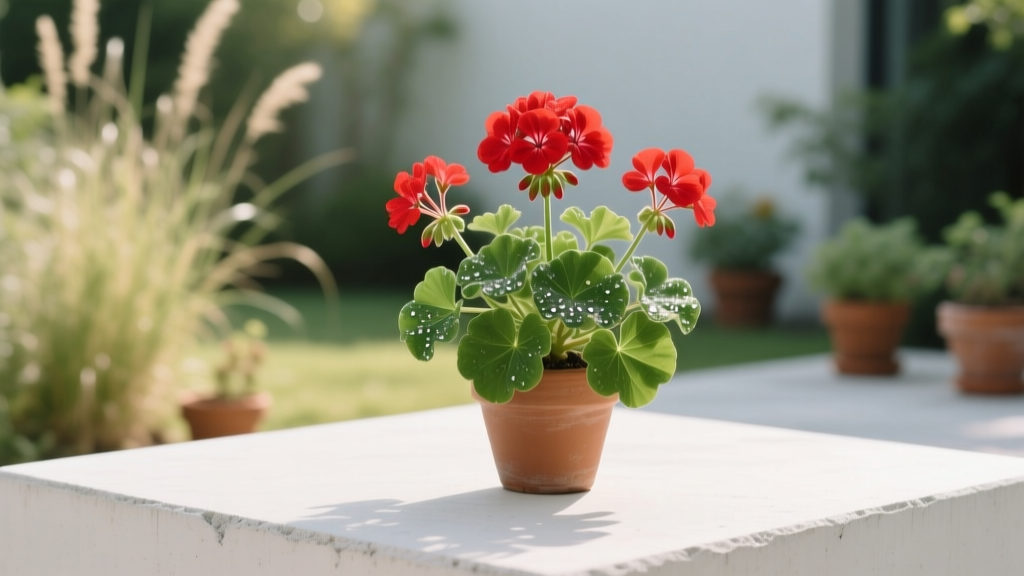
How Often Should You Water Geraniums
Every spring I watch the same thing happen: someone sets a flat of geraniums (Pelargonium) on the porch, gives them a generous drink “so they won’t dry out,” and a week later the leaves are yellowing, the stems feel soft, and the potting mix smells a little swampy. Then they swing the other way—no water for days—until the plant wilts and drops buds. Geraniums are tough, but they’re not mind-readers. If you want nonstop bloom, you need a watering rhythm you can repeat.
The surprising part is this: geraniums are more often killed by too much water than too little. They like moisture, but they hate sitting in it. Once you understand what the roots are doing—and how pot size, sun, heat, and wind change demand—watering becomes predictable instead of stressful.
How often should you water geraniums? The practical rule
If you want one rule that works in real gardens, use this:
- Water when the top 1 inch (2.5 cm) of soil is dry, then water thoroughly until excess runs from the drainage holes.
- In warm, sunny conditions, that often means every 2–4 days in containers and about once per week in the ground—adjusting for heat, wind, and pot size.
That’s the “when.” The “how much” matters just as much. A quick splash that barely wets the surface trains roots to stay shallow (and makes the plant more drought-sensitive). Deep watering encourages roots to fill the pot and support heavier flowering.
Start with the finger test (and make it a habit)
Geraniums do best when you check soil first, not the calendar. Here’s a method I’ve used for decades because it’s fast and reliable:
- Push your finger into the potting mix up to your first knuckle (about 1 inch).
- If it feels cool and damp, wait.
- If it feels dry and the mix doesn’t cling to your finger, water now.
If you don’t like the finger test, use a wooden skewer or chopstick: insert it 2–3 inches, pull it out, and look for dampness or dark soil clinging to it.
How much water is “thorough”?
For containers, you’re aiming to fully wet the root zone:
- 6-inch pot: roughly 1–2 cups (240–480 mL) per watering, until you see drainage.
- 10–12 inch pot: roughly 4–8 cups (1–2 liters) per watering, depending on how dry the mix is.
For in-ground geraniums, think in inches of water rather than cups:
- Target about 1 inch of water per week from rain + irrigation during active growth, delivered as one deep soak or two moderate waterings.
This “1 inch per week” benchmark aligns with common extension guidance for many bedding plants and is a solid starting point, adjusted by conditions. For irrigation measuring, a tuna can (about 1 inch tall) placed in the sprinkler zone is a simple gauge.
Watering schedules by growing situation (with real-world scenarios)
Geranium watering is context. Here are the scenarios I see most often, and the schedules that tend to work.
Scenario 1: Patio containers in full sun (the fastest to dry)
A black plastic pot on a south-facing patio can heat the root zone dramatically. In 85–95°F (29–35°C) weather, expect to water more often.
- Typical frequency: every 2–3 days (sometimes daily during heat waves or strong wind).
- Best time: morning, ideally before 10 a.m.
- Tip: if you’re watering daily, it’s a sign the pot may be too small or the mix too airy—consider upsizing or adding water-holding components (more on soil below).
Scenario 2: Hanging baskets (wind + exposure = thirsty)
Hanging baskets dry out faster because air moves around them on all sides. Even “drought-tolerant” geranium varieties will flag in baskets if you let them go bone-dry repeatedly.
- Typical frequency: every 1–3 days in summer.
- Watering method that works: water slowly until it runs out, pause 60 seconds, then water again. Dry peat-based mixes can shed water at first; the second pass soaks deeper.
Scenario 3: In-ground bed plantings (less frequent, deeper)
In the ground, roots can explore a wider area and the soil doesn’t swing from wet to dry as fast as a pot.
- Typical frequency: about once per week (twice per week during long stretches over 90°F / 32°C with no rain).
- How to tell: check moisture 2–3 inches down. If it’s dry at that depth, it’s time to irrigate.
- Goal: moisten soil down to 6–8 inches with a deep soak.
Scenario 4: Indoor geraniums in winter (easy to overwater)
When you overwinter geraniums indoors, growth slows, evaporation slows, and watering needs drop sharply.
- Typical frequency: every 7–14 days, sometimes longer depending on pot size, indoor temperature, and light.
- Temperature note: many geraniums hold best indoors around 60–70°F (16–21°C).
- Red flag: if soil stays wet for more than 4–5 days indoors, your mix is too heavy or drainage is poor.
Method matters: top-watering vs bottom-watering (with data)
Both methods can work, but they behave differently. Here’s a grounded comparison using practical numbers most home gardeners can apply.
| Watering method | How it’s done | Typical time | Best for | Watch-outs |
|---|---|---|---|---|
| Top-watering | Pour water onto soil surface until it drains from the bottom | About 30–90 seconds per pot (depending on size) | Most outdoor pots, quick checks, flushing excess salts | Can wet foliage; if you rush, water may channel and miss dry pockets |
| Bottom-watering | Set pot in a tray with 1–2 inches of water and let soil wick it up | 10–20 minutes, then drain | Indoor plants, preventing fungus gnat-friendly wet surfaces, rehydrating dry mixes | Must dump excess water; repeated bottom-watering without flushing can concentrate salts |
Comparison analysis with real data: If you bottom-water a 10-inch pot for 15 minutes in a tray with 1.5 inches of water, you’ll typically re-wet the lower root zone effectively, but the top inch may remain drier—useful indoors to discourage fungus gnats. If you top-water the same pot with about 1.5 liters slowly, you’ll fully saturate the mix and also help flush fertilizer salts (a big deal when you feed regularly). I top-water outdoors most of the time and bottom-water selectively indoors or when a peat-heavy mix has become hydrophobic.
“Allow the soil to dry slightly between waterings; geraniums do not tolerate constantly wet soil.” — University of Minnesota Extension, Geranium care guidance (2023)
Soil and containers: your watering schedule starts here
Watering frequency is mostly a reflection of soil structure and container drainage. If your geranium is in a mix that stays soggy, you’ll be “watering correctly” and still losing plants.
Best potting mix texture for geraniums
A good geranium mix holds moisture but drains fast. Aim for:
- A quality peat- or coir-based potting mix with added perlite/pumice for air space
- No garden soil in containers (it compacts, drains poorly, and invites root rot)
If you’re mixing your own, a practical blend is:
- 2 parts high-quality potting mix
- 1 part perlite or pumice
- Optional: a small amount of compost (up to 10–15% of total volume)
Container details that change watering by days
- Drainage holes: non-negotiable. One clogged hole can turn a pot into a bucket.
- Pot size: a 6-inch pot dries much faster than a 12-inch pot. If you’re watering every day in moderate weather (70–80°F / 21–27°C), the pot is often undersized.
- Material: terra cotta dries faster than plastic or glazed ceramic—sometimes by a full day in hot weather.
- Saucers: don’t let pots sit in water longer than 30 minutes. Empty saucers after watering.
Light and heat: the hidden drivers of water use
Geraniums bloom best with strong light, and strong light means higher water demand.
Outdoor light targets
- Full sun: ideally 6+ hours of direct sun for best flowering (in very hot climates, afternoon shade helps).
- Part sun: 4–6 hours can still bloom well but may need less frequent watering.
When temperatures climb above 90°F (32°C), geraniums may slow flowering and use water differently—sometimes wilting midday even when soil is moist. That’s heat stress, not always drought. Check soil before you react.
Indoor light targets
Indoors, insufficient light causes lanky growth and lower water use (which makes overwatering more likely).
- Place at the brightest window you have (south or west is usually best).
- If using a grow light, aim for 12–14 hours daily for sturdy growth.
Feeding geraniums without causing watering problems
Fertilizer and watering are tied together. Heavy feeding increases growth and water demand; salt buildup from fertilizer can make leaf edges crisp and can interfere with water uptake.
A simple feeding plan that works
- During active growth outdoors: feed every 2–4 weeks with a balanced liquid fertilizer at label rates.
- For constant bloom in containers: many gardeners do well with a “weakly, weekly” approach—1/4 to 1/2 strength fertilizer every week.
To prevent fertilizer salts from building up (especially if you bottom-water often), flush the pot about once per month:
- Move the pot where it can drain freely.
- Run water through the soil until you see strong drainage for 20–30 seconds.
- Let it drain completely; don’t leave it sitting in runoff.
The University of California Agriculture and Natural Resources notes that container plants are prone to soluble salt accumulation and benefit from periodic leaching (UC ANR guidance, 2020).
Common watering mistakes (and what to do instead)
Most geranium trouble traces back to a few habits. Fix these and your “how often” question becomes much easier.
Mistake: watering on a fixed schedule
- What happens: roots alternate between soggy and bone-dry depending on weather shifts.
- Do this instead: check moisture depth (top 1 inch in pots, 2–3 inches in ground) and water based on that.
Mistake: letting pots sit in runoff
- What happens: oxygen-starved roots, fungus gnats, root rot.
- Do this instead: empty saucers within 30 minutes.
Mistake: shallow “sips” of water
- What happens: roots stay near the surface; plant wilts faster and blooms less.
- Do this instead: water until it drains; for very dry mix, water twice with a 60-second pause.
Troubleshooting: symptoms, causes, and fixes (specific and actionable)
When geraniums look off, don’t guess—match the symptom to the likely cause and test the soil. Here are the problems I see most.
Symptom: yellow leaves, soft stems, soil smells sour
- Likely cause: overwatering + poor drainage (early root rot).
- Check: is the mix wet more than 4–5 days after watering?
- Fix:
- Stop watering until the top 2 inches dry.
- Ensure free drainage; remove any decorative cachepot holding water.
- If the mix is heavy/compacted, repot into fresh, airy mix with perlite/pumice.
- Trim mushy roots if repotting; keep in bright shade for 5–7 days while it rebounds.
Symptom: wilting midday, but soil is damp
- Likely cause: heat stress or root zone overheating (especially in dark pots).
- Fix:
- Move container to get afternoon shade during heat over 90°F (32°C).
- Mulch the soil surface lightly (even 1/2 inch of fine bark) to reduce evaporation.
- Water in the morning; avoid late-day watering that keeps roots wet overnight.
Symptom: crispy leaf edges, white crust on soil surface or pot rim
- Likely cause: soluble salt buildup from fertilizer or hard water; inconsistent watering can worsen it.
- Fix:
- Flush the pot with clean water for 1–2 minutes of steady drainage.
- Switch to fertilizer at 1/2 strength for the next month.
- If your tap water is very hard, use rainwater occasionally (even once every 2–3 weeks helps).
Symptom: buds form but drop before opening
- Likely causes: repeated drought stress (letting pots go fully dry), sudden heat spikes, or low light.
- Fix:
- Keep moisture more even: water when the top 1 inch is dry, not when the plant collapses.
- Increase light to 6+ hours sun outdoors (or 12–14 hours under lights indoors).
- During heat waves, protect from late-afternoon sun and hot reflected heat.
Symptom: fungus gnats indoors (tiny flies around the pot)
- Likely cause: soil surface staying moist too long.
- Fix:
- Let the top 1–2 inches dry between waterings.
- Try bottom-watering for 10–15 minutes, then drain thoroughly.
- Use yellow sticky traps and improve airflow.
Timing tips that make watering easier (and plants happier)
Little timing habits prevent big problems.
- Water early: morning watering (before 10 a.m.) reduces disease risk and helps plants handle afternoon heat.
- Adjust after repotting: newly repotted geraniums often need slightly less frequent watering for the first 7–10 days while roots re-establish.
- Deadhead and prune: removing spent blooms and pinching leggy stems reduces stress and improves airflow, which helps the soil dry at a healthy pace.
What the research and extensions back up (and why it matters)
You’ll find plenty of opinions about geranium care, but the consistent thread in credible recommendations is drainage and letting the mix dry slightly between waterings. The University of Minnesota Extension specifically cautions against constantly wet soil for geraniums (University of Minnesota Extension, 2023). And UC ANR has long emphasized that container plants are vulnerable to salt accumulation and benefit from periodic leaching—something you’ll only do if you’re watering thoroughly and allowing full drainage (UC ANR, 2020).
That’s the “master gardener” takeaway: geranium watering isn’t about pampering; it’s about oxygen at the roots, thorough soakings, and a dry-down period that prevents rot.
A dependable routine you can stick with
If you want a simple routine that covers most home setups, here’s the one I teach neighbors who are tired of guessing:
- Check soil moisture every 2 days in summer (daily during heat waves); every 5–7 days in cooler weather.
- Water only when the top 1 inch is dry (pots) or the top 2–3 inches are dry (in-ground).
- Water deeply until it drains; empty saucers within 30 minutes.
- Once a month, flush containers to reduce salt buildup.
- If you’re watering constantly, fix the cause (pot size, soil structure, heat exposure) instead of just pouring more water.
After a couple of weeks, you’ll know your geraniums’ cadence the way you know when a houseplant needs a drink—by feel, weight of the pot, and how quickly the top layer dries. And when you get it right, geraniums reward you the best way possible: steady growth, thicker stems, and blooms that keep coming without drama.