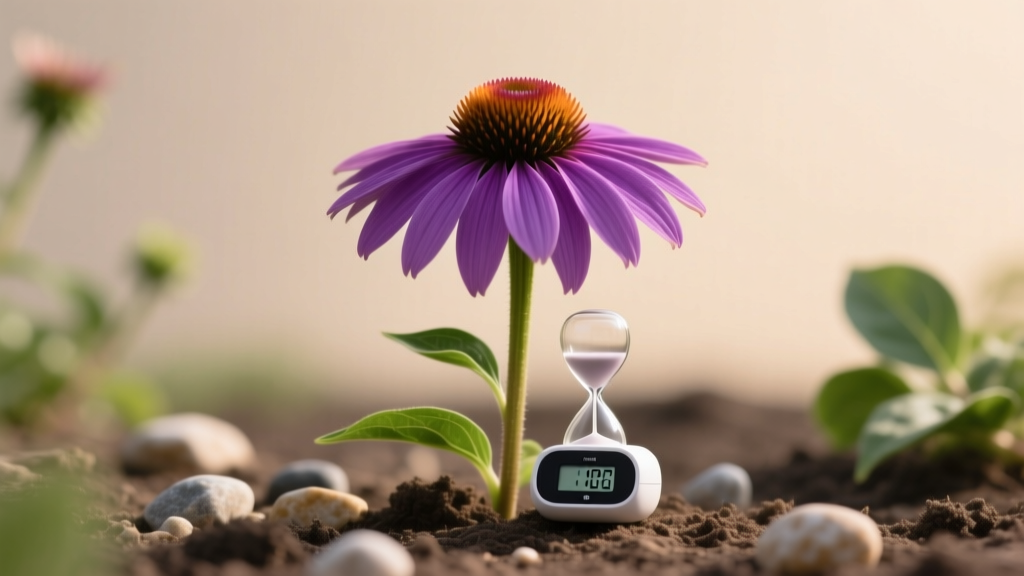
Drip Timer Programming for Coneflowers
Last July, a neighbor proudly showed me her “set-it-and-forget-it” drip system—then pointed at a sad row of coneflowers (Echinacea) that were flopping like wet paper. The timer was running every day for 20 minutes, and the soil under the mulch was soggy. She assumed more water would mean more blooms. Instead, she got lanky stems, fewer flowers, and the start of crown rot. Two houses down, another gardener ran drip once a week in the same heat, but for a longer soak, and her coneflowers were stiff-stemmed and loaded with pollinators. Same plant, same weather—different timer programming.
Coneflowers are tough, but drip timers can make or break them because coneflowers prefer a deep, occasional soak over daily sips. Your goal isn’t to keep the surface damp; it’s to wet the root zone, then let it breathe. Let’s program your timer like a master gardener would—based on plant age, soil type, emitter flow, and real weather.
Know What Coneflowers Actually Want From Water
Coneflowers are prairie natives in many regions and perform best when the root zone cycles between moist and slightly dry. Once established, they’re notably drought-tolerant—but new plantings and containers are a different story. Timers are most useful for the first growing season, heat waves, and vacation coverage.
Two guiding principles:
- Deep watering: encourage deeper roots and sturdier stems.
- Dry-down time: reduce crown/root disease and keep soil oxygenated.
University-based guidance lines up with this approach. For example, the Minnesota Extension (2023) emphasizes watering new perennials to establish roots, then backing off to avoid disease and weak growth. And the Colorado State University Extension (2022) notes that established xeric-adapted perennials generally do better with less frequent, deeper irrigation rather than daily watering.
Before You Touch the Timer: Measure Your Drip Output
Programming without knowing your flow rate is guesswork. You need two numbers: emitter flow (GPH) and how many emitters feed each plant.
Step-by-step: Quick drip audit (10 minutes)
- Find the emitter rating (printed on emitter or listed on packaging). Common rates are 0.5 GPH, 1.0 GPH, and 2.0 GPH.
- Count emitters per coneflower. A good baseline is 2 emitters per plant placed 4–6 inches from the crown on opposite sides.
- Confirm real flow if you suspect low pressure or clogs:
- Put one emitter into a measuring cup for 15 minutes.
- Multiply the collected amount by 4 to estimate per-hour flow.
- Check wetting pattern: After a run, dig down 6 inches with a trowel. You want moisture there, not just on top.
Why this matters: A plant with two 1 GPH emitters running 60 minutes receives about 2 gallons. Change the emitter to 0.5 GPH and that same hour delivers 1 gallon. Same timer, half the water.
Programming the Timer: Practical Schedules That Work
Below are starting points that you’ll adjust for soil and weather. I’ll give you schedules in minutes and days per week, plus what to look for to tweak them.
Scenario 1: Newly planted coneflowers (first 4–6 weeks)
New transplants have small root systems and can’t reach deeper moisture yet. You want consistent moisture—but not a constantly damp crown.
- Week 1–2: Run drip every 2–3 days, 30–45 minutes per run (assuming two 1 GPH emitters per plant).
- Week 3–6: Shift to every 4–5 days, 45–60 minutes per run.
- Water time: Early morning, ideally starting between 4:00–8:00 a.m. to reduce evaporation and leaf wetness overlap with evening humidity.
If you’re planting during a hot stretch (highs above 90°F for several days), keep the “every 2–3 days” rhythm a bit longer, but watch the crown for sogginess.
Scenario 2: Established coneflowers in the ground (second year and beyond)
These plants are happiest with infrequent deep watering, especially in loam or clay-loam soils.
- Typical summer schedule: 1 time per week, 60–90 minutes per run (two 1 GPH emitters).
- Heat wave schedule: 2 times per week, 60 minutes per run if temperatures stay above 95°F and there’s no rain.
- After meaningful rainfall: Skip the next cycle if you receive 0.5 inch or more.
Many gardeners overwater established coneflowers because the surface looks dry. Don’t chase the surface. Dig down 4–6 inches—if it’s cool and slightly damp, you’re fine.
Scenario 3: Coneflowers in containers (patio pots and raised planters)
Containers dry faster, heat up more, and have limited root volume. Timer programming needs a tighter cadence, especially in terracotta or fabric pots.
- Moderate weather (70–85°F): Every 2–3 days, 10–20 minutes (using a 1 GPH emitter or drip ring sized to the pot).
- Hot weather (85–95°F): Daily, 5–15 minutes.
- Extreme heat (95°F+): Sometimes 2 short cycles/day (morning + late afternoon), 5–8 minutes each, especially for small pots.
Container tip: aim the water at the soil, not the crown, and keep mulch 1 inch back from the base to reduce rot.
Soil Type Changes Everything (And Your Timer Must Follow)
Timers don’t water plants—soil does. Sandy soil needs more frequent runs because it drains quickly. Clay needs fewer, longer runs because it infiltrates slowly but holds water.
| Soil type | How water moves | Established coneflower baseline (2 × 1 GPH emitters) | What to watch for |
|---|---|---|---|
| Sandy / fast-draining | Soaks in quickly, drains quickly | 2x/week, 45–60 min | Wilting midday that doesn’t recover by evening |
| Loam | Balanced infiltration and holding | 1x/week, 60–90 min | Good stem strength, steady bloom cycle |
| Clay / slow-draining | Infiltrates slowly, holds water longer | Every 7–10 days, 75–110 min | Yellowing leaves, soft crowns, fungus/gnats |
Practical rule: In clay, split long runs into two cycles to prevent runoff—example 45 minutes, pause 30–60 minutes, then another 45 minutes. Many smart timers call this “cycle and soak.”
Light and Heat: When Full Sun Changes Your Water Math
Coneflowers bloom best with 6+ hours of direct sun. More sun means more transpiration; reflected heat from sidewalks or south-facing walls can double stress.
Use your timer to compensate for exposure, not your anxiety:
- Full sun, open wind: increase run time by 15–25% or add a second weekly cycle during heat waves.
- Afternoon shade: decrease frequency; coneflowers can stay too wet in shaded beds.
- Near reflective surfaces: check soil moisture twice weekly; heat islands can dry the root zone faster than you expect.
“Deep, infrequent irrigation encourages deeper rooting and better drought tolerance than frequent, shallow watering.” — Colorado State University Extension publication on efficient landscape watering (2022)
Feeding Coneflowers Without Making Them Flop
One reason gardeners think they need more water is that stems get tall and weak. Often that’s too much nitrogen (or too much shade), not too little irrigation.
Fertilizer approach that pairs well with drip timers
- In-ground, average soil: top-dress with 1–2 inches of compost in spring. Often that’s enough.
- Lean/sandy soil: apply a slow-release balanced fertilizer like 5-5-5 at label rates once in spring.
- Avoid heavy nitrogen: anything resembling lawn fertilizer rates can push soft growth and fewer blooms.
If you fertigate (feed through drip), go light: a diluted feed every 3–4 weeks during active growth is plenty, and skip feeding during extreme heat (plants aren’t using nutrients efficiently then).
Common Problems: What Your Timer Is Accidentally Causing
Drip systems are sneaky. They can keep the crown wet while the rest of the bed looks dry, especially under mulch. Here are the big timer-related issues I see with coneflowers.
Problem: Flopping stems and fewer blooms
Likely causes: too frequent watering, excess nitrogen, or not enough sun.
Fix:
- Switch from daily runs to 1 deep run/week (established plants).
- Move emitters 4–6 inches away from the crown.
- Stop fertilizing midseason; compost top-dress next spring instead.
Problem: Yellowing lower leaves, mushy base, or a plant that “lets go” at the crown
Likely causes: crown rot/root stress from wet soil, especially in clay or heavy mulch.
Fix:
- Reduce frequency immediately; let soil dry slightly between cycles.
- Use cycle-and-soak rather than one long run if runoff is occurring.
- Pull mulch back 1–2 inches from the crown.
- Check that emitters aren’t buried or dripping right against stems.
Problem: Plants look fine in the morning, then wilt hard by mid-afternoon
Likely causes: sandy soil drying out, insufficient run time, clogged emitters, or new plants not established.
Fix:
- First do the “dig test” at 6 inches. If dry, increase run time by 20 minutes next cycle.
- Check emitter flow: clogs can reduce output by half without obvious leaks.
- Add a second emitter or switch from 1 GPH to 2 GPH in very sandy sites (then reduce run time accordingly).
Problem: Powdery mildew or leaf spots
Likely causes: stressed plants (too dry), overcrowding, or irrigation mist hitting foliage (less common with drip, but happens with sprayers nearby).
Fix:
- Water early morning and avoid evening irrigation.
- Space plants for airflow; divide crowded clumps every 3–4 years.
- Keep drip lines under mulch but not against stems.
For disease management basics and moisture-related disease prevention in ornamentals, extension references like University of Minnesota Extension (2023) highlight the value of correct watering and airflow for reducing common fungal issues.
Troubleshooting Your Drip Timer Like a Pro
If your coneflowers aren’t thriving, don’t just change the schedule randomly. Diagnose, then adjust one variable at a time.
Symptom-based troubleshooting (fast checks)
- Soil is wet 2–3 days after watering: cut frequency in half; consider shorter runs or cycle-and-soak if drainage is poor.
- Soil is dry at 3–4 inches the day after watering: increase run time 25–50% or add emitters.
- One plant struggles while neighbors thrive: suspect a clogged emitter, kinked line, or gopher damage. Swap an emitter from a healthy plant to confirm.
- Plants near the end of the line look smaller: pressure loss. Use pressure-compensating emitters or shorten the run length.
Timer settings that prevent common mistakes
- Use “odd/even” or interval scheduling for new plants (every 2 days), then graduate to weekly for established plants.
- Enable seasonal adjust if your controller offers it: drop runtime by 20–30% in spring/fall.
- Add a rain sensor or use weather-based skipping. It’s one of the few add-ons that truly pays for itself.
Drip vs. Sprinklers: A Real Data Comparison for Coneflower Beds
I’ve managed coneflowers under both overhead sprinklers and drip. Drip usually wins for water efficiency and disease prevention, but only if it’s programmed for deep watering.
| Method | Typical runtime to deliver ~1 inch of water over a bed | Where the water goes | Best use case |
|---|---|---|---|
| Drip (2 × 1 GPH emitters/plant) | ~60–90 minutes for a deep root-zone soak (varies by soil) | Root zone, minimal evaporation | Perennial borders, mulch beds, drought-wise landscapes |
| Overhead sprinkler | Often 30–45 minutes to reach ~1 inch (depends on precipitation rate) | Leaves + soil surface; more loss to wind/evaporation | Large mixed lawns/beds where drip isn’t installed |
Here’s the tradeoff: sprinklers can deliver a measured “inch” more directly if you catch-can test them, but they wet foliage and waste more water on hot, windy days. Drip is more targeted, but you must verify emitters and soil penetration—or you’ll run it too often and keep crowns damp.
Three Real-World Programming Examples You Can Copy
These are the kinds of schedules I set for clients, then refine after one or two weeks of observation.
Case A: New coneflowers in loam, full sun, summer planting
- Emitters: 2 per plant, 1 GPH
- Schedule: Every 3 days, 40 minutes, start time 6:00 a.m.
- After 3 weeks: Every 5 days, 55 minutes
Adjustment trigger: if the plants wilt and don’t rebound by evening, add 10–15 minutes or move to every 2 days temporarily.
Case B: Established coneflowers in clay, mulched border
- Emitters: 2 per plant, 1 GPH
- Schedule: Every 9 days, cycle-and-soak: 45 minutes, pause 45 minutes, then 45 minutes
Adjustment trigger: if the soil is still wet at 4 inches on day 5, extend the interval to 10–12 days.
Case C: Coneflowers in 16-inch patio pots, hot exposure
- Emitter: 1 GPH drip ring
- Schedule (85–95°F): Daily, 10 minutes, start time 7:00 a.m.
- Extreme heat (95°F+): Add a second cycle 6:00 p.m. for 6 minutes
Adjustment trigger: if water runs out of the drainage holes within 2 minutes, your potting mix may be hydrophobic or compacted—slow the application (shorter cycles) and consider reworking the mix at season’s end.
Little Details That Make a Big Difference
These are the “hard-won” tips that keep coneflowers upright and blooming while your timer does the work.
- Don’t water the crown. Place emitters around the plant, not at the base. Crown problems are one of the main reasons coneflowers fade out early.
- Mulch lightly and correctly. Keep mulch 2–3 inches deep, but pulled back from stems by 1–2 inches.
- Recheck in midseason. Drip lines shift, emitters clog, and plants grow. Do a quick audit every 4 weeks in summer.
- Use a simple moisture check. If you don’t want gadgets, use the trowel test at 4–6 inches. It beats guessing.
Once you get the rhythm right, coneflowers become wonderfully low-drama. Your timer should run often enough to establish and support blooming, but not so often that the soil stays constantly damp. Program for the roots, verify with a quick dig, and tweak based on what the plant is telling you—upright stems, steady bloom, and deep green leaves are your confirmation that the schedule is working.
Sources: University of Minnesota Extension (2023); Colorado State University Extension (2022).