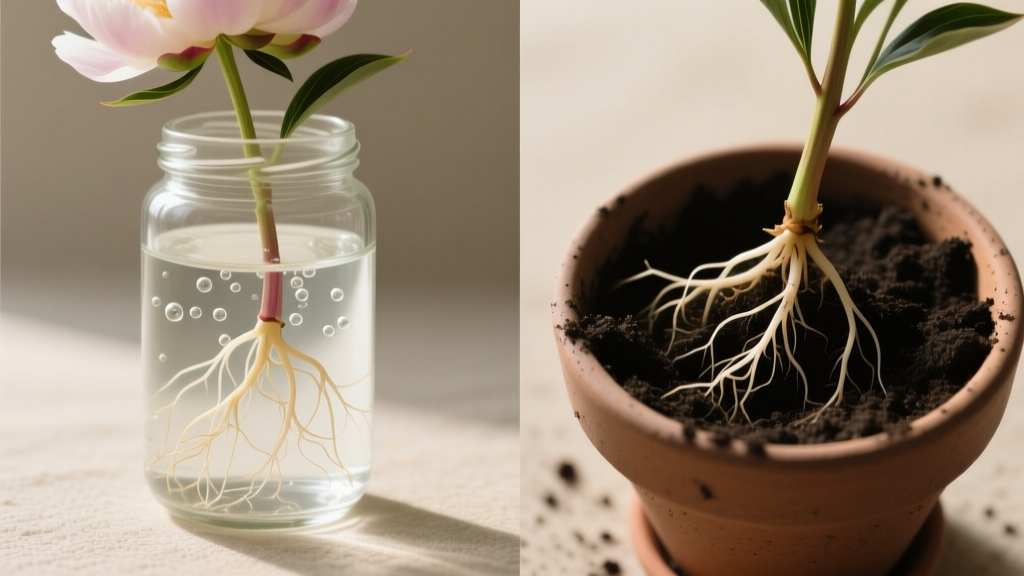
Rooting Peonies in Water vs Soil
You cut a few peony stems for a vase, and a week later you notice tiny white nubs near a node sitting in the water. It’s tempting to think, “Aha—free peony plants!” Then you try it: you keep the cutting in a jar, baby it for a month, and… it rots, stalls, or collapses the moment you pot it up. If that story feels familiar, you’re not alone. Peonies can tease you with callus and “almost-roots,” but they don’t behave like pothos or coleus.
This guide compares rooting peonies in water versus soil in practical terms, including what works, what usually fails, and exactly how to set up each method so you’re not wasting a season.
First, what “rooting a peony” actually means
When gardeners say “rooting peonies,” they might mean three different things:
- Rooting a cut stem in water (like a houseplant cutting). This is the least reliable for peonies.
- Establishing a division (a piece of crown with “eyes” and attached roots) in soil. This is the standard, high-success method.
- Rooting a tree peony cutting (semi-hardwood/wood cuttings). Possible, but slow and finicky—usually done by specialists.
Most home gardeners get best results by focusing on division establishment. Water can help you keep divisions from drying out for a day or two, but it’s not the finish line.
Water vs soil: what actually happens to peony tissue
Peony stems in water often form callus (a healing tissue) and sometimes tiny root initials, but they struggle to make the kind of strong, branched root system needed to transition into potting soil. Meanwhile, peony divisions already have storage roots designed to power new growth—soil is where those roots stay healthy and oxygenated.
| Factor | Rooting/holding in Water | Establishing in Soil (recommended) |
|---|---|---|
| Best use | Short-term hydration (24–48 hours), observing buds, holding divisions before planting | Long-term establishment and growth |
| Success rate (typical home attempts) | Low for stem cuttings; often <10% survive potting | High for divisions; commonly 70–95% with correct planting depth |
| Rot risk | High if water is warm/stagnant; bacteria build fast | Moderate if soil is heavy or overwatered; manageable with drainage |
| Root quality | Often weak, brittle, poorly branched “water roots” | Stronger, soil-adapted roots with better oxygen access |
| Timeline to stability | 4–8 weeks to see anything meaningful (often ends in stall) | New feeder roots in 2–6 weeks in cool soil; top growth next season is normal |
Data point that matters: planting depth is make-or-break for herbaceous peonies. The University of Minnesota Extension notes peony “eyes” should be set about 1–2 inches below the soil surface for reliable flowering and establishment (University of Minnesota Extension, 2023).
“Peonies are long-lived perennials, but they resent being planted too deeply; shallow placement of buds is one of the simplest ways to avoid years of leafy plants with no flowers.” — University Extension horticulture guidance (University of Minnesota Extension, 2023)
Scenario 1: You have a bouquet stem and want to root it
What to do instead (practical alternatives)
- Ask for a division from the original garden plant in early fall (best timing).
- Mark the plant in spring and plan to divide after bloom when foliage is still easy to find, then actually divide in fall.
- Try layering (tree peonies) if you have access to a living shrub—more reliable than water rooting.
If you still want to experiment with water (the least-bad setup)
Consider this a science project, not a guaranteed propagation method.
- Use a fresh stem taken from a living plant (not a florist stem). Choose a stem that’s firm, not floppy.
- Cut a 6–8 inch section with at least 2 nodes.
- Strip lower leaves; leave only 1–2 small leaves to reduce water loss.
- Use a clean jar and change water every 2 days. Keep it at 60–68°F (cool room) and out of direct sun.
- If you see slimy tissue or a sour smell, discard. Rot spreads fast in water.
Even if roots form, transplant shock is common. If you try potting up, use a very airy mix (more on that below) and keep the pot in bright shade for 10–14 days.
Scenario 2: You ordered bare-root peonies and they arrived dry
This is where water helps, and it’s a legitimate use. Bare-root peonies sometimes arrive slightly dehydrated. A short soak can rehydrate the roots before planting, but long soaking can suffocate tissues and encourage rot.
How to rehydrate bare-root peonies safely
- Soak roots in cool water for 1–4 hours. If they’re severely dry, you can extend to 6 hours, but don’t leave them overnight.
- Keep water cool: ideally 50–60°F. Warm water speeds bacterial growth.
- Plant immediately after soaking in prepared soil.
The Iowa State University Extension emphasizes the importance of proper planting depth and soil conditions for peony establishment (Iowa State University Extension and Outreach, 2022). Rehydration is helpful, but it doesn’t replace correct planting.
Scenario 3: You’re dividing an established peony and want every piece to survive
This is where soil wins—hands down. A division with 3–5 eyes and several healthy storage roots is a powerhouse, but it still needs the right depth, drainage, and watering rhythm.
Best timing for dividing peonies
For most home gardens, divide in early fall when nights cool down but soil is still workable—often September in many temperate climates. Aim for at least 6 weeks before the ground freezes so new feeder roots can form.
Soil method (recommended): step-by-step for strong rooting
Soil prep that actually matters
Peonies hate “wet feet,” especially in winter. They also don’t thrive in ultra-rich, soggy compost pockets. Think: fertile, well-drained garden soil with added mineral structure.
- Drainage target: water should not stand in the planting area longer than 4–6 hours after a heavy rain.
- Planting hole size: about 12–18 inches wide and 12 inches deep loosened, especially in compacted beds.
- Amendment approach: mix in 2–3 inches of compost across the bed surface, not a deep “compost bowl” in the hole. If soil is heavy clay, add coarse mineral material (like expanded shale or pine bark fines) to improve air space.
Planting depth (the number that decides flowering)
- Herbaceous peonies: set eyes 1–2 inches below soil surface (University of Minnesota Extension, 2023).
- Warmer climates: closer to 1 inch is often better.
- Cold climates: up to 2 inches helps prevent heaving.
Watering after planting: how much, how often
- Water in with 1–2 gallons per plant to settle soil.
- For the next 3–4 weeks, water only when the top 2 inches of soil are dry.
- Once established, peonies generally do well with about 1 inch of water per week from rain/irrigation during active growth (more in sandy soils, less in cool weather).
Overwatering is the sneaky killer in fall. If the weather turns rainy and cool, stop watering and let the soil breathe.
Light: where each method succeeds or fails
For soil-established divisions
- Sun target: at least 6 hours of direct sun for best bloom.
- Hot climates: morning sun with light afternoon shade can prevent flower scorch.
For water experiments or newly potted pieces
- Bright shade is safer than full sun while roots are limited.
- Avoid windowsills with hot glass; warm water + low oxygen = rot.
Feeding: fertilize less than you think
Simple feeding plan
- At planting (fall): skip high-nitrogen fertilizers. If soil is poor, scratch in a balanced slow-release (something close to 5-10-10 or similar) lightly—don’t bury fertilizer against roots.
- Spring of year 2: apply a light feeding as shoots are 2–4 inches tall.
- Annual compost: top-dress with 1 inch compost in spring, keeping it a few inches away from the crown.
Water rooting vs soil rooting: common problems and what to do
Problem: Stem turns brown and mushy in water
Symptoms: cloudy water, sour smell, blackening at the cut end, stem collapses.
- Cause: bacterial growth + low oxygen; peony stems are prone to rot in stagnant water.
- Fix: restart with a fresh cutting; sterilize jar; change water every 48 hours; keep at 60–68°F; reduce leaf area. If rot starts, it rarely reverses.
Problem: You planted a division and it grows leaves but never flowers
Symptoms: strong foliage, no buds year after year.
- Cause #1: eyes planted too deep (common). Anything deeper than about 2 inches can reduce flowering.
- Cause #2: too much shade (less than 6 hours sun).
- Cause #3: excess nitrogen.
- Fix: in early fall, lift and reset at correct depth; thin overhead shade if possible; switch to lower-nitrogen feeding.
Problem: New division flops or wilts even though soil is moist
Symptoms: shoots droop midday, don’t perk up; base may darken.
- Cause: root damage during division, or early root rot in heavy soil.
- Fix: improve drainage; avoid daily watering; ensure crown isn’t sitting in a depression; consider replanting slightly higher with a gentle slope away from the crown.
Problem: Buds form, then turn black and fail to open
Symptoms: blackened buds, gray fuzz sometimes; common in cool, wet springs.
- Cause: botrytis blight can attack buds and stems.
- Fix: remove and trash infected tissue (don’t compost); improve air circulation; avoid overhead watering late in the day; clean up fall debris. If it repeats yearly, a labeled fungicide timed at early shoot emergence can help.
Comparison analysis with real-world timing and survival expectations
- Water-rooted stem: you may see callus in 7–14 days, occasional rootlets by 4–8 weeks, and then a high failure rate during potting. Survival after transplant is often under 10% unless you’re working with unusually suitable material and controlled conditions.
- Soil-planted division: root activity resumes in cool fall soils; you may not see much top growth until spring, and flowering may take 1–2 years depending on division size. Survival commonly runs 70–95% when planted at 1–2 inches depth in well-drained soil.
Three quick case notes from real gardens
Case 1: The jar-on-the-kitchen-counter experiment
A gardener keeps a peony stem in a mason jar on a bright counter. The water warms to household temps (often 70–75°F), gets cloudy, and the stem rots within 10 days. The fix wasn’t “more time”—it was lower temperature, frequent water changes, and accepting that peony stems aren’t built for this.
Case 2: Bare-root arrival in rough shape
A shipment arrives late, roots are shriveled. A 2–4 hour soak in cool water plumps the roots enough to plant. The gardener plants eyes at 1–2 inches, waters in with 1–2 gallons, then stops fussing. The plant doesn’t bloom the first spring, but by year two it’s flowering on schedule.
Case 3: The “too deep” inheritance planting
A peony planted years ago never blooms. When lifted, the eyes are 4–5 inches deep due to years of mulching and settling. Resetting to 1–2 inches and reducing nitrogen brings blooms back the following season (sometimes it takes two).
If you insist on combining methods: a safer hybrid approach
- Rinse soil off roots so you can inspect for damage.
- Hold the division in cool water for 30–60 minutes to rehydrate while you prep the planting hole.
- Plant the same day. Don’t store it submerged for days.
Common questions gardeners ask (answered plainly)
Can peonies root in water at all?
You may see callus and occasional rootlets, but reliable propagation from herbaceous peony stem cuttings in water is uncommon. If you want a sure thing, start with a division.
What’s the fastest way to get more peony plants?
Divide an established plant in early fall. Aim for pieces with 3–5 eyes, plant eyes 1–2 inches deep, and don’t overwater.
What temperature do peonies prefer while establishing?
If you take one thing to the garden with you: water is a tool for short-term hydration, not a long-term home for peony propagation. Put your energy into good soil prep, correct planting depth, and restrained watering—then let the plant do what peonies do best: settle in slowly, build deep roots, and reward your patience for decades.
Sources: University of Minnesota Extension peony planting guidance (2023); Iowa State University Extension and Outreach peony care/planting recommendations (2022).