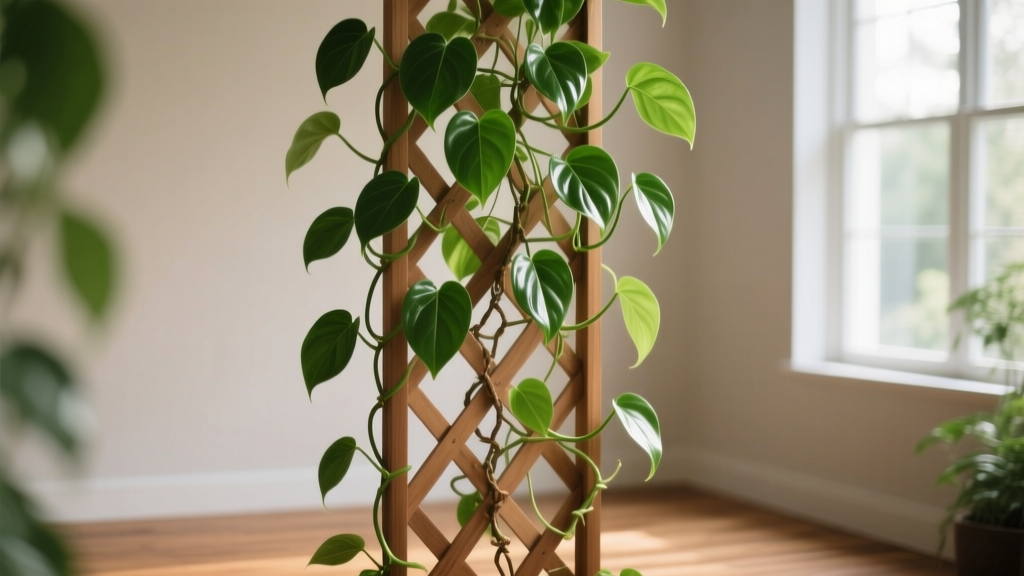
Training Pothos to Climb a Trellis
You buy a pothos as a cute 6-inch starter plant, set it on a shelf, and within a year it’s dragging 6-foot vines across the floor, snagging dust bunnies, and shedding the occasional leaf where the vine kinked around a chair leg. Here’s the surprising part: pothos often looks “healthier” (bigger leaves, thicker stems, less legginess) when it’s encouraged to climb instead of trail. In the wild it clambers up trees, and indoors you can use a trellis to mimic that growth habit—with a lot more control and a lot less chaos.
This is a practical, hands-on guide for getting pothos (Epipremnum aureum) to climb a trellis cleanly and confidently: what trellis to use, how to attach vines without injuring them, how to adjust watering and feeding once it’s vertical, and what to do when it stalls, drops leaves, or refuses to “grab on.”
Before you start: what climbing changes for pothos
When pothos climbs, two things happen that affect care: (1) the plant tends to put energy into thicker, sturdier vines and often larger leaves, and (2) the top portion can dry out faster because it’s farther from the moist pot surface and exposed to more air movement and light. That means your watering habits may need a tweak, and your support needs to be stable enough to hold the plant’s new growth pattern.
According to the University of Florida IFAS Extension, pothos performs best in bright, indirect light and is commonly grown as a hanging or climbing plant indoors (UF/IFAS Extension, 2023). And if you’ve ever noticed aerial roots popping out along the nodes, that’s the plant’s built-in climbing hardware waiting for a surface.
Choosing a trellis: stability beats style
You can train pothos up almost anything, but not everything makes the plant look better long-term. A trellis that wobbles leads to stressed stems and broken nodes.
Best trellis options for indoor pothos
- Bamboo U-trellis or fan trellis: light, inexpensive, easy to insert into the pot. Best for 1–3 vines.
- Wire hoop trellis: great for looping vines into a neat shape; less “natural” for aerial roots to grab.
- Moss pole or coco coir pole: best if you want larger leaves and more dramatic climbing behavior. Requires higher humidity and more attentive watering.
- Wood lattice trellis: stable and attractive; needs a pot heavy enough to prevent tipping.
Comparison: trellis methods with real-world tradeoffs
| Support Type | Best For | Watering Impact | Leaf Size Potential | Maintenance Level |
|---|---|---|---|---|
| Bamboo trellis (12–24 in) | Small pots (4–8 in), tidy vertical look | No change to pot watering | Moderate | Low (tie vines every 2–4 weeks) |
| Wire hoop (10–18 in) | Looping vines, compact shape | No change to pot watering | Moderate | Low–Medium (reposition as it grows) |
| Coco/moss pole (18–36 in) | Big leaves, stronger climbing habit | Pole may need misting/rewetting 2–4x/week | High (best odds indoors) | Medium–High (keep pole evenly moist) |
| Wood lattice (18–36 in) | Decorative, multi-vine display | No change to pot watering | Moderate–High | Medium (needs sturdy pot/anchoring) |
Soil and pot setup (because climbing starts at the roots)
Training pothos to climb is easier when the root system is healthy and the pot is stable. A lightweight, over-peaty mix in a top-heavy pot is a recipe for tipping and root rot.
A reliable potting mix recipe
Aim for a chunky, fast-draining mix that still holds some moisture. If you like a simple DIY blend, start with:
- 2 parts high-quality indoor potting mix
- 1 part orchid bark (or fine pine bark)
- 1 part perlite or pumice
Use a pot with drainage holes. For a plant that’s about to go vertical, I like a heavier pot (ceramic or thick plastic) and I size up only slightly: from a 6-inch pot to an 8-inch pot is usually plenty. Oversizing encourages wet soil that stays wet too long.
Texas A&M AgriLife Extension notes that pothos prefers well-drained media and is tolerant of indoor conditions but should not be kept constantly saturated (Texas A&M AgriLife Extension, 2022). That’s especially important once you add a trellis, because people tend to water “a little extra” to compensate for the climbing growth—often too much.
Light: the difference between “climbing” and “reaching”
Pothos will climb in lower light, but it won’t look its best. In dim rooms, the plant tends to stretch between nodes, producing a sparse “ladder” effect on the trellis. Bright, indirect light encourages tighter spacing and fuller coverage.
Actionable light targets
- Best placement: 2–6 feet from an east or north window, or filtered light near a south/west window.
- Grow light option: A simple LED grow light placed 12–18 inches away for 10–12 hours/day can tighten growth dramatically.
- Temperature sweet spot: keep it in the 65–85°F range. Below 55°F, pothos can stall and drop leaves after watering.
If your pothos is climbing but the leaves get smaller as it goes up, that’s usually a light issue (not a trellis issue). Move the whole setup closer to brighter light or add a grow light above the trellis so the top doesn’t shade itself out.
How to train pothos to climb a trellis (step-by-step)
Training is mostly gentle redirection. You’re not forcing woody stems; you’re guiding a flexible vine and letting it lignify (firm up) over time.
What you’ll need
- Trellis (12–36 inches, matched to pot size)
- Soft plant ties or Velcro garden tape (avoid thin wire)
- Clean pruners
- (Optional) sphagnum moss pole and a spray bottle
Step-by-step training method
- Install the trellis first. Insert it near the pot edge, not through the crown of the plant. Push it down until it’s stable—ideally within 1 inch of the pot bottom.
- Identify nodes. Nodes are the slightly swollen points where leaves and aerial roots emerge. These are your “anchor points.”
- Start with the longest vine. Gently curve it toward the trellis. Don’t make sharp bends; keep curves wide.
- Tie below a node. Place your tie 1/2–1 inch below a node so the node can sit against the trellis and produce aerial roots. Snug, not tight—you should be able to slide a fingertip under the tie.
- Repeat every 4–6 inches of vine. The goal is support, not a straitjacket.
- Rotate the pot weekly for 3–4 weeks. This evens out growth so the plant doesn’t lean hard toward the brightest side and pull away from the trellis.
“Aerial roots form at nodes and will cling when given a textured, slightly moist surface; the key is steady support and consistent light so the plant grows into the structure rather than away from it.” — University of Florida IFAS Extension (2023)
Watering: vertical growth changes drying patterns
Most pothos problems I see on trellises come down to watering habits that didn’t change when the plant’s architecture changed. A climbing plant often has more leaf mass in the air and more exposure, so it may use water faster—unless the potting mix is heavy, in which case it stays wet and roots suffer.
A simple watering routine that works
- Check depth: water when the top 2 inches of soil are dry (use your finger or a chopstick).
- Water thoroughly: pour until you get 10–20% runoff, then empty the saucer after 10 minutes.
- Typical frequency: every 7–14 days indoors, but light, temperature, and pot size swing this widely.
If you’re using a moss/coco pole
A moss pole is a separate hydration system. The potting mix may be perfect while the pole is bone dry, and pothos won’t attach well to a crispy pole.
- Mist or lightly water the pole 2–4 times per week (more in dry homes).
- Don’t soak it to dripping daily; constant wet + low airflow can invite fungus gnats and stem rot.
- Try to keep indoor humidity around 40–60% if you want reliable aerial root attachment.
Feeding: enough to grow, not so much it gets floppy
On a trellis, you’re aiming for sturdy, leafy growth. Over-fertilizing can give you long, soft internodes that need constant tying and are easier to snap.
A practical fertilizing schedule
- Spring through early fall: feed every 4 weeks with a balanced liquid fertilizer at 1/4 to 1/2 strength.
- Winter: feed every 8–10 weeks or stop entirely if growth slows.
- Flush salts: every 8–12 weeks, run plain water through the pot for 1–2 minutes to reduce fertilizer buildup (especially if you see white crust on soil).
If you prefer numbers: if the label says 10 mL per liter, use 2.5–5 mL per liter for pothos indoors. Slow and steady beats “big meals.”
Real-world training scenarios (and what actually works)
These are the situations that come up in real homes, not greenhouse perfection.
Scenario 1: A leggy pothos with long bare sections
What you see: long stretches of vine with leaves only near the ends; trellis looks sparse.
What’s happening: low light and/or the plant was allowed to trail too long without pruning, so it shed older leaves.
What works:
- Move to brighter indirect light (or add a grow light 12–18 inches away for 10–12 hours/day).
- Prune vines back by 6–12 inches to force branching.
- Pin cuttings back into the pot (root them in water for 2–4 weeks or place directly into moist mix). This thickens the base so the trellis fills from the bottom up.
Scenario 2: A full pothos that keeps slipping off the trellis
What you see: you tie it up, and two weeks later the vine leans away and falls forward.
What’s happening: ties are too far apart, the trellis is too smooth, or the pot is rotating toward the light and pulling the plant off-center.
What works:
- Add ties every 4–6 inches, especially near the top where growth is tender.
- Switch from slick plastic ties to Velcro tape or soft twine that grips.
- Rotate the pot 90° once a week for a month to balance phototropism.
- If the trellis is glossy metal, wrap it with jute twine to create texture for aerial roots.
Scenario 3: A moss pole pothos that won’t attach
What you see: aerial roots form, but they stay short and don’t grip; vines need constant tying.
What’s happening: the pole surface is too dry, humidity is very low, or the plant is underlit and not producing robust nodes.
What works:
- Keep the pole evenly damp (not soggy): mist or lightly water it 2–4 times/week.
- Raise humidity to 40–60% (a small humidifier nearby works better than endless misting).
- Increase light intensity so nodes are closer together and roots are more likely to contact the pole.
Common problems and targeted fixes
When a pothos is trained vertically, problems show up in predictable ways. Here’s how to read the symptoms and respond without guessing.
Yellow leaves near the bottom
- Most likely cause: overwatering or soil staying wet too long.
- Check: is the soil still damp 5–7 days after watering? Is the pot sitting in runoff?
- Fix: let the mix dry to at least the top 2 inches before watering again; improve drainage with perlite/bark next repot; ensure 10–20% runoff then empty saucer after 10 minutes.
Brown, crispy leaf edges (especially higher on the trellis)
- Most likely cause: underwatering, low humidity, or salt buildup from fertilizer.
- Check: do you fertilize regularly but never flush? Is the top of the plant closer to a vent?
- Fix: water more thoroughly; keep humidity near 40–60%; flush the pot with plain water every 8–12 weeks; move away from heat/AC vents by at least 2–3 feet.
Black, mushy nodes or stem sections
- Most likely cause: rot from consistently wet soil or a constantly soaked moss pole with poor airflow.
- Immediate steps:
- Cut back to healthy tissue (sterilize pruners).
- Discard mushy sections; don’t compost indoors.
- Let the soil dry more between waterings.
- Long-term fix: switch to a chunkier mix; reduce pole watering; increase airflow.
Small leaves and long gaps between leaves (leggy growth)
- Most likely cause: insufficient light.
- Fix: move closer to bright indirect light or add a grow light 10–12 hours/day; prune back 6–12 inches to encourage bushier regrowth.
Leaves curling inward
- Most likely cause: thirst, heat stress, or root issues.
- Check: if soil is dry and pot feels light, water. If soil is wet and leaves still curl, inspect roots for rot.
- Fix: correct watering; keep temperatures 65–85°F; avoid placing the trellis setup directly above a radiator or in a hot window pocket.
Pests on trellised pothos: what to watch for
A trellis doesn’t cause pests, but it can hide them. Check stems where they’re tied, and inspect the undersides of leaves halfway up the structure.
Most common indoor pests
- Spider mites: fine webbing, stippled leaves. Rinse foliage, then treat with insecticidal soap every 7 days for 3 rounds.
- Mealybugs: cottony clusters at nodes. Dab with 70% isopropyl alcohol on a cotton swab; repeat weekly until gone.
- Scale: brown bumps on stems. Scrape gently, then treat with horticultural oil (test a leaf first).
If you’re tying vines, don’t ignore the ties during pest checks. Mealybugs love hiding where tape overlaps.
Pruning and shaping: the secret to a trellis that looks intentional
Without pruning, pothos will climb like it’s trying to escape. With pruning, you get a full, layered look.
Pruning rules that keep the plant attractive
- Prune in spring/summer for fastest recovery.
- Cut 1/4 inch above a node to encourage branching from that point.
- Don’t remove more than about 25–30% of the plant at once if it’s already stressed or recently repotted.
Use your cuttings. Root them and replant around the base to bulk up the crown. A trellised pothos looks best when the bottom 6–10 inches are leafy—otherwise the whole thing reads “top-heavy.”
Repotting with a trellis in place (without making a mess)
When pothos is climbing, repotting intimidates people—and then they avoid it too long. The trick is to keep the trellis and root ball stable as one unit.
Repotting steps
- Water lightly the day before (not soaking) so the root ball holds together.
- Remove the plant and trellis together; lay it sideways on a towel.
- Loosen circling roots gently; don’t tear aggressively.
- Move up one pot size (typically +2 inches in diameter).
- Backfill with your chunky mix and press lightly to remove large air pockets.
- Water until 10–20% runoff; keep in medium-bright light for 7 days before returning to strongest light.
If the trellis is tall (24–36 inches), consider a heavier pot or add a thin layer of clean gravel at the bottom for stability—just don’t block drainage holes.
A few final habits that make trellised pothos easy
Once your pothos is climbing, it becomes the kind of plant you “manage” in small moments rather than big rescues. Keep a roll of soft tie tape nearby and do quick adjustments as you walk past.
- Tie new growth early: tender vines train in seconds; older vines fight you.
- Keep the top lit: aim light at the upper half so it keeps leafing out as it climbs.
- Let it breathe: don’t plaster every vine flat—some spacing reduces pest issues and helps leaves size up.
When you get the support, light, and watering rhythm working together, pothos stops looking like a houseplant that’s “getting away from you” and starts looking like a living design element—lush, vertical, and surprisingly tidy for something that’s naturally a jungle climber.