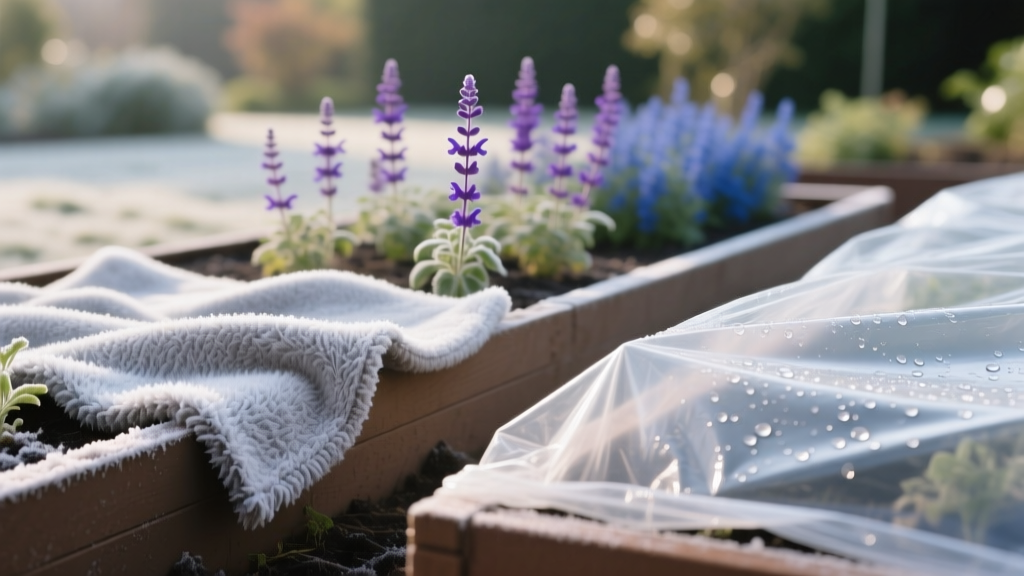
Frost Cloth vs Plastic for Salvia
The forecast says 30°F, then it “updates” at dinner to 26°F with wind. You’ve got salvias still blooming, hummingbirds still visiting, and you’re standing in the garage holding two options: a roll of frost cloth and a sheet of plastic. You can only cover once, it’ll be dark in an hour, and you want the plants to survive without turning into a soggy mess by morning.
Here’s the surprising part: plastic can protect plants from frost, but it can also cause cold damage if it touches leaves. Frost cloth is more forgiving, but it isn’t magic—especially on windy nights or when temperatures drop fast. With salvias, the right cover depends on the type of salvia, your soil moisture, and whether you can keep the cover off the plant tissue.
This is the practical, master-gardener take: use frost cloth as your default, use plastic only when you can keep it off the foliage and vent it properly, and always pair covers with good watering and soil habits. Salvias are tougher than they look, but the wrong protection can turn a near-miss into a setback.
Know Your Salvia: Tender vs Hardy Changes Everything
“Salvia” covers a lot of ground: tender varieties grown as annuals in cold climates (like pineapple sage, Salvia elegans) and hardy perennials (like Salvia nemorosa and many of the smaller meadow sages). Before you choose fabric or plastic, decide which situation you’re in:
- Tender salvias (often grown in containers or as annuals): can be damaged around 32°F and may die back with a hard freeze.
- Hardy salvias: tops may get nipped, but roots often survive well below freezing once established and mulched.
In practical terms: if you’re trying to save blooms and top growth, the cover matters a lot. If you’re mainly trying to protect crowns and roots, mulching and moisture management are just as important as what you throw over the plant.
Frost Cloth vs Plastic: What They Do Differently (with Real Numbers)
Frost cloth (also called row cover or garden fabric) traps heat rising from the soil while still letting moisture and some air move through. Plastic blocks air movement almost completely and can trap more heat, but it also traps condensation and can transmit cold by contact.
| Factor | Frost Cloth (Row Cover) | Plastic Sheeting |
|---|---|---|
| Typical temperature protection | 2–6°F depending on weight and how well sealed | 4–10°F if tented and edges sealed; less if touching foliage |
| Breathability | Breathable; reduces condensation | Not breathable; condensation builds quickly |
| Risk of leaf burn | Low (fabric rarely “freezes” leaves) | High if plastic touches leaves during freeze |
| Wind performance | Good when pinned/weighted; can flap if loose | Can act like a sail; must be secured well |
| Morning management | Can stay on longer; less overheating | Must vent/remove early to avoid overheating on sunny days |
Those temperature ranges aren’t marketing fluff—they reflect what shows up in field and extension recommendations for season extension materials. The key is the setup: a cover that’s tight to the ground with edges sealed performs far better than one draped loosely with gaps.
“Covers work best when they trap heat from the soil; the goal is to create a pocket of warmer air, not to wrap the plant like a bandage.” — University Extension frost protection guidance (2020)
Extension programs consistently emphasize keeping covers from contacting foliage and anchoring edges to reduce heat loss. Plastic can outperform cloth for raw temperature gain, but cloth wins for reliability and lower risk in a typical home-garden setup.
3 Real-World Scenarios: What I’d Use and Why
Scenario 1: Sudden radiational frost, calm night (28–32°F)
You’ll often see this on clear, still nights where the heat just drains away. For salvias in the ground, this is where frost cloth shines.
- Use: Frost cloth, 0.5–1.0 oz/yd² weight if you have it.
- Timing: Cover 1–2 hours before sunset to trap residual warmth.
- Bonus: Water the soil earlier in the day (details below). Moist soil holds more heat than dry soil.
Scenario 2: Hard freeze predicted (24–27°F) and you must save top growth
If it’s a tender salvia you truly want to keep looking good (or you’re stretching the season for blooms), you can use plastic—but only if you build a tent so the plastic doesn’t touch leaves.
- Use: Plastic over hoops/stakes + a cloth layer underneath if you have it.
- Must-do: Keep plastic 2–6 inches off foliage.
- Morning: Vent by 9–10 a.m. if sun hits it, or you’ll cook stems even when it’s cold outside.
Scenario 3: Windy freeze (below 30°F with wind)
Wind strips away the warm pocket you’re trying to create. A loose cover is almost useless. I lean toward frost cloth tightly pinned, plus mulch at the base. Plastic is risky because it flaps and tears, and it’s harder to seal.
- Use: Frost cloth pinned every 12–18 inches along edges, weighted with boards or bricks.
- Add: 2–3 inches of straw or shredded leaves around the crown (keep mulch pulled back an inch from the stem to avoid rot).
How to Cover Salvia Correctly (Step-by-Step)
Most cover failures come down to three mistakes: covering too late, leaving gaps at the bottom, and letting plastic touch leaves.
Frost cloth method (my default)
- Water earlier if soil is dry (aim for morning/early afternoon).
- Drape cloth to the ground so it covers the entire plant and the soil around it.
- Seal the edges with soil, boards, or rocks. Don’t leave open sides.
- Avoid tight binding on stems; you want a tent-like shape, not compression.
- Remove or vent once temps rise above 35–40°F, especially if the day will be sunny.
Plastic method (only when you can tent it)
- Stake or hoop first so plastic will not touch leaves (aim for 2–6 inches clearance).
- Cover at dusk and anchor edges tightly to ground.
- Add a cloth layer under plastic if you’re pushing protection—fabric buffers temperature swings and reduces condensation drip.
- Vent early the next day. If sun hits plastic, temperatures inside can climb fast even when air is chilly.
For research-backed guidance on covering and venting, see University of California Agriculture and Natural Resources recommendations on frost protection and cover management (UC ANR publication, 2019), and general frost protection principles summarized by multiple U.S. Extension programs (e.g., University of Minnesota Extension cold/frost protection resources, 2021).
Watering: The Quiet Factor That Changes Frost Outcomes
If you remember one thing: dry soil cools faster than moist soil. That can be the difference between a light nip and serious dieback. You don’t want soggy ground for weeks, but you do want the root zone hydrated going into a cold night.
- Before a frost: If the top 2 inches of soil are dry, water in the morning so the soil has time to absorb it.
- Amount: Aim for roughly 0.5–1 inch of water total that week (including rain), more for sandy soils, less for heavy clay.
- Containers: Pots freeze faster. Water lightly if dry, but avoid soaking right before a deep freeze—wet potting mix plus cold can stress roots.
For salvias, watering is also tied to disease: cool + wet + poor airflow can invite root rot and mildew, especially under plastic. Cloth breathes; plastic sweats.
Soil: Drainage Keeps Salvias Alive Through Winter
Many salvias survive cold better than they survive winter wet. If your soil holds water, your first “frost protection” tool is drainage, not a cover.
What salvia roots want
- Texture: Loose, well-drained soil. Heavy clay benefits from raised beds.
- pH: Most garden salvias tolerate a wide range, but do well around pH 6.0–7.5.
- Mulch: Use 2–3 inches after the ground cools, not early fall when soil is still warm (early mulching can keep crowns too wet).
If you’ve got a low spot where water puddles after rain, covering the top won’t stop the crown from rotting. In that case, consider moving the plant or building a small berm.
Light: How Sun Exposure Changes Your Cover Choice
Sun is your friend the day after a frost—unless you used plastic and forgot to vent. Salvias in full sun generally harden off better than those in shade, but they also warm faster in the morning, which can worsen damage if frozen tissue thaws too rapidly.
- Full sun beds: Frost cloth is safer because it moderates the thaw.
- Shadier spots: Plastic can stay colder longer; condensation lingers and encourages fungal issues.
When the forecast swings between cold nights and warm sunny days, frost cloth is a better “leave it on for a bit” option. Plastic is a “use it for the night, manage it in the morning” option.
Feeding: Don’t Push Tender Growth Right Before Frost
Late-season fertilizer is one of the easiest ways to make salvia more frost-sensitive. Nitrogen pushes soft growth that nips at higher temperatures.
- Stop feeding: About 6–8 weeks before your average first frost date.
- If you must feed: Use a low-nitrogen approach (compost top-dress or a balanced, light application) earlier in the season, not in late fall.
- Container salvias: Reduce fertilizer by late summer; don’t fertilize right before moving pots into protection.
Healthy, moderately fed plants overwinter better than lush, overfed ones. A little stress tolerance beats a lot of soft growth when cold arrives.
Common Problems When Covering Salvia (and How to Fix Them Fast)
Problem: Leaves turned black and mushy after a freeze
Likely causes: Plastic touched foliage, or the plant was exposed to a hard freeze without enough insulation.
What to do:
- Wait 48–72 hours before pruning; you’ll see what’s truly dead.
- Cut mushy growth back to firm tissue with clean pruners.
- If the crown looks firm and new buds are visible at the base, mulch lightly and let it recover.
Problem: White/gray fuzz or spotting after covering
Likely causes: Condensation and low airflow, especially under plastic; mildew pressure increases in humid pockets.
What to do:
- Switch to frost cloth (breathable) or vent plastic daily.
- Water at the base, not overhead, and only in the morning.
- Thin nearby plants for airflow; salvias hate being smothered.
Problem: Plant survived the freeze but collapsed a week later
Likely causes: Root stress—either drought followed by cold, or waterlogged soil leading to root rot.
What to do:
- Check soil moisture 3–4 inches down. If soggy, improve drainage and pull mulch back from the crown.
- If very dry, deep-water once the weather moderates (don’t keep it constantly wet).
- For containers, move pots against a sheltered wall and wrap the pot (bubble wrap or burlap) to reduce freeze-thaw cycling.
Troubleshooting by Symptom: Quick Diagnoses
Symptom: Brown, crispy leaf edges after a cold night
- Usually means: Mild frost burn, often on exposed tips.
- Fix: Cover with frost cloth next cold night; don’t fertilize; prune lightly once weather stabilizes above 40°F during the day.
Symptom: Entire plant looks “steamed” under plastic
- Usually means: Overheating on a sunny morning or extreme condensation drip plus cold shock.
- Fix: Vent earlier; add a cloth layer under plastic; use hoops so plastic doesn’t touch; remove plastic by mid-morning.
Symptom: New shoots emerge, then die back repeatedly in late winter
- Usually means: Freeze-thaw cycles and premature growth during warm spells.
- Fix: Keep mulch in place at 2–3 inches; avoid heavy pruning in fall; wait until stable spring weather to cut back hard.
Plastic + Salvia: When It’s Worth the Hassle
Plastic is worth using when you have a short, sharp cold event and you can build a proper tent. Think: a single night at 24–26°F when you’re trying to hold onto blooms for another week, or you’re protecting a tender, container-grown salvia you plan to overwinter.
Two rules keep plastic from backfiring:
- No contact with leaves. Plastic touching foliage can transmit cold and cause blackened patches.
- Vent daily. Trapped humidity and heat swings stress salvias and invite disease.
For the home gardener, plastic is not a “set it and forget it” cover. It’s a short-term tool that requires morning follow-up.
Frost Cloth + Salvia: The Reliable Workhorse
Frost cloth is the cover I reach for when I want protection with fewer surprises. It’s especially good for in-ground salvias where you’re protecting the crown and preserving as much top growth as you reasonably can.
It also plays well with repeated cold nights. You can leave it on through a cold spell, lifting it when daytime temperatures are comfortably above freezing and the sun is strong. That matters in real life, because cold snaps rarely happen just once.
Extension resources frequently recommend breathable covers for frost protection because they reduce condensation-related issues and moderate temperature swings (University of Minnesota Extension guidance, 2021; UC ANR frost protection publication, 2019).
Cold-Season Care That Makes Covers Work Better
Covers are just one part of the system. If your salvias struggle every winter, tighten up these basics:
- Mulch timing: Apply winter mulch after a few cold nights, when soil temps have cooled, not during warm early fall.
- Pruning: Leave some stems on hardy salvias through winter as a little “umbrella” for the crown; cut back hard in spring once you see new growth.
- Windbreaks: A temporary screen or even moving a container to the leeward side of the house can add a few degrees of protection.
If you garden in a spot with frequent freeze-thaw, prioritize root and crown health over saving every last bloom. A living crown in spring beats perfect foliage in November.
My Go-To Decision: Cloth First, Plastic Only With Structure
If you’re standing there with a tender salvia and one cold night coming, either material can help—but the success rate is higher with frost cloth because it’s harder to misuse. Plastic is powerful when it’s tented, sealed, and vented; it’s a plant-killer when it’s draped directly on foliage and left until noon.
For most home gardens, here’s the simple playbook:
- Use frost cloth for routine frosts (28–32°F) and multi-night cold spells.
- Use plastic only for short emergencies (24–27°F) when you can keep it off the plant and you’ll be around to vent/remove it early.
- Water smart, mulch right, and avoid late fertilizer so your salvia has real resilience underneath whatever you cover it with.
When you get it right, you’ll notice something satisfying the next afternoon: salvias bounce back quickly. The leaves perk up, stems stay firm, and you’ve bought yourself weeks of color—without waking up to blackened tips or a collapsed plant. That’s the goal: not perfection, just protection that actually matches how salvias live.