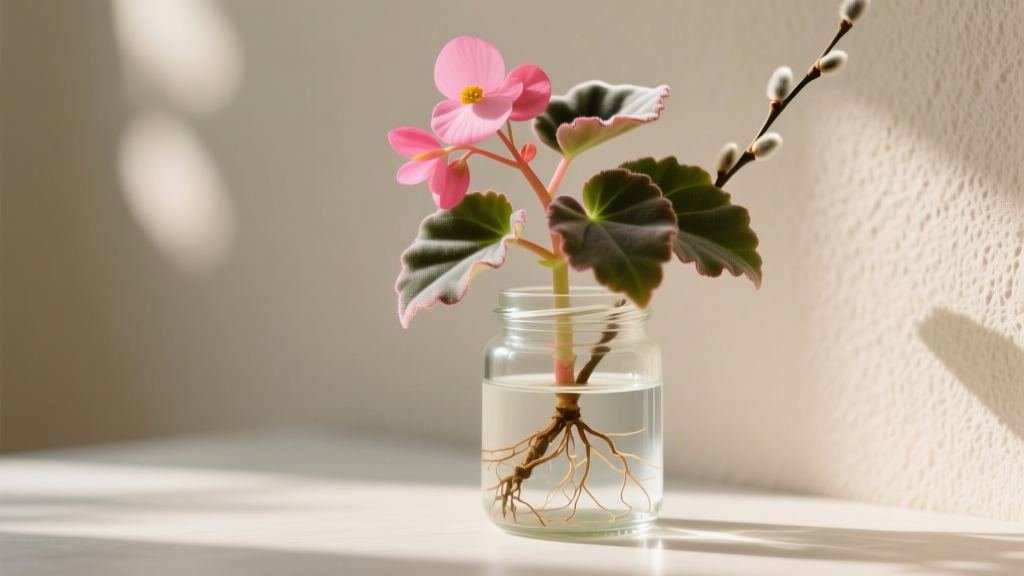
Willow Water Rooting Aid for Begonias
You take a perfect begonia cutting—plump stem, clean node, a couple healthy leaves—stick it in water, and two weeks later it’s a sad, mushy straw. Or it sits there forever, doing nothing, like it’s waiting for a written invitation to root. If that sounds familiar, you’re not alone. Begonias root readily when conditions are right, but they’re also quick to rot if the water gets stale, the temperature swings, or the cutting is too soft.
Willow water is one of those old-school tricks that still earns space on my potting bench. It’s not magic, and it won’t compensate for poor sanitation or cold windowsills. But used correctly, it can tip the odds in your favor—especially for fussy cane begonias, rex types that sulk, and any cutting that needs a gentle push while you dial in humidity and warmth.
What willow water actually does (and what it can’t do)
Willow (Salix spp.) contains natural plant compounds that matter to rooting: auxin-like substances (especially indole-3-butyric acid, IBA) and salicylic acid–related compounds. Auxins are key hormones involved in root initiation, while salicylic acid is associated with stress responses and can support overall cutting resilience.
“Auxins are the primary plant hormones used to stimulate adventitious root formation in cuttings, and IBA is the most widely used because it is effective and relatively stable.” — North Carolina State Extension publication on plant propagation (2020)
Willow water is milder than commercial rooting hormone. Think of it as a supportive soak and a cleaner rooting environment rather than a guaranteed root switch. If you’re taking thick, woody cane begonia cuttings or trying to rescue a borderline cutting, powder or gel rooting hormone often outperforms willow water. But for water-rooting, leaf cuttings, and gentle propagation, willow water is a practical tool.
What it can’t do: It won’t stop bacterial rot if you’re using dirty jars, it won’t fix cold (below about 65°F / 18°C), and it won’t root a cutting taken from weak, pest-stressed stock.
Scenario #1: The “I root everything in a glass on the windowsill” problem
If your cuttings sit in a decorative glass in direct sun, the water warms and cools dramatically, algae blooms, and oxygen drops. Begonias hate that. Willow water helps a bit, but the bigger win is controlling temperature and cleanliness.
- Keep rooting jars in bright, indirect light, not hot sun.
- Aim for a steady 70–75°F (21–24°C) for fastest rooting.
- Change water every 2–3 days (or top off daily and fully refresh twice weekly).
How to make willow water (two reliable methods)
You can make willow water as a quick tea or as a longer cold infusion. Use young, pencil-thin willow shoots if you can—new growth tends to contain more active compounds than old, barky stems.
Willow water quick method (hot steep)
- Cut young willow twigs into 1–2 inch (2.5–5 cm) pieces.
- Pack loosely: about 2 cups chopped twigs into a clean jar.
- Pour over 4 cups (1 quart / ~950 ml) of just-boiled water.
- Cover and steep for 12–24 hours.
- Strain. Store refrigerated up to 7 days.
Willow water slow method (cold infusion)
- Chop twigs as above.
- Combine 2 cups twigs with 4 cups room-temperature water.
- Soak 48 hours in a cool spot.
- Strain and refrigerate up to 7 days.
Practical note: If the willow water smells sour, looks slimy, or gets cloudy fast, toss it. Fresh matters.
Using willow water with begonia cuttings (step-by-step)
This is the workflow I use when I want consistent results without fuss.
Step 1: Choose the right cutting
- Cane begonias: take a 4–6 inch (10–15 cm) tip cutting with at least 2 nodes.
- Rhizomatous/rex begonias: leaf or leaf-and-petiole cuttings root well; pick a mature, unblemished leaf.
- Avoid flower buds on cuttings. Snip them off—flowers steal energy.
Step 2: Clean tools and containers
Begonias rot fast when bacteria get a head start.
- Wipe pruners with 70% isopropyl alcohol.
- Wash jars in hot soapy water; rinse well.
Step 3: Soak or use as rooting water
You have two good options:
- Pre-soak: soak the cut end in willow water for 2–4 hours, then move into clean water (or your propagation mix).
- Root directly: place the cutting directly into willow water, then refresh with fresh willow water every 2–3 days.
If you’re using willow water in water propagation, don’t “set and forget.” Fresh oxygen is as important as hormones.
Comparison: Willow water vs rooting hormone vs plain water (what to expect)
Home gardeners always ask which method is best. Here’s the grounded answer: it depends on your setup and what kind of begonia you’re propagating. Under warm indoor conditions (70–75°F), these are reasonable expectations based on typical propagation performance reported by extension resources on rooting hormones and common grower results.
| Method | Typical time to first roots | Rot risk | Best use-case | Cost per batch |
|---|---|---|---|---|
| Plain water | 10–21 days | Medium–High (stale water) | Easy cane begonia cuttings, quick experiments | $0 |
| Willow water | 7–18 days | Medium (still needs frequent changes) | Water rooting when you want a gentle boost and better cutting “vigor” | Low (free if you have willow) |
| Commercial rooting hormone (IBA powder/gel) | 7–14 days | Low–Medium (depends on humidity/medium) | Soilless propagation mix, tougher cane cuttings, high success batches | Low–Moderate |
Data point that matters: Most commercial rooting hormones use IBA because it’s consistently effective for adventitious rooting. That’s not marketing fluff; it’s standard horticulture practice. See propagation guidance from North Carolina State Extension (2020) and Royal Horticultural Society propagation references (RHS, 2021) for general hormone use in cuttings.
Watering: keeping cuttings alive long enough to root
Rooting begonias is mostly about moisture management. Too dry and they collapse; too wet and they rot. Willow water doesn’t change that balancing act.
For water propagation
- Keep only the lowest node submerged. Don’t submerge leaves.
- Use a narrow jar to reduce wobble (movement damages callus tissue).
- Change water every 48–72 hours.
For propagation in mix (often more reliable than water)
If you want sturdier roots that transition to soil easily, root in a light mix and use willow water as a pre-soak.
- Use a small pot with drainage.
- Moisten the mix until it feels like a wrung-out sponge (damp, not dripping).
- Cover with a clear bag or dome to hold humidity, but vent daily for 10–15 minutes.
Soil: the rooting mix and the “after-potting” mix
Begonias want air around their roots. Dense potting soil is a common reason cuttings fail after they’ve rooted in water.
Rooting mix recipe (simple and effective)
- 50% coco coir or peat-based seed-starting mix
- 50% perlite
This drains fast but stays evenly moist. If you don’t have coco/peat, a light potting mix cut with perlite at a 2:1 ratio (potting mix:perlite) works.
After-potting mix (for established begonias)
- 2 parts quality potting mix
- 1 part perlite or pumice
- Optional: 10–15% fine orchid bark for extra airflow (great for cane begonias)
University of Minnesota Extension notes that good drainage and avoiding saturated soils are key to preventing common houseplant root rots (University of Minnesota Extension, 2022).
Light: bright shade beats sunny sills
For rooting, begonias do best in bright, indirect light—enough to fuel growth, not so much they dehydrate.
- Target a spot that would comfortably grow a pothos: bright room light, no harsh midday sun.
- If using grow lights, start at 12–14 hours per day, with the light about 12–18 inches (30–45 cm) above the cuttings.
Too much sun on a jar of water also encourages algae, which competes for oxygen and turns your “clean rooting station” into a swamp fast.
Feeding: when to fertilize (and when not to)
Don’t fertilize fresh cuttings in water. They don’t have roots to use it, and nutrients encourage bacterial growth.
- In water: no fertilizer until roots are at least 1–2 inches (2.5–5 cm) long and you’re ready to pot up.
- After potting: wait 2 weeks, then feed at 1/4 strength using a balanced houseplant fertilizer (for example, 10-10-10 or similar).
If you want to be extra cautious, start with one light feeding per month. Begonias prefer steady, modest nutrition over big doses.
Scenario #2: Leaf-cutting rex begonia that keeps collapsing
Rex begonias can be dramatic. Leaf cuttings fail most often from low humidity or soggy media.
What works:
- Use a shallow tray with your 50/50 coir-perlite mix lightly moistened.
- Cut a healthy leaf and slice across a few main veins on the underside.
- Lay the leaf flat and pin it down so the cuts contact the mix.
- Mist once, then cover with a clear dome or bag.
- Keep at 72–78°F (22–26°C) if possible.
Willow water fits here as a light pre-moisten for your mix or a quick dip of the petiole end, but humidity control is the real driver. If the leaf collapses within 48 hours, it’s usually drying out—not failing to “get hormones.”
Scenario #3: Cane begonia cutting that roots in water but dies after potting
This is one I see constantly: water roots form, you pot it up, and the plant wilts as if it lost its mind overnight. Water roots are adapted to water; they’re fragile in soil.
Make the transition smoother:
- Pot up when roots are 1–2 inches long, not 6 inches long. Shorter roots adapt better.
- Use a small pot—3–4 inches (7.5–10 cm) wide is plenty for a single cutting.
- Pre-moisten the soil mix. Don’t pot into dry mix and then drench.
- Keep humidity higher for 5–7 days (a loose bag over the pot works), then gradually open it.
Willow water can be used as the first watering after potting, but keep it light—just enough to settle the mix. Saturating the pot is how rot starts.
Common problems and fixes (symptoms-first troubleshooting)
Problem: Stem turns brown/black and mushy at the waterline
- Likely cause: bacterial rot from stagnant water, too-warm sun, or submerged leaves.
- Fix: recut the stem 1/2 inch (1–1.5 cm) above the rot into clean tissue; disinfect jar; refill with fresh willow water or clean water.
- Prevention: change water every 2–3 days; keep in indirect light; submerge only a node.
Problem: Cutting wilts even though it’s in water
- Likely cause: too much leaf area (transpiration), warm dry air, or a damaged stem.
- Fix: remove the largest leaf or cut leaves in half; move to 70–75°F with stable humidity; ensure the cut end is freshly recut.
- Tip: a loose clear bag over the cutting (not touching leaves) for 3–5 days often saves it.
Problem: No roots after 3 weeks, but the cutting stays green
- Likely cause: temperature too cool (below 65°F), low light, or cutting taken from slow-growth tissue.
- Fix: warm it up (top of a fridge or a seedling heat mat set around 72°F / 22°C); increase light to bright indirect; refresh willow water more often.
- Escalation: switch to a propagation mix and use a light dusting of commercial IBA rooting hormone.
Problem: White fuzz on the cutting or on the soil surface
- Likely cause: fungal growth from stale humidity and low airflow.
- Fix: remove affected material; vent the dome/bag daily for 10–15 minutes; avoid over-misting.
- Prevention: start with clean containers and fresh mix; don’t crowd cuttings.
Problem: Roots form, but tips are brown and stop growing
- Likely cause: oxygen-poor water or old willow water breaking down.
- Fix: move to fresh water immediately; rinse the jar; keep water level lower; consider rooting in mix instead of water.
Using willow water safely and effectively (a few hard-won pointers)
Willow water is a “fresh product.” Treat it like a short-lived tool, not a shelf-stable solution.
- Refrigerate and use within 7 days.
- Don’t mix with fertilizer.
- Don’t use if it smells off.
- Label the jar with the date—easy to forget.
If you’re looking for the most repeatable results across many cuttings, commercial rooting hormones provide consistent IBA concentrations (North Carolina State Extension, 2020). Willow water varies by species, season, and how fresh the twigs are. That variability is why I treat it as a helpful habit, not a guarantee.
A practical rooting routine I’d use for 5 begonia cuttings at home
If you want a simple plan that avoids the usual mistakes, this is it:
- Take cuttings in the morning and keep them shaded while you work.
- Sanitize pruners with 70% alcohol.
- Make fresh willow water the day before (or use refrigerated from this week).
- Pre-soak cut ends for 2–4 hours.
- Root in a 50/50 coir-perlite mix under a vented clear cover at 70–75°F.
- Check moisture every 2 days; water lightly only when the surface begins to dry.
- Pot up when you feel resistance with a gentle tug (usually 14–28 days, depending on type and warmth).
That routine beats “a glass on the windowsill” in both success rate and the strength of the roots you end up with.
If you try willow water and your begonias still rot, don’t assume you “did it wrong.” Most failures come down to one of three things: the cutting was too soft, the temperature was too cool, or the environment was too wet and stale. Fix those, and willow water becomes what it’s meant to be—a small edge that helps good technique pay off.
Sources: North Carolina State Extension propagation guidance on auxins and rooting hormones (2020); Royal Horticultural Society propagation references (2021); University of Minnesota Extension houseplant care and root-rot prevention guidance (2022).