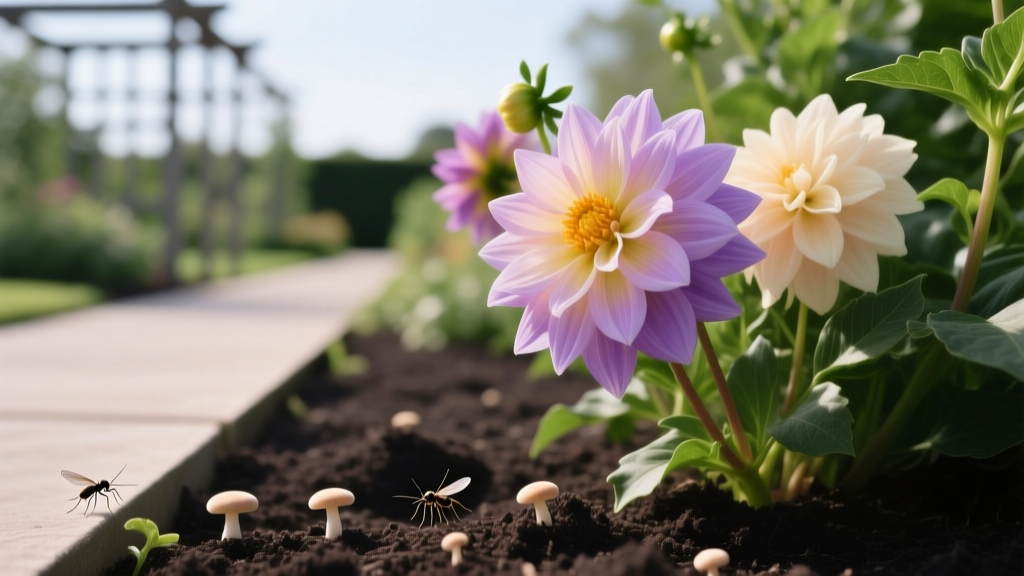
How to Prevent Fungus Gnats in Dahlias
You bring home a gorgeous dahlia, pot it up, and within a week you notice tiny black “specks” hovering around the rim of the pot. You water again, and suddenly they’re everywhere—little gnats flying into your face, crawling on the soil, and showing up on the windowsill. Here’s the surprising part: most of the real damage isn’t from the adults you see. It’s from their larvae feeding in the top layer of damp potting mix, where young dahlia roots and tender feeder roots live.
Fungus gnats are one of those problems that feel like a mystery until you understand the simple truth: they need consistently moist organic media to reproduce. Dahlia care often involves rich soil and regular watering—exactly what gnats love. The good news is you can prevent them (and stop them) with a few practical adjustments that won’t sabotage your blooms.
This guide focuses on prevention first, then gives you a clear, step-by-step plan if gnats are already present—because most of us only start researching once we see them.
Know your enemy: fungus gnat basics (in plain English)
Adult fungus gnats are small (about 2–4 mm long) and mosquito-like. They lay eggs in moist potting mix. The larvae hatch and feed on fungi, decaying organic matter, and—when populations are high—fine roots. That’s when dahlias start stalling, yellowing, or collapsing after a “normal” watering.
“Fungus gnat larvae primarily feed on fungi and organic matter, but they can also injure roots—especially in young plants and cuttings.” — University of Minnesota Extension (2021)
Most indoor/outdoor container dahlia gnat outbreaks come from one of three triggers: overwatering, overly rich/peaty media that stays wet, or bringing home a plant (or bag of mix) already carrying eggs.
Watering: the #1 lever for preventing fungus gnats
If you only change one thing, change how you water. Fungus gnats need persistently wet topsoil. Dahlias, meanwhile, do best with deep, thorough watering followed by partial drying—especially in containers.
How often to water dahlias without inviting gnats
Use a simple rule: water when the top 1–2 inches (2.5–5 cm) of soil are dry. For many home gardeners, that means:
- In-ground dahlias: about 1 inch of water per week from rain + irrigation, adjusted for heat and soil type.
- Container dahlias: often every 2–4 days in summer, but it depends on pot size, sun, and wind.
During cool spells (below about 65°F/18°C) or when plants are small, dial watering back. Small root systems plus rich media equals “wet too long,” which is prime gnat real estate.
Deep watering beats frequent sips
Frequent light watering keeps the top layer damp—exactly where gnats lay eggs. Instead:
- Water slowly until it runs out the drainage holes (containers) or penetrates several inches deep (in-ground).
- Empty saucers after 10–15 minutes so pots don’t re-absorb water.
- Wait until that top 1–2 inches dries before watering again.
Easy “master gardener” trick: bottom-water selectively
If you’re battling gnats indoors or on a covered patio, bottom-watering can break their cycle because it keeps the surface drier. Set the pot in a tray with 1–2 inches of water for 20–30 minutes, then remove and drain thoroughly. Use this method only when the plant actually needs water—don’t keep it sitting in water.
Soil and potting mix: build a surface gnats can’t use
Fungus gnats love fine-textured, peat-heavy mixes that stay damp near the surface. Dahlias like rich soil, but “rich” doesn’t have to mean soggy.
What a gnat-resistant dahlia mix looks like
For containers, aim for a mix that drains fast but still holds moisture in the root zone. A practical recipe by volume:
- 50% high-quality potting mix
- 25% perlite or pumice (for air and drainage)
- 25% fine pine bark or orchid bark (adds structure; dries quicker at the surface)
If you’re using bagged mix, consider “cutting” it with perlite/pumice at about 20–30% to reduce waterlogging. This one change alone prevents a lot of infestations.
Drainage: non-negotiable for containers
Dahlias in pots need:
- A container with drainage holes (plural)
- No “drainage layer” of rocks (it doesn’t improve drainage and can raise the perched water table in pots)
- A pot size that matches the plant: commonly 12–18 inches wide for many varieties, larger for big dinnerplates
Top dress to block egg-laying (and compare methods)
One of the most reliable prevention tools is making the soil surface less inviting. Here’s a practical comparison with real-world pros/cons.
| Surface treatment | Recommended depth | How it helps | Tradeoffs | Best use case |
|---|---|---|---|---|
| Coarse horticultural sand | 0.5 inch (1.3 cm) | Surface dries faster; reduces egg-laying sites | Can crust; messy indoors; doesn’t kill larvae already deep | Outdoor containers; porch pots |
| Fine gravel (2–4 mm) | 0.5–0.75 inch (1.3–1.9 cm) | Physical barrier; helps keep crown area drier | Harder to remove for fertilizing/topdressing | Long-season pots; hot climates |
| Diatomaceous earth (dry) | Thin dusting | Abrasive to soft-bodied insects when kept dry | Stops working when wet; can irritate lungs—apply carefully | Short-term spot use indoors |
| No topdress (bare soil) | 0 | Nothing | Highest gnat risk if watering is frequent | Only if you’re very disciplined with drying cycles |
My experience: a 1/2 inch layer of coarse sand or fine gravel can noticeably reduce adult activity in a week, but it works best paired with better watering habits. If the mix stays wet for days, gnats will still find cracks and edges.
Light and airflow: small tweaks that make a big difference
Low light slows evaporation and keeps the surface damp longer. That’s why fungus gnats explode on indoor dahlias or dahlias started early under lights.
Give dahlias enough light so the soil dries on schedule
For strong growth (and faster, safer dry-down):
- Outdoors: aim for 6–8+ hours of direct sun.
- Indoors (starting tubers/cuttings): provide bright light and keep air moving; weak light plus warm rooms often means wet pots and gnats.
Air movement reduces “always damp” surfaces
A small fan on low, aimed to move air across the pots (not blast the foliage) can shorten dry-down time. This matters most in grow rooms, sunrooms, and covered patios where rain can’t help flush and breezes are limited.
Feeding dahlias without feeding gnats
Over-fertilizing doesn’t directly cause fungus gnats, but it can push you into watering more often, and it can create soft growth that struggles when roots are stressed by larvae.
Practical feeding schedule that keeps roots healthy
- At planting in the ground: incorporate compost modestly—think 1–2 inches worked into the top layer, not a deep “muck” zone.
- Once plants are actively growing: feed every 2–4 weeks with a bloom-leaning fertilizer (lower nitrogen). Follow label rates; don’t “double for more flowers.”
- For containers: use diluted liquid feed at about 1/2 strength every 7–14 days, adjusting to plant vigor.
Also: avoid leaving decomposing leaves on the soil surface. Rotting organic matter is a buffet for fungi, and fungi are what gnat larvae are built to eat.
Common problems that invite fungus gnats (and how to prevent them)
Think of fungus gnats as a symptom of a system that stays too wet. Fix the system, and gnats usually fade out.
Problem: “My potting mix never dries out.”
- Cause: too much peat/fine compost, pot too large for the plant, low light, cool temperatures.
- Fix: increase drainage (add 20–30% perlite/pumice), move to brighter light, water less often, and consider downsizing the pot until the plant bulks up.
Problem: “I’m watering correctly, but gnats keep coming back.”
- Cause: eggs already in the mix, or adults coming from nearby plants, or algae/fungus growth on the surface.
- Fix: yellow sticky cards + a biological drench (see next section), and quarantine new plants for 7–10 days.
Problem: “Dahlias are wilting even though the soil is wet.”
- Cause: root stress—could be fungus gnat larvae, but also root rot from chronic saturation.
- Fix: let the pot dry down, check drainage, and inspect roots if symptoms persist.
The UC IPM program notes fungus gnats are common in moist potting media and are best managed by reducing moisture and using integrated tactics, not just spraying adults (UC ANR IPM, 2021).
Troubleshooting: match symptoms to solutions
Here’s how I diagnose fungus gnat issues in dahlias quickly, without guesswork.
Symptom: small black flies hover when you water
Likely: adult fungus gnats breeding in the pot.
Do this today:
- Place 1–2 yellow sticky cards per pot cluster, right at soil level.
- Let the top 1–2 inches dry before watering again.
- Remove dead leaves and any moss/algae on the surface.
Symptom: seedlings/cuttings stall, yellow, or topple
Likely: larvae feeding on fine roots (most common when plants are young).
Do this within 48 hours:
- Apply a biological control drench: Bacillus thuringiensis israelensis (Bti) (often sold as Mosquito Bits/Dunks) steeped and used as irrigation water.
- Repeat the drench once a week for 2–3 weeks to catch new hatchlings.
- Improve airflow and light to shorten dry-down time.
Colorado State University Extension highlights Bti as a management option for fungus gnat larvae in potting media, paired with moisture management (Colorado State University Extension Fact Sheet, 2020).
Symptom: soil surface has green film (algae) or fuzzy mold
Likely: consistently damp surface encouraging fungal growth—larval food.
Fix:
- Scrape off the top 1/2 inch and replace with fresh, drier mix plus a sand/gravel topdress.
- Water less frequently; aim for a dry surface between waterings.
- Increase sun/airflow.
3 real-world scenarios (and what actually worked)
These are common “this is exactly what happened” situations I see with home gardeners growing dahlias.
Scenario 1: Patio container dahlias in a rainy spell
You’re doing everything right, then you get a week of summer thunderstorms. Containers stay wet for days. Gnats appear.
- What worked: pulling pots under cover for 3–5 days to allow a real dry-down, then adding a 1/2 inch gravel topdress and using sticky cards.
- What didn’t: spraying adults with random “houseplant bug spray.” It knocks down what you see, but larvae keep coming.
Scenario 2: Indoor dahlia starts under lights (warm room, low airflow)
Tubers or cuttings are started early. The room is 70–75°F (21–24°C), and pots dry slowly. Gnats explode fast indoors because there’s no wind and lots of moisture.
- What worked: a small fan, bottom-watering only when needed, and weekly Bti drenches for 3 weeks.
- Key change: stopping misting and surface-wetting—mist is gnat fuel in slow-drying setups.
Scenario 3: In-ground dahlias with heavy mulch and frequent drip
Drip irrigation runs daily “just a little,” and the bed is heavily mulched. The soil stays constantly moist near the surface. You notice gnats when you kneel near the plants, and growth looks sluggish.
- What worked: changing drip scheduling to fewer, deeper runs (for example, 2 times per week instead of daily), and pulling mulch back 2–3 inches from the crown to let the surface breathe.
- Bonus: fewer waterings often leads to stronger rooting and sturdier stems.
Integrated prevention plan: stop gnats before they start
If you want a dependable routine, this is the one I’d use for my own dahlias.
Step-by-step prevention checklist
- Start clean: use fresh potting mix, clean pots, and don’t reuse last year’s soggy media.
- Build drainage: add 20–30% perlite/pumice if your mix is heavy.
- Water with a trigger: only water when the top 1–2 inches are dry.
- Keep surfaces unfriendly: apply 1/2 inch sand or fine gravel topdress in containers.
- Monitor early: place a yellow sticky card near new plants for the first 10–14 days.
- Quarantine additions: keep new plants separate for 7–10 days to avoid importing gnats.
If you already have fungus gnats: a practical 14-day knockout plan
You don’t have to live with them for months. The trick is to target both adults (so they stop laying eggs) and larvae (so the population collapses).
Days 1–3: cut off egg-laying and reduce moisture
- Let the surface dry: no watering unless the plant truly needs it.
- Add sticky cards at soil level.
- Remove decaying leaves/flowers sitting on the potting mix.
Days 4–14: target larvae on a schedule
- Use Bti as a soil drench once per week for 2–3 applications.
- Keep the top layer on the drier side between treatments.
- If the pot is badly waterlogged, consider repotting into a better-draining mix (best done when the plant is not in peak bloom stress).
Expect adult numbers on sticky cards to drop noticeably within 7 days if you’re consistent. If you keep seeing lots of adults after two weeks, look for a “source pot” nearby—often one chronically wet houseplant is supporting the whole gnat population.
Common mistakes I see (and how to avoid them)
These are the habits that keep fungus gnats cycling, even in otherwise well-tended gardens.
- Watering on a calendar: dahlias don’t care what day it is; they care how wet the root zone is.
- Using saucers and leaving water sitting: it keeps the lower mix saturated and slows dry-down.
- Over-mulching container surfaces: organic mulches (compost, shredded bark) can hold moisture right where gnats breed.
- Only treating adults: swatting/spraying adults without larval control is like bailing a boat with a hole in it.
Citations and further reading (the sources behind the advice)
- University of Minnesota Extension. “Fungus gnats.” (2021).
- UC Agriculture and Natural Resources, Integrated Pest Management (UC IPM). “Fungus gnats.” (2021).
- Colorado State University Extension. “Fungus gnats as houseplant and greenhouse pests.” Fact Sheet (2020).
If you take nothing else from this: keep the top 1–2 inches of dahlia soil from staying constantly wet, and you’ll prevent most fungus gnat problems before they get started. Add a simple barrier topdress and a sticky card early in the season, and you’ll usually catch the issue before it turns into a full-blown swarm.