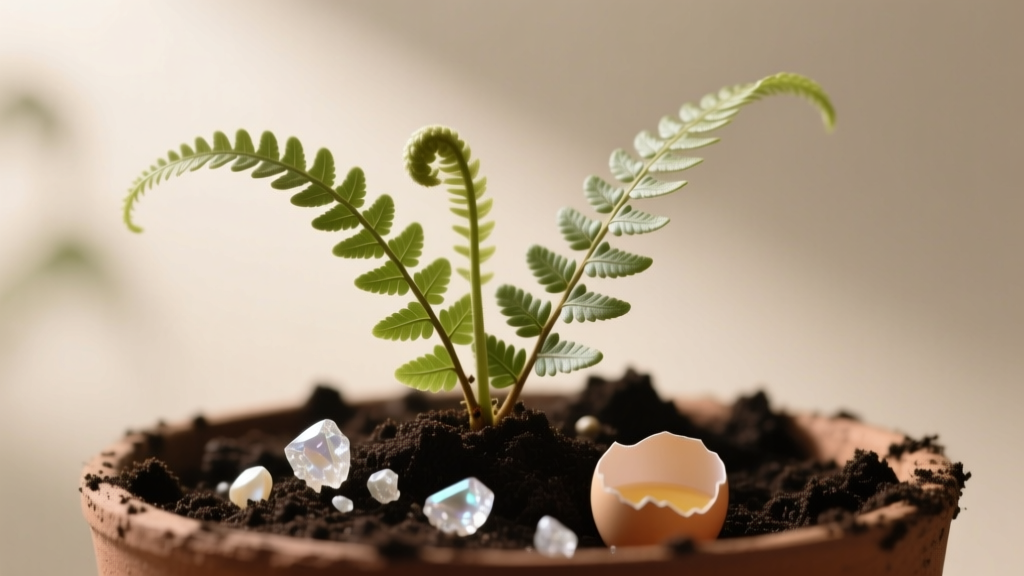
Eggshell Calcium Boost for Ferns
You’ve got a fern that’s been “fine” for months—then the fronds start looking tired. Tips brown. New growth comes in smaller. The potting mix smells a little sour, and the plant seems to drink water one day and sulk the next. A lot of home gardeners blame light or humidity (often correctly), but there’s a quieter culprit I see all the time: a root zone that’s slowly drifting out of balance. And when people reach for eggshells to “add calcium,” they sometimes fix one problem while creating another—especially with ferns.
Eggshells can be useful, but not as a casual sprinkle-and-hope remedy. Ferns aren’t tomatoes; many prefer slightly acidic conditions, and eggshells are mostly calcium carbonate, which can nudge pH upward if you overdo it. Used thoughtfully—ground fine, applied lightly, and paired with good watering habits—eggshell calcium can support steadier growth and stronger tissue without turning your fern’s soil into a chalky mess.
This is the practical, hard-won way to do it: what eggshells actually do in potting mix, which ferns tolerate (or benefit from) calcium additions, how much to apply, and how to troubleshoot when a “calcium boost” backfires.
First, what eggshells really do (and what they don’t)
Eggshells are mostly calcium carbonate (CaCO3). That matters because calcium carbonate dissolves slowly in typical potting conditions. Translation: eggshells are not a fast calcium fix. They’re more like a slow-release nudge that depends on moisture, particle size, and soil acidity.
Two grounding facts:
- Eggshells release calcium slowly. If you need an immediate correction (for example, severe deficiency symptoms), a soluble calcium source works faster than shells.
- Eggshells can raise pH over time. That’s good in overly acidic mixes, but many ferns prefer a slightly acidic range. Pushing pH too high can lock out iron and manganese, leading to chlorosis (yellowing) even when nutrients are present.
For perspective, Clemson University Extension notes that eggshells are primarily calcium carbonate and can act similarly to lime, affecting soil pH over time (Clemson Cooperative Extension, 2023). And the University of Minnesota Extension emphasizes that liming materials change pH gradually and should be guided by testing rather than guesswork (University of Minnesota Extension, 2022).
“Calcium is important, but the plant’s ability to use it depends on water movement and a suitable root-zone pH. Adding a calcium source won’t help if roots are stressed or the pH is out of range.” — adapted from University Extension guidance on calcium nutrition and pH management (University of Minnesota Extension, 2022)
Real-world scenarios: when eggshell calcium helps—and when it’s a waste
Scenario 1: The apartment Boston fern with chronic tip burn. The plant lives near a heating vent. Humidity swings, and watering is inconsistent. Eggshells won’t fix dry air, but a light calcium addition paired with steadier watering can reduce tissue collapse in new growth—because calcium supports cell wall structure. The bigger win, though, is improving watering rhythm and humidity.
Scenario 2: The staghorn fern mounted on wood, fertilized heavily. Fertilizer salts build up. You see browned edges and stalled growth. This is not a calcium problem; it’s a salt and moisture management problem. Adding eggshells on a mount usually does nothing measurable. A soak-and-flush routine helps more than any eggshell trick.
Scenario 3: The outdoor fern bed under maples with very acidic soil. Some garden soils under conifers or heavy leaf litter can test quite acidic. In those cases, small, measured calcium carbonate additions (including finely ground eggshell) may help—especially for tougher, adaptable ferns—but only after a simple pH test tells you where you’re starting.
Light: don’t “feed” a fern that’s starving for photons
Before we talk feeding, get light right. A fern in poor light can’t use nutrients efficiently. Most common house ferns (Boston fern, Kimberly Queen) do best in bright, indirect light. Too dark leads to sparse growth; too much sun leads to scorch.
- Indoors: Place 2–6 feet from an east or north window, or 4–8 feet from a bright south/west window with a sheer curtain.
- Outdoors: Dappled shade is ideal. Morning sun is often fine; hot afternoon sun can crisp fronds quickly.
If you’re moving a fern to higher light, do it over 7–10 days to avoid shock.
Watering: calcium only “moves” when water moves
Calcium is taken up with water flow. If the root ball alternates between bone-dry and swampy, calcium uptake becomes erratic even if calcium is present.
Indoor pot watering targets
Use the “top-inch” rule as your baseline: water when the top 1 inch of mix feels barely damp—not wet, not dust-dry. In an average home, that’s often every 4–7 days, but let the plant and season set the pace.
- Water until you get steady drainage out the bottom (for a 6–8 inch pot, that’s typically 2–3 cups of water, depending on mix).
- Empty the saucer after 10 minutes.
- Once a month, flush the pot with plain water equal to about 2× the pot volume to reduce salt buildup (especially if you fertilize).
Temperature and water quality
Use room-temperature water, roughly 65–75°F. Very cold water can shock roots. If your tap water is very hard, you may already be adding calcium carbonate regularly—without realizing it. Hard water plus eggshells is a common path to creeping alkalinity.
Soil and pH: the eggshell trap for fern lovers
Most house ferns prefer a slightly acidic to neutral mix. As a practical target, aim for a root-zone pH around 5.5–6.5 unless you know your species prefers otherwise.
Eggshells (calcium carbonate) can push pH upward over time. That’s not automatically bad—but it must be measured. A simple pH probe or soil test kit is enough for home use.
A fern-friendly potting mix recipe (easy and reliable)
For most potted ferns, this blend holds moisture but drains well:
- 2 parts peat-based or coco-coir-based potting mix
- 1 part fine pine bark (orchid bark “small” grade works)
- 1 part perlite
If you already have a bagged “indoor potting soil,” you can lighten it by mixing in 20–30% perlite and a handful of fine bark.
Feeding: eggshells are not fertilizer, so treat them like a supplement
Ferns are steady feeders, not heavy feeders. They respond best to gentle, consistent nutrition.
Base fertilizer plan (what does most of the work)
- During active growth (spring through early fall), feed with a balanced liquid fertilizer at 1/4 to 1/2 strength every 2–4 weeks.
- In winter (low light, slower growth), reduce to every 6–8 weeks or pause if the plant is not producing new fronds.
If you’re using a fertilizer that already includes calcium and magnesium (many do), you may not need eggshells at all.
How to use eggshells for ferns (the safe, effective method)
If you take one thing from this article, make it this: particle size and dose determine whether eggshells help or harm. Big shell chunks don’t break down well and can invite fungus gnats by trapping damp pockets near the surface. A fine powder behaves more predictably.
Step-by-step: making eggshell powder
- Rinse shells to remove egg residue.
- Dry completely. I use an oven at 200°F for 10–15 minutes or air-dry for 48 hours.
- Grind into a fine powder (coffee grinder or mortar and pestle). You want it close to flour consistency.
- Store dry in a jar with a lid.
Dosing guidelines (pots and garden beds)
Start small. You can always add more later; it’s harder to bring pH back down quickly.
- Small pots (4–6 inch): 1/4 teaspoon eggshell powder mixed into the top layer, no more than once every 3 months.
- Medium pots (8–10 inch): 1/2 to 1 teaspoon every 3–4 months.
- Garden beds: 1–2 tablespoons per square foot, worked into the top 2–3 inches of soil, once per season—only if a pH test indicates you’re too acidic.
Important: If your fern is a known acid-lover (many maidenhair ferns, for example, can be touchier), keep eggshell use minimal or skip it unless a test shows very low pH.
Eggshell “tea”: useful or hype?
Soaking shells in water makes gardeners feel like they’ve brewed a calcium tonic, but the chemistry is stubborn: calcium carbonate barely dissolves in plain water. You’ll get a tiny amount of calcium, not a dramatic boost. If you like the ritual, it’s not harmful, but it’s not the most efficient approach.
If you want a more effective liquid option while staying kitchen-adjacent, calcium dissolves better in acidic solutions. That said, experimenting with acids can swing pH quickly—so I prefer keeping it simple: powder, tiny dose, infrequent application, and test your pH.
Method comparison: eggshell powder vs. gypsum vs. liquid calcium
Here’s the practical tradeoff. If your goal is calcium without raising pH, eggshells are not your first choice.
| Calcium method | Speed of availability | Effect on pH | Best use case for ferns | Typical home dose |
|---|---|---|---|---|
| Eggshell powder (calcium carbonate) | Slow (weeks to months) | Raises pH over time | Very acidic mixes; gentle long-term buffer | 1/4–1 tsp per pot every 3–4 months |
| Gypsum (calcium sulfate) | Moderate | Minimal pH change | Need calcium but want to keep mix acidic | 1–2 tsp per gallon of mix (lightly mixed in) |
| Liquid calcium (calcium chloride or calcium nitrate) | Fast | Depends on product; can affect EC/salts | Correcting confirmed deficiency quickly (use carefully) | Follow label; often 1–2 mL per liter for supplements |
Data-based takeaway: eggshells are slow and pH-shifting; gypsum is steadier for pH; liquid calcium is fastest but easiest to overdo. University of Maryland Extension notes that nutrient issues are often tied to soil pH and soluble salts, and correcting the root environment is as important as adding nutrients (University of Maryland Extension, 2021).
Common problems (and what eggshells can’t fix)
Calcium is only one piece of fern health. Here’s how I diagnose the usual suspects—starting with the symptoms you can see.
Troubleshooting: crispy brown tips
Most likely causes: low humidity, inconsistent watering, fertilizer salts, hot air.
What to do:
- Keep the mix evenly moist; don’t let it dry past the top 1 inch.
- Move away from vents/radiators; aim for a room temp of 60–75°F.
- Flush monthly with plain water (about 2× pot volume).
- Use a humidity tray or run a humidifier to maintain 40–60% relative humidity for fussier ferns.
Eggshell note: A tiny dose won’t hurt, but it won’t solve dry air. Fix environment first.
Troubleshooting: yellow fronds (especially new growth)
Most likely causes: too much light, nutrient imbalance, high pH causing iron/manganese lockout, root stress.
What to do:
- Check light exposure—no hot direct sun.
- Test pH. If it’s above 6.8–7.0, pause eggshells and avoid liming materials.
- Switch to a gentle, complete fertilizer at 1/4 strength every 2–4 weeks.
- If the mix stays wet for days, repot into a better-draining blend.
Eggshell note: If your pH is already high, eggshells can make yellowing worse.
Troubleshooting: blackened stems or a sour smell
Most likely causes: root rot from waterlogged mix, poor drainage, cold/wet conditions.
What to do:
- Unpot and inspect roots. Healthy roots are firm; rotting roots are mushy and dark.
- Trim rotted roots with clean scissors.
- Repot into fresh mix with added perlite (aim for 20–30% aeration component).
- After repotting, water once and then wait until the top 1 inch is barely damp before watering again.
Eggshell note: Don’t add eggshells during active rot. Fix drainage and root health first.
Troubleshooting: tiny new fronds, slow growth
Most likely causes: low light, underfeeding, cramped roots, cold temperatures.
What to do:
- Increase bright indirect light.
- Feed lightly but consistently (1/4–1/2 strength).
- Repot if roots are circling heavily; step up only 1–2 inches in pot diameter.
- Keep temps above 60°F at night for tropical house ferns.
Eggshell note: Calcium alone won’t enlarge fronds if light is limiting.
Using eggshell calcium for different fern setups
Potted indoor ferns (Boston, Kimberly Queen, rabbit’s foot)
These are the best candidates for careful eggshell use because you can control dose and monitor pH. Stick to the low end: 1/4–1/2 teaspoon of fine powder every 3–4 months, and only if you’re not already using hard water plus a calcium-containing fertilizer.
Terrarium ferns (button fern, small maidenhair types)
Skip eggshells unless you have a measured reason. Terrarium substrates are small-volume and can swing pH quickly. Also, extra mineral residues in a closed environment can contribute to salt buildup. If you suspect a deficiency, adjust fertilization at 1/8 strength instead of adding shell-based minerals.
Outdoor fern beds (Japanese painted fern, lady fern, ostrich fern)
In-ground, eggshells are less risky because soil biology and volume buffer changes. But they’re also less impactful unless you apply enough to matter—meaning you need to be guided by a pH test. If your soil is already near neutral, focus on organic matter (leaf mold, compost) rather than calcium carbonate.
A practical routine you can actually keep up with
If you like the idea of recycling eggshells but want fern-safe results, use this schedule.
- Every week: Check moisture; water when the top 1 inch is barely damp.
- Every month: Flush the pot to reduce fertilizer salts.
- Every 2–4 weeks (spring–summer): Feed at 1/4–1/2 strength.
- Every 3–4 months: If pH is below about 5.5–6.0 and you’re not using hard water, add a small dose of eggshell powder.
- Twice a year: Check pH (especially if you use eggshells and tap water).
Common mistakes I see with eggshells on ferns
Mistake 1: Tossing shell chunks on top of the pot. They break down painfully slowly, look messy, and create damp hideouts for fungus gnats. Powder is the difference between “old wives’ tale” and a workable supplement.
Mistake 2: Adding eggshells to fix every browning tip. Nine times out of ten, that’s humidity, watering rhythm, or salts. Fix the growing conditions and the plant will often correct itself.
Mistake 3: Combining hard tap water + eggshells + occasional overfertilizing. This combo creeps pH upward and leaves salts behind. The fern responds with yellowing and crispy edges, and the gardener adds more “supplements,” making the spiral worse.
Mistake 4: Not testing pH. You don’t need a lab. You do need a baseline. A $10–$20 test kit can save months of guessing.
When to skip eggshells entirely
Don’t use eggshell calcium if:
- Your potting mix pH is already above 6.8.
- You consistently water with hard water (white crust on soil or pots is a clue).
- Your fern is a sensitive acid-lover and is doing well—don’t tinker without a reason.
- You’re battling fungus gnats or mold; surface amendments can worsen the problem if they hold moisture.
If you want calcium without pH shift, consider gypsum in small amounts, or choose a complete fertilizer that includes calcium and magnesium. University Extension resources repeatedly stress matching amendments to measured needs rather than adding materials “just because” (University of Minnesota Extension, 2022; University of Maryland Extension, 2021).
If you keep your fern evenly moist, give it bright indirect light, and feed gently, you’ll be surprised how little “special stuff” it needs. Eggshell powder can be a helpful tool in the kit—best used with a light hand, a calendar reminder, and a quick pH check now and then. The goal isn’t to chase perfect chemistry; it’s to keep the root zone stable so your fern can do what it does best: push out fresh, arching fronds that look like they belong in a rainforest, not a recycling experiment.