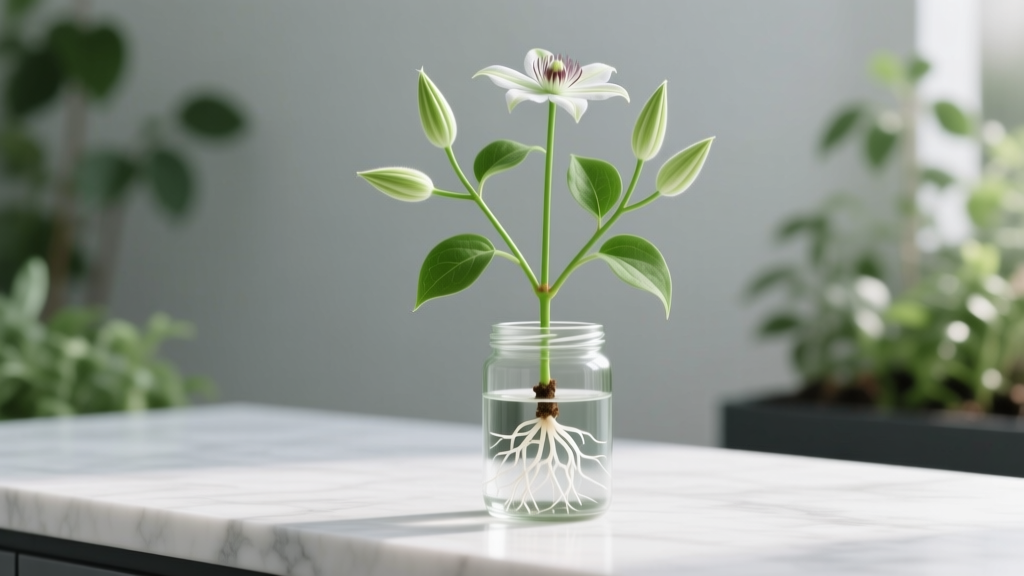
Propagating Clematis from Stem Cuttings
You buy one clematis, fall in love with it, and then realize the trellis looks lonely everywhere else. The next spring you go back to the nursery—only to find your cultivar is gone, replaced by something “similar.” That’s usually the moment home gardeners decide they’re going to make their own plants. The good news: clematis will propagate from stem cuttings reliably if you get the timing and moisture right. The bad news: they punish sloppy humidity control. Let’s walk through the method I use when I want a high strike rate without fancy equipment.
If you’ve tried before and ended up with limp cuttings, blackened stems, or cuttings that “just sat there” for months—those are solvable problems. Clematis isn’t hard, but it is specific: the cutting stage matters, the nodes matter, and so does your aftercare.
Best time to take clematis stem cuttings (timing matters)
For most garden clematis, the sweet spot is late spring through mid-summer when stems are softwood to semi-ripe. In many climates that’s roughly May through July. Too soft and they collapse; too woody and they root slowly (or not at all).
- Softwood cuttings: tender new growth, usually late spring; fastest rooting but highest wilting risk.
- Semi-ripe cuttings: partially firmed stems, early to mid-summer; often the best balance.
- Hardwood cuttings: late fall/winter; possible for some shrubs, but clematis is typically less cooperative by this route for home gardeners.
Many extension services recommend softwood/semi-ripe cuttings under mist or high humidity. North Carolina State Extension notes clematis among plants suited to softwood propagation, emphasizing humidity management for success (NC State Extension, 2023).
What you’ll need (keep it simple, but don’t skip sanitation)
You don’t need a greenhouse. You do need clean tools and a way to keep humidity high without soaking the stems.
- Sharp pruners or a clean knife
- Isopropyl alcohol (70%) or a 10% bleach solution for tool sanitation
- Small pots (3–4 inch) or a propagation tray with cells
- Clear humidity dome, large zip-top bag, or a clear plastic storage bin
- Propagation medium (details below)
- Rooting hormone (optional but helpful; IBA powder or gel)
- Plant labels (you’ll forget which is which—everyone does)
Sanitize pruners between plants. Clematis can carry fungal issues, and you don’t want to spread trouble into a tray of tender cuttings.
Step-by-step: taking and sticking clematis cuttings
This is the exact sequence I use. It’s quick, and it prevents your cuttings from drying out while you “get the next one.”
- Water the mother plant the night before. A well-hydrated vine gives you sturdier cuttings.
- Cut in the cool part of the day (morning is best). Bring a damp paper towel or a zip bag so cuttings don’t wilt in your hand.
- Select a non-flowering shoot if possible. Flowering stems spend energy on buds instead of roots.
- Cut a section 3–5 inches (8–13 cm) long with at least 2 nodes.
- Make the lower cut just below a node. Nodes are where rooting hormones naturally concentrate.
- Remove the lower leaves and keep one set of leaves at the top. If leaves are large, cut them in half to reduce moisture loss.
- Dip the base in rooting hormone (tap off excess powder).
- Stick the cutting so at least one node is buried in the medium. Firm gently.
- Water in to settle the medium, then drain well.
- Cover with a humidity dome or bag and place in bright, indirect light.
“The two big killers of softwood cuttings are dehydration and disease. High humidity helps the first, but sanitation and air exchange prevent the second.” — American Horticultural Society propagation guidance (2022)
Propagation medium: soil vs soilless mixes (what actually works)
Regular potting soil is usually too water-retentive for clematis cuttings. You want a medium that stays lightly moist but drains fast and holds air.
Here’s a practical comparison using mixes I’ve tested repeatedly in home conditions:
| Medium | Drainage/Air | Moisture holding | Rot risk | Typical rooting time* |
|---|---|---|---|---|
| 50% perlite + 50% peat/coir | High | Medium | Low–Medium | 4–8 weeks |
| 100% perlite | Very high | Low | Low | 5–9 weeks |
| Seed-starting mix (fine soilless) | Medium | Medium–High | Medium | 5–10 weeks |
| All-purpose potting soil | Low–Medium | High | High | Often fails / slow |
*Rooting time varies with cultivar, temperature, and cutting maturity.
If you want my default: 50/50 perlite and coir (or peat if that’s what you have). It’s forgiving, drains well, and doesn’t collapse around the stem.
Light: bright shade beats sun for cuttings
Cuttings don’t have roots yet, so they can’t replace water lost through the leaves. Put them in bright, indirect light, not full sun. A north-facing porch, bright windowsill (not baking), or under LED grow lights works well.
- Target light: bright enough to read a newspaper comfortably, but no direct midday sun.
- Grow light option: 12–16 hours/day, lights 8–12 inches above the dome (adjust so leaves don’t overheat).
Temperature and humidity: the quiet difference between success and mush
Rooting speeds up with warmth, but heat without ventilation breeds fungus. Aim for:
- Air temperature: 65–75°F (18–24°C)
- Medium temperature: about 70°F (21°C) if possible
- Humidity: high (often 80–95% under a dome), but with brief daily air exchange
If your house runs cool, a simple seedling heat mat on low can help. If you use one, check that the medium stays only slightly warm—overheated trays can turn a cutting to compost in a hurry.
Watering: how to keep cuttings moist without inviting rot
For clematis cuttings, watering isn’t “every day” or “once a week.” It’s “as needed,” based on the medium and the dome.
Right after sticking
- Water thoroughly until it drains.
- Let it drip out—don’t leave pots sitting in water.
During rooting (weeks 1–8)
- Check moisture every 2–3 days. Under a dome you may barely water at all.
- If the surface looks dry, water lightly around the edge of the pot (avoid splashing the stem).
- Condensation inside the dome is a clue you’re holding humidity. If it’s dripping constantly and stems look dark, you need more airflow.
A practical rule: the medium should feel like a wrung-out sponge—moist, not soggy.
Feeding: when (and when not) to fertilize
Don’t fertilize fresh cuttings. Fertilizer salts can burn tender tissue and encourage soft, weak growth before roots exist.
- Weeks 0–4: no fertilizer
- After roots form (usually 4–8 weeks): start a half-strength liquid feed (for example, 1/2 rate of a balanced 10-10-10 or similar) every 10–14 days
Once cuttings are potted up and actively growing, you can transition to normal feeding appropriate for clematis in your garden.
How to tell when clematis cuttings have rooted
The biggest mistake is tugging too early. Clematis can sit quietly, looking “unchanged,” while it builds roots.
- Time window: commonly 4–10 weeks, depending on conditions and cultivar.
- Signs: fresh new leaf growth, improved turgor (stays perky), and gentle resistance when you nudge the stem.
- Best test: wait for visible new growth, then lightly tip the pot and look for white roots at drainage holes.
Potting up and hardening off (don’t rush the transition)
Once roots are established, your job shifts from “prevent wilting” to “build a sturdy young plant.”
- Vent the dome for 2–3 days (open a little more each day).
- Remove the dome once cuttings don’t wilt in normal room humidity.
- Pot up into a 1-quart pot using a quality potting mix amended with extra perlite (about 20–30% perlite added is helpful).
- Water in and keep in bright shade for 7–10 days.
- Move gradually toward more light, avoiding hot afternoon sun for the first couple of weeks.
If you’re planning to plant outside, wait until the young plant has filled the pot with roots and is growing strongly—often 8–12 weeks after potting up. In cold-winter climates, it’s sometimes smarter to overwinter the young plant in a protected spot and plant out the following spring.
Common problems (and what to do instead of guessing)
When clematis cuttings fail, they usually fail in predictable ways. Match the symptom to the fix.
Symptom: cuttings wilt within 24–48 hours
- Likely causes: too much light/heat, low humidity, cutting too soft, too many leaves left on.
- Fix: move to bright shade; seal in a dome/bag; reduce leaf area by half; take slightly firmer (semi-ripe) cuttings next round.
- Useful number: keep them in 65–75°F air, not on a sun-baked windowsill.
Symptom: stems turn black at the soil line; cutting collapses (rot)
- Likely causes: medium too wet, poor airflow, dirty tools, potting soil too heavy.
- Fix: switch to a faster-draining mix (like 50/50 perlite and coir); vent daily for 5 minutes; remove any rotting cuttings immediately.
- Prevention: sanitize tools; don’t let pots sit in water.
Symptom: cutting stays green but does nothing for 2–3 months
- Likely causes: cutting too woody, temperatures too cool, low light, or a slow-rooting cultivar.
- Fix: provide steadier warmth (aim for 70°F medium temp); ensure bright indirect light; be patient up to 10–12 weeks before you give up.
Symptom: white fuzzy growth on medium or leaves (mold)
- Likely causes: stagnant humid air, decaying leaf matter, medium too wet.
- Fix: remove dead material; increase airflow (prop the dome open slightly); water less frequently; consider a fresh, clean medium.
Three real-world scenarios (and how to handle each)
Scenario 1: You only have one prized vine and you can’t afford to lose it
If you’re propagating a rare cultivar or one with sentimental value, take more cuttings than you think you need, but don’t strip the plant bare. A good rule is to take no more than 10–15% of the vine’s soft growth at one time. Choose healthy, non-flowering shoots, and spread your risk:
- Stick half your cuttings in 50/50 perlite-coir.
- Stick the other half in straight perlite (especially if your environment runs humid and you’ve had rot before).
This isn’t overkill; it’s insurance.
Scenario 2: Hot, dry summer air keeps frying your cuttings
If your summer humidity is low and your patio hits 85–95°F (29–35°C), cuttings can wilt even under shade. Move propagation indoors where temperatures are steadier, or create a cooler microclimate:
- Place the dome in a bright room away from heat vents.
- Use a double layer of protection: pot inside a tray, tray inside a clear bin with the lid loosely set.
- Keep them out of direct sun—humidity domes can overheat fast.
Scenario 3: You’re seeing rot every time, even though you “barely water”
This is common when the medium is too dense or the dome never gets vented. Even if you don’t water much, a peat-heavy or potting-soil mix can hold a wet pocket around the node. Try this reset:
- Discard the old medium and wash pots.
- Switch to at least 50% perlite (more if your area is humid).
- Bury only one node—don’t sink the cutting deep.
- Vent daily and wipe heavy condensation off the lid if it’s dripping.
Method comparison: stem cuttings vs layering (which is better for you?)
Stem cuttings are faster and produce more plants at once, but layering is often more forgiving because the stem stays attached to the mother plant while it roots.
| Method | Speed to rooted plant | Equipment needed | Failure risk | How many plants at once? |
|---|---|---|---|---|
| Stem cuttings (softwood/semi-ripe) | Typically 4–10 weeks | Medium + dome/bag | Medium (wilting/rot) | Many (10+ from a vigorous vine) |
| Simple layering (pin a stem to soil) | Often 8–16+ weeks | Pin/stone + soil | Low | Few (limited by stem length) |
If you’re the kind of gardener who forgets to vent a dome or check moisture, layering may fit your style better. If you want a batch of plants for a fence line, cuttings are the way to go—just commit to checking them regularly.
Common clematis pest and disease issues during propagation
Fungus gnats
They show up when the medium stays too wet. Let the surface dry slightly between waterings, use a grittier mix, and consider yellow sticky traps near the tray. Gnats don’t usually kill cuttings outright, but larvae can damage tender bases.
Botrytis (gray mold)
Often appears as fuzzy gray growth on dying leaf tissue under high humidity. Remove affected leaves, increase airflow, and avoid wetting foliage. University of Minnesota Extension notes botrytis is encouraged by prolonged moisture on plant surfaces and poor air circulation (University of Minnesota Extension, 2021).
Clematis wilt (on mature plants)
This is more a garden problem than a propagation-tray problem, but it matters: don’t take cuttings from a vine currently showing sudden collapse of stems or blackened lesions. Start with vigorous, healthy material only.
Small habits that noticeably improve success rates
- Label immediately (cultivar + date). If you take cuttings on June 10, write it down.
- Make a clean lower cut—crushed stems rot faster.
- Don’t overcrowd trays. Leaves pressed together stay wet and moldy.
- Vent daily even if everything looks fine.
- Be consistent: steady conditions beat “perfect” conditions you only provide once a week.
Once you’ve rooted your first batch, you’ll see why gardeners get hooked: a single vine can turn into a whole run of clematis for gates, arbors, mailboxes, and shared divisions for neighbors. And when your favorite cultivar disappears from the retail racks, you won’t be stuck hunting—you’ll already have your own young plants, ready to climb.
Sources: NC State Extension, softwood cutting propagation guidance (2023); American Horticultural Society propagation guidance (2022); University of Minnesota Extension, Botrytis management notes (2021).