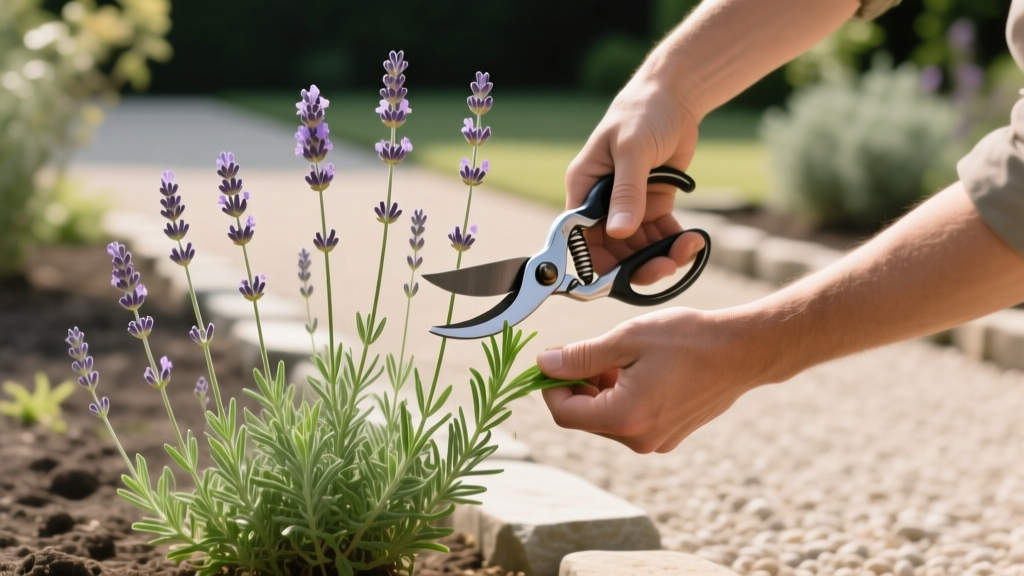
How to Prune Lavender Without Damaging Them
You step outside in spring, look at your lavender, and your stomach drops: half the plant is woody and bare, the other half is a mop of floppy green growth. Last year you “gave it a haircut,” and it never really bounced back. Or maybe you were afraid to touch it at all—so now it’s split open like a doughnut, with flowers only on the rim. Lavender is tough, but pruning is where it gets surprisingly picky: cut at the wrong time or into the wrong wood, and you can stall growth for a season (or lose the plant entirely).
I’ve pruned hundreds of lavenders in home gardens, from tidy border hedges to sprawling hillside plants. The plants that thrive long-term aren’t the ones left alone—they’re the ones pruned with a steady hand, on the right schedule, and with an eye for where lavender can (and can’t) re-sprout.
Before You Cut: What Lavender Will (and Won’t) Regrow From
Lavender (especially English lavender, Lavandula angustifolia, and lavandins, L. x intermedia) behaves like a small woody shrub. It produces new shoots readily from green, leafy growth, but it often struggles to push new growth from old, leafless wood. That’s the entire trick: prune to encourage branching while keeping enough green growth on the plant to fuel regrowth.
“Avoid cutting into old wood that has no leaves, as lavender may not regrow from those bare stems.” — Royal Horticultural Society advice on lavender pruning (RHS, 2023)
One more key point that trips people up: lavenders are short-lived if they get woody and split. Pruning doesn’t just make them prettier—it’s what keeps them producing new stems, staying dense, and resisting wind damage.
Tools and Prep: Make Every Cut Count
Lavender doesn’t need fancy tools, but it does need clean, sharp ones. Ragged cuts slow healing and invite dieback.
- Hand pruners for individual stems and shaping small plants.
- Shears for larger mounds or hedges (best for a quick, even “haircut”).
- Disinfectant (70% isopropyl alcohol) if you’re moving between plants with visible disease.
If your lavender is wet from rain or irrigation, wait until it’s dry. Wet foliage plus fresh cuts can increase the odds of fungal trouble—especially in humid climates.
Pruning Timing: Two Reliable Windows (and One to Avoid)
The cleanest results come from a simple rhythm: prune once lightly after flowering, and once more decisively in early spring (or choose one main prune depending on your climate).
1) After flowering (summer prune)
After the main flush of blooms fades, prune within 2–4 weeks. This is usually July–August in cooler climates and can be earlier in warmer zones. Your goal is to remove spent flower stems and a bit of leafy growth to prompt branching.
2) Early spring (structural prune)
In early spring—when you see fresh green shoots starting but before the plant gets leggy—do your main shaping. In many gardens, that’s when nights are mostly above 28–32°F (-2 to 0°C) and the plant is clearly waking up. Spring pruning is especially helpful if you skipped the summer prune.
What to avoid: late fall hard pruning
A hard prune in late fall can leave tender new growth exposed to cold and wet. If you live where winters are damp or temperatures dip below 20°F (-6°C), fall pruning is one of the fastest ways to lose plants to rot and dieback.
These timing principles line up with extension and botanic garden guidance that emphasizes pruning after flowering and avoiding cuts into old wood. For example, the University of Vermont Extension notes lavender’s need for sharp drainage and careful pruning practices to maintain vigor (University of Vermont Extension, 2020). The Royal Horticultural Society similarly recommends pruning to prevent woodiness while avoiding leafless old stems (RHS, 2023).
The No-Damage Method: Step-by-Step Pruning You Can Trust
This is the method I use when I’m trying to keep lavender alive for years, not just make it look good for a month.
Step 1: Find the “green line”
Look closely at stems. You’ll see a transition from leafy green growth to woody brown stems. Your safest cuts are made above that woody section, leaving green leaves below the cut.
- If a stem has no leaves on the lower section, don’t cut below the last leafy point.
- If the plant has leaves close to the base, you can prune lower.
Step 2: Remove spent flower stems
Cut the flower stems down to just above a set of leaves. On many lavenders, that’s 1–3 inches below the flower stalks, but it varies by variety and how long the stems are.
Step 3: Shape the plant into a dome
A rounded “mound” sheds water better than a flat top. That matters because lavender hates winter wet. Aim for a gentle dome, not a box.
Step 4: Don’t take too much at once
As a rule of thumb:
- Summer prune: remove about 10–20% of the plant (mostly flower stems + light shaping).
- Spring prune: you can remove about 20–30% if the plant is healthy and leafy.
Step 5: Clean up the center
If the plant is dense, thin a few stems to improve airflow. This helps in humid regions where fungal problems show up first in the shaded interior.
Method A vs Method B: Shears or Hand Pruners?
Both work, but they’re not equal in every situation. Here’s a practical comparison based on real garden outcomes: speed, precision, and the risk of accidentally cutting into old wood.
| Pruning Method | Best For | Typical Time for 1 Mature Plant | Cut Precision | Risk of Cutting into Leafless Wood |
|---|---|---|---|---|
| Method A: Hand pruners (selective cuts) | Leggy plants, small specimens, rehabilitation, flowering display gardens | 8–15 minutes | High | Low (you can choose each cut) |
| Method B: Shears (even “haircut”) | Lavender hedges, large mounds, quick post-bloom shaping | 2–5 minutes | Medium | Medium–High (easy to go too low) |
My take: use shears when the plant is already dense and healthy, and you’re staying well above the woody base. Use hand pruners for any lavender that’s gappy, old, or uneven—because precision is what prevents damage.
Watering: The Hidden Partner to Good Pruning
Pruning stress and watering mistakes often show up together. Lavender wants deep, infrequent watering—especially once established.
New plants (first growing season)
- Water deeply once per week for the first 4–6 weeks if there’s no rain.
- After that, taper to every 10–14 days depending on heat and soil drainage.
Established plants
- In average garden soils with good drainage: water every 2–4 weeks during dry spells.
- In containers: expect to water more often, sometimes every 5–10 days in summer, because pots dry faster.
After pruning: don’t “pamper” with extra water. Overwatering after cutting is one of the quickest routes to root trouble. If the soil is already moist, skip irrigation.
Soil: Pruning Won’t Fix Roots Sitting in Wet Feet
If your lavender repeatedly dies back after pruning, look at the soil first. Lavender is a Mediterranean plant: it wants drainage more than richness.
- Ideal soil texture: sandy or gravelly loam.
- Ideal pH: roughly 6.5–7.5.
- Drainage test: if a planting hole holds water longer than 2 hours, fix drainage or plant elsewhere.
Heavy clay? Don’t fight it with a tiny amendment in the planting hole—that can create a “bathtub effect.” Instead:
- Plant on a mound raised 6–12 inches, or
- Use a raised bed with gritty mineral soil, or
- Grow lavender in a container with a fast-draining mix.
Light: The Difference Between a Tight Mound and a Floppy Mess
Lavender needs sun—real sun. When it gets less than it wants, it stretches, flops, and becomes harder to prune without exposing bare wood.
- Minimum: 6 hours of direct sun.
- Best flowering and structure: 8+ hours.
Scenario I see constantly: lavender planted near a fence or shrub line. It gets sun on top, shade on the sides, and the shaded stems go bare. The fix isn’t just pruning—it’s moving the plant or opening up the light.
Feeding: Less Is More (And Too Much Makes Pruning Harder)
Fertilizer pushes soft, sappy growth that flops and is more susceptible to winter damage. Lavender performs best lean.
- If your soil is decent, you can often skip fertilizer entirely.
- If growth is weak, top-dress in spring with 1–2 cups of compost around (not on) the root zone for a mature plant.
- Avoid high-nitrogen lawn fertilizers anywhere near lavender.
If you’re using a granular fertilizer, choose something mild (for example, 5-5-5 or similar) and apply at half the label rate once in spring—then stop. Strong feeding makes lavender grow fast and lanky, which forces you into heavier pruning later.
Common Problems That Get Blamed on Pruning (But Usually Aren’t)
When lavender declines after pruning, pruning gets the blame. Sometimes it’s the cause—but often it’s just the moment the underlying issue becomes obvious.
Root rot (the #1 silent killer)
- Symptoms: gray-green droop, blackened stems at the base, sudden collapse even when soil is wet.
- Fix: improve drainage immediately; replant in a mound or container; water less frequently.
Winter dieback from wet + cold
- Symptoms: stems brown out after winter, plant resprouts unevenly (if at all).
- Fix: keep plants domed; avoid late fall hard pruning; ensure crown isn’t buried in mulch.
Split, hollow centers
- Symptoms: plant opens in the middle, flops outward, flowers only on the edges.
- Fix: regular annual pruning; avoid top-heavy growth from excess fertilizer; consider replacing very old plants.
Troubleshooting: Symptoms and Specific Fixes
Here are the real-world “what now?” moments I hear most often, with practical responses.
Symptom: “I pruned and it turned brown where I cut.”
- Likely cause: cuts made into older wood with no leaves below the cut, or pruning followed by wet/cold conditions.
- What to do:
- Wait 2–3 weeks in spring to see if any buds break below the cut.
- Trim back only clearly dead tips (snap-test: dead stems snap cleanly; live stems flex).
- Check soil drainage and reduce watering.
Symptom: “My lavender is huge and woody at the base—can I cut it back hard?”
- Likely situation: mature lavender (often 4–8+ years) with a woody frame.
- What to do (safer rehab):
- In early spring, reduce height by 20%, staying above leafy growth.
- After flowering, do a second light prune (10–15%) to encourage branching.
- Repeat for 2 seasons. If it won’t push new growth low on the plant, replace it.
Symptom: “It flowers, but it’s floppy and splits open.”
- Likely cause: insufficient sun, too much nitrogen, or skipped pruning.
- What to do:
- Make sure it gets 8 hours of sun if possible (or move it).
- Stop fertilizing for a season; don’t let lawn feed drift into the bed.
- Prune into a dome twice yearly (light summer prune + spring shaping).
Symptom: “New growth looks fine, but the plant dies from the bottom up.”
- Likely cause: crown staying wet (mulch piled against base, clay soil, frequent irrigation).
- What to do:
- Pull mulch back 3–4 inches from the crown.
- Water at the outer root zone, not at the stem base.
- Improve drainage or replant on a mound 6–12 inches high.
Three Real-World Pruning Scenarios (and What Works)
Scenario 1: Lavender hedge along a walkway
You want a clean edge and reliable blooms. This is where shears shine—but only if you keep the “green line” rule in mind. After flowering, shear off spent blooms and a light layer of foliage (think 1–2 inches on a healthy hedge). In early spring, go back and shape into a gentle dome so rain sheds off the top. If you shear too low one year and expose bare wood, switch to hand pruners the next season to selectively rebuild density.
Scenario 2: A single, old plant that’s sentimental (and scary to touch)
Old lavender can be priceless in the garden—bees love it, and it can perfume the whole yard. But if it’s mostly woody, a hard cut can finish it. Use the two-season rehab: small reductions (20% in spring, 10–15% after bloom), excellent drainage, and zero fertilizer. If it still won’t leaf out low, take cuttings in summer and start a replacement while you still have the original.
Scenario 3: Container lavender on a hot patio
Container lavender often looks great—until midsummer, when it dries out fast and gets crispy. Here pruning damage is usually drought stress showing up after cutting. Don’t prune on the hottest week of the year. Prune right after flowering, then water deeply and let the pot drain completely. Make sure the container has unobstructed drainage holes; if water sits in a saucer for more than 30 minutes, dump it. A pot that stays soggy overnight is a root-rot setup.
Common Pruning Mistakes I’d Stop You From Making
- Cutting into leafless old wood because you want the plant smaller fast.
- Pruning late in fall and triggering tender growth before winter.
- Flattening the top like a boxwood (water sits, crown stays wetter).
- Overwatering after pruning out of guilt—lavender hates that.
- Feeding heavily to “help it recover,” which causes flop and winter damage.
A Practical Seasonal Checklist (What I Do Each Year)
If you like a simple routine you can repeat without overthinking, this is it:
- Early spring: prune for shape and density, removing up to 20–30%, always leaving green leaves below cuts.
- After flowering: deadhead and lightly shape (about 10–20%), keeping a rounded mound.
- All season: water deeply but infrequently; no routine fertilizer.
- Before winter: don’t hard prune; keep the crown dry and uncovered by heavy mulch.
When you keep lavender in full sun, fast-draining soil, and a simple pruning rhythm, it stops being a temperamental shrub and becomes what it should be: a reliable, long-blooming plant that gets better each year. And if you ever feel unsure, remember the one rule that prevents most damage—make your cuts where you can still see green life below them.
Sources: Royal Horticultural Society (RHS), lavender pruning guidance (2023). University of Vermont Extension, lavender growing and care recommendations (2020).