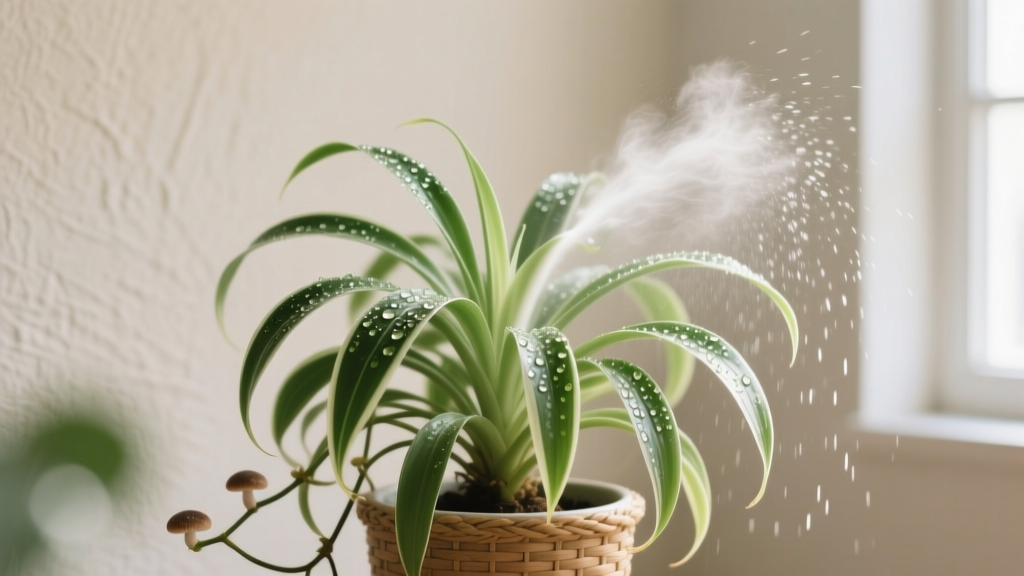
Milk Spray for Fungal Prevention on Spider Plants
The first time I saw it on a spider plant, I thought it was dust from a nearby shelf—until it came back two days after wiping the leaves. A faint, chalky haze on the leaf surface, especially where the leaves arch and overlap. Sometimes it’s true mildew; other times it’s mineral residue plus damp, stagnant air. Either way, it’s a signal: conditions are leaning fungal, and your plant is quietly telling you it’s time to adjust care.
Milk spray is one of those old-school remedies that sounds odd until you’ve seen it work. Used correctly, it can suppress fungal spores on leaf surfaces, and it’s gentle enough for most houseplants. Used incorrectly, it can leave a smell, a film, or even invite more trouble. This guide walks you through how to use milk spray specifically on spider plants (Chlorophytum comosum), and—equally important—how to fix the indoor conditions that cause fungus to show up in the first place.
When spider plants get fungal problems (and when they don’t)
Spider plants aren’t usually “fungus magnets,” but they do have two traits that can make fungal issues more likely indoors: lots of narrow, arching leaves that hold moisture in the crown, and a tendency to be overwatered because they look thirsty when the tips brown.
Here’s what I actually see in real homes:
- Powdery mildew look-alike: Pale dusty patches on leaf surfaces, often after cool nights and poor airflow.
- Leaf spot fungi: Small tan/brown spots with yellow halos that slowly expand.
- Crown and root rot (fungal/oomycete): Soft base, sour smell, limp leaves—usually from staying wet too long.
Milk sprays are mainly helpful for surface fungi (powdery mildew and some leaf-spot pressure). They do not “cure” rot in the pot. If the plant is rotting, the fix is drainage, drying, and sometimes repotting.
How milk spray works (in plain language)
Milk contains proteins and salts that can create a leaf-surface environment that’s unfriendly to certain fungi. Research has repeatedly shown milk sprays can reduce powdery mildew severity on some crops. The effect is strongest when applications start early and are repeated consistently.
“Milk solutions have been shown to reduce powdery mildew incidence when applied regularly, and are most effective when used preventatively rather than after heavy infection.” — University of California Agriculture & Natural Resources, Integrated Pest Management guidance (2014)
Another well-known reference for home gardeners is Cornell’s powdery mildew guidance, which includes milk as a documented, lower-toxicity option. Cornell University’s plant disease resources emphasize early action and repeated sprays for best results (Cornell Cooperative Extension, 2020).
Citations: University of California Agriculture & Natural Resources IPM (2014); Cornell Cooperative Extension powdery mildew resources (2020).
Mixing milk spray for spider plants (ratios, timing, and how to apply)
If you take nothing else from this article, take this: keep the mix mild, apply it in good light (but not hot sun), and don’t soak the potting mix.
Best milk ratio for spider plants
For spider plants indoors, I’ve had the most consistent results with a 1:9 dilution:
- 1 part milk (any cow’s milk; low-fat reduces residue)
- 9 parts water
That’s roughly:
- 100 mL milk + 900 mL water (makes 1 liter)
- Or 1 tablespoon milk + 9 tablespoons water (small batch)
If you’re dealing with visible powdery patches and want a slightly stronger mix, you can try 1:4 (20% milk), but indoors it’s more likely to leave a film or a “dairy” smell if airflow is poor. Start at 10% first.
Application timing (this matters more than people think)
- Spray in the morning so leaves dry before evening.
- Aim for a room temperature of 18–24°C (65–75°F) while drying.
- Keep the plant out of harsh direct sun for 4–6 hours after spraying to avoid leaf scorch on wet foliage.
Repeat frequency:
- Preventative: once every 10–14 days during humid seasons or when airflow is poor.
- Active early infection: once every 5–7 days for 3 applications, then reassess.
Step-by-step: applying milk spray without making a mess
- Move the spider plant to a sink, shower, or bathtub.
- Dust leaves first with a dry microfiber cloth (fungus loves dusty leaves).
- Mix fresh solution in a clean spray bottle. Don’t store it for weeks—make what you’ll use in a day.
- Spray top and underside of leaves until lightly coated, not dripping.
- Avoid spraying the crown heavily and avoid saturating the potting mix.
- Let the plant drip-dry with good airflow for 30–60 minutes.
Pro tip: If you’re sensitive to smells, use skim or 1% milk, and set a small fan across the room for 1–2 hours after spraying. Air movement is half the battle.
A comparison: milk spray vs other common options (with real numbers)
Milk is not the only tool. Sometimes it’s the best fit (especially for gentle, preventive care). Sometimes you’re better off changing the environment or using a different spray.
| Method | Typical Mix Rate | Repeat Interval | Best For | Main Risk Indoors |
|---|---|---|---|---|
| Milk spray | 10% (1:9) to 20% (1:4) | Every 5–14 days | Powdery mildew prevention/early pressure | Residue/odor if airflow is poor |
| Neem oil spray | 5 mL neem + 1 mL soap per 1 L water (varies by label) | Every 7–10 days | Fungus pressure + some pests | Leaf spotting if too strong; smell; oil buildup |
| Baking soda spray | 5 mL (1 tsp) baking soda per 1 L water + a drop of soap | Every 7 days | Surface fungal suppression | Salt stress/leaf burn; residue |
| Environmental fix (airflow + drying) | Fan 1–2 hours/day; spacing leaves; avoid wet foliage at night | Daily habits | Root cause prevention | None—this is the foundation |
My take after years of indoor troubleshooting: if you only choose one “treatment,” choose environmental fixes. Use milk spray as a helper when conditions have been slightly off and you want to keep spores from gaining traction.
Watering: the #1 lever for fungal prevention
Overwatering doesn’t just rot roots—it raises humidity at the soil surface and keeps the crown damp. Spider plants like a rhythm: thorough watering, then partial drying.
How often to water (practical rule)
- Water when the top 2–5 cm (1–2 inches) of mix is dry.
- In a typical home, that’s often every 7–14 days, but temperature and pot size matter more than the calendar.
When you water, water fully:
- Use room-temperature water (around 20°C / 68°F).
- Water until you get 10–20% runoff from the drainage holes.
- Empty the saucer within 10 minutes.
Three real-world watering scenarios (and what I do)
Scenario 1: The plant is in a low-light corner and “never dries out.”
Solution: Move it closer to a bright window or add a grow light, and downsize watering volume. Low light slows water use—fungus loves that.
Scenario 2: You water lightly “so it won’t rot,” but fungus still appears.
Solution: Light sips create a constantly damp top layer. Instead, water thoroughly, then let it dry to the 1–2 inch depth before watering again.
Scenario 3: You mist daily because you heard spider plants love humidity.
Solution: Stop misting. If you want humidity, use a room humidifier and aim for 40–55% RH. Wet leaves + still air is a mildew invitation.
Soil and pot setup: drainage is a fungal “off switch”
Spider plants don’t need fancy soil, but they do need air around roots. If you’re fighting fungal issues repeatedly, I’d look at the potting mix before I’d keep spraying anything.
A reliable spider plant mix
- 2 parts quality indoor potting mix
- 1 part perlite or pumice
- Optional: 10% fine orchid bark for extra structure
Use a pot with drainage holes. If you have a decorative cachepot, keep the plant in a nursery pot inside it and never let water pool in the bottom.
When to repot to prevent fungus
- Repot every 18–24 months if growth is strong.
- Repot sooner if the mix stays wet longer than 10 days in moderate light, or if you smell sour/composty odors.
Light: bright enough to dry leaves, gentle enough to avoid scorch
Spider plants tolerate lower light, but fungal issues are more common when the plant is underlit and stays damp longer. Aim for bright, indirect light.
- Best placement: near an east or north window, or a few feet back from a bright south/west window.
- If using a grow light: keep it about 30–45 cm (12–18 inches) above the foliage for many common LED panels, and run it 10–12 hours per day.
Good light also helps milk spray dry quickly—which is where a lot of people go wrong. A wet, dim corner turns “treatment” into “fermentation.”
Feeding: don’t push soft growth that fungi love
Spider plants aren’t heavy feeders. Overfertilizing creates soft, tender growth that’s more prone to spotting and stress, and fertilizer salts can mimic fungal residue.
- Feed during active growth (spring through early fall) every 4–6 weeks.
- Use a balanced liquid fertilizer at 1/4 to 1/2 the label rate.
- Flush the pot with plain water every 8–12 weeks to reduce salt buildup (water thoroughly until you get generous runoff).
If your “fungus” wipes off and comes back as a white crust near the tips or edges, check your water and fertilizer salts first. Hard water leaves mineral deposits that can look suspiciously like mildew.
Common problems that get mistaken for fungus
Before you spray anything, make sure you’re treating the right issue. Spider plants are famous for a few problems that masquerade as disease.
White film that looks like powder
- Could be: Hard-water minerals or fertilizer salts
- Quick test: Wipe with a damp cloth. If it dissolves cleanly and feels gritty, suspect minerals.
- Fix: Switch to filtered water for a month, flush the pot, and stop foliar spraying.
Brown tips
- Could be: Low humidity, salt buildup, inconsistent watering—not fungus
- Fix: Keep watering consistent, flush salts every 2–3 months, and aim for 40–55% RH.
Brown spots with yellow halos
- Could be: Leaf spot (fungal/bacterial), or sun scorch
- Fix: Remove the worst leaves, improve airflow, keep leaves dry at night, and consider milk spray as a preventive if spotting is mild.
Troubleshooting milk spray on spider plants (symptoms & fixes)
Milk is forgiving, but indoor conditions magnify small mistakes. Here’s how I troubleshoot when people tell me milk “didn’t work” or “made it worse.”
Symptom: Leaves feel sticky or look glossy, dust clings to them
- Cause: Mix too strong (20%+) or oversprayed; not enough airflow
- Fix: Wipe leaves with a damp cloth, then switch to 10% (1:9). Spray lighter—just a fine coat.
Symptom: Sour milk smell after 24 hours
- Cause: Leaves stayed wet too long; cool, still room
- Fix: Improve airflow (fan across the room), increase light, and only spray in the morning. Keep room around 18–24°C while drying.
Symptom: New spots appear even after spraying
- Cause: You’re seeing new infections because the environment is still favorable, or it’s not fungus (could be salts or sun)
- Fix: Stop misting, water less often, space plants so leaves don’t press together, and remove affected leaves. Milk is support—not a substitute for airflow and drying.
Symptom: Leaf edges look scorched a day after spraying
- Cause: Sprayed then placed in hot direct sun, or solution dried too slowly then concentrated
- Fix: Keep out of direct sun for 4–6 hours post-spray; use bright indirect light and a lighter coat.
Three case-style scenarios (what I’d do at your house)
Case 1: Bathroom spider plant with beautiful growth… and recurring mildew haze.
Bathrooms are humid and often poorly ventilated. I’d run the exhaust fan for 20 minutes after showers, stop any leaf misting, and make sure the plant isn’t tucked into a corner. Then I’d use a 10% milk spray every 10 days for a month as prevention. If the haze wipes off gritty, I’d suspect mineral residue from misting with hard water rather than mildew.
Case 2: Office spider plant under fluorescent lights, watered “every Friday,” getting brown spots.
Weekly watering schedules are a classic overwatering trap. I’d switch to watering only when the top 2–5 cm are dry, and I’d check that the pot drains freely. Milk spray might help if spots are fungal, but first I’d stop wetting leaves and improve light exposure (even moving it 1 meter closer to a window can change drying time dramatically).
Case 3: Hanging spider plant in a kitchen window, fine white powder shows up after a cold snap.
Cool nights plus daytime warmth can trigger powdery mildew pressure. I’d avoid spraying late in the day, keep the leaves dry overnight, and use milk at 10% every 7 days for three rounds. I’d also make sure the plant isn’t pressed against cold glass (cold stress weakens leaf tissue and invites problems).
Extra prevention habits that actually move the needle
- Prune for airflow: Remove the oldest, most crowded leaves at the base. Don’t be shy—taking 10–20% of foliage can improve drying.
- Sanitize tools: Wipe scissors with 70% isopropyl alcohol before and after trimming spotted leaves.
- Quarantine new plants: Keep new houseplants separate for 14 days. Fungal spores and pests often hitchhike together.
- Bottom-water occasionally (carefully): If you tend to splash leaves, bottom-water for 15 minutes, then drain completely. Don’t leave the pot soaking for hours.
When milk spray isn’t the right tool
If your spider plant has a soft, collapsing crown; blackened bases; or a persistent swampy smell, skip the milk. That’s a root/crown rot situation. The right move is to:
- Unpot the plant and inspect roots.
- Trim mushy roots and remove soggy soil.
- Repot into a fresh, airy mix and a pot with drainage.
- Water lightly once, then let it dry more than usual for the next 10–14 days.
Milk spray is for leaf-surface prevention and early pressure, not for rescuing a plant that’s drowning.
Used at a sane dilution, sprayed lightly, and paired with better airflow and smarter watering, milk spray can be a handy part of your spider plant routine—especially in humid rooms or during seasonal swings. If you make the plant’s leaves dry faster than fungi can settle in, you’ll find you need sprays less and less, and that’s the real win.