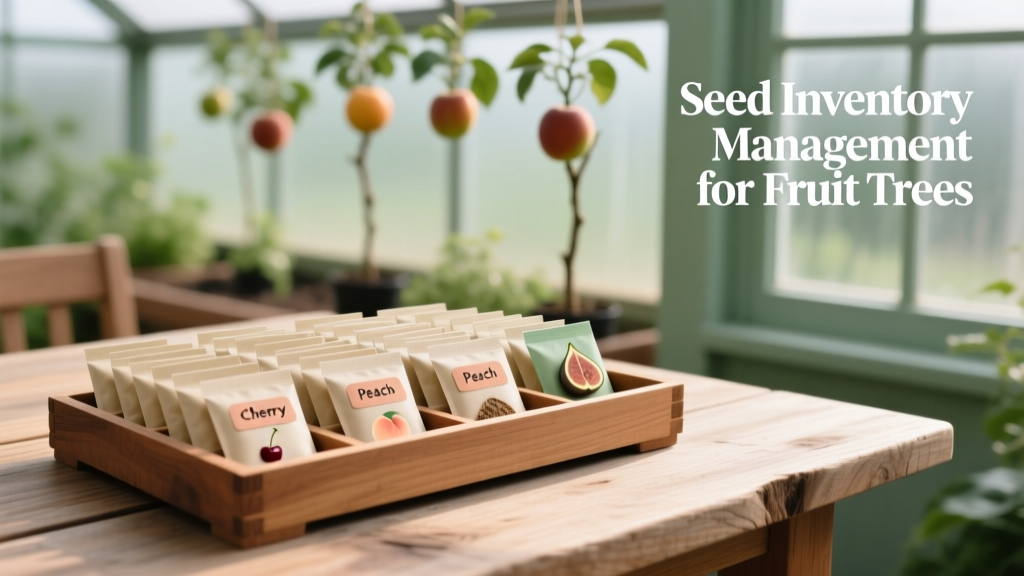
Seed Inventory Management for Fruit Trees
Every winter it happens: you find a shoebox of “apple seeds—good ones!” in the back of a drawer, and you honestly can’t remember if they’re from the crisp Honeycrisp you ate in October or the crabapple you grabbed off the sidewalk. You sow them anyway, wait weeks, and get… uneven germination, mystery seedlings, or nothing at all. The hard part isn’t planting seeds—it’s managing them like they matter, because they do. Fruit tree seeds are living embryos with a clock ticking, and your storage choices can easily cut germination in half.
Good seed inventory management is part gardening and part record-keeping. Done well, it gives you predictable germination, healthy rootstocks for grafting, and fewer wasted trays. Done poorly, it creates a yearly cycle of “I think these are peach?” and disappointment. This guide lays out a practical system you can run at home: collecting, cleaning, labeling, storing, stratifying, sowing, and troubleshooting—plus a few real-life scenarios so you can see how it works when life (and weather) get messy.
Set up a simple inventory system (before you collect a single seed)
Think of this as plant care for seeds: the “watering, soil, light, feeding” needs are different at each stage—storage vs. stratification vs. seedling growth—but the basics still apply. First, build a system that won’t collapse when you’re busy.
What to track (minimum fields that actually save you later)
- Species + parent source: “Malus domestica, seed from farmers market apple” or “Prunus persica, seed from backyard tree.”
- Collection date: Day/month/year.
- Prep steps: Cleaned? Dried? Treated for mold?
- Storage conditions: Room temp, fridge, freezer; plus container type.
- Stratification plan: Start date, target duration (e.g., 90 days), medium (moist sand/paper towel).
- Lot number: A simple code like “2026-AP-01” for apples collected in 2026.
- Viability notes: Float test results, germination percentage, any mold issues.
Label like you mean it
Use two labels every time: one inside the bag/jar and one outside. Ink fades; condensation smears. Pencil on a paper tag inside a zip bag has saved more seed lots than any fancy gadget I’ve tried.
- Assign a lot number immediately.
- Write it on the container and on an inner tag.
- Log it in a notebook or spreadsheet the same day (don’t “remember later”).
Collecting and cleaning fruit tree seeds (and avoiding the most common mistake)
The common mistake: storing seeds wet and dirty. Fruit pulp is sugar-rich and turns into a mold party in a sealed bag. Clean seeds are easier to store, stratify, and evaluate.
Collection timing and handling
- Collect at full ripeness whenever possible. Immature seeds have lower viability.
- Keep lots separate: Don’t mix “all the apples from October” if you want reliable results.
- Don’t bake them: Leaving seeds in a hot car can easily reach 40–50°C (104–122°F), which is a quiet germination killer.
Cleaning steps by fruit type
Use these quick methods:
- Apple/pear: Rinse seeds in a sieve, rub gently to remove clinging pulp, then surface-dry on a coffee filter for 24 hours at ~20°C (68°F).
- Peach/plum/apricot: Remove flesh, rinse pits, air-dry pits 2–3 days. Crack the pit only if you have experience; damaging the kernel is easy.
- Citrus: Plant fresh if you can. If storing, rinse thoroughly and store barely moist for short periods.
A note on “true to type” (important reality check)
Most fruit tree seeds won’t grow “true” to the named variety. Apples especially are genetically variable. Seed inventory management is still worth doing—because you’re often growing seedlings for rootstocks, breeding, or curiosity—but label your expectations too: “seedling apple (unknown genetics).”
Watering, soil, light, and feeding—at the seed stage vs seedling stage
Seeds don’t need fertilizer or light to sprout, but they do need the right moisture and temperature. Once they emerge, they behave like young fruit trees: they want consistent moisture, good drainage, strong light, and moderate feeding.
Watering: moisture targets that prevent rot and stalls
During stratification, aim for “wrung-out sponge” moisture. During germination and early seedling life, even moisture is key.
- Stratification medium: Moist, not wet. If you can squeeze water out, it’s too wet.
- Seedling trays: Water when the top 1–2 cm of mix is dry. Overwatering invites damping-off.
- Deep watering rule once potted: Water until 10–15% drains out the bottom, then don’t water again until the surface dries slightly.
Soil: what actually works for fruit tree seedlings
For sowing after stratification, use a sterile, well-draining mix. Garden soil indoors is asking for fungus gnats and disease.
- Starter mix recipe: 2 parts peat or coco coir, 1 part perlite, 1 part fine compost (optional). If you skip compost, start feeding earlier.
- Target pH: Most fruit tree seedlings do well around pH 6.0–7.0. Blueberries are the exception (they want acidic conditions).
- Sowing depth: A good rule is 2x the seed’s thickness. Apple seeds often do well around 6–10 mm deep.
Light: prevent lanky seedlings
Once sprouts emerge, give them strong light immediately.
- Windowsill: Often not enough in late winter. Rotate trays daily.
- Grow lights: 14–16 hours/day, lights kept about 10–20 cm above the seedlings (adjust so they don’t stretch or scorch).
Feeding: gentle, timed nutrition
Seedlings don’t need heavy fertilizer. Start small and watch the leaves.
- When to start: When seedlings have 2–3 true leaves.
- What strength: 1/4-strength balanced liquid fertilizer every 10–14 days, or a light top-dress of compost once they’re in pots.
Cold stratification: the “hidden season” you must schedule
Most temperate fruit trees need cold stratification: a period of moist chilling that mimics winter. If your inventory system doesn’t track stratification dates, you’ll miss windows and end up sowing too late.
Many common fruit seeds (apple, pear, peach) respond to moist chilling around 1–5°C (34–41°F) for a set duration. Requirements vary by species and even by seed lot.
“For many woody plants, moist chilling (stratification) is needed to break physiological dormancy and promote uniform germination.” — USDA Forest Service Nursery Manual (2014)
Cold stratification guidelines are widely recommended through extension resources; for example, Michigan State University Extension notes that many tree seeds require a period of cold, moist conditions to break dormancy and germinate reliably (MSU Extension Bulletin, 2020). Washington State University Extension similarly emphasizes matching chilling and moisture to the seed’s dormancy needs to improve germination (WSU Extension Publication, 2019).
Two stratification methods compared (with real-world tradeoffs)
| Method | Typical temperature | Moisture control | Mold risk | Best use case |
|---|---|---|---|---|
| Bag + moist medium (sand/vermiculite) | 1–5°C (34–41°F) | High (easy to adjust) | Moderate (needs periodic checks) | Large lots (25–200 seeds) where uniformity matters |
| Paper towel in zip bag | 1–5°C (34–41°F) | Medium (dries out faster) | Higher if too wet | Small lots (5–25 seeds) and quick monitoring |
| Outdoor pot stratification (protected) | Variable; depends on winter | Low (weather-driven) | Low to moderate | When fridge space is limited; natural timing for your climate |
My practical stratification schedule
- Start date: Count backward from your desired sowing date. If you want to sow March 15 and your seed needs ~90 days, start stratification by December 15.
- Check every 10–14 days: Look for mold, dryness, or early sprouting.
- When radicles appear: Plant immediately. A sprouted seed left in the bag will tangle roots fast.
Storage: temperature, humidity, and the containers that don’t fail you
Not all fruit seeds store well for long periods. But for most home growers, you’re storing for weeks to months, not years—so focus on preventing moisture swings, mold, and accidental warming.
Storage basics (numbers that matter)
- Short-term dry storage: Cool room (~15–20°C / 59–68°F), dry container, clearly labeled.
- Cold storage: Fridge at ~1–4°C (34–39°F) for most stratification work.
- Relative humidity: Keep seeds dry in storage, but remember stratification is intentionally moist. Don’t confuse the two stages.
Containers I trust
- Zip bags: Good for stratification; double-bag if you’re prone to leaks.
- Glass jars: Excellent for dry storage with a label inside; add a small silica gel packet if you live humid.
- Paper envelopes: Only for very short dry storage; they breathe (good), but they don’t protect from humidity swings (bad).
Common problems (and exactly what to do when they show up)
Seed inventory management shines when things go wrong—because you can trace what happened and fix it next batch.
Symptom: Mold in the stratification bag
What you’ll see: White fuzz on seeds or medium; sour smell.
Likely causes: Too wet, not cleaned well, warm fridge zones, contaminated medium.
Fix:
- Remove seeds, rinse under cool water.
- Soak 5 minutes in 3% hydrogen peroxide diluted 1:1 with water, then rinse (gentle, but effective for many home setups).
- Replace medium with fresh, barely moist sand/vermiculite.
- Return to 1–5°C (34–41°F), and check again in 7 days.
Symptom: Seeds never sprout after stratification
What you’ll see: No radicles; seeds look intact; weeks pass after sowing.
Likely causes: Stratification too short, seeds dried out during stratification, seed lot not viable, or temperature too warm.
Fix:
- Dig up and inspect a few seeds: if they’re mushy, they rotted; if they’re hard and dry, they desiccated.
- If hard but intact: re-stratify in moist medium for another 30 days at 1–5°C.
- Next season: record actual fridge temperature with a thermometer (don’t trust the dial).
Symptom: Seedlings collapse at the soil line (damping-off)
What you’ll see: Healthy sprout one day, toppled and pinched the next.
Likely causes: Overwatering, poor airflow, contaminated mix.
Fix:
- Remove affected seedlings immediately.
- Let the surface dry slightly between waterings.
- Add airflow: a small fan on low, not blasting.
- Next sowing: use fresh sterile mix and clean trays with soap and hot water.
Symptom: Pale leaves and slow growth after first true leaves
What you’ll see: Yellow-green seedlings that stall.
Likely causes: Low nitrogen, cold roots, or cramped cells.
Fix:
- Start feeding 1/4-strength balanced fertilizer every 10–14 days.
- Pot up once roots reach the cell edges (don’t let them circle).
- Keep root zone around 18–22°C (64–72°F) if possible.
Three real-world scenarios (how a good inventory system saves the season)
Scenario 1: “The fridge-cleanout disaster” (mixed bags, lost labels)
You find three unlabeled bags: one has small tan seeds (apple/pear?), one has pits (stone fruit), one has something already sprouting. Here’s how to recover without wasting the lot:
- Create emergency lot numbers: “UNK-01,” “UNK-02,” etc. Label everything immediately.
- Photograph contents next to a ruler (seed size helps later ID).
- Plant sprouted seeds first: Handle by the seed coat, not the root.
- Log assumptions honestly: “Likely apple/pear based on size; unknown parent.”
Even if you can’t name them perfectly, you prevent the bigger loss: repeating the same chaos next year.
Scenario 2: “I only have a warm fridge” (stratification temperature is too high)
Many household fridges run warmer in the door—often 6–10°C (43–50°F)—and that can stretch stratification times or encourage mold. If you can’t get a stable 1–5°C (34–41°F):
- Move seed bags to the back of a lower shelf (usually colder, more stable).
- Add an inexpensive fridge thermometer and record readings for 7 days.
- If you can’t get cold enough, plan for a longer stratification window (add 2–4 weeks) and monitor closely.
Scenario 3: “Outdoor stratification meets rodents” (pots dug up, seeds missing)
This one is heartbreakingly common. You stratify in pots outside, come back in late winter, and find holes and missing seed. Here’s a system that works:
- Use hardware cloth (6 mm / 1/4 inch mesh) over pots, secured with clips or wire.
- Bury pots to the rim in a protected bed to moderate temperature swings.
- Label pots with UV-resistant tags plus a backup label buried in a small plastic strip inside the pot.
- Log pot locations (“north fence, bed 2, row 1”). Sounds fussy—until you’re staring at 12 identical pots in March.
Feeding, watering, soil, and light—after germination (keeping seedlings on track)
Once your seeds become seedlings, the inventory system