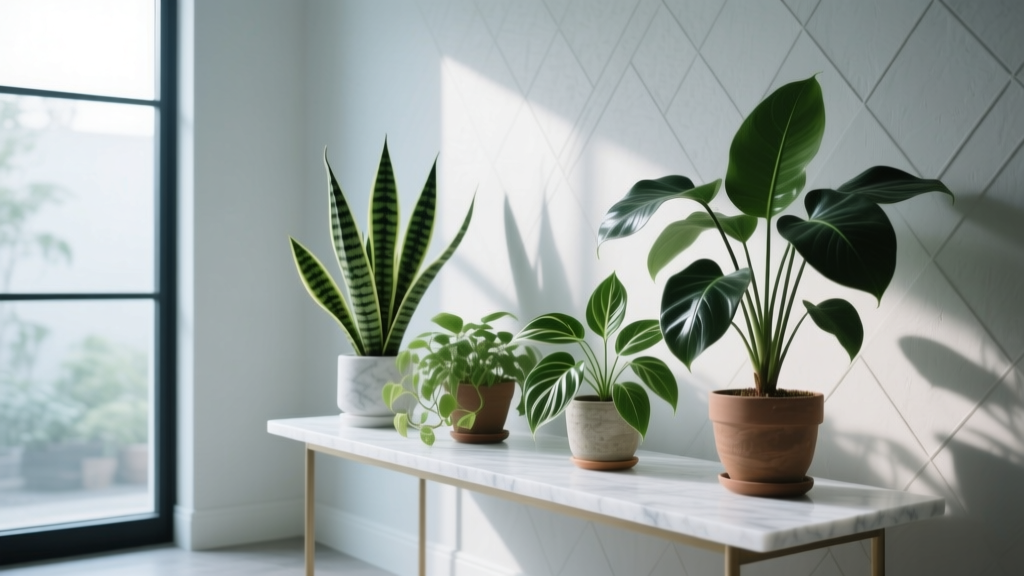
Low-Stress Training for Indoor Plants
You bring home a gorgeous indoor plant, it shoots up fast, and then it does the thing we all dread: it gets tall, top-heavy, leans toward the window, and starts dropping lower leaves. A month later you’re staring at a bare “trunk” with a tuft of foliage at the top, wondering if you did something wrong. Most of the time, the plant isn’t failing—your indoor space is. Low-stress training (LST) is how experienced growers coax healthier, fuller growth out of the same square footage and the same light by gently changing a plant’s shape instead of “letting it figure it out.”
LST is simple: you bend and guide stems slowly, using soft ties and anchors, so light reaches more growing points. It’s not bonsai-level manipulation and it’s not brutal topping or heavy pruning (though those can work with some plants). It’s a steady, low-drama technique that helps houseplants stay bushier, better lit, and less likely to snap under their own weight.
One surprising fact that makes LST “click”: plants don’t just grow toward light—they prioritize the topmost growing tip through hormone signaling (apical dominance). When you lower that main tip and spread the canopy, you interrupt that priority system and encourage side shoots to wake up. Done gently, it’s like rearranging a crowded room so everyone gets a seat near the window.
What low-stress training is (and what it isn’t)
Low-stress training is the practice of guiding plant growth using gradual bending, tying, and repositioning. The goal is a wider, flatter canopy where multiple stems share the best light. It’s commonly used in indoor crop production, but the same plant physiology applies to many houseplants and indoor edibles.
LST is not:
- Hard pruning that removes large portions of the plant at once
- “Crushing” or supercropping (high-stress techniques that intentionally damage stems)
- Forcing a brittle plant to bend in one session
Think of LST like physical therapy: small adjustments, frequent check-ins, and patience.
Tools and setup (cheap, plant-safe, and effective)
You don’t need specialized gear. You do need materials that won’t cut into stems as they thicken.
- Soft plant ties (silicone tie, Velcro plant tape, or soft garden wire with a rubber coating)
- Anchors: binder clips on pot rims, small screw-in eyelets for wooden planters, or plant stakes
- Bamboo stakes (8–16 inches) or fiberglass stakes for longer stems
- Pruners for selective leaf removal (sanitize with 70% isopropyl alcohol)
Rule of thumb: if a tie would leave a mark on your skin after an hour, it’s too tight for a stem that’s going to swell.
Light: the real reason LST works indoors
Indoor plants don’t get “even” light. Window light is directional; grow lights have hot spots and falloff. LST is your way of redistributing that limited light across more leaves and buds.
Target light levels (practical numbers)
If you use grow lights, here are workable ranges for many indoor edibles and high-light ornamentals:
- Leafy herbs/greens: 150–300 µmol/m²/s PPFD at the canopy
- Flowering/fruiting indoor crops: 400–700 µmol/m²/s PPFD
- Photoperiod: 12–16 hours/day for most indoor veg growth; 12 hours/day for flowering species that require it
These ranges align with common controlled-environment recommendations; for example, Utah State University Extension publications summarize PPFD targets for indoor plant production and emphasize uniform canopy lighting for consistent growth (Utah State University Extension, 2020). For home growers without a quantum sensor, a phone lux meter can help you compare “bright spots” vs “dim spots,” even if it’s not perfectly accurate.
Spacing and heat management
Keep most LED grow lights 12–24 inches above the canopy (check your fixture). If you’re training a plant wider, remember to adjust height so the new “outer” tops don’t end up too far from the center of the light.
Also watch leaf temperature. Many indoor plants are happiest when room temps stay around 68–78°F (20–26°C) during the day and not much cooler than 60°F (16°C) at night. Large swings slow recovery after training.
Soil and pot stability: the hidden foundation of training
LST fails when the plant wobbles. If the root ball shifts every time you tighten a tie, you’ll damage fine roots and stall growth.
Soil mix that holds anchors and drains well
A workable indoor training mix for many plants is:
- 40% high-quality potting mix
- 30% coco coir or fine bark
- 20% perlite/pumice
- 10% worm castings (optional but helpful)
This blend stays airy but doesn’t collapse. If you’re training heavy, top-heavy plants (like a leggy rubber plant or ficus), consider a heavier pot (ceramic) or add a 1–2 inch layer of washed gravel at the bottom for ballast (not drainage—just weight).
Repot timing
Don’t repot and train aggressively in the same week. Give the plant 10–14 days after repotting before major bending so it can re-establish fine roots. If you must do both, keep training minimal—just a gentle reposition and a loose tie.
Watering: keep growth steady so stems stay flexible
Plants bend best when they’re growing steadily. The fastest way to turn a flexible stem into a snapping hazard is inconsistent watering—bone dry followed by a flood.
Practical watering method for LST
- Water thoroughly until you get 10–20% runoff from the pot (for most container plants with drainage).
- Empty the saucer after 10 minutes so roots aren’t sitting in water.
- Wait to water again until the top 1–2 inches of mix is dry (or the pot feels noticeably lighter).
If you’re training a plant wider, it may transpire more (more leaf area exposed to light), so watering frequency may increase. Track it for two weeks instead of sticking to a calendar.
Water quality matters more indoors
Many indoor growers fight mysterious tip-burn and stalled growth that isn’t “training stress” at all—it’s mineral buildup. If your tap water is hard, periodically flush the pot with plain water equal to 2x the container volume (for example, 2 gallons through a 1-gallon pot) to reduce salt accumulation.
Excess soluble salts and fertilizer burn are well-documented container issues; extension resources routinely recommend leaching as a corrective tool for potted plants (University of Maryland Extension, 2023).
Feeding: support new side growth without forcing it
LST encourages more growth tips to become “leaders.” That’s great—unless the plant is underfed, in which case it responds with pale leaves and weak stems that won’t hold a trained shape.
A sensible indoor feeding schedule (general-purpose)
- Active growth (spring/summer or under strong lights): feed at 1/4 to 1/2 strength every 2–4 weeks
- Low light or winter slowdown: feed at 1/4 strength every 6–8 weeks, or pause if growth stops
If you want one simple ratio: use a balanced fertilizer (like 10-10-10 or 3-1-2 style houseplant blends). For flowering/fruiting indoor crops, shift to a bloom-supporting ratio once buds set, but don’t “overcorrect”—LST already pushes the plant to make more growing points.
“Uniform light distribution across the canopy improves plant growth consistency and reduces stretching—training and spacing are practical tools to achieve it.” — University Extension lighting guidance for indoor production (Utah State University Extension, 2020)
How to do low-stress training step by step
Here’s the method I use when I’m shaping an indoor plant without setting it back.
Step-by-step: the gentle bend and tie
- Pick the right time: train when the plant is hydrated (water the day before) and room temps are stable (68–78°F).
- Identify the main leader: the tallest growing tip that’s hogging the light.
- Create an anchor point: clip a binder clip to the pot rim or insert a stake opposite the direction you’ll pull.
- Pre-bend with your fingers: gently flex the stem back and forth a few millimeters to “warm it up.” Don’t crease it.
- Pull down gradually: bend the leader to a lower angle—start with 10–20° off vertical. If it tolerates that for 48 hours, go farther.
- Tie loosely: you should be able to slide a toothpick between tie and stem.
- Re-adjust every 3–7 days: stems thicken quickly in good light; loosen and reposition before ties bite in.
Most indoor plants respond well when you spread training over 2–4 weeks instead of forcing the final shape in one afternoon.
Comparison: LST vs topping vs staking (with real tradeoffs)
These three methods solve different problems. Here’s how they stack up for indoor growers dealing with leggy plants and limited light.
| Method | Stress level | Time to see bushier growth | Best for | Common risk |
|---|---|---|---|---|
| Low-stress training (bend & tie) | Low | 7–21 days | Leggy plants, uneven window light, maximizing grow light footprint | Stem kinks if bent too fast; ties cutting in after 3–7 days |
| Topping (cutting the main tip) | Medium | 14–28 days | Fast branching on tolerant plants; resetting height | Shock/stall if light is weak; infection if tools aren’t clean |
| Staking (support only) | Very low | 0 days (support is immediate) | Preventing collapse; heavy fruiting stems | Doesn’t fix legginess; can hide light problems |
Comparison analysis with actual “home reality” data: if your grow light covers a circle about 24 inches wide, a tall, narrow plant may only place 1–2 tips in that brightest zone. With LST spreading the canopy, it’s common to get 4–8 active tips into the same light footprint—without increasing wattage—because you’re redistributing height and spacing.
Real-world scenarios (what I’d do at the pot)
Scenario 1: The leaning window plant with a bald backside
Problem: A pothos, philodendron, or rubber plant leans hard toward the window; the back side loses leaves.
Fix:
- Rotate the pot 90° every 7 days for one month.
- Use LST to pull the longest stems sideways so light hits more nodes.
- Add a reflective surface (a white board) behind the plant to lift back-side light.
Tip: Don’t rotate and re-tie on the same day. Rotate, wait 48 hours, then adjust ties—plants reorient quickly and you’ll fight yourself otherwise.
Scenario 2: Indoor chili pepper or dwarf tomato getting too tall under LEDs
Problem: The plant is healthy but pushes into the light, risking heat stress; flowers drop because the canopy is uneven.
Fix:
- Start training early when stems are still pliable, around 8–12 inches tall.
- Bend the main stem slightly off-center, then train 3–5 side branches outward like spokes.
- Keep airflow moving gently to reduce humidity pockets inside the widened canopy.
Feeding adjustment: Once you see buds, avoid big nitrogen spikes. Stick to steady feeding at 1/2 strength every 2 weeks instead of occasional full-strength hits.
Scenario 3: A tall, top-heavy ficus or dracaena that keeps tipping
Problem: You want a fuller plant, but the stem is stiff and the pot wants to topple.
Fix:
- Stabilize first: switch to a heavier pot or add ballast so the container is harder to tip.
- Use a stake as an intermediate “bend point” rather than pulling directly to the rim.
- Train in micro-steps: adjust only 1/2 inch of position every 5–7 days.
When LST isn’t ideal: If stems are woody and resist bending, you may get better results from selective pruning (remove one tall leader) plus staking, rather than trying to force a bend.
Common problems and fixes (symptoms you’ll actually see)
Symptom: Stem creased or split after bending
Cause: Bent too far, too fast; stem was dehydrated or cold.
Fix:
- Immediately relieve tension—remove the tie.
- Support the stem with a stake and soft wrap (plant tape) to hold alignment for 10–14 days.
- Keep conditions steady: 70–75°F, avoid blasting fan directly on the wound.
Prevention: Train the day after watering; bend in 10–20° increments.
Symptom: Ties cutting into the stem (“girdling”)
Cause: Stems thicken; ties were snug; fast growth under strong light.
Fix:
- Remove and re-tie with a looser loop.
- Switch to wider, softer material (Velcro plant tape beats thin wire).
- Check tie points every 3–7 days.
Symptom: Leaves droop for 24–48 hours after training
Cause: Normal temporary response, or minor root disturbance from pot movement.
Fix:
- Don’t “fix” it with extra water unless the mix is actually dry.
- Raise humidity modestly (aim around 40–60% for many indoor plants) and avoid heat spikes.
- Wait 48 hours before making more adjustments.
Symptom: New growth is pale, small, or stalls after training
Cause: Not enough light, or the plant is underfed (or rootbound).
Fix:
- Increase light intensity or lower the grow light (safely) by 2–4 inches.
- Feed lightly: 1/4 strength balanced fertilizer, then reassess in 10 days.
- If roots circle the pot heavily, repot—but wait 10–14 days before resuming training.
Symptom: Leaf scorch on newly exposed inner leaves
Cause: LST suddenly exposed shaded leaves to high PPFD or direct sun.
Fix:
- Raise the light or reduce intensity for 3–5 days while the plant acclimates.
- Train in stages so inner leaves adjust gradually.
- Remove only fully crisp leaves; keep partially damaged leaves if they’re still green (they still photosynthesize).
Pests and disease: training changes airflow (for better or worse)
A widened canopy can improve airflow if you spread branches, but it can also create dense, shaded pockets if you overdo it. Dense pockets are where spider mites and powdery mildew love to start.
Quick prevention checklist
- After training, make sure you can see “daylight” through the canopy from at least one angle.
- Keep a small fan moving air gently (not a wind tunnel).
- Inspect undersides of leaves once a week—especially near tie points and stakes.
If you see early spider mites (fine stippling, tiny webbing), rinse foliage and treat with insecticidal soap, repeating every 5–7 days for 3 rounds to catch hatch cycles. For powdery mildew, increase airflow, avoid wetting leaves at night, and remove the worst affected leaves.
Training schedule: how often to adjust (and when to stop)
The sweet spot for most indoor plants is small adjustments on a predictable rhythm. Here’s a schedule that keeps you from overhandling the plant.
- Week 1: First bend and tie. Watch for droop and creasing.
- Week 2: Reposition by small increments; loosen any tight ties.
- Week 3: Spread secondary branches; remove a leaf or two only if they’re heavily shading new shoots.
- Week 4: Maintain shape; stop bending once stems lignify (turn more woody) or once you’ve filled your light footprint.
When to stop: if you’re doing more than one significant adjustment every 3 days, you’re probably chasing the plant instead of guiding it. Let it grow into the shape for a bit.
A few hard-won tips that save plants
Train the plant you have, not the one in your head. Some plants (pothos, many herbs, peppers) bend like they’re made of rubber. Others (dracaena, older ficus) will punish impatience. If it resists, switch to smaller steps or use pruning plus staking instead of forcing a bend.
Don’t ignore the pot. A plant that’s loose in its pot or rootbound will act “dramatic” after training. Fix the root environment first, then train.
Keep notes for two weeks. Record when you tied, when you watered, and when you fed. LST is simple, but indoor variables stack up fast, and notes keep you from guessing.
Low-stress training is one of those techniques that feels almost too easy—until you see your plant stop stretching, start branching, and actually use the light you’re paying for. Take it slow, check your ties like you mean it, and let the plant do the heavy lifting once you’ve pointed it in the right direction.
Sources: Utah State University Extension indoor lighting guidance (2020); University of Maryland Extension container plant salt management and leaching recommendations (2023).