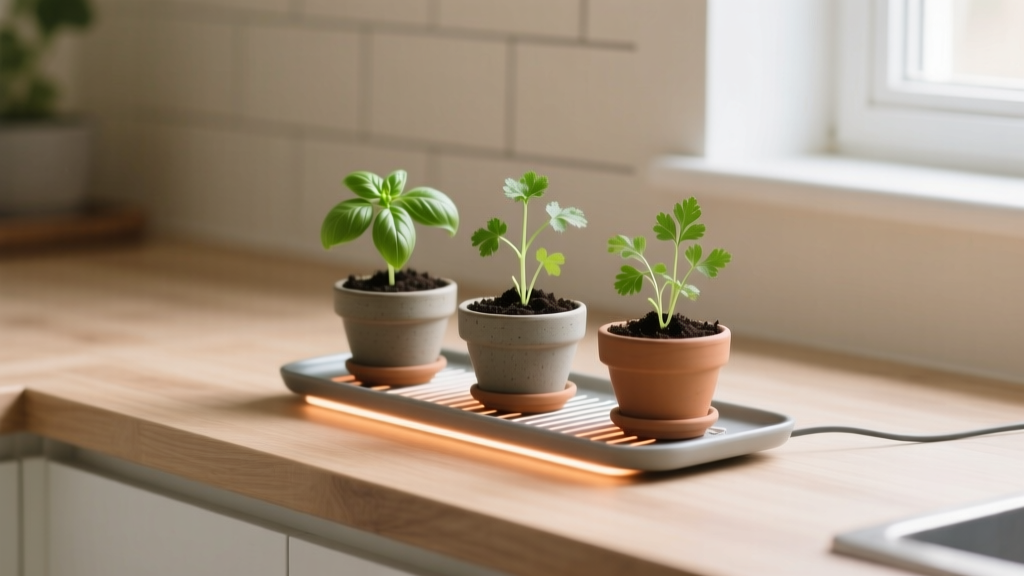
Using a Heat Mat for Herb Gardens Germination
The first time you start basil indoors in late winter, it feels like it should be easy: sprinkle seeds, water, set the tray by a bright window, and wait. Then two weeks pass and you’ve got… nothing. Meanwhile, your friend started the same packet and has a jungle of seedlings. The difference is often boring but powerful: warm soil. Most herbs don’t fail because the seed is bad—they stall because the potting mix is sitting at 62°F when the seed is waiting for 75°F.
A heat mat is one of the few pieces of gear that can genuinely change your germination results, especially for warmth-loving herbs like basil, oregano, thyme, and rosemary. Used well, it speeds sprouting, evens out stands, and reduces damping-off risk by shortening the time seeds sit in soggy mix. Used poorly, it can dry cells out, cook seeds, or create a fungus party under a humidity dome. Let’s do it the right way—practical, measured, and repeatable.
What a heat mat actually does (and what it doesn’t)
A seedling heat mat warms the root zone—not the air. Your room might be 68°F, but your tray sitting on a cold windowsill can be far cooler. Heat mats raise the temperature of the soil/mix in the tray so seeds hit their preferred germination range.
Most mats are designed to raise soil temperature about 10–20°F above ambient (depending on model, insulation, and room conditions). That’s why a thermostat controller is the difference between “reliable tool” and “mystery heater.” Even if the mat is labeled “seedling mat,” it can overshoot under a dome or on an insulated surface.
For target temperatures, I lean on extension recommendations and seed physiology basics. North Carolina State Extension notes basil germinates best in warm soil and commonly references temperatures around the mid-70s to 80s °F for fastest germination (NC State Extension, 2020). The University of Maryland Extension also emphasizes that bottom heat can speed germination for warm-season seedlings and recommends using a thermostat to prevent overheating (University of Maryland Extension, 2022).
“Bottom heat can speed up germination considerably, but it must be monitored—warm media dries faster and can stress seedlings if moisture isn’t kept even.” — University of Maryland Extension (2022)
Germination temperature targets for common culinary herbs
Here’s the practical range I use at home. These aren’t theoretical lab numbers—they’re workable targets for trays under lights.
| Herb | Target soil temp (°F) | Typical germination time | Notes from the bench |
|---|---|---|---|
| Basil | 75–85°F | 5–10 days | Slow at 65°F; very fast when kept warm and evenly moist. |
| Parsley | 65–75°F | 14–28 days | Heat mat helps consistency, but patience matters more than extra heat. |
| Cilantro | 60–70°F | 7–14 days | Too warm can reduce vigor; don’t “basil-heat” cilantro. |
| Thyme | 70–75°F | 10–21 days | Tiny seed—surface sow and press in; don’t bury deeply. |
| Oregano | 70–80°F | 7–14 days | Likes warmth; hates saturation. |
| Rosemary | 70–80°F | 14–28+ days | Can be slow/spotty; fresh seed helps, warmth improves odds. |
| Sage | 65–75°F | 7–21 days | Moderate warmth; avoid overwatering under a dome. |
Notice the key point: a heat mat is not “set it and forget it at 85°F for everything.” Cilantro and parsley are classic cases where too much heat doesn’t help, and sometimes hurts.
Setting up a heat mat the way a master gardener would
Gear checklist (keep it simple)
- Seedling heat mat (size matched to your tray)
- Thermostat controller with probe (strongly recommended)
- Cell tray or soil blocks + watertight tray underneath
- Seed-starting mix (fine-textured, sterile or pasteurized)
- Clear humidity dome or plastic wrap (optional, used strategically)
- LED grow light (or very bright window, but lights are more consistent)
- Thermometer (optional, but helpful to verify soil temp)
Step-by-step: from dry mix to first sprouts
- Pre-moisten your mix before filling cells. Aim for “wrung-out sponge” moisture—wet enough to clump, not drip.
- Fill cells and firm gently. Don’t pack tight; you want air pockets.
- Sow at the right depth:
- Most herbs: sow at 1/8 inch or surface sow and press (thyme, oregano).
- Parsley: 1/4 inch is usually enough.
- Label everything now. Future-you will not remember which row is thyme.
- Set tray on the heat mat, place the thermostat probe in the mix (not dangling in air), and set the target temperature:
- 80°F for basil/oregano
- 70°F for parsley/cilantro
- If using a dome, vent it daily or crack one corner once you see condensation.
- Check moisture at least once per day. Heat mats dry trays faster—especially along edges.
- The moment you see sprouts, plan to remove the dome within 24 hours and get seedlings under strong light.
A good working rhythm is “warm and humid until germination, then warm (briefly) and airy with bright light.” Most damping-off problems start when we keep the dome on too long after sprouting.
Watering: the make-or-break detail when using bottom heat
Heat mats don’t just warm the mix—they increase evaporation. That’s great for preventing stagnant, cold, swampy soil. It’s also how you end up with dry cells and dead embryos if you don’t pay attention.
How much water, how often?
Instead of pouring a “cup measure” on top (which varies wildly), use these practical benchmarks:
- Before sowing: pre-moisten the entire batch of mix so every cell starts evenly hydrated.
- During germination: mist the surface if it lightens in color, or bottom-water lightly so the tray absorbs moisture for 10–20 minutes.
- After germination: water when the top 1/4 inch feels barely dry to the touch. Keep consistent, not soggy.
Bottom-watering is usually cleaner with herb seedlings. Add water to the solid tray, let cells wick it up, then pour off extra. Don’t leave cells sitting in water for hours—roots need oxygen.
Real-world scenario: “My basil sprouts, then collapses overnight”
This is classic “surface swings.” On a heat mat, the surface can go from wet to crusty fast, especially if a fan is running or the dome is off. Basil seedlings have tiny roots at first; if the top dries hard, roots can’t keep up. Solution: keep surface moisture even for the first week after sprout—light misting once daily, or bottom-water more frequently with shorter soaks.
Soil and containers: pick the mix that behaves well on heat
Not all “potting soil” is good for germination. Heat mats amplify problems in chunky, woody mixes because they dry unevenly and leave air gaps around seeds.
Best soil characteristics for heat-mat germination
- Fine texture (seeds contact soil evenly)
- Drains well but holds moisture (peat/coir + vermiculite/perlite blends work)
- Low fertility at first (seedlings don’t need strong fertilizer early)
If you make your own seed-starting mix, a reliable blend is roughly 2 parts peat or coir : 1 part vermiculite : 1 part perlite. The exact ratio isn’t sacred—texture and moisture behavior matter most.
Cell size matters
Herbs started in tiny plug cells dry faster on a heat mat. If your indoor air is dry (heated homes in winter often sit at 25–35% RH), consider slightly larger cells (like 1.5–2 inch) for basil and parsley so you’re not watering twice a day.
Light: heat speeds germination, but light grows seedlings
A heat mat can give you fast sprouting, but if light is weak, you’ll get tall, floppy seedlings in a hurry.
Practical lighting targets
- Provide 14–16 hours of light daily for indoor herb seedlings.
- Keep LED grow lights about 2–4 inches above the seedlings (adjust based on your fixture’s intensity and heat).
- Use a gentle fan on low, or brush your hand over seedlings daily to strengthen stems once true leaves appear.
When to turn the heat mat off
This is one of the most common mistakes: leaving the mat on long after germination. After most seeds have sprouted, you can usually switch the mat off within 2–5 days and let seedlings grow at normal room temps (often 65–70°F). If your room is very cool (below 62°F), you may keep gentle bottom heat a bit longer, but watch moisture closely.
Feeding: when seedlings actually need nutrients
Seeds carry enough energy to germinate. Fertilizer too early can burn delicate roots—especially in warm, moist media.
A simple feeding schedule that works
- Wait until seedlings have 1–2 sets of true leaves (not the first seed leaves).
- Then feed at 1/4 strength liquid fertilizer every 7–10 days.
- For heavy feeders like basil, you can move to 1/2 strength once plants are growing steadily.
If your mix already contains slow-release fertilizer, go lighter—warm soil increases nutrient release and can push soft, weak growth.
Method comparison: heat mat vs. no heat mat (with real numbers)
Here’s what home gardeners usually care about: how much faster and more reliable is germination?
| Starting method | Soil temp | Basil germination window | Uniformity | Common downside |
|---|---|---|---|---|
| Bright windowsill, no heat | 60–68°F (often fluctuates) | 10–21 days (often patchy) | Low to medium | Slow sprouting; higher risk of damping-off from long, wet waits |
| Heat mat + thermostat | 75–82°F (stable) | 5–10 days (more consistent) | High | Dries faster; can overheat without a controller |
| Warm room (no mat) + lights | 70–74°F | 7–14 days | Medium to high | Depends on your house; nighttime drops slow things down |
Those ranges line up with what many extension services describe: warm, stable media speeds and evens germination; inconsistent temps slow it down (University of Maryland Extension, 2022; NC State Extension, 2020).
Common problems (and what to do about them)
Symptom: Seedlings never emerge, but the surface looks crusty
- Likely cause: Top layer dried out on the heat mat, forming a crust that tiny seedlings can’t push through.
- Fix: Mist the surface 1–2 times daily during germination, or use a dome until sprouts appear. Consider top-dressing with a thin layer (1/8 inch) of vermiculite to hold moisture.
Symptom: Seeds rot or smell sour; fuzzy mold shows up
- Likely cause: Too wet + too warm + not enough airflow (especially under a dome).
- Fix: Vent the dome daily, reduce watering, and remove the dome as soon as you see sprouts. Bottom-water briefly (10 minutes) and drain. If mold persists, scrape off the top layer and dust lightly with cinnamon (mild antifungal) or increase airflow.
Symptom: Leggy, pale seedlings
- Likely cause: Not enough light, or lights too far away; heat mat left on too long can speed lanky growth.
- Fix: Move lights to 2–4 inches above plants, run lights 16 hours daily, and turn off bottom heat after germination.
Symptom: Basil seedlings get twisted or stop after sprouting
- Likely cause: Temperature too high (media overheated above 85–90°F), or inconsistent moisture.
- Fix: Use a thermostat probe in the soil and set to 80°F. If you don’t have a thermostat, elevate the tray slightly (a thin towel between mat and tray) and monitor with a thermometer.
Symptom: Damping-off (seedlings pinch at the soil line and fall)
- Likely cause: Fungal pathogens thriving in still, wet conditions—often worsened by keeping the dome on too long.
- Fix: Remove dome promptly, add airflow, water from below and avoid splashing stems, and don’t overcrowd. Start with clean trays and fresh mix. Warmer germination temps help only if paired with better air exchange.
Three real-world heat mat scenarios (and how to handle each)
Scenario 1: Cold kitchen counter, warm-loving herbs (basil, oregano)
Your house runs cool at night—maybe 60–62°F. Basil sits and sulks. In this case, a mat is a game changer. Set the thermostat to 80°F, use a dome until germination, and check moisture daily. Once 70–80% of seeds sprout, remove the dome and shut the mat off within a few days. You’ll get faster, more uniform basil, and you’ll spend less time trying to “keep the tray wet enough” for three weeks.
Scenario 2: You’re starting cilantro and parsley with a mat because “more heat is better”
This is where people accidentally sabotage themselves. Cilantro prefers cooler germination; parsley is slow no matter what. Set the thermostat to 68–72°F, not 82°F. For parsley, soak seeds for 12–24 hours before sowing (optional but helpful), then keep the moisture steady. Don’t let a too-hot mat bake the top layer—parsley embryos are small and can be sensitive to drying.
Scenario 3: Apartment grow shelf under LEDs, humidity dome, and a “hot” mat
On a shelf, heat gets trapped. Under a dome, it gets trapped again. A mat without a thermostat can push soil temps into the high 80s, even if your room is comfortable. In this scenario, always use a controller and probe. If you notice heavy condensation every morning, crack the dome or swap to vented domes. Aim for warm soil, not tropical swamp air.
Timing: when to start herb seeds and how long the mat runs
For most indoor starts, herbs are sown 6–10 weeks before your last frost date, depending on how quickly they grow and how big you want them at transplant time. Heat mats matter most during germination and the first few days after emergence.
- Heat mat ON: from sowing until most seeds sprout (often 5–21 days depending on herb).
- Heat mat OFF: typically 2–5 days after emergence, once seedlings are established.
- Grow on: at 65–70°F with strong light; pot up if roots fill cells.
Small details that prevent big headaches
- Insulate under the mat if it sits on a stone countertop that steals heat. A thin cork mat or folded towel under the heat mat can help maintain stable temps (monitor to prevent overheating).
- Don’t let the probe float. Tape it so the tip sits in the root zone; otherwise you’ll get false readings and temperature swings.
- Label and date. Knowing you sowed parsley 18 days ago keeps you from digging it up on day 10.
- Thin early. Crowding increases damping-off risk. Snip extras at soil level rather than pulling and disturbing roots.
Once you get the hang of bottom heat, you’ll notice a shift: you’re no longer “hoping” seeds come up. You’re setting conditions and getting predictable results. That’s the real payoff—especially with herbs, where a tray of sturdy starts means fresh pesto, chimichurri, and garnishes on your schedule, not the seed’s mood.
If you want the simplest rule to remember, it’s this: use the heat mat to wake the seeds up, then take it away once they’re awake. Warm soil to germinate, bright light to grow, and steady moisture the whole time. That combination beats luck every season.