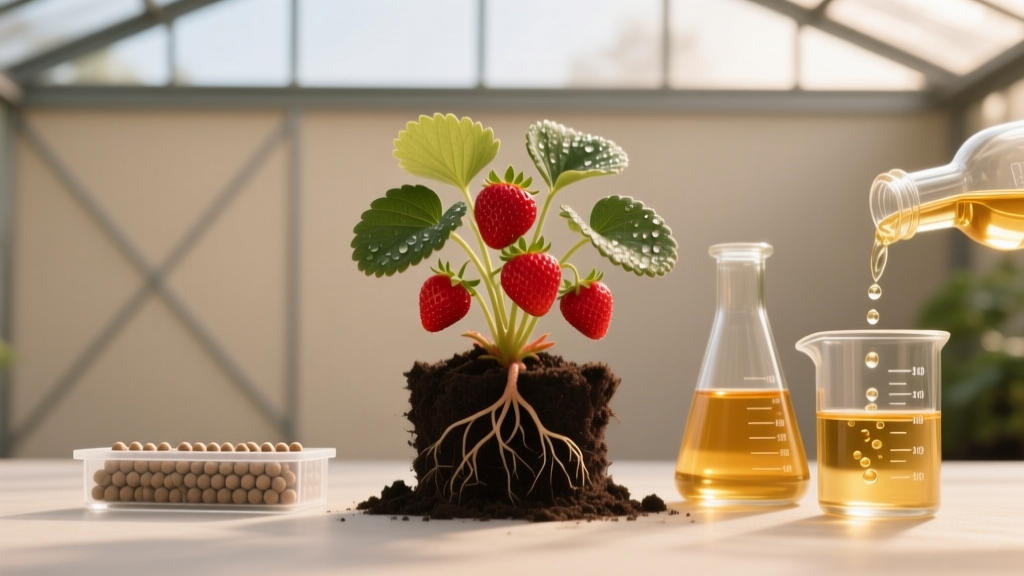
Slow-Release vs Liquid Fertilizer for Strawberries
The most common strawberry disappointment I see in home gardens isn’t pests or birds—it’s a plant that looks “fine” all spring, then makes a handful of small berries that taste watery. The gardener swears they watered and “fed them a lot.” When we dig into the details, the issue is almost always fertilizer timing: either too much quick nitrogen at the wrong moment (lush leaves, few berries), or not enough steady nutrition when the plant is building flowers and fruit.
Strawberries are fast, responsive plants. Feed them the right way and they reward you within weeks. Feed them the wrong way and they’ll still look green, but you’ll be asking why the harvest doesn’t match the hype. This guide compares slow-release and liquid fertilizers for strawberries with practical schedules, real measurements, and troubleshooting you can use immediately.
Before fertilizer: get the “big three” right (water, soil, light)
Watering: steady moisture beats heroic soaking
Strawberries have shallow roots, which makes them sensitive to both drought and waterlogging. Aim for consistent soil moisture, especially from first bloom through harvest.
- Target water amount: about 1–1.5 inches of water per week (rain + irrigation) during active growth and fruiting.
- Best method: drip irrigation or a soaker hose to keep foliage dry and reduce fruit rot.
- When to water: morning, so leaf surfaces dry quickly.
In containers, you’ll often water more frequently—sometimes daily during a heat wave—because pots dry fast. In raised beds with compost-rich soil, you may only need to water every 3–4 days depending on weather.
Soil: strawberries don’t forgive poor drainage
Strawberries want loose, fertile soil that drains well. If your bed stays soggy after rain, no fertilizer plan will save the crop—roots need oxygen.
- Ideal soil pH: 5.5–6.5.
- Topsoil texture: loamy; avoid heavy clay without amendment.
- Organic matter: work in 1–2 inches of finished compost before planting or each spring in established beds.
For a quick drainage check, dig a 12-inch-deep hole and fill it with water. If water is still standing after 4 hours, you’re going to fight root issues (and fertilizer won’t fix that).
Light: fruit needs sun, not just green leaves
Strawberries can survive in part sun, but good fruiting usually requires 8+ hours of direct sun. With only 4–6 hours, you often get smaller berries and lighter yields—even if nutrition is perfect.
What strawberries actually need from fertilizer (and when)
The fertilizer conversation gets clearer when you match feeding to plant stage:
- Early spring (leaf and root growth): modest nitrogen + steady nutrients.
- Pre-bloom to fruit set: balanced feeding; avoid heavy nitrogen spikes.
- Fruiting: consistent moisture + potassium and micronutrients help fruit quality; too much nitrogen can dilute flavor.
- Post-harvest (especially June-bearers): rebuild crowns and set next year’s buds; this is a key time to feed.
University of Minnesota Extension notes that strawberries are relatively sensitive to over-fertilization and that excess nitrogen can promote lush growth at the expense of fruiting (University of Minnesota Extension, 2023). That single point explains a lot of “my plants are huge but my berries are tiny” stories.
“Excessive nitrogen leads to vigorous leaf growth, fewer berries, and softer fruit that is more prone to disease.” — Utah State University Extension strawberry guidance (2020)
Slow-release vs liquid fertilizer: what changes in the bed
Both can grow great strawberries. The difference is how tightly you control timing and how often you’re willing to apply nutrients.
| Factor | Slow-Release Fertilizer (granular) | Liquid Fertilizer (water-soluble) |
|---|---|---|
| Release speed | Feeds gradually over 6–12 weeks (typical coated products) | Available immediately; effect visible in 3–7 days |
| Application frequency | Usually 1–3 times per season | Often every 7–14 days during active growth |
| Risk of overfeeding | Lower if applied at label rate; still possible if over-applied | Higher if mixed strong or applied too often (salt buildup in pots) |
| Best use cases | Busy gardeners, in-ground beds, steady baseline fertility | Containers, quick corrections, precision feeding around bloom/fruit |
| How weather affects it | Warm soil speeds release; cool soil slows it | Less dependent on soil temperature; depends on watering schedule |
Feeding strawberries with slow-release fertilizer (practical schedule)
When slow-release shines
If you grow strawberries in an in-ground bed or a big raised bed, slow-release fertilizer is the “set a baseline and don’t mess it up” approach. It’s also forgiving if you sometimes forget to fertilize.
How much to apply (real numbers)
Because products vary, always follow the label. But here are realistic home-garden targets that align with extension guidance to avoid excess nitrogen:
- Early spring (new growth begins): apply a balanced slow-release such as 10-10-10 at about 1/2 pound per 100 sq ft (or the equivalent label rate for your product).
- Post-harvest (June-bearers): another light application at 1/2 pound per 100 sq ft helps set next year’s buds without pushing late, tender growth.
Penn State Extension notes that strawberries are commonly fertilized after renovation (post-harvest) and warns against heavy spring nitrogen that can increase disease and reduce fruit quality (Penn State Extension, 2022).
Step-by-step: applying granular slow-release correctly
- Water first if soil is dusty dry. Fertilizer on bone-dry soil can burn feeder roots.
- Broadcast evenly over the bed, keeping granules off the crowns (the central growing point).
- Scratch lightly into the top 1 inch of soil if possible (especially in bare soil beds), or apply before mulch.
- Water in with at least 1/4 inch of irrigation to start nutrient release and prevent granules from sitting on leaves.
Scenario 1: A busy gardener with a 4x8 raised bed
You’ve got a 32 sq ft bed, planted with June-bearers. You want a simple plan.
- Early spring: apply roughly 0.16 lb (about 2.5 oz) of a balanced granular fertilizer if you’re using the 1/2 lb per 100 sq ft guideline.
- After harvest: repeat the same amount, then water it in.
This approach keeps growth steady and reduces the “oops, I overfed and got leaf jungle” problem.
Feeding strawberries with liquid fertilizer (practical schedule)
When liquid wins
Liquid fertilizer is my go-to for containers, hanging baskets, strawberry towers, and any situation where nutrients wash out quickly. It also lets you adjust feeding based on what the plants are actually doing this week—not what you hoped they’d do two months ago.
Mixing and frequency: avoid the classic mistake
The classic liquid-fertilizer mistake is mixing too strong “because strawberries are heavy feeders.” They’re not heavy feeders compared to tomatoes. They’re timing-sensitive feeders.
- Typical dilution: mix to 1/4–1/2 strength of the label rate for routine feeding in containers.
- Frequency: every 7–14 days during active growth; back off during extreme heat when plants are stressed.
- Container flush: once every 4 weeks, water heavily until at least 20% drains out the bottom to prevent salt buildup.
Step-by-step: a reliable liquid-feeding routine for pots
- Water the pot with plain water until you see a little drainage.
- Apply diluted liquid fertilizer, aiming to wet the entire root zone.
- Do this in the cool part of the day when temperatures are under 85°F if possible (hot roots + fertilizer can stress plants).
- Pause feeding if plants wilt daily despite moist soil (heat stress) and resume when nights cool below 70°F.
Scenario 2: Patio strawberries in containers that “never get big”
This is a common case: the plant flowers, but berries stall at marble size. Usually it’s a mix of inconsistent watering and nutrients washing out.
- Switch to liquid feeding at 1/4 strength every 7 days for 3 weeks.
- Keep soil evenly moist (not soggy). In warm weather, that may mean watering every day.
- Pinch off the first flush of flowers on newly planted crowns for about 2–3 weeks to let roots establish (especially day-neutrals/everbearers).
You’re not “forcing” fruit with fertilizer—you’re keeping the plant from running out of gas mid-race.
Comparison analysis with actual data: what you’ll likely see
Here’s a grounded way to think about performance. In home beds, the biggest difference isn’t total seasonal yield (both methods can produce well). It’s the shape of growth and fruiting.
- Slow-release: steadier foliage growth and fewer swings; less chance of accidental overfeeding; fruit size remains more consistent through the season.
- Liquid: faster response; can correct pale growth quickly; can also create “leaf surges” if you feed strong near bloom.
If you want numbers to hang your hat on: a coated slow-release applied in spring commonly releases nutrients over 6–12 weeks, while a liquid feed is available immediately and may leach within days in a porous potting mix—hence the 7–14 day reapplication rhythm. That timing difference is the whole story.
Common problems (and what fertilizer type has to do with them)
Problem: huge leaves, few flowers
Symptoms: dark green foliage, long petioles, runners everywhere, but sparse blossoms and small harvest.
Most likely cause: too much nitrogen, especially from frequent liquid feeding or high-N lawn fertilizer drift.
Fix:
- Stop nitrogen-heavy feeding for 2–3 weeks.
- Switch to a more balanced or slightly lower-N feed; avoid anything marketed for “lush green growth.”
- Ensure full sun (8+ hours).
- Remove excessive runners during fruiting so energy stays on berries.
Problem: pale leaves, slow growth, thin crowns
Symptoms: light green to yellowish leaves, slow new growth, plants look “stuck.”
Likely causes: underfeeding, cool soil slowing slow-release, or root stress from soggy conditions.
Fix:
- Check soil moisture first—if it’s wet and cold, improve drainage rather than adding more fertilizer.
- If soil is fine, apply a gentle liquid feed at 1/4–1/2 strength and reassess in 7 days.
- Confirm soil pH is 5.5–6.5; outside that range, nutrients can be present but unavailable.
Problem: leaf burn (brown edges) after feeding
Symptoms: crispy leaf margins, sudden decline after fertilizing, especially in containers.
Likely causes: fertilizer salts, too-strong liquid mix, granular fertilizer contacting crown/leaves, or fertilizing dry soil.
Fix:
- Flush the root zone with plain water: run water through the pot until at least 20–30% drains out.
- Remove visible granules sitting on crowns or leaves.
- Resume feeding at 1/4 strength only after you see healthy new growth.
Problem: soft berries, gray mold (Botrytis), and fast rot
Symptoms: berries look fine, then develop fuzzy gray mold; fruit softens quickly.
Fertilizer connection: excess nitrogen can create dense foliage that traps humidity and makes fruit softer.
Fix:
- Thin leaves lightly to improve airflow (don’t scalp plants).
- Mulch under fruit (clean straw or pine needles) so berries aren’t sitting on damp soil.
- Water at the base; avoid overhead watering during bloom and harvest.
- Dial back nitrogen; keep feeding balanced.
Feeding plans by strawberry type (June-bearer vs day-neutral)
June-bearers (one big crop)
June-bearers set many of next year’s flower buds after harvest. That’s why post-harvest feeding matters.
- Best approach: slow-release in early spring + slow-release after harvest, with liquid only if plants show deficiency.
- Avoid: heavy nitrogen during bloom/fruiting; it can reduce fruit quality and increase rot.
Day-neutral / everbearing (repeat flowering)
These are more like marathoners. They often do better with lighter, more frequent feeding—especially in containers.
- Best approach: a modest slow-release baseline at planting, plus liquid feed at 1/4–1/2 strength every 10–14 days during production.
- Watch: heat. When daytime highs push past 90°F, many day-neutrals slow down regardless of fertilizer.
Three real-world cases (and what I’d do)
Scenario 3: Spring planted strawberries that flower immediately
You plant new crowns in spring, and they try to fruit right away. It’s tempting to feed hard to “support” that fruiting.
What works better:
- Pinch off flowers for the first 2–3 weeks to build roots and crown size.
- Use a gentle slow-release at planting (label rate), or a mild liquid feed at 1/4 strength weekly for 2 weeks.
- After the plant is clearly growing (new leaves expanding), let it flower.
Scenario 4: Established bed with great plants but bland berries
If berries are plentiful but taste washed out, gardeners often reach for fertilizer. More often, the fix is water management and picking timing.
- Keep irrigation consistent, but don’t overwater right before harvest.
- Pick fully red berries; flavor doesn’t improve much after picking.
- Keep nitrogen moderate—overfeeding can push watery growth.
Scenario 5: Strawberries planted near a fertilized lawn
I’ve seen strawberry beds accidentally “fed” by lawn fertilizer, especially after rain or irrigation. The result is leafy plants, fewer berries