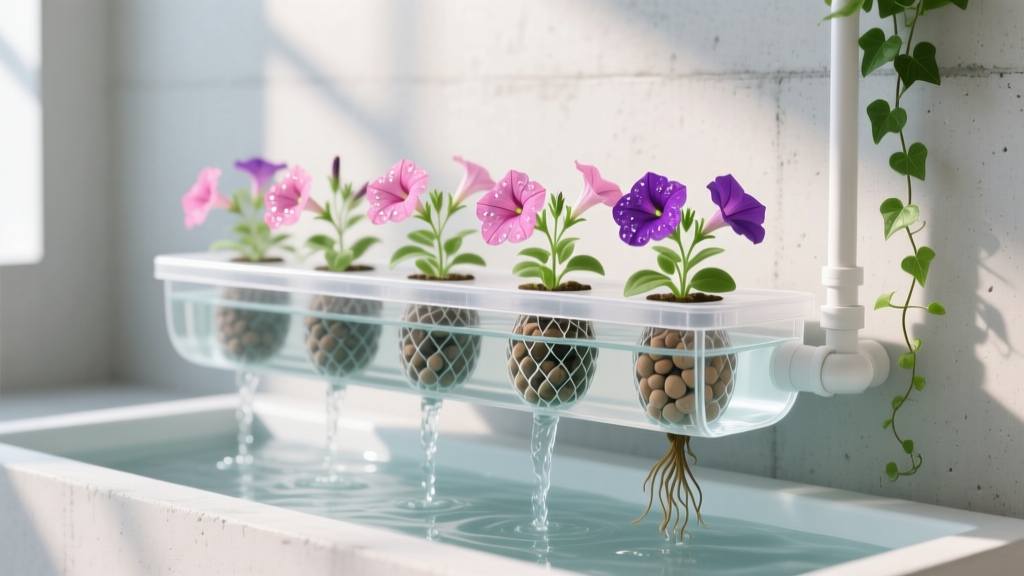
Aquaponics Setup for Growing Petunias
The first time I tried petunias in aquaponics, I did what most of us do: I treated them like they were in potting mix. They looked fine for about two weeks—then the leaves went pale, the stems got soft, and the flowers stalled. The fish were happy, the water was clear, and I still managed to “starve” a flowering plant in a system full of nutrients. That’s the surprise with petunias: they’re heavy feeders, and aquaponics tends to run short on a couple of key things petunias demand (especially iron and potassium) right when you want the biggest bloom show.
This article walks you through an aquaponics setup that actually supports petunias from transplant to full color—without crashing your pH, stressing your fish, or wondering why you’ve got lush green growth and no flowers. I’ll share practical numbers, a few hard-won lessons, and a troubleshooting playbook you can use the same day you read this.
Before you build: what petunias ask for in aquaponics
Petunias aren’t difficult, but they’re picky about three things: light intensity, steady moisture at the roots (not constant drowning), and available micronutrients at the right pH. In soil, a slow-release fertilizer hides a lot of mistakes. In aquaponics, the water chemistry shows every gap.
Here are the targets I shoot for when growing petunias in a mature home aquaponics system:
- Water temperature: 68–74°F (20–23°C) for strong growth; avoid prolonged periods below 60°F (15.5°C).
- pH: 6.4–7.0 (a compromise between plant uptake and fish comfort).
- Photoperiod: 12–14 hours of bright light for steady blooming.
- Electrical Conductivity (EC): often runs lower than hydro; don’t chase hydroponic EC numbers—focus on plant symptoms and supplementation.
- Air movement: steady gentle airflow to prevent botrytis and keep stems sturdy.
For general petunia culture, including light and temperature preferences, North Carolina State Extension notes petunias perform best in full sun and are commonly grown as warm-season annuals (NC State Extension, 2023). In aquaponics, “full sun” becomes either a very bright greenhouse or a serious grow light plan.
Choosing the right aquaponics style for petunias
Petunias can grow in several aquaponic designs, but some make your life easier than others. Petunias hate “wet feet” in stagnant conditions, and they’re prone to root issues if oxygen is low. That means you want a root zone that breathes.
| System type | Root oxygen | Best for petunias? | Typical watering rhythm | Notes from real use |
|---|---|---|---|---|
| Media bed (flood & drain) | High | Excellent | Flood 5–15 min, drain 45–60 min | Most forgiving; supports flowering plants well. |
| DWC raft | Medium (depends on aeration) | Okay with strong aeration | Constant water contact | More root disease risk if oxygen is low; flowering can be weaker. |
| NFT channels | High | Good if tuned | Thin film 24/7 | Great for compact varieties; clogging and dry-outs are the risk. |
| Wicking beds (aquaponic-fed) | Medium | Good for patios | Reservoir stays filled; top stays drier | Nice balance; choose airy media to prevent sour root zones. |
If you want the most dependable bloom results at home, I recommend a media bed flood-and-drain setup. It provides oxygen to the roots and buffers nutrients better than water-only roots.
Step-by-step aquaponics setup tailored for petunias
This is a practical build approach that fits a garage, greenhouse, or sunny patio. Adjust size to your space, but keep the ratios sensible and prioritize filtration and aeration.
1) Size the system so nutrients keep up with flowers
Petunias are not lettuce. If your system is lightly stocked, petunias may look “fine” but won’t flower heavily. As a home baseline, I’ve had reliable results when the system is mature and stocked enough to produce steady nitrates.
- Fish tank: 30–100 gallons is a comfortable home range for stability.
- Grow bed depth: 10–12 inches of media gives good root space and moisture buffering.
- Plant spacing: 8–12 inches between plants (closer for compact types, wider for trailing types).
If your system is brand new, grow leafy greens first for 4–6 weeks while the biofilter establishes. Then add petunias once ammonia and nitrite are consistently 0 ppm and nitrates are present.
2) Use the right “soil” (media) and avoid common root mistakes
Aquaponics doesn’t use soil, but your media choice plays the same role: holding roots, storing moisture, and providing oxygen pockets.
- Best media: expanded clay pebbles (hydroton) or washed lava rock.
- Avoid: fine sand, garden soil, or any media that packs tight and stays soggy.
- Rinse media thoroughly until runoff is mostly clear to protect fish gills and keep pumps from clogging.
I like expanded clay for petunias because it supports a high-oxygen root zone. Lava rock works too, but it’s heavier and can be rough on hands during planting.
3) Transplanting petunias without shock
Most petunias come in peat-based plugs. Moving them straight into constant moisture can cause stem rot or a stall. Do it gently:
- Choose sturdy starts with green growth and visible buds, not stretched seedlings.
- Remove the plant from the pot and tease roots lightly—don’t wash roots aggressively unless you see disease.
- Plant so the crown sits just above the media surface. Don’t bury the stem.
- For the first 3–5 days, keep airflow steady and avoid blasting the canopy with intense midday sun if they were grown indoors.
Watering in aquaponics: what “right” looks like
In aquaponics, “watering” is really about root-zone oxygen and consistent moisture—two things that often fight each other. Petunias want evenly moist conditions, but they decline fast if roots go anaerobic.
Flood-and-drain timing that works for petunias
For media beds, start with this rhythm and adjust by season:
- Spring/fall: flood 5–10 minutes, drain 50–60 minutes.
- Summer heat: flood 10–15 minutes, drain 30–45 minutes (more frequent cycling).
If your bed stays soaked at the bottom all the time, shorten floods or improve drainage. If plants wilt in the afternoon while the media is dry 2–3 inches down, increase cycle frequency.
Air and water temperature matter more than you think
Warm water holds less oxygen. If your water creeps above 78°F (25.5°C), increase aeration and shading, especially in DWC or heavily stocked tanks. Petunia roots respond quickly when oxygen drops: leaves lose shine, growth slows, and stems get weak.
Light: the make-or-break factor for blooms
If your petunias are green but stingy with flowers, light is the first suspect. In outdoor sun they’re easy. Under cover, you must plan for intensity.
- Outdoor: aim for 6–8+ hours of direct sun.
- Indoor/garage: use strong LEDs and target 12–14 hours of light daily.
- Grow light distance: often 12–18 inches from the canopy (follow your fixture’s specs; stronger fixtures may need more distance).
NC State Extension emphasizes full sun for best petunia performance (NC State Extension, 2023). In practice, “bright shade” usually equals fewer blooms, longer internodes, and softer growth.
Feeding petunias in aquaponics (without hurting fish)
This is where aquaponic petunias separate the casual setup from the bloom machine. Fish waste provides nitrogen well, but petunias often need boosts of iron, potassium, and sometimes calcium and magnesium, depending on your source water and pH.
A useful rule: fix the system first (stable biofilter, steady feeding), then fine-tune plant nutrients.
Core water testing schedule
Test at least weekly when dialing in flowering plants:
- Ammonia: 0 ppm
- Nitrite: 0 ppm
- Nitrate: present (many home kits show this broadly; look for a consistent reading rather than chasing a single “perfect” number)
- pH: keep in the 6.4–7.0 range if possible
The University of the Virgin Islands aquaponics work highlights the importance of maintaining water quality (especially ammonia/nitrite at safe levels) and balancing plant uptake with fish inputs (Rakocy et al., 2006). That balance is exactly what petunias stress-test because they demand more than greens.
Iron: the most common missing piece
If new leaves turn pale with green veins (classic interveinal chlorosis), your petunias are asking for iron. In many aquaponics systems, chelated iron is a standard, fish-safe supplement when used correctly.
- Practical dose many growers use: 1–2 mg/L Fe added periodically (follow the product label; calculate based on total system water volume).
- Best form: chelated iron (often DTPA or EDDHA; choose based on your pH—EDDHA holds better at higher pH).
- Timing: add in the evening, then observe fish behavior for 30–60 minutes.
“Iron deficiency is one of the most common nutrient problems in aquaponics, particularly for fruiting and flowering crops, and is typically corrected by adding chelated iron.” — FAO Aquaponics guidance (FAO, 2014)
Potassium for flowering and stem strength
If plants grow but flowers are sparse, small, or fade quickly, potassium is often the limiter. In aquaponics, potassium can be supplemented carefully using fish-safe sources. Many hobbyists use potassium bicarbonate (also helps raise KH), or potassium sulfate in some systems—always verify compatibility with your fish and your pH goals.
My practical approach is conservative: small adjustments, then watch for 7–10 days. Petunias respond fast when you correct potassium—blooms become fuller and stems firm up.
pH management: keep it stable, not “perfect”
Petunias prefer slightly acidic conditions for nutrient uptake, but fish and biofilters often prefer nearer neutral. Rather than bouncing pH, keep it stable:
- If pH is stuck high (7.6+), iron and some micros become less available. Consider EDDHA iron and gradual pH correction.
- If pH drops below 6.2, nitrification can slow and fish can stress—buffer carefully.
Three real-world setups (and what actually happens)
Here are three scenarios I see all the time—and what to do about each.
Scenario 1: Patio media bed with goldfish (low fish load)
What happens: Petunias stay small, light green, and bloom lightly. Water tests look “safe,” but nitrates stay low because fish feeding is modest.
What fixes it:
- Add more plants slowly or increase fish feed gradually (without causing ammonia spikes).
- Supplement iron (watch new growth color over 5–7 days).
- Add a potassium supplement in small, measured doses if flowering is weak.
Scenario 2: Bright greenhouse DWC raft (great growth, root issues)
What happens: Plants take off early, then mid-season you notice wilting even though roots are in water. Roots look tan or smell sour.
What fixes it:
- Increase aeration immediately (add an air stone under the raft zone).
- Keep water temps closer to 68–74°F (20–23°C); shade the tank if it’s heating up.
- Thin plant spacing to improve airflow and reduce humidity around foliage.
Scenario 3: Indoor rack with LEDs (green jungle, no flowers)
What happens: Petunias produce lots of leaves, long stems, and few blooms. You’re cycling water perfectly, but the show never comes.
What fixes it:
- Increase light intensity or lower the fixture (safely) and run 12–14 hours/day.
- Pinch or trim tips once to encourage branching.
- Check potassium and iron; flowering plants reveal deficiencies faster than leafy crops.
Common problems: symptoms and fixes that work
When something goes wrong in aquaponics, it’s usually a chain reaction: light affects growth rate, growth rate affects nutrient demand, and pH determines what nutrients are actually available. Use symptoms as your map.
Yellow new leaves with green veins
- Likely cause: iron deficiency (often from high pH or low available iron).
- Fix: add chelated iron per label to reach roughly 1–2 mg/L Fe; consider EDDHA if pH is above 7.2; recheck color on new growth in 5–7 days.
Lots of leaves, very few flowers
- Likely causes: insufficient light, potassium shortage, or plants are too warm and soft-grown.
- Fix: provide 6–8 hours sun or 12–14 hours strong LEDs; ensure good airflow; supplement potassium cautiously; pinch stems once to increase branching.
Wilting midday even though roots are wet
- Likely causes: low root oxygen (warm water, poor aeration), root rot starting, or too-dense canopy.
- Fix: increase aeration; reduce water temperature (shade tank, increase circulation); thin plants; check roots—healthy roots are pale and clean-smelling.
Brown, mushy roots or sour smell
- Likely causes: anaerobic conditions, high organic load, poor filtration, stagnant zones.
- Fix: improve mechanical filtration (remove solids), increase aeration, clean dead roots, and stop overstocking/overfeeding until stable.
Leaf edges turning brown or crisp
- Likely causes: potassium deficiency, heat stress, or salt buildup in certain top-off practices.
- Fix: improve shading during extreme heat, maintain steady water level, and address potassium if flowering is also poor.
Pruning and grooming for nonstop blooms
Aquaponics can grow petunias fast, which means they can get leggy fast too. The trick is regular, light grooming instead of a once-a-season hack job.
- Deadhead spent blooms every few days, especially after rain or heavy humidity.
- Pinch tips once early (when plants are 6–8 inches tall) to encourage branching.
- Midseason cutback: if plants get stringy, trim back by about 1/3, then support with iron/potassium and strong light. Expect a bloom flush in 10–14 days under good conditions.
Pest and disease watch in aquaponic petunias
You can’t spray whatever you want around an aquaponics system. Anything that drifts into the water can harm fish or your biofilter. Prevention and gentle controls are your friends.
Common pests
- Aphids: blast off with water, use insecticidal soap carefully away from the tank, or hand-wipe outbreaks.
- Whiteflies: yellow sticky traps, vacuum in the morning, improve airflow.
- Spider mites: increase humidity slightly (without creating fungal issues), rinse foliage, and isolate badly infested plants.
Common diseases
- Botrytis (gray mold): common in humid greenhouses. Remove spent blooms, improve airflow, avoid wetting flowers late in the day.
- Root rot: almost always a system oxygen/solids issue. Fix the system first; plants will follow.
Method comparison with real numbers: flood-and-drain vs DWC for petunias
If you’re deciding between a media bed and a raft bed, here’s the practical comparison I use when advising home gardeners. The “numbers” below are the operating targets that most often determine success, not abstract theory.
| Factor | Media bed (flood & drain) | DWC raft |
|---|---|---|
| Typical cycle / contact | Flood 5–15 min, drain 30–60 min | Roots in water 24/7 |
| Water temp tolerance | More forgiving; cooler root zone pockets | More sensitive above 78°F (25.5°C) |
| Aeration requirement | Moderate (bed drains add oxygen) | High (needs strong dissolved oxygen) |
| Common petunia failure | Iron/potassium deficiency if lightly stocked | Root health decline if aeration/solids are off |
| Best use case | Home gardeners wanting blooms with fewer headaches | Growers already running strong aeration and filtration |
A simple weekly routine that keeps petunias flowering
When petunias are thriving, it’s because someone is doing the small tasks regularly. Here’s the routine I’d put on a sticky note:
- Twice weekly: deadhead and lightly groom; check for aphids under leaves.
- Weekly: test pH and observe fish feeding; look at newest leaves for iron chlorosis.
- Weekly: check pumps, air stones, and remove trapped solids from filters.
- Every 2–3 weeks (as needed): add chelated iron if new growth pales; adjust potassium if flowering is weak and light is adequate.
- Midseason: trim plants back by 1/3 if they get leggy; expect rebound blooms in 10–14 days.
Once you see the pattern—strong light, oxygenated roots, stable pH, and targeted iron/potassium support—petunias become one of the most satisfying “ornamental stress tests” for your aquaponics system. When they’re blooming hard, it’s a good sign your whole setup is balanced, clean, and running like it should.
Sources: NC State Extension (2023); FAO Aquaponics guidance (2014); Rakocy et al., University of the Virgin Islands aquaponics research (2006).