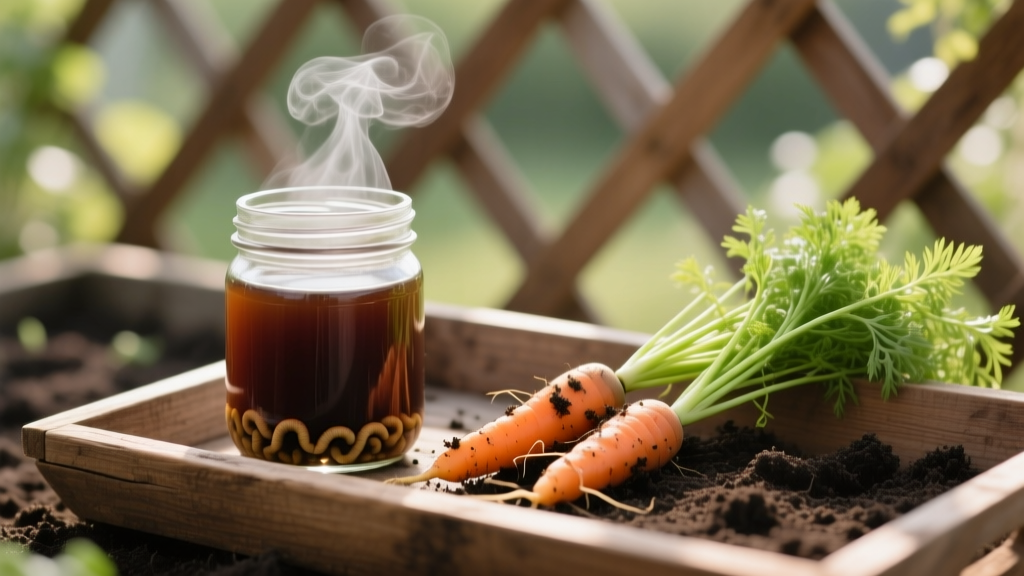
How to Make Worm Tea for Carrots
You pull a carrot and it looks like it’s wearing a beard—hairy side roots everywhere, with a stubby forked tip instead of that clean, straight root you pictured. The tops looked fine, you watered “pretty regularly,” and you even sprinkled compost. So what happened? Most of the time it’s not a mystery pest—it’s uneven moisture, lumpy soil, or too much fast nitrogen at the wrong time. Worm tea can help, but only when you brew it right and apply it like a carrot grower, not like you’re feeding tomatoes.
I use worm tea as a gentle, biology-forward feed that supports steady growth and better nutrient uptake. For carrots, “steady” is the whole game. Big swings (dry to soaking wet, hungry to overfed) make roots split, fork, or turn woody. This article walks you through brewing worm tea safely, applying it at the right dilution, and matching it to carrot needs—watering, soil, light, feeding, and troubleshooting included.
What “worm tea” actually is (and what it isn’t)
Gardeners use “worm tea” to mean two different liquids, and mixing them up causes most of the problems.
- Vermicompost tea (recommended): A brewed extraction of worm castings (vermicompost) in water, often aerated for 12–24 hours. This is what we’re making for carrots.
- Worm bin leachate (use caution): The liquid that drains out of a worm bin. It can go anaerobic and may contain plant pathogens if the bin conditions are off. Many extension-style resources advise caution with raw leachate, especially on edible crops.
When I say “worm tea” below, I mean aerated vermicompost tea made from finished castings. If all you have is leachate, I’ll give you a safer way to handle it later—just don’t splash it straight onto carrot beds and call it good.
What carrots need from feeding (a reality check)
Carrots are light feeders compared to leafy greens. They like moderate fertility and consistent moisture. Too much readily available nitrogen early can produce lush tops and hairy, misshapen roots. Too much late can delay maturation and reduce storage quality.
Worm tea shines here because it’s typically mild. It supports soil biology and provides a small nutrient nudge without pushing a nitrogen surge—if you dilute it correctly and don’t apply it too often.
“Compost tea should be made with care to avoid conditions that favor human pathogens; use clean water, clean equipment, and apply in a way that minimizes contact with the edible portion.” — Oregon State University Extension (2015)
That’s not meant to scare you off—it’s meant to keep your process clean and your harvest safe.
Method comparison: Aerated worm tea vs. simple soak (and why it matters)
There are two common ways home gardeners make worm tea. One is a quick soak; the other uses aeration. Both can work, but they behave differently in a carrot bed.
| Method | Typical brew time | Oxygen level | Best use on carrots | Main risk |
|---|---|---|---|---|
| Aerated vermicompost tea (ACT) | 12–24 hours at 60–75°F (16–24°C) | High (if pump is sized right) | Soil drench early and mid-growth for steady nutrition | Over-brewing or dirty equipment can sour the batch |
| Non-aerated “soak” tea | 24–48 hours | Lower; can turn anaerobic | Emergency mild feed when you can’t run a pump | Stink/anaerobic conditions; inconsistent results |
| Worm bin leachate (drain liquid) | Instant | Variable; often low | Best avoided on edible roots unless composted/treated | Pathogen risk; unstable biology |
If you want repeatable results on carrots, go aerated and keep the brew short and clean.
How to make worm tea for carrots (step-by-step)
What you’ll need
- Finished worm castings: 1 cup (about 250 mL) per 1 gallon (3.8 L) water, or 2 cups per 5 gallons (19 L) for a mild batch
- Dechlorinated water: If using tap water, let it sit 24 hours or use a carbon filter
- Air pump + air stone: Sized for your bucket (a small aquarium pump can work for 1–2 gallons; for 5 gallons use a stronger pump meant for larger tanks)
- Mesh bag or old nylon stocking for holding castings (optional but keeps sprayers from clogging)
- Bucket: Food-grade if possible
- Unsulfured molasses (optional): 1 teaspoon per gallon (too much can cause runaway growth and oxygen crash)
- Thermometer (helpful): Aim for 60–75°F (16–24°C)
Brewing instructions (my reliable home-garden method)
- Clean your gear. Rinse bucket, stone, tubing, and any mesh bag. A quick wash with hot soapy water and a thorough rinse is usually enough.
- Fill with water. Add 1 gallon (3.8 L) dechlorinated water to your bucket.
- Add castings. Put 1 cup worm castings into a mesh bag and suspend it in the water, or add directly and plan to strain later.
- Add molasses (optional). Use 1 teaspoon per gallon. Skip it if your castings are very rich or if your temps are above 75°F (24°C).
- Aerate hard. Run the air pump so the surface looks like it’s steadily boiling—lots of movement, not a lazy bubble.
- Brew 12–24 hours. At 60–75°F (16–24°C), 18 hours is a sweet spot. If your brew smells sour, sulfur-y, or “rotten,” discard it.
- Use immediately. Apply the same day. Once aeration stops, biology shifts quickly.
Smell test: Good worm tea smells earthy and sweet like healthy soil. Bad tea smells like a swamp. Trust your nose.
Straining and application tools
If you’re using a watering can or soil drench, straining isn’t critical. If you plan to use a sprayer, strain through a fine mesh or old T-shirt. Carrot foliage doesn’t need spraying for nutrition in most home gardens, and spraying adds food-safety complexity, so I usually stick to soil drenches.
How to apply worm tea to carrot beds (timing, dilution, and frequency)
For carrots, I treat worm tea like a light supplement, not a main fertilizer.
Dilution rates that work
- Young seedlings (true leaf stage): Dilute 1:10 (1 part tea to 10 parts water).
- Actively growing carrots (2–6 weeks after emergence): Dilute 1:5.
- Midseason boost (root bulking): Dilute 1:5 to 1:3 only if growth is pale/slow and soil is not already rich.
If you’re not sure, start at 1:10. You can always apply again; you can’t un-apply an overfeed that triggers hairy roots.
How much to apply
As a soil drench, aim for about 1 quart (1 L) of diluted tea per 4 square feet (0.37 m²). You’re moistening the root zone, not flooding it.
Best timing
- First application: When seedlings are 2–3 inches tall (5–8 cm).
- Second application: 2–3 weeks later.
- Optional third: Another 3–4 weeks later if your soil is sandy, your tops are pale, or growth is sluggish.
Stop liquid feeding about 2–3 weeks before harvest if you’re growing for storage. At that point, consistent watering matters more than extra nutrition.
Watering carrots (the part most people get wrong)
If you want straight, sweet carrots, water rhythm matters more than worm tea. Carrots need steady moisture so the root expands smoothly.
A practical watering target
Most carrot beds do well with about 1 inch of water per week (rain + irrigation), adjusted for heat, wind, and soil type. Sandy soil may need smaller doses more often; clay needs less frequent but deeper watering.
Three watering rules I follow
- Keep the seed zone damp until germination. Carrot seeds can take 7–21 days to sprout. A dry crust can wipe out a whole sowing.
- Water deeply once roots are established. Aim to wet soil down 6–8 inches (15–20 cm).
- Avoid “feast or famine.” Big swings cause splitting and bitterness.
Scenario #1: Heat wave hits and your carrots start splitting
What happens: Dry spell slows root growth; then a heavy watering or storm makes roots swell too fast and crack.
What to do:
- Water in smaller amounts more frequently for 7–10 days to stabilize moisture.
- Mulch with 1–2 inches of clean straw or shredded leaves (keep it light over seedlings).
- Hold off on worm tea until moisture is stable again; feeding during a moisture swing can amplify cracking.
Soil for carrots: where worm tea helps (and where it can’t)
Carrots want soil that’s deep, loose, and stone-free. Worm tea helps biology, but it won’t fix a bed full of rocks or clods.
Carrot soil checklist
- Texture: Loose loam or sandy loam is ideal; heavy clay needs serious prep.
- Depth: Loosen to 10–12 inches (25–30 cm) for maincrop varieties.
- pH: Aim for 6.0–6.8. (If you’re outside that range, address pH first; carrots get finicky.)
- Fresh manure: Skip it. Fresh manure and high-N amendments are classic causes of forked, hairy roots.
North Carolina State Extension notes carrots perform best in loose, well-drained soils and emphasizes pH management for root crops (NC State Extension Publication, 2023).
Scenario #2: Beautiful tops, ugly roots (hairy and forked)
Likely causes:
- Lumpy/compacted soil or stones
- Excess nitrogen (especially early)
- Root disturbance (thinning too late, or weeding aggressively)
Fix it next round:
- Prep a deeper, finer seedbed; sift compost if it’s chunky.
- Use a light compost application (½–1 inch) worked into the top few inches, not a big nitrogen dump.
- Use worm tea diluted 1:10 early, no more than twice unless plants are clearly pale.
Light and spacing: keep growth steady
Carrots want full sun: 6–8 hours is a good baseline. In very hot climates, a little afternoon shade can reduce stress, but too much shade leads to weak tops and slow root sizing.
Spacing that prevents runts
- Thin to: 2–3 inches (5–8 cm) apart for most varieties.
- Row spacing: 10–12 inches (25–30 cm) is comfortable for weeding and airflow.
Overcrowding is sneaky: carrots may look fine above ground, but the roots stay skinny. Worm tea won’t fix a spacing problem.
Feeding plan: worm tea + simple soil building (no overthinking)
I like a two-part plan: build the soil before planting, then use worm tea as a gentle in-season assist.
Before planting
- Add ½–1 inch finished compost and work it into the top 4–6 inches (10–15 cm).
- If you use a granular organic fertilizer, pick a balanced, modest one and follow label rates—avoid heavy nitrogen.
During the season (worm tea schedule)
- Week 2–3 after emergence: 1:10 soil drench
- Week 4–6: 1:5 soil drench
- Week 8–10 (optional): 1:5 only if plants are pale or growth stalls
One more data point worth knowing: food-safety guidance commonly suggests a 90–120 day interval between applying raw manure and harvesting crops that contact soil. Worm castings are not raw manure, but the principle—keep inputs clean and avoid splashing edible portions—still matters for root crops. Use clean materials and soil-drench rather than foliar spray when you can (National Organic Program guidance is commonly referenced; check your local extension for the most current interpretation).
Common problems and troubleshooting (with specific symptoms)
Problem: Tea smells bad (rotten eggs, sour, swampy)
Symptoms: Off odor, slimy film, few bubbles, dark froth.
Likely cause: Anaerobic brew from weak aeration, too much molasses, or brewing too long in warm temps.
Fix:
- Discard the batch (don’t “dilute and hope”).
- Next time brew 12–18 hours, reduce molasses to ½–1 tsp/gal, and increase aeration.
- Keep brew temp under 75°F (24°C).
Problem: Carrot tops are lush, roots are thin
Symptoms: Big greens, pencil roots, slow bulking.
Likely cause: Too much nitrogen, too much shade, or overcrowding.
Fix:
- Stop feeding (including worm tea) for 2–3 weeks.
- Thin to 2–3 inches.
- Ensure 6–8 hours sun; remove shading if possible.
Problem: Pale leaves, slow growth (especially in sandy soil)
Symptoms: Light green tops, stalled growth, small roots.
Likely cause: Low fertility or nutrients leaching in sandy beds; inconsistent moisture can also mimic deficiency.
Fix:
- First correct watering to ~1 inch/week, evenly applied.
- Apply worm tea at 1:5 as a soil drench, then reassess in 7–10 days.
- Top-dress with a thin layer of compost (¼ inch) if the bed is clearly low in organic matter.
Problem: Forked or twisted carrots
Symptoms: Split “legs,” bent roots, multiple tips.
Likely cause: Stones, compacted soil, fresh manure, or transplanting/disturbing the taproot.
Fix:
- Grow carrots where you can loosen soil to 10–12 inches.
- Remove rocks; avoid chunky undecomposed compost.
- Direct sow; thin early by snipping seedlings at soil level instead of pulling.
Problem: Bitter or woody carrots
Symptoms: Tough texture, strong flavor, poor sweetness.
Likely cause: Heat stress, drought stress, or harvesting too late.
Fix:
- Maintain steady moisture; mulch helps.
- Harvest on time—many varieties size up in 65–80 days (check your packet).
- Don’t overfeed late; focus on watering consistency instead.
Real-world ways gardeners use worm tea on carrots (3 scenarios)
Scenario #3: Container carrots that stall midseason
Containers dry out fast and leach nutrients quickly, especially in hot weather. If your container carrots hit 4–6 inches of top growth and then seem to pause, you’re usually seeing a moisture-nutrient combo issue.
- Water until it runs out the bottom, then water again when the top 1 inch is dry.
- Apply worm tea at 1:5 every 14 days for a month.
- Make sure the container is at least 10–12 inches deep for standard varieties (or pick a shorter cultivar).
Scenario #4: A new raised bed built with “hot” compost
Brand-new beds are great, but if the compost isn’t fully finished, it can be too salty or too active biologically, stressing seedlings.
- Hold worm tea until seedlings have 2–3 true leaves.
- Water consistently for two weeks to help the bed stabilize.
- Then use a mild worm tea dilution 1:10 once, not repeatedly.
Scenario #5: Heavy clay in-ground bed that crusts over
Clay can grow excellent carrots if you loosen deep and manage the surface crust, but it takes prep.
- Work in compost and create a fine seedbed; consider a thin layer of screened compost on top for sowing.
- Use a light mulch (like grass-free straw) once seedlings are established.
- Use worm tea sparingly—clay holds nutrients. Apply 1:10 once early, then only if plants show pale growth.
Safety and best practices for edible root crops
Carrots grow in direct contact with soil, so keep your worm tea process clean and sensible.
- Use finished castings from a well-managed worm bin (no raw meat/dairy, no pet waste).
- Use clean water and clean equipment.
- Soil drench is safer than foliar spraying for root crops you’ll pull from the ground.
- Apply in the morning so surfaces dry quickly.
- Rinse harvested carrots well and scrub if needed—standard practice, worm tea or not.
For additional context on compost tea safety and handling, see Oregon State University Extension guidance (2015) and related extension publications that emphasize clean inputs and careful application on edible crops.
If you only remember five things
- Brew from castings, not mystery bin drips.
- Keep brew temp around 60–75°F (16–24°C) and brew 12–24 hours.
- Dilute for carrots: start at 1:10, move to 1:5 if needed.
- Water consistently—aim around 1 inch/week and avoid big swings.
- Loose, stone-free soil to 10–12 inches beats any liquid feed.
Once you’ve got the basics—steady water, a fine seedbed, and reasonable spacing—worm tea becomes a handy tool rather than a rescue remedy. Brew it clean, keep it mild, and apply it like you’re aiming for calm, even growth. That’s how you get carrots that pull clean, snap crisp, and taste like they’re supposed to.
Sources: Oregon State University Extension (2015); North Carolina State Extension Publication on carrot production and soil/pH considerations (2023).