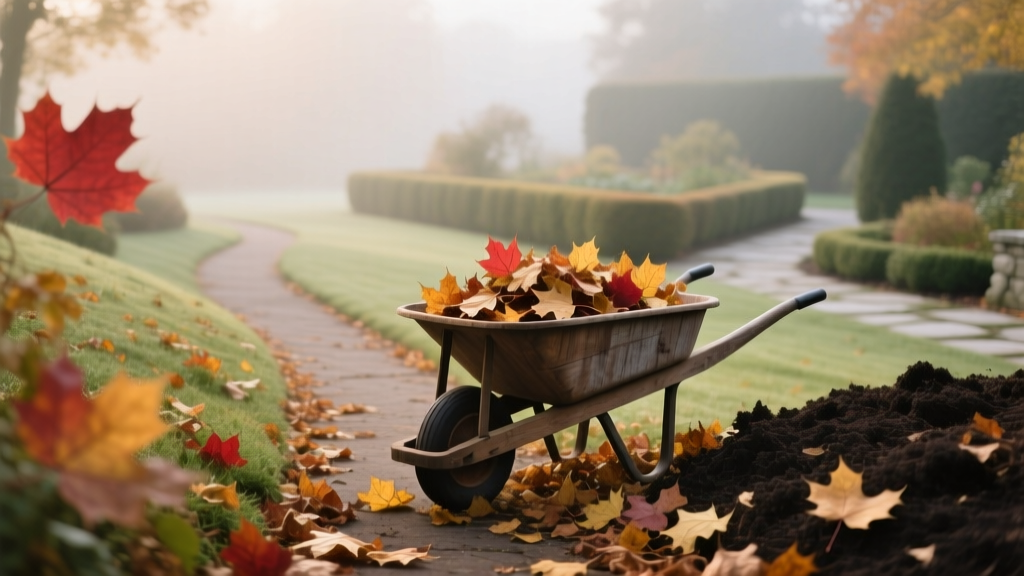
Fall Garden: Leaf Collection for Mulch and Compost
The next 4–8 weeks are make-or-break for next year’s soil. Fallen leaves are arriving in waves, and if you capture them now—before they mat, blow away, or get hauled to the curb—you can stockpile mulch, build compost, suppress winter weeds, and protect roots from freeze-thaw. The goal isn’t a spotless yard. The goal is to turn an annual “mess” into a predictable supply chain: collect, shred, store, apply.
Use this guide as a seasonal work order. Start with the high-impact tasks that must happen before hard frost, then move into prep work you can do after the first freeze. Timing notes below reference average first-frost windows and soil temperatures; adjust to your local conditions and USDA hardiness zone.
Priority #1 (This Week): Collect and Sort Leaves Before They Turn into a Wet Mat
Wet, compacted leaves shed water and slow down decomposition. Dry leaves shred better, store better, and make better mulch. The sweet spot is after a dry day, when leaves are crisp and before a multi-day rain.
Quick timing targets (use these numbers)
- Start collecting when nighttime lows regularly hit 45–50°F and leaf drop accelerates (often mid-October to mid-November depending on region).
- Plan to finish heavy collection 1–2 weeks before your average first hard frost (28°F)—not because leaves stop falling, but because your attention will shift to protection tasks.
- Apply leaf mulch after soil cools to about 50°F or lower to avoid creating a warm habitat for late-season pests and to reduce vole activity.
- For compost: aim for a pile that can hold 131°F (55°C) for several days if you’re hot-composting (use a long-stem thermometer).
- Leaf mold (cold compost) takes 6–12 months; shredded leaves can be ready in 6–8 months under good moisture and airflow.
Leaf triage: what to keep, what to skip
- Keep: most deciduous leaves (maple, birch, ash, poplar, fruit trees). These are reliable carbon (“brown”) for compost and make excellent mulch when shredded.
- Use with restraint: oak and beech (tougher; shred well and mix with greener materials), walnut (can contain juglone; compost thoroughly before using around sensitive plants).
- Skip or handle separately: leaves with visible disease lesions (tar spot, severe scab, heavy mildew). Hot compost only, or remove from the garden area to reduce reinfection pressure.
“Composting is a good way to recycle yard trimmings. For best results, use a mix of ‘brown’ and ‘green’ materials and maintain adequate moisture and aeration.” — University of Minnesota Extension (2020)
Citation: University of Minnesota Extension, “Composting at home” (2020).
How to collect efficiently (and keep your back happy)
- Mow-and-catch method: Run a mower with a bagger over dry leaves to shred and collect in one pass. Shredded leaves pack tighter and compost faster.
- Tarp drag method: Rake onto a tarp, then drag to your storage area. Faster than wheelbarrows for big volumes.
- Vacuum/chipper: Helpful for large properties, but a mower is often enough if you go out weekly.
Checklist: “Today’s leaf run”
- Rake/collect leaves while dry
- Shred at least one batch (mower or shredder)
- Separate “clean” leaves from “questionable disease” leaves
- Fill one storage bin/bag for mulch, one for compost browns
- Clear leaves away from crowns of perennials to reduce rot
Priority #2 (Next 7–14 Days): Shred and Store Leaves so They’re Ready When You Need Them
Unshredded leaves are still useful, but shredding makes everything easier: better compost aeration, less matting as mulch, faster breakdown. If you only do one “extra” step this fall, make it shredding.
Simple storage options
- Wire ring or hardware-cloth bin: 3–4 feet in diameter; breathes well and holds a lot.
- Paper leaf bags: Good for shredded leaves; store under cover so they don’t turn to mush.
- Trash can with holes drilled: Keeps leaves contained and dry; add a lid for rain protection.
Label at least two categories: “Mulch-grade shredded” (clean, dry, shredded) and “Compost browns” (anything else that’s still safe). This prevents you from spreading potential disease back onto beds.
Leaf mulch vs. compost: when to use which
| Goal | Best leaf approach | How thick to apply | Best timing | Watch-outs |
|---|---|---|---|---|
| Suppress winter weeds / reduce erosion | Shredded leaf mulch | 2–4 inches | After soil cools (≤50°F) | Keep 2–3 inches away from plant crowns |
| Improve soil structure long-term | Compost (finished) or leaf mold | 1–2 inches top-dressed | Anytime soil is workable | Don’t dig deeply in fall; top-dress instead |
| Build a hot compost pile fast | Shredded leaves + green nitrogen | N/A (pile) | Now through first freeze | Needs moisture and turning; avoid too many leaves at once |
| Protect tender roots from freeze-thaw | Shredded leaves as insulating mulch | 3–6 inches after ground cools | After first hard frost (28°F) | Voles/rodents can nest if mulch is too fluffy near stems |
Citation: Cornell Waste Management Institute notes that leaves are a valuable carbon source and shredding improves composting efficiency; Cornell University (2021).
Priority #3 (Timing Window: 2–6 Weeks Before First Frost): What to Plant Right Now (Using Leaf Mulch as the Finishing Step)
Leaf work pairs naturally with fall planting. Plant first, water in, then mulch with shredded leaves after the soil cools. For many gardeners, this is late September through November depending on USDA zone.
Garlic and shallots
Plant garlic 2–4 weeks before the ground freezes. In many Zone 5 areas, that’s often mid-October to early November; in Zone 7, it may be late November. Plant cloves 2–3 inches deep, then add 3–4 inches of shredded leaf mulch after a hard frost (28°F) to stabilize soil temperatures.
Spring bulbs
Plant tulips, daffodils, and crocus when soil temperatures drop to about 55°F or lower. Mulch lightly (2 inches shredded leaves) after planting to reduce heaving and protect from temperature swings.
Cool-season greens (mild-winter regions)
If you’re in USDA Zones 8–10, fall is prime planting time for kale, arugula, spinach, and lettuces. Use leaf mulch between rows to reduce mud splash (a disease driver) and to buffer moisture as rains increase.
Cover crops (all regions with workable soil)
Where winters aren’t too severe, sow winter rye or a rye/vetch mix 4–6 weeks before first frost so it can establish. In colder regions, oats can be sown earlier and will winter-kill, leaving an easy spring mulch. Leaf mulch can be applied around edges and pathways to control weeds while the cover crop does its job in beds.
Priority #4 (This Month): What to Prune (and What Not to Prune) While Leaves Are Falling
Fall pruning is where gardeners lose shrubs to winter dieback. Use a conservative approach: remove the obviously broken, diseased, or dangerous—save shaping for late winter or early spring.
Do prune now
- Dead, diseased, damaged wood (anytime). Make clean cuts and sanitize tools when disease is present.
- Perennials with severe foliar disease (powdery mildew-riddled phlox, blackened peony leaves). Remove and dispose; don’t add to a cool compost pile.
- Tomatoes/annual veggies after frost: remove vines and fallen fruit to reduce overwintering pests and disease.
Don’t prune now (or prune lightly)
- Spring-flowering shrubs (lilac, forsythia, azalea): buds are already set; pruning now removes spring bloom.
- Roses (major pruning): in Zones 4–6, heavy fall pruning can stimulate growth that dies back. Wait until spring; only shorten extra-tall canes if wind-rock is a problem.
- Hydrangeas (many types): pruning timing depends on type; if unsure, don’t prune now—just clean up leaves and mulch roots.
Pest and disease angle: Leaving infected leaves under apples (apple scab) and roses (black spot) increases spring infection pressure. Several extension services recommend sanitation—removing or hot-composting diseased leaves—to reduce carryover. Citation: Penn State Extension, home orchard disease sanitation guidance (2019).
Priority #5 (After First Hard Frost or When Soil Is Cold): What to Protect Using Leaves
Leaves are insulation. The mistake is applying them too early, when warm soil encourages rodents and keeps plants too cozy. Wait until plants are dormant and the soil surface is cooling.
Perennials and bulbs: prevent heaving
In climates with freeze-thaw cycles (common in Zones 4–7), apply 3–6 inches of shredded leaves after the first hard frost (28°F) or when daytime highs regularly stay below 50°F. Keep mulch back from crowns to prevent rot.
Strawberries: a targeted leaf blanket
After several nights in the 20s°F, cover strawberry beds with 3–5 inches of clean, loose mulch (pine needles are classic; shredded leaves also work). The goal is to keep crowns consistently cold, not warm.
Young trees and shrubs: rodent and sunscald prevention
- Pull leaf mulch 6 inches away from trunks to reduce vole damage.
- Install trunk guards for young fruit trees in vole-heavy areas.
- In sunny, cold regions (High Plains, mountain states), consider white tree wrap to reduce sunscald on thin-barked species.
Container plants (Zones 3–7 especially)
If you overwinter pots outdoors, cluster them in a sheltered spot and surround pots with bagged leaves for insulation. Containers experience colder root temperatures than in-ground plants—often equivalent to 1–2 USDA zones colder. Keep potting mix slightly moist going into deep winter.
Priority #6 (Anytime After Cleanup): What to Prepare for Better Compost and Fewer Spring Problems
Fall leaf management is also pest management. The goal is to reduce overwintering habitat for disease and insects, while still keeping enough organic cover to protect soil.
Build a leaf-driven compost pile that actually heats up
Leaves are carbon-rich; to compost efficiently, pair them with nitrogen. A practical home recipe is roughly 3 parts shredded leaves to 1 part “greens” by volume (greens: fresh grass clippings, garden trimmings, coffee grounds, manure). Keep the pile as moist as a wrung-out sponge.
- Pile size: at least 3’ x 3’ x 3’ for heat retention.
- Temperature: aim for 131–160°F (55–71°C) in a hot pile; turn when temps fall and the center cools.
- Reality check: if you can’t turn a pile in winter, build it now, let it heat once or twice, then let it finish slowly.
Citation: USDA NRCS and university extension compost guidance commonly cites 131°F as a pathogen/weed-seed reduction threshold for managed compost; see Washington State University Extension composting publications (2018).
Leaf mold: the “set it and forget it” option
If turning isn’t your style, make leaf mold. Stuff shredded leaves into a wire bin, wet them thoroughly, and wait. By next fall (6–12 months), you’ll have a dark, crumbly soil conditioner that improves moisture retention without the intensity of hot compost.
Pest and disease prevention: fall-specific moves
- Apple/pear trees: remove fallen fruit (“mummies”) and heavily spotted leaves to reduce scab and insect carryover.
- Vegetable beds: pull stakes and cages; scrub and disinfect tomato supports to reduce early blight/Septoria carryover.
- Slugs: reduce thick, wet leaf mats right against tender crowns; use shredded leaves and keep a small “dry collar” around susceptible plants.
- Voles: avoid piling leaves thickly around trunks and shrub bases; stomp down fluffy mulch in vole-prone areas or switch to a thinner, denser mulch layer.
Monthly Leaf-Mulch Schedule (Adjust by Region and USDA Zone)
| Month | Primary leaf task | Garden actions paired with it | Temperature / timing trigger |
|---|---|---|---|
| September | Start first leaf collections; begin shredding stockpile | Sow cover crops; prep garlic beds | Night lows trending 50°F |
| October | Weekly leaf runs; fill storage bins; start compost pile | Plant garlic/bulbs (Zones 3–7); clean veggie beds | 2–6 weeks before average first frost |
| November | Finish major collection; apply mulch after soil cools | Protect perennials; wrap young trunks if needed | After first hard frost (28°F) or soil ≤50°F |
| December | Check mulch coverage after wind; store remaining shredded leaves dry | Monitor vole activity; keep crowns uncovered | After repeated freezes; before deep snow |
Regional Scenarios: Adjust Your Leaf Plan to Your Reality
Leaf strategy changes with winter pattern, rainfall, and how fast the ground freezes. Use the scenario that fits best, then borrow tips from the others.
Scenario 1: Upper Midwest / New England (USDA Zones 3–5): fast freeze, frequent thaw
Your biggest risk is freeze-thaw heaving and a sudden deep freeze after warm spells. Prioritize shredded leaf mulch for perennials and bulbs after dormancy. Build compost early—once daytime highs stay in the 40s°F, piles cool quickly.
- Target: finish garlic planting by late October to early November (local first frost often mid-October; hard freezes can follow quickly).
- Apply 3–6 inches shredded leaves after 28°F nights arrive.
- Keep trunks clear; vole pressure increases under deep mulch and snow.
Scenario 2: Pacific Northwest / Maritime climates (Zones 7–9): long, wet fall
Your biggest risk is leaf mats that stay wet, leading to slime, slugs, and anaerobic compost. Shredding matters here more than anywhere. Store shredded leaves under cover so you have dry material to balance wet kitchen scraps all winter.
- Collect leaves ahead of heavy rain events; shred and tarp-cover immediately.
- Use thinner mulch layers (2–3 inches) to avoid creating a slug hotel.
- Compost: add structure (small twigs, shredded leaves) to keep airflow.
Scenario 3: Mid-Atlantic / Southeast (Zones 7–9): warm fall, slow dormancy
Your biggest opportunity is extended planting season. Leaves become mulch for winter weeds and a moisture buffer for fall crops. Your biggest risk is applying mulch too early while soil is still warm, which can shelter pests.
- Wait to mulch thickly until soil cools closer to 50°F.
- Keep fall vegetables going; use shredded leaves between rows to reduce soil splash and foliar disease.
- Hot composting can continue longer; monitor moisture as rains vary.
Scenario 4: Dry Intermountain West / High Plains (Zones 4–7): wind and low humidity
Your biggest risk is leaves blowing away and compost piles drying out. Your biggest opportunity is using leaf mulch to protect soil from wind erosion and to retain moisture.
- Contain leaves immediately (wire bins, lidded cans, bags).
- Wet compost layers thoroughly; dry leaves can stay unchanged for months without moisture.
- Mulch after watering beds deeply; mulch holds that moisture in place.
Timelines You Can Follow (Pick One and Execute)
14-day “Leaf-to-Mulch” sprint
- Day 1–3: Collect and shred 10–20 bags’ worth (or fill one wire bin). Separate clean from diseased.
- Day 4–7: Top-dress garden beds with 1–2 inches compost (if ready). Clear leaves away from crowns.
- Day 8–10: Plant garlic/bulbs where appropriate; water in.
- Day 11–14: After a cold snap (nights near 28–32°F), apply shredded leaf mulch to beds and around perennials.
30-day “Leaf-to-Compost” build
- Week 1: Stockpile shredded leaves under cover; gather nitrogen sources.
- Week 2: Build a 3’ cube pile; wet each layer.
- Week 3: Monitor temperature; if it peaks above 131°F, turn once after it begins to fall.
- Week 4: Turn again if you can; otherwise, cap with shredded leaves and let it finish over winter.
Practical “Do / Don’t” Rules for Leaf Mulch in Beds
Do use shredded leaves 2–4 inches deep on bare soil to block winter annual weeds (chickweed, henbit). Don’t bury crowns—leave a visible gap around the base of perennials.
Do keep leaf mulch off tree trunks and shrub stems (6-inch clearance). Don’t create a hidden rodent runway right up to the bark.
Do mulch after the soil cools (around 50°F) or after a hard frost (28°F) for insulation. Don’t apply thick mulch early in warm falls; it can delay dormancy and harbor pests.
Do shred leaves for paths—your future self will appreciate mud-free winter access. Don’t leave slick, whole leaves on hard surfaces (they’re a slip hazard and stain concrete).
Tool and Supply List (Keep It Simple)
- Leaf rake plus a stiff garden rake
- Tarp (8’x10’ or larger) for dragging
- Mower with bagger or mulching blade
- Wire bin or breathable storage setup
- Long-stem compost thermometer (optional but useful)
- Trunk guards if voles are common in your area
If you do nothing else this fall, do this: shred a stash of clean leaves and keep them dry. In spring, that stash becomes instant mulch for new plantings and the carbon you need to keep compost from turning slimy.
Once you’ve gotten one good leaf collection cycle under your belt, the fall yard becomes predictable: weekly pickup, shred, store, then apply when the temperature cues line up. That’s the quiet advantage of autumn—turning a short season of abundance into year-round soil resilience.