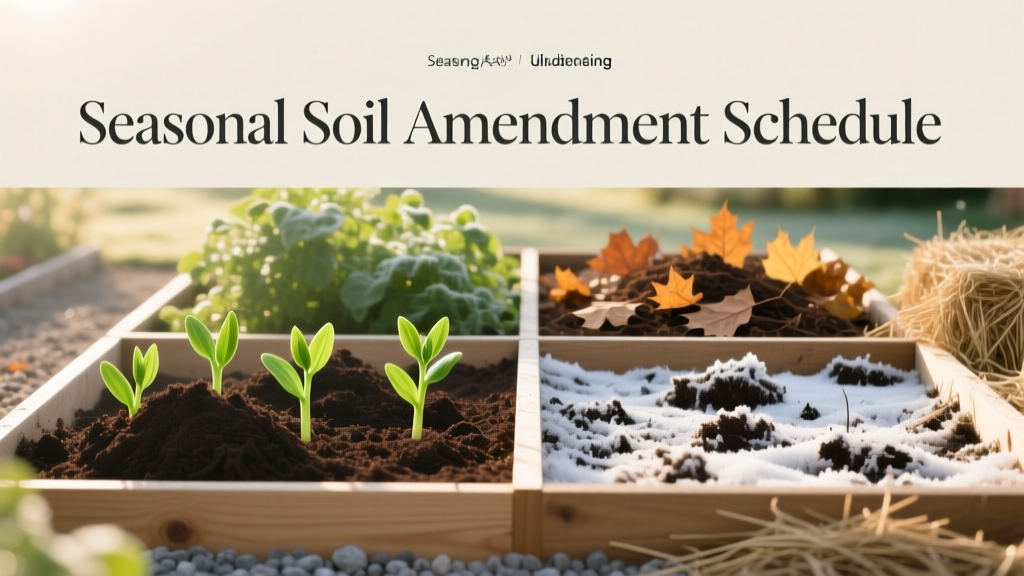
Seasonal Soil Amendment Schedule
Right now is when soil work pays off twice: you get faster spring growth (because roots hit fertile, well-structured soil early), and you prevent summer problems (blossom end rot, chlorosis, drought stress) before they start. The window is short: once soils warm and beds fill with seedlings, you’ll be correcting deficiencies reactively instead of building a steady nutrient and moisture supply. Use this seasonal schedule to decide what to amend this week, what to hold until temperatures rise, and what to avoid so you don’t burn plants or waste money.
To make this actionable, the tasks below are organized by priority—what to plant, what to prune, what to protect, what to prepare—with timing anchors like soil temperature, frost dates, and week-by-week triggers. Adjust for your USDA hardiness zone and your region’s spring pattern (wet/cold, warm/dry, or late-frost).
Priority 1: What to prepare first (soil tests, structure, and baseline amendments)
Week 1 (as soon as the ground is workable): Test, observe, and stop compaction
Timing trigger: When a handful of soil crumbles instead of forming a wet ribbon, you can work it. If it forms a sticky ball, wait—working wet soil creates compaction that lasts all season.
Do now (45–60 minutes per bed):
- Soil test: If you haven’t tested in the last 2–3 years, pull a composite sample. Target a lab turnaround before planting heavy feeders. Many gardeners aim to sample 4–6 weeks before last frost so results arrive before bed prep.
- Quick field checks: Note drainage (standing water after a 1-inch rain), earthworm activity, and any crusting. These guide whether you prioritize organic matter, gypsum (only for sodic soils per test), or drainage work.
- Stop walking in beds: Set stepping stones or permanent paths. Soil structure improves more from avoiding compaction than from any bagged amendment.
“Soil testing is the only way to develop specific and meaningful fertilizer and lime recommendations.” — University of Minnesota Extension (2022)
Amendment baseline (most gardens): Add 1–2 inches of finished compost to vegetable beds annually, then lightly incorporate into the top 4–6 inches or leave as topdressing if you garden no-till. Compost supports water-holding in sandy soils and aggregation in clay soils.
Citation: University of Minnesota Extension, “Soil testing and fertilizer recommendations” (2022). Also see Oregon State University Extension guidance on compost use and nutrient management (2021).
Week 2–3 (2–4 weeks before last frost): Adjust pH and calcium early
Timing trigger: If your soil test recommends lime, apply it early—lime reacts slowly. Aim for at least 3–4 weeks before planting, longer if possible.
- Lime (if pH is low): Apply per soil test. Incorporate into the top 6 inches for faster effect. For most vegetables, a target pH of 6.2–6.8 is typical; blueberries want 4.5–5.5 and should not receive lime.
- Gypsum: Use only if your soil test or local guidance indicates sodium issues; gypsum is not a cure-all for clay.
- Calcium strategy for tomatoes/peppers: If your soil is low in calcium, correct early (lime or calcium sulfate depending on pH). Blossom end rot is often triggered by inconsistent moisture, but low available calcium raises risk.
Temperature anchor: Start serious bed prep once soil temperatures reach 40–45°F consistently; many cool-season crops can germinate near that threshold, but soil biology and nutrient cycling accelerate as soils approach 50°F.
Priority 2: What to plant (and how soil amendments change your planting window)
Cool-season planting (when soil is 40–50°F): feed lightly, focus on structure
Plant now (typical): peas, spinach, radish, lettuce, onion sets, and brassica transplants (broccoli, cabbage) if your region supports it.
Amendment approach: For cool-season beds, emphasize compost and modest nutrients. Heavy nitrogen too early can push soft growth that’s more aphid-prone and frost-sensitive.
- Compost: 1 inch topdress is usually enough for leafy greens.
- Starter phosphorus: If soil test is low, band a small amount near the seed row. Phosphorus is less available in cold soils; this is one case where placement beats quantity.
Date anchor examples: In many zone 6 areas with a last frost around April 15, cool-season sowing often starts March 15–April 1. In zone 5 with a last frost near May 10, shift that window to April 10–April 25. Use your local frost date as the master switch.
Warm-season planting (after soil is 60°F): time fertilizers to active uptake
Timing trigger: Tomatoes, peppers, basil, and beans perform best when soil temperatures are reliably 60°F (beans) and closer to 65°F (peppers). Planting earlier often stalls growth and invites disease.
Amendment approach: Warm-season crops can use more nutrition, but avoid dumping high-nitrogen fertilizer into cold soil—nutrients leach and seedlings don’t use them.
- At transplanting: Add compost + a balanced organic fertilizer (per label) worked into the top 3–4 inches.
- 2–3 weeks after transplanting: Side-dress heavy feeders (tomatoes, corn, squash) if growth is pale or slow—especially after heavy spring rain.
Citation: Oregon State University Extension (2021) notes compost contributes nutrients but should be managed with soil test awareness to avoid excess phosphorus buildup.
Priority 3: What to prune (and how pruning changes your soil plan)
Late winter to early spring (before bud break): prune, then feed woody plants correctly
Timing trigger: Prune most dormant deciduous fruit trees before buds swell—often 2–6 weeks before last frost, depending on region.
- Fruit trees: Prune for structure and airflow. Then apply compost under the drip line (not against the trunk) and mulch 2–4 inches deep.
- Raspberries/blackberries: Remove dead canes and thin for airflow. Avoid heavy nitrogen now; too much early nitrogen can increase soft growth and disease pressure.
- Roses: Prune when forsythia blooms (a reliable phenological cue in many regions). Follow with a light compost topdress.
Soil tie-in: After pruning, plants push new growth. That’s when steady moisture and moderate fertility matter most—mulch and compost do more for long-term vigor than quick-release nitrogen spikes.
Priority 4: What to protect (pests, diseases, and weather—built into the amendment schedule)
Prevent spring disease: stop splashing, reduce excess nitrogen, and protect seedlings
Many early-season diseases are cultural problems in disguise: wet leaves, splashing soil, and lush growth from excess nitrogen.
- Mulch timing: After seedlings emerge or transplants establish, add 1–3 inches of clean straw or leaf mold mulch to reduce soil splash (a major vector for fungal spores onto lower leaves).
- Water strategy: Water early in the day; keep foliage dry. Drip irrigation or soaker hoses pair well with compost-rich soils.
- Nitrogen restraint: If you already added manure or rich compost, hold off on extra N until plants show true demand (rapid growth stage). Too much N can worsen aphids and some foliar diseases.
Manure and food safety: use the right timing to protect harvests
If you use raw manure, timing matters for food safety.
- Apply raw manure: Ideally in fall. If spring is your only option, follow the 120-day rule before harvesting crops that touch soil (e.g., lettuce, carrots) and 90 days for crops that don’t touch soil, per USDA organic standards commonly adopted as best practice.
- Better spring option: Use finished composted manure from a reputable source for spring beds.
Weather protection: don’t seal cold, wet soil under mulch too early
Timing trigger: In cold-wet springs, wait to mulch thickly until soil temperatures are climbing toward 55–60°F. Mulching too early can slow warming and keep soils soggy, stressing seedlings and favoring slugs.
Slug alert: Cool, mulched beds can harbor slugs. Set beer traps or boards for monitoring, and thin mulch near tender seedlings until plants size up.
Monthly soil amendment schedule (use as your seasonal checklist)
| Month / Window | Soil Temp / Date Trigger | Top Amendments | Best Uses | What to Avoid |
|---|---|---|---|---|
| Late Winter (4–8 weeks before last frost) | Soil workable; no standing water | Soil test; compost planning; lime if recommended | Bed mapping, pH correction lead time | Tilling wet soil; high-N fertilizer on dormant beds |
| Early Spring (2–4 weeks before last frost) | Soil 40–50°F | 1–2" compost; light starter fertilizer if test indicates | Cool-season greens, peas, brassicas | Thick mulch on cold soils; excess nitrogen |
| Frost-to-Post-Frost (last frost week + 2 weeks) | Night lows above 35–40°F | Mulch after establishment; balanced fertilizer for transplants | Hardening off, transplant establishment | Overwatering; burying stems in raw compost/manure |
| Late Spring (2–6 weeks after last frost) | Soil 60–65°F | Side-dress heavy feeders; maintain mulch; calcium strategy | Tomatoes, peppers, beans, squash | Late heavy lime applications right next to seedlings |
| Summer Maintenance | Heat arrives; soil dries faster | Compost tea optional (not a fertilizer); mulch refresh; targeted feeding | Moisture stability, steady growth | Frequent shallow watering; repeated high-P additions without soil test |
| Fall Reset (6–10 weeks before first frost) | Soil still warm; growth slowing | Leaves for mulch/leaf mold; cover crops; compost application | Building organic matter for next year | Leaving bare soil over winter |
Regional and real-world scenarios (adjustments that matter)
Scenario 1: Cold-wet spring (Pacific Northwest, Great Lakes, Northeast; many zones 4–8)
If spring rains linger and soils stay saturated, your main enemy is compaction and root rot—not lack of fertilizer.
- Switch to raised beds or broadfork instead of deep tilling. Broadforking opens channels without smearing clay.
- Amendment priority: Compost + coarse mulch later; avoid adding sand to clay (it can create a cement-like texture unless you add very large amounts).
- Disease prevention: Keep lower leaves off the soil; mulch once soils hit 55°F to reduce splash.
- Timing tip: Delay warm-season planting until soil reaches 60°F even if the calendar says it’s time; cold soil stalls roots and invites fungal issues.
Scenario 2: Warm spring with early heat (parts of the South, Southwest, zones 8–10)
When heat arrives early, the soil amendment schedule must lock in moisture retention and protect soil biology from baking.
- Amendment priority: Compost for water-holding + mulch earlier (as soon as transplants establish) to cut evaporation.
- Fertilizer timing: Split applications—smaller doses every 3–4 weeks for heavy feeders—reduce salt stress and keep growth steady.
- pH watch: Many arid-region soils run alkaline; don’t apply lime by habit. Use sulfur only if soil test recommends and apply months ahead for best effect.
- Pest pressure: Early aphids and whiteflies thrive on over-fertilized, lush plants—keep nitrogen moderate and encourage airflow.
Scenario 3: Short season, late frosts (high elevation, northern plains, zones 3–5)
In short-season climates, you’re racing the calendar, but you still can’t force warm crops into cold soil.
- Warm soil faster: Use black landscape fabric or clear plastic to pre-warm beds for 10–14 days before transplanting (remove or vent clear plastic to avoid overheating).
- Amendment priority: Compost early + targeted starter fertilizer near transplants once soil is at least 50°F.
- Protection: Row covers buy 2–4°F of frost protection on calm nights and help seedlings establish faster, which improves nutrient uptake.
- Frost date anchor: If your last frost is around June 1, schedule warm-season planting closer to June 10–15 unless soil temperatures prove otherwise.
Soil amendment decision rules (fast, practical, and hard to mess up)
Use these rules when you’re standing in the garden with a bag of something and wondering if it’s worth applying.
- Rule 1: If you don’t know your pH, don’t add lime “just because.”
- Rule 2: If your soil is already dark, crumbly, and productive, compost is maintenance—not a license to over-fertilize.
- Rule 3: If you’re growing leafy greens, go easy on nitrogen early; steady moisture and moderate fertility reduce bolting and aphids.
- Rule 4: If you’re growing fruiting crops (tomato, pepper, squash), prioritize consistent watering + mulch, then feed in small side-dresses once growth takes off.
- Rule 5: If a bed puddles after rain, fix structure and drainage before adding more “food.” Roots need oxygen first.
Timelines you can follow this season (by frost date)
Find your local average last frost date, then work backward/forward using this checklist. (USDA zones help you estimate, but local frost dates vary by elevation and microclimate.)
6 weeks before last frost
- Order soil test or submit sample.
- Plan compost volume: roughly 0.6 cubic yards per 1-inch layer on a 1,000 sq ft area (scale to your beds).
- Identify beds for heavy feeders (tomatoes, corn, squash) vs light feeders (beans, peas).
4 weeks before last frost
- Apply lime per soil test (if needed).
- Spread 1–2 inches compost on beds you’ll plant early.
- Broadfork or lightly incorporate compost only if soil is dry enough to crumble.
2 weeks before last frost
- Direct sow cool-season crops if soil is near 40–50°F.
- Set up drip irrigation/soaker hoses before plants fill in.
- Scout for slugs in cool, wet beds; reduce hiding spots near seedlings.
Last frost week to +2 weeks
- Transplant brassicas and hardy herbs; protect with row cover if nights drop below 35°F.
- Mulch lightly after seedlings establish to prevent soil splash.
- Hold off on heavy feeding until plants show active growth.
+2 to +6 weeks after last frost
- Plant warm-season crops when soil is reliably 60–65°F.
- Side-dress heavy feeders at 2–3 weeks after transplanting.
- Refresh mulch to 2–3 inches for moisture stability and disease prevention.
Pest and disease prevention tied to soil amendments (don’t separate these)
Amendments change pest and disease pressure by changing plant growth rate, leaf tenderness, and soil moisture. The goal is balanced growth—fast enough to outgrow minor damage, not so lush that pests move in.
Cutworms, flea beetles, and tender transplants
- Cutworms: Use collars at transplanting; keep fresh, undecomposed organic debris away from seedling stems (it can shelter pests).
- Flea beetles: Row covers during establishment; avoid over-fertilizing arugula and brassicas with high N which can make foliage more attractive.
Damping-off and seedling losses
- Use well-finished compost; avoid thick layers of raw organic matter in seed rows.
- Ensure sharp drainage and avoid daily watering “just in case.” Let the surface dry slightly between waterings.
Blossom end rot prevention (tomatoes/peppers/squash)
- Correct calcium issues early (lime if pH low; gypsum if pH is fine but calcium is low per test).
- Mulch after establishment and water deeply—aim for consistent moisture rather than frequent shallow watering.
Citation: North Carolina State University Extension and other land-grant guidance consistently emphasize that blossom end rot is strongly tied to inconsistent moisture and calcium availability; managing irrigation and soil pH early is more effective than chasing symptoms mid-season (e.g., NC State Extension resources updated through 2020s).
Quick “right now” checklist (use this week)
Pick the list that matches your current conditions.
If your soil is still cold (below 50°F)
- Submit soil test if not done.
- Topdress compost (1 inch) and leave it—avoid aggressive tilling.
- Start cool-season sowing; avoid heavy fertilizer applications.
- Delay thick mulching until soils warm toward 55°F.
If your soil is warming (50–60°F)
- Transplant brassicas; direct sow carrots, beets, chard.
- Install irrigation lines; mulch lightly after emergence.
- Spot-correct deficiencies based on soil test (not guesswork).
If your soil is ready for warm-season crops (60–65°F)
- Plant beans, tomatoes, peppers (timed to soil temp, not just the calendar).
- Apply a balanced fertilizer at planting, then side-dress at 2–3 weeks.
- Mulch to 2–3 inches to stabilize moisture and reduce disease splash.
As the season moves forward, keep amendments boring and consistent: compost for structure, mulch for moisture stability, and fertilizer only when plant growth and soil tests justify it. If you do those three things on schedule—especially around the last frost date and the 60°F soil temperature threshold—your garden will look like you got a head start, even if you didn’t.