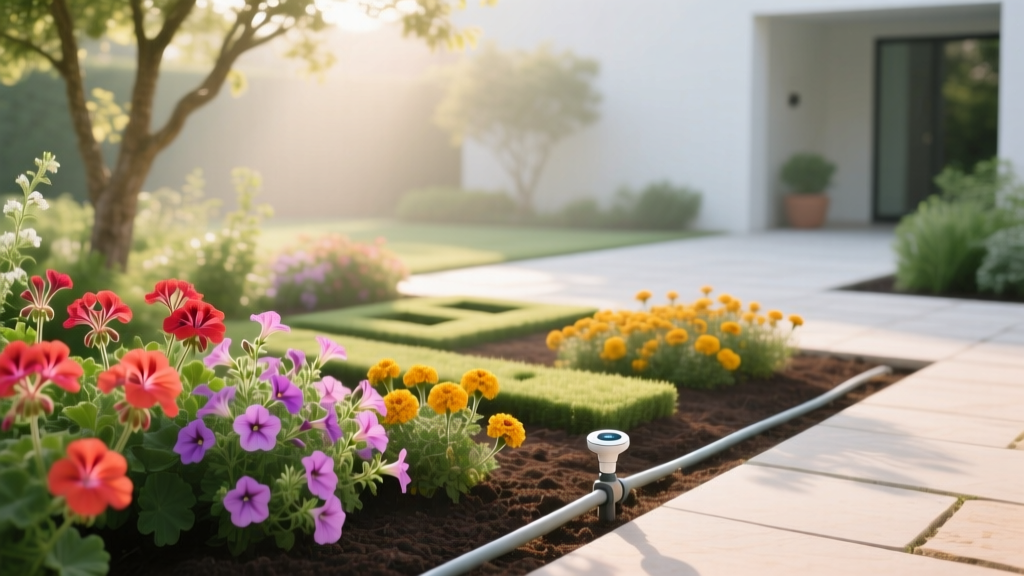
Summer Flower Bed Watering Strategies
Summer doesn’t politely “dry out” your flower beds—it pulls moisture out by the hour. A single windy 90°F day can undo a week of careful care, and the difference between thriving blooms and a bed full of wilted stems is usually not more water, but better-timed water delivered to the right place. If your forecast shows highs above 85°F for the next 7–10 days, treat watering like a weekly job schedule: plan it, measure it, and adjust it as conditions change.
This guide is organized by what to do first, with a strong emphasis on what you can do right now—plus timing thresholds (temperatures, inches, dates) you can actually use. You’ll also find regional variations for common U.S. summer patterns and a month-by-month watering rhythm you can copy into your garden notebook.
Top priority: Water smart (not just more)
Set your weekly “inch goal” (then verify)
Most established ornamental beds perform well with about 1 inch of water per week (rain + irrigation), delivered deeply rather than as daily sprinkles. During heat waves and on fast-draining soil, that target often rises to 1.5–2 inches/week. The critical move is measuring—don’t guess.
- Do this today: Put 3–5 straight-sided containers (tuna cans or rain gauges) around the bed. Run irrigation and record how long it takes to collect 0.5 inch. Double that time for a 1 inch week.
- Adjust for rain: If you get 0.6 inch of rain on Tuesday, you only need about 0.4 inch from irrigation that week.
- Use the soil test, not the leaf test: Check moisture 4–6 inches down with a finger or trowel. Leaves wilt for many reasons; soil tells the truth.
Extension recommendations consistently emphasize deep, infrequent irrigation over light daily watering for many landscape plants. North Carolina State University Extension notes that deep watering encourages deeper roots and improves drought tolerance (NCSU Extension, 2018).
Research finding: “Frequent, light irrigation encourages shallow rooting, increasing the likelihood of drought stress.” (NCSU Extension, 2018)
Water at the right hour (and pick a cutoff)
If you’re watering overhead, timing matters for disease pressure. Aim for early morning, typically between 4 a.m. and 9 a.m.. This reduces evaporation compared with midday and allows foliage to dry faster than evening watering.
- Morning target: Finish irrigation by 9 a.m. during humid spells.
- Heat-wave exception: If plants are collapsing in 95°F+ heat, a brief “rescue” trickle at the root zone late afternoon can prevent permanent damage—but keep foliage as dry as possible.
For turf and many landscape plants, University of Florida IFAS also recommends early-morning irrigation to reduce evaporative loss and improve water efficiency (UF/IFAS Extension, 2020). While your flower bed isn’t turf, the physics of evaporation is the same.
Choose the delivery method that matches your bed
Drip irrigation and soaker hoses are the workhorses of summer: they place water at the root zone and keep foliage drier, which can reduce leaf spot issues. Overhead sprinklers can still work, but they raise disease risk and waste water on paths and mulch.
| Method | Best for | Typical runtime goal | Summer cautions |
|---|---|---|---|
| Dripline (0.5 gph emitters) | Mixed borders, perennials, shrubs | 60–120 minutes, 1–2x/week (measure!) | Clogs; check filters weekly in July/August |
| Soaker hose | Annual beds, dense plantings | 45–90 minutes, 1–2x/week | Uneven output on slopes; pin in place |
| Hand-watering at base | Containers, new plants, spot fixes | Until water penetrates 6 inches | Easy to under-water; apply slowly |
| Overhead sprinkling | Large beds when no other option | Short cycles to prevent runoff | Higher leaf disease risk; water early only |
Use cycle-and-soak on clay or compacted beds
If water puddles or runs off, don’t “water longer”—water in cycles. Example: instead of a single 40-minute run, do two 20-minute cycles with a 45–60 minute pause between. This lets moisture move downward rather than sideways.
Quick decision rules (printable)
- If your bed gets < 1 inch rain in 7 days and highs are 85°F+, plan to irrigate.
- If winds are 15 mph+ for multiple days, expect to add 0.25–0.5 inch that week.
- If the soil is dry at 4 inches by midday, water the next morning.
- If the soil is damp at 4 inches, skip watering even if the surface looks dusty.
Next priority: What to plant (and how to water it in)
Planting window: use temperature, not the calendar
Summer planting can work beautifully, but only if you respect heat and root establishment. Use these thresholds:
- Best planting days: When highs stay under 85°F for the next 5–7 days.
- Proceed with caution: Highs 85–92°F—plant only with shade cloth and a strict watering plan.
- Delay planting: Highs 93°F+ for more than 3 consecutive days unless you can baby plants daily.
What to plant now (most zones, with irrigation): heat-tolerant annuals (zinnia, vinca, celosia, cosmos), tough perennials in pots (rudbeckia, salvia, coreopsis), and drought-adapted natives. In USDA Zones 3–5, you can still plant container-grown perennials in early summer with careful watering; in Zones 8–10, lean into heat lovers and plant at dusk or early morning.
Watering-in protocol for new transplants (first 21 days)
New plants fail in summer because the root ball dries out faster than the surrounding soil. Your goal is to keep the root ball evenly moist while encouraging roots to move out.
- Day 1–3: Water daily at the base, slowly, until the root ball is soaked (check by gently probing).
- Day 4–10: Water every other day unless you receive ≥ 0.5 inch rain.
- Day 11–21: Water every 3–4 days, shifting toward deep soaks.
If you’re planting close to your average first fall frost date, work backward: many perennials need about 6 weeks to establish before hard freezes. For example, if your average first frost is October 15, aim to have new perennials in by around September 1 in colder regions—earlier if you can.
High payoff: What to prune (to reduce water stress)
Deadhead aggressively—but don’t scalp
Deadheading keeps annuals blooming, but it also reduces the plant’s demand for water by preventing seed set. Focus on removing spent flowers and a small section of stem, not stripping the plant bare during heat spikes.
- Weekly task (every 7 days): Deadhead zinnias, marigolds, cosmos, and salvias before seed heads mature.
- During heat waves: Leave more leaf area to shade stems and soil.
Pinch back leggy growth early in summer
In early summer (or after the first flush), pinch back by 1/3 on plants like asters and mums to reduce flop and lower transpiration later. Avoid heavy pruning when highs are 90°F+—you’ll trigger tender regrowth that wilts easily.
Weed control is watering strategy
Weeds are water thieves. Remove them before they seed, especially crabgrass, spurge, and purslane in sunny beds. After weeding, water only the cultivated plants—drip makes this easy; overhead makes it hard.
Critical protection: Keep water in the bed and stress off the plants
Mulch like you mean it (2–3 inches, not 6)
A 2–3 inch mulch layer is one of the fastest ways to stabilize soil moisture. Too little mulch bakes; too much can suffocate crowns and invite rot.
- Best summer mulches: shredded bark, pine fines, leaf mold, or composted wood chips.
- Keep clear: Pull mulch back 1–2 inches from plant crowns and stems.
- Refresh timing: Check mulch depth around July 1 and again around August 15.
Shade and wind breaks during extreme heat
For tender annuals, new plantings, and beds against heat-reflecting walls, temporary shade can save your watering budget.
- Use 30–40% shade cloth when highs exceed 95°F for multiple days.
- Wind screens (burlap, lattice) help when hot winds hit 15–25 mph.
Prevent common summer diseases by watering correctly
Summer watering mistakes are often disease starters. If you see leaf spots ramping up right after you begin evening watering, that’s a strong clue.
- Powdery mildew: Encourage airflow, avoid excess nitrogen, water at soil level. (Common on phlox, bee balm, zinnia.)
- Leaf spots (Alternaria, Septoria): Avoid overhead watering, remove infected leaves, don’t compost diseased debris unless your pile heats thoroughly.
- Botrytis (gray mold): Watch dense, shaded beds; water early so foliage dries quickly.
If you must water overhead, do it early and avoid splashing soil onto foliage. Many fungal spores spread via splash and prolonged leaf wetness.
Summer pest pressure: prevent the “watering spiral”
Pests can look like drought and lead to overwatering. Check plants before you flood the bed.
- Aphids: Inspect new growth weekly; hose off early in the day or use insecticidal soap if needed.
- Spider mites: Explode in hot, dry weather. Look for stippling and fine webbing, especially on stressed plants near pavement. Increase humidity with targeted rinsing in morning (not nightly soaking) and remove heavily infested stems.
- Thrips: Distorted flowers and silvery streaks; remove damaged blooms promptly.
Integrated pest management resources commonly emphasize monitoring and correct identification before treatment; this prevents unnecessary watering and chemical use (UC IPM, 2022).
Prepare now: Set up systems that make late summer easier
Audit coverage and uniformity (one Saturday morning)
Uneven irrigation is the hidden reason flower beds look patchy in August. Do a simple uniformity check within the next 2 weeks:
- Place 8–12 containers across the bed.
- Run irrigation for a fixed time (say 30 minutes).
- Measure water in each container; if the wettest spot has 2x the driest, you’ll need to adjust emitters, hose placement, or zoning.
Improve soil moisture holding (without turning the bed into a sponge)
If your bed dries out a day after watering, soil structure is likely the issue. For sandy soils, add organic matter; for clay, focus on aggregation and surface management.
- Sandy beds: Top-dress with 1 inch of compost in early summer or after deadheading, then mulch.
- Clay beds: Avoid frequent shallow watering; it encourages surface crusting. Use cycle-and-soak and keep mulch consistent.
Get ready for vacation (automate, then test)
If you’ll be away for more than 5 days in summer, assume hand-watering won’t happen reliably. Set up a timer, then test it for 7 days before you leave.
- Vacation checklist (do 10 days before departure):
- Check filters and flush drip lines.
- Stake soaker hoses so they don’t shift.
- Mulch thin spots to 2–3 inches.
- Remove spent blooms and weak growth.
- Water deeply the morning you leave.
Monthly watering rhythm (adjust for rain and heat)
| Month | What to watch | Baseline watering target | Action this week |
|---|---|---|---|
| June | New plantings, rapid growth | ~1 inch/week (more for new plants) | Calibrate irrigation with containers; mulch to 2–3 inches |
| July | Heat spikes, wind, peak bloom | 1–1.5 inches/week; cycle-and-soak on clay | Water early; deadhead weekly; check drip clogs every 7 days |
| August | Root stress, disease pressure, tired annuals | 1–2 inches/week in hot zones; adjust for storms | Scout mites/thrips; thin dense growth for airflow; refresh mulch by Aug 15 |
Regional scenarios: adjust strategy to your summer reality
Scenario 1: Hot, humid Midwest/Northeast (USDA Zones 5–7)
If your nights stay above 70°F and humidity is high, disease pressure becomes your limiting factor. Focus on morning watering and airflow.
- Watering move: Drip or soaker hoses, 1–2 deep sessions weekly; avoid evening overhead watering.
- Disease prevention: Remove lower leaves that touch mulch; space plants to reduce leaf wetness duration.
- Storm tactic: After a 1+ inch rain event, don’t “top off.” Let the bed draw down for several days, then check moisture at 4–6 inches.
Scenario 2: Hot, dry Intermountain West (Zones 4–7, high elevation)
Intense sun, low humidity, and wind drive evapotranspiration. Your bed may need more total water, but you can still avoid daily sprinkling by watering deeply and shielding soil.
- Watering move: 1.5 inches/week baseline, often split into 2 deep waterings; add 0.25–0.5 inch during windy spells.
- Mulch is mandatory: Keep 3 inches (not 1). Bare soil will punish you.
- Salt caution: In arid regions, salts can accumulate. Once a month, apply a slow deep soak to leach salts beyond the root zone (only if drainage is good).
Scenario 3: Mediterranean summer pattern (Pacific Coast, Zones 8–10)
Little summer rain means your irrigation schedule is the weather. The opportunity: consistent, predictable moisture makes flower beds easier to manage—if you prevent runoff and target roots.
- Watering move: Drip 2x/week early summer; move to 3x/week during heat waves above 95°F, then back down as nights cool.
- Heat-reflecting sites: Beds near stucco walls or pavement may need 25–50% more frequent watering.
- Plant choice note: Prioritize drought-adapted ornamentals and natives; they look better with less water once established.
Scenario 4: Southeast with sandy soils and daily thunderstorms (Zones 8–9)
Sandy soil drains fast, and afternoon storms can be deceptive: you may get heavy rain that runs off, then the bed is dry again in 24–48 hours.
- Watering move: Measure rainfall—don’t assume. If storms deliver < 0.5 inch total for the week, irrigate.
- Root-zone check: Probe at 6 inches the morning after rain; if dry, your bed didn’t benefit as much as you think.
- Disease pressure: Keep irrigation off foliage; leaf spot can roar in persistent humidity.
Timelines and checklists you can use this week
This week (pick one morning and one evening)
- Morning (60 minutes): Calibrate irrigation to deliver 0.5 inch; note runtime.
- Evening (20 minutes): Walk the bed and flag dry pockets, runoff zones, and clogged emitters.
- Anytime: Pull weeds before they seed; replace missing mulch.
Every 7 days through peak heat
- Deadhead and remove diseased leaves.
- Check soil moisture at 4–6 inches in 3 spots (sunny, shady, edge).
- Inspect for spider mites, aphids, and thrips (especially on stressed plants).
- Flush drip lines and clean filters (more often if water is silty).
When a heat wave is forecast (48 hours before)
- Water deeply the morning before the first 95°F+ day.
- Top up mulch to 2–3 inches.
- Install shade cloth for new plantings and sensitive annuals.
- Pause fertilizing until temperatures moderate; soft growth demands more water.
Common watering mistakes that show up in summer flower beds
Mistake 1: Watering by the clock, not the soil. If you water every Tuesday and Thursday no matter what, you’ll overwater after storms and underwater during wind and heat. Keep the schedule, but allow yourself to skip or add based on measured rain and soil checks.
Mistake 2: “A little every day.” Daily sprinkles wet the surface, grow shallow roots, and feed weeds. Deep watering pushes roots down, buying you resilience during the next hot spell.
Mistake 3: Watering the leaves to fix wilting. Wilting at 3 p.m. doesn’t always mean drought. Check soil first. If the soil is moist, focus on shade and reducing stress rather than adding water.
Mistake 4: Ignoring bed edges. The perimeter of beds dries faster (more heat and airflow). Run drip lines close enough to the edge or hand-water borders during hot weeks.
Mistake 5: Letting mulch drift away from the root zone. Summer downpours and foot traffic move mulch. Re-rake it back around plants—your irrigation is only as effective as your soil cover.
By the time daytime highs stay above 85°F and nights remain warm, watering becomes less about heroic soaking and more about consistency: measured inches, early timing, root-zone delivery, and quick corrections after wind, heat, and storms. Keep your weekly check routine tight, and your flower beds will hold color even when the rest of the landscape looks tired.
Sources: North Carolina State University Extension (2018); University of Florida IFAS Extension (2020); University of California Integrated Pest Management (UC IPM) (2022).