Drip Irrigation vs Sprinkler System: Which Saves More Water
The sneaky water-waster most gardeners never notice: you can “water the whole yard” and still leave roots thirsty—because a big chunk of sprinkler water never makes it into the soil. Wind drift, evaporation, and overspray onto sidewalks can quietly eat up 10–40% of what you pay for, especially on hot or breezy days. The good news is you don’t have to guess which system saves more water—you can set things up so the water you buy actually grows plants.
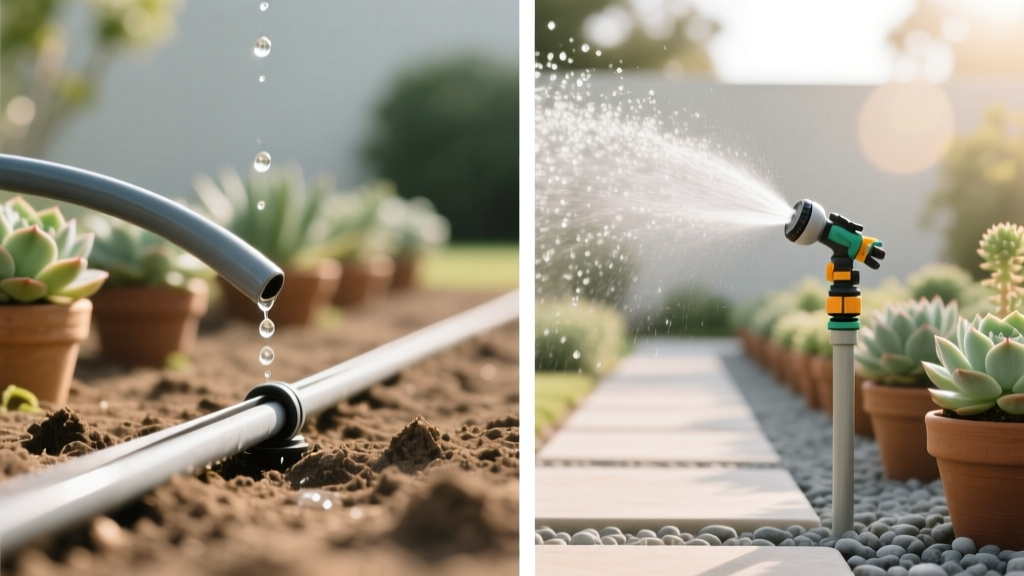
Generally, drip irrigation saves more water than sprinklers for beds, shrubs, and vegetable gardens because it delivers water directly to the root zone. Sprinklers can still be efficient (and sometimes the best tool) for lawns and dense groundcovers, but only if they’re tuned and scheduled like a pro.
The real water math (so you’re not paying to water the driveway)
Tip: Use “application efficiency” to compare systems, not marketing claims
Water savings comes down to how much water actually reaches the root zone. University of California ANR notes that properly managed drip can achieve ~90% efficiency, while traditional sprinklers are often ~50–70% depending on wind, evaporation, and design (UC ANR, 2021). That efficiency gap is where the biggest savings live.
Real-world example: If you apply 100 gallons, drip may put ~90 gallons where roots can use it, while a poorly tuned sprinkler might deliver only ~60 gallons—meaning you’d have to run sprinklers longer to get the same result.
Tip: Know your sprinkler output—most people overwater because they never measure it
Put 6–8 straight-sided tuna cans (or rain gauges) across the sprinkler zone and run it for 15 minutes. Measure the average depth collected; if you got 0.25 inches in 15 minutes, your sprinkler rate is 1 inch/hour. Once you know the rate, you can schedule based on inches (what plants need) instead of minutes (what the controller guesses).
Shortcut: Many established lawns only need about 1 inch/week during peak season (including rain), but your soil type and weather can push that up or down.
Tip: Put a dollar sign on overspray—it makes decisions easy
Let’s say you irrigate with a sprinkler system that loses 20% to wind/overspray. If your outdoor water use is 5,000 gallons/month in summer, that’s 1,000 gallons you paid for that didn’t help plants. At a typical municipal rate of about $4–$8 per 1,000 gallons (varies widely), that’s $4–$8/month just in avoidable loss—often more in high-rate areas.
When drip wins (and how to make it actually save water)
Tip: Match emitters to plants, not to “rows”
Drip saves water when each plant gets what it needs—no more, no less. Use 0.5 GPH emitters for drought-tolerant shrubs, 1.0 GPH for most vegetables, and 2.0 GPH for thirstier plants or sandy soils that drain fast. Place emitters at the dripline (outer edge of the plant canopy), not against the stem, to encourage wider root growth.
Real-world example: A young tomato might do great with 1–2 emitters at 1 GPH, while a mature tomato in peak heat may need 2–4 emitters spaced around the plant.
Tip: Use two shorter runs instead of one long run on heavy clay
Clay soils absorb water slowly; if you run drip too long, water can pool and run off—yes, even with drip. Try two cycles of 20–30 minutes separated by 30–60 minutes so water soaks in between cycles. This “cycle-and-soak” approach can cut runoff dramatically without reducing plant moisture.
Case example (clay front bed): A homeowner with puddling around salvias switched from one 60-minute drip run to two 25-minute runs and stopped surface runoff while keeping the bed greener through heat waves.
Tip: Bury drip under mulch—mulch is the secret efficiency booster
Drip lines laid under 2–3 inches of mulch lose less water to evaporation and keep soil moisture steadier. Keep mulch a finger-width away from plant crowns to prevent rot. This combo (drip + mulch) is one of the fastest ways to reduce summer watering frequency.
DIY angle: If you don’t have mulch budget, shredded leaves work surprisingly well—aim for a 2-inch layer and top up as it breaks down.
Tip: Add a pressure regulator and filter or your “drip” becomes a sprinkler in disguise
Most drip components want 15–30 PSI; many homes deliver 50–80 PSI. Without regulation, fittings pop off, micro-sprayers mist, and you’ll see uneven watering (and leaks you won’t notice until the water bill hits). A basic drip filter + regulator combo is often $15–$35 and prevents most clogging and blowouts.
Tip: Use a weekly “flush day” to prevent clogs that silently waste water
Clogged emitters cause you to compensate by running longer—which wastes water and still leaves dry plants. Once a week in peak season, open the end caps and flush lines for 30–60 seconds. If you use well water or have hard water, flush twice a month even in cooler weather.
“Drip irrigation can be extremely efficient, but only when it’s designed, filtered, and maintained so the system applies water uniformly.” — UC Agriculture and Natural Resources (UC ANR), 2021
When sprinklers make more sense (and how to stop the waste)
Tip: For lawns, pick matched-precipitation nozzles—mixing heads is a hidden water bill
One common mistake: combining different nozzle types or brands in the same zone. That creates dry spots and soggy spots, and you “fix” it by watering longer—overwatering half the yard. Use matched precipitation rate (MPR) nozzles so all heads apply water evenly, even if arcs differ (quarter, half, full).
Case example (patchy lawn): A 1,500 sq ft lawn with mismatched nozzles needed 45 minutes to look decent. After switching to MPR nozzles and fixing one tilted head, the same lawn held color with 25–30 minutes per cycle.
Tip: Water at dawn—before wind and heat spike
Early morning (roughly 4 a.m.–8 a.m.) is prime sprinkler time: lower wind, cooler air, less evaporation. Evening watering can leave foliage wet overnight and encourage disease, especially in humid areas. This one timing tweak often saves water because more of it lands where intended.
Tip: Fix “low head drainage” with check valves, not longer run times
When a zone shuts off, water in the line can drain out of the lowest sprinkler heads and pool—wasting water and creating muddy spots. Heads with built-in check valves (or inline check valves) stop that drain-down. They typically cost $2–$6 more per head, and they pay for themselves fast if you have sloped yards.
Tip: Convert spray zones to rotating nozzles to cut misting
Traditional spray nozzles create fine droplets that drift and evaporate, especially above 85°F or in breezes. Rotating stream nozzles (often called “rotator” nozzles) apply water more slowly and in heavier streams, reducing drift. Many gardeners see 20–30% real savings just by switching nozzles and adjusting run times to match the slower application rate.
Tip: Use a smart controller the “cheap” way—add a rain sensor if nothing else
If a full smart controller isn’t in the budget, a wired rain sensor is a simple upgrade that stops irrigation after rainfall. Many models cost $20–$50 and prevent the classic mistake: sprinklers running during or right after a storm. For bigger savings, weather-based controllers can cut irrigation notably in many climates; EPA’s WaterSense program reports average savings of up to 15,000 gallons per year for labeled controllers (EPA WaterSense, 2023).
Side-by-side: which saves more water for your yard?
| Factor | Drip Irrigation (beds/shrubs/veg) | Sprinkler System (lawns/groundcover) |
|---|---|---|
| Typical application efficiency | ~85–95% with good filtration and maintenance (UC ANR, 2021) | ~50–70% depending on wind, head type, and layout (UC ANR, 2021) |
| Best use cases | Vegetable rows, raised beds, shrubs, trees, containers | Turfgrass, large uniform areas, new seed (short frequent cycles) |
| Common water-waste mistake | Clogged emitters → you run longer and still get dry plants | Misting/overspray and uneven coverage → you water to fix dry spots |
| DIY-friendly? | Very—poly tubing, punch-in emitters, gravity options | Moderate—layout and pressure require more planning |
| Typical starter cost | $30–$120 for a small garden zone (filter/regulator + tubing) | $100–$400+ for parts on a basic small-yard zone (heads, pipe, fittings), more if trenching |
Shortcuts that save water no matter what system you choose
Tip: Water “to depth,” not “every day”—and verify with a shovel
The fastest way to waste water is shallow, frequent watering that never reaches the deeper root zone. Once a week, check moisture with a trowel: you want moisture down about 6–8 inches for lawns and 8–12 inches for many shrubs and vegetables. If only the top 2 inches are wet, you’re training roots to stay shallow (and you’ll water more often forever).
Tip: Use the tuna-can test for sprinklers and the “catch cup” test for drip
For drip, place small cups under several emitters and run the system for 30 minutes. Volumes should be similar; if one cup is half full compared to others, that emitter is clogged or the line pressure is off. Fixing one clogged section can save more water than cutting your schedule—because you stop compensating with extra run time.
Tip: Split zones by sun exposure so you’re not watering shade like it’s full sun
A south-facing strip bakes; a north-side bed can stay moist much longer. If both are on the same zone, you’ll overwater the shade to keep the sunny area alive. If you can’t replumb zones, at least add drip emitters with different flow rates (ex: 0.5 GPH in shade, 1.0–2.0 GPH in sun) or partially close a valve to reduce flow to cooler areas.
Tip: Aim for “hydrozones” in your planting design—free water savings with a shovel and a plan
Group thirsty plants together and drought-tolerant plants together. This lets you run one zone longer (when needed) without wasting water on plants that prefer it dry. The practical hack: when you add a new plant, ask “Does it want weekly soaking or occasional deep watering?” and place it accordingly.
Real-world scenarios (what I’d do in your shoes)
Scenario 1: A raised-bed vegetable garden (drip usually wins)
Raised beds drain faster and are easy to overwater with sprinklers because you soak paths and edges. Run 1/2-inch poly tubing to the bed, then use 1/4-inch dripline with emitters spaced 6–12 inches apart. In peak summer, many beds do well with 30–45 minutes per watering, 2–4x per week, adjusted by soil feel—not the calendar.
Money-saver: A basic DIY kit for 2–4 beds can land around $50–$150, and you’ll likely recoup that by avoiding daily hose watering and overspray.
Scenario 2: A small lawn with a windy afternoon microclimate (sprinklers can work, but only if scheduled right)
If afternoon winds are common, set sprinklers for early morning and switch to rotating nozzles to reduce drift. Use the tuna-can test to target 0.5 inches per cycle on lawns that need about 1 inch/week (split into two cycles). If your yard slopes, add check valves to stop low-head drainage.
Shortcut: If you’re stuck watering on windy days due to restrictions, lower the spray trajectory with appropriate nozzles and shorten arcs to keep water inside the lawn edge.
Scenario 3: Mixed foundation planting (shrubs + perennials) where sprinklers keep hitting the house
This is where drip shines: run a drip line along the bed, then branch off to individual emitters so you’re not soaking siding, windows, or mulch you don’t need to wet. Use 1 GPH emitters for most perennials and add a second emitter as plants mature. Top with 2–3 inches of mulch to stabilize moisture so you can water less often.
DIY alternative: For a tiny bed, a gravity-fed setup from a 5-gallon bucket on a stand can run low-flow drip emitters for spot-watering—cheap, simple, and surprisingly effective for weekend cabins or rentals.
Scenario 4: Newly seeded lawn or fresh sod (sprinklers are usually the better tool—temporarily)
New grass needs frequent light watering at first (to keep the top layer consistently moist), which drip isn’t great at doing evenly across turf. Use sprinklers for the first few weeks, watering 2–4 times per day in short bursts (often 5–10 minutes, depending on output), then taper to deeper, less frequent watering once roots establish. The trick is to transition quickly—staying on frequent cycles too long wastes water and weakens roots.
DIY swaps and upgrades that pay off fast
Tip: Convert one sprinkler zone to drip without tearing up the yard
If you already have sprinklers and want drip in a shrub bed, you can often convert a spray head to a drip outlet using a retrofit kit. Add a 25 PSI pressure regulator and filter at the zone, cap extra heads, and run poly tubing through the bed. This avoids trenching and lets you keep lawn zones on sprinklers while shifting beds to drip.
Tip: Use inexpensive “flag” emitters to troubleshoot fast
Flag emitters (the little adjustable ones on spikes) are great for testing because you can visually confirm flow at a glance. Use them temporarily to see which plants dry out fastest, then replace with fixed-flow emitters (0.5/1/2 GPH) for consistent watering. It’s a cheap way to avoid redesigning the whole system blindly.
Tip: Put shutoff valves where you’ll actually use them
Add a simple inline valve at the start of each bed line. When rain hits or a bed finishes for the season, you can shut off that line without reprogramming controllers or messing with the main supply. This is one of those “small parts, big savings” moves—especially for vegetable gardens that change every month.
The quick decision rule I use
If you’re watering plants spaced apart (shrubs, tomatoes, peppers, roses, young trees), go drip and run it under mulch—you’ll almost always save water and get healthier plants. If you’re watering a solid carpet (lawn, dense groundcover, new seed), sprinklers are usually more practical, but only when the system is tuned (matched nozzles, correct timing, minimal overspray).
The biggest “pro” move isn’t picking sides—it’s using both on the same property: drip for beds and sprinklers for turf, each on its own schedule. Once you measure output, fix the obvious losses, and water to depth, you’ll see the difference where it matters most: steadier plants, fewer disease problems, and a water bill that doesn’t jump every heat wave.
Sources: University of California Agriculture and Natural Resources (UC ANR), 2021; U.S. Environmental Protection Agency WaterSense, 2023.