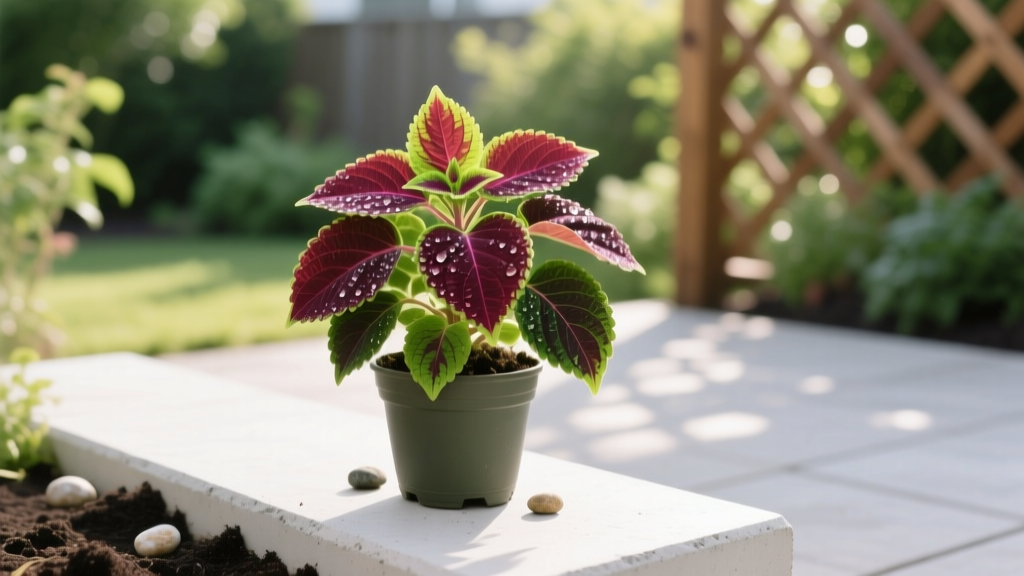
Hardening Off Coleus Before Planting Outside
You set a lush coleus on the porch for “a little fresh air,” and by dinner the leaves look like wet tissue paper—bleached patches, curled edges, and a plant that suddenly seems to hate you. This is one of the most common spring heartbreaks I see: coleus that looked bulletproof indoors collapses outdoors because it wasn’t hardened off. Coleus isn’t difficult, but it is honest—skip the transition and it will show you exactly where you went wrong.
Hardening off is simply training a plant grown in protected conditions (windowsill, greenhouse, grow tent) to handle real sun, wind, cooler nights, and lower humidity. Do it well and coleus explodes with color all summer. Rush it and you’ll spend June nursing plants that never really recover.
Know What You’re Up Against: What Changes Outdoors
Indoors, light is weaker, wind is basically zero, and humidity is usually steadier. Outdoors, coleus is hit with:
- Much stronger light (even shade outdoors can be brighter than a sunny window)
- Wind that increases water loss and can snap tender stems
- Cool nights that slow growth and stress roots
- Bigger temperature swings day-to-night
Coleus is a warm-season plant. Many growers treat 50°F (10°C) as a practical lower limit for keeping coleus happy outdoors overnight. Some will survive dips below that, but “survive” and “look good” are not the same thing.
University extension guidance on tender annuals consistently emphasizes gradual exposure to outdoor conditions before transplanting. North Carolina State Extension notes hardening off reduces transplant shock by slowly adapting plants to sun and wind (NC State Extension, 2022). Likewise, the University of Minnesota Extension describes hardening as a stepwise process over about a week to improve plant performance after transplanting (University of Minnesota Extension, 2020).
“A sudden move from indoors to full sun outdoors can cause leaf scorch and stunting; gradual exposure over several days allows plants to adjust their leaf structure and water balance.” — University of Minnesota Extension (2020)
When to Start: Timing and Temperature Benchmarks
The calendar is less useful than your forecast. Use these benchmarks:
- Start hardening off 7–10 days before you plan to plant coleus in the ground or outdoor containers.
- Begin when daytime temps are reliably above 60°F (15.5°C).
- Aim to keep nighttime temps above 50°F (10°C) during the hardening period. If nights drop to 45°F (7°C), bring plants in or use protection.
- If you’re using a cold frame, vent it when it hits 75–80°F (24–27°C) inside—coleus can cook fast in spring sun.
Real-world scenario #1: You have a warm week in April, then a cold snap. Hardening off can still happen—just pause on cold nights. It’s better to stretch hardening to 14 days than to “power through” and set plants back.
The 7–10 Day Hardening Off Plan (Step-by-Step)
I’ve hardened off hundreds of coleus this way—seedlings, cuttings, and nursery starts. The key is morning shade first, then gentle increases in light and time.
- Day 1: Put plants outside in bright shade for 1–2 hours, sheltered from wind. Bring them back inside.
- Day 2: Bright shade for 2–3 hours. Avoid midday sun.
- Day 3: Bright shade for 3–4 hours. Introduce a little early morning sun (up to 30 minutes).
- Day 4: 4–6 hours outside. Morning sun up to 1 hour.
- Day 5: 6–8 hours outside. Morning sun up to 2 hours. Light breeze is okay; avoid gusty days.
- Day 6: Most of the day outside. If your variety tolerates sun, allow 2–3 hours of sun (still not harsh afternoon sun yet).
- Day 7: Full day outside. If nights are above 55°F (13°C), you can trial an overnight stay in a protected spot.
- Days 8–10 (if needed): Increase sun exposure gradually until plants match their final planting light (shade/part shade/sun-tolerant).
Wind matters as much as sun. A breezy 65°F day can dry coleus faster than a calm 75°F day. If it’s windy, cut exposure time by a third and tuck plants behind a wall, hedge, or patio furniture.
Method Comparison: Slow-and-Steady vs. “Sink or Swim”
Gardeners often ask if hardening off really makes a difference. In practice—yes. Here’s what I typically see in home gardens when the same variety is treated two ways.
| Method | Hardening Duration | First Week Outdoors: Water Need | Visible Leaf Damage | Growth After 2 Weeks | Best Use Case |
|---|---|---|---|---|---|
| Gradual hardening | 7–10 days | Usually 1x/day in containers (less in-ground) | Low (minor edge curl at most) | Steady new leaves; color stabilizes | Most gardens; any prized varieties |
| “Sink or swim” | 0–1 day | Often 2x/day in containers due to stress | Moderate to severe (bleaching/scorch common) | Stalled growth; may take 2–4 weeks to rebound | Only if replacements are easy and weather is perfect |
That water-need jump is real. Stressed coleus dumps moisture fast, and once a leaf is scorched it doesn’t “green back up.” You’re waiting for new growth to hide the damage.
Light: Matching Coleus to Its Final Spot
Not all coleus handles sun the same. Many modern varieties tolerate more light, but most still look best with morning sun and afternoon shade—especially in hot climates. The hardening schedule above assumes you’re not throwing them into harsh afternoon sun right away.
Practical light targets
- Shade/part shade coleus: Aim for 2–4 hours of gentle morning sun max, or bright filtered light all day.
- Sun-tolerant coleus: Can build up to 6+ hours of sun, but do it gradually and watch leaf color. If colors look washed out, back off.
Real-world scenario #2: Your patio is shaded in April, but by June the sun angle shifts and it becomes a blast furnace at 3 p.m. When hardening off, stand where the coleus will live and check sun patterns at different times. If afternoon sun will hit later in the season, plan for a container you can scoot or provide light shade cloth.
Watering During Hardening Off (This Is Where Most People Slip)
Hardening off increases transpiration (water loss) because of wind and brighter light. The goal is to keep the root ball evenly moist—not soggy, not bone dry.
How to water coleus in pots during hardening
- Check moisture twice daily (morning and late afternoon) for the first 3 days.
- Water when the top 1 inch of potting mix feels dry.
- Water thoroughly until you get a steady trickle out the drainage holes; then let it drain fully.
- On warm, breezy days, expect to water small pots (4-inch) daily—sometimes 2x/day.
Signs you’re watering wrong (and how to fix it)
- Wilting midday but fine by evening: Often normal during early hardening. Provide more shade and wind protection; don’t automatically drown the pot.
- Wilting that doesn’t recover after watering: Root ball may have dried too far and become hydrophobic. Bottom-water for 15–20 minutes (set pot in a tub), then drain.
- Yellowing leaves + sour smell: Overwatering/poor drainage. Let the pot dry slightly, increase airflow, and confirm drainage holes are open.
A good rule: during hardening off, coleus should never go bone dry. One hard dry-down can cause leaf drop and stalled growth.
Soil and Potting Mix: Set the Roots Up for Outdoor Life
Coleus isn’t fussy, but it does demand drainage. Outdoors, roots need oxygen as much as they need water.
For containers
- Use a high-quality potting mix (not garden soil).
- If your mix stays wet, add 20–30% perlite by volume to improve drainage.
- Choose a pot with drainage holes; for a full plant, plan on at least a 10–12 inch pot for one coleus, or larger mixed containers.
For in-ground planting
- Work in 1–2 inches of compost over the bed if soil is thin or sandy.
- If you have heavy clay, plant slightly high (a gentle mound 1–2 inches above grade) to prevent waterlogging.
- Mulch with 1 inch of fine mulch after planting (keep mulch off the stems). This stabilizes moisture while roots establish.
Real-world scenario #3: You hardened off perfectly, then planted into cold, wet soil after a spring rain. Coleus sits still, leaves dull, and stems can blacken at the base. In that case, the problem isn’t hardening—it’s cold/wet roots. Wait for soil to warm and drain, or use containers until weather settles.
Feeding: When (and When Not) to Fertilize
During the hardening week, keep feeding gentle. A plant under transition stress doesn’t need a heavy nitrogen push—it needs stable moisture and time.
Simple feeding schedule that works
- During hardening off: If needed, use a half-strength liquid fertilizer (for example, 1/2 teaspoon per gallon, depending on product directions) once mid-week.
- After planting outside: Feed again after 7–10 days once you see new growth.
- Ongoing: Container coleus often benefits from feeding every 2 weeks at half strength, or use a slow-release fertilizer mixed into the potting soil per label.
Too much fertilizer, especially in cool weather, can create soft growth that scorches faster and attracts pests.
Planting Outside: The Smoothest Transition
Once your coleus can handle a full day outside (and nights are reasonable), plant it out.
Planting steps
- Water the plant 1–2 hours before planting so the root ball is evenly moist.
- Dig a hole just as deep as the root ball and about 2x as wide.
- Set the plant at the same depth it was in the pot.
- Water in with enough water to settle soil around roots (typically 2–4 cups for a small transplant; more for larger plants/loose soil).
- Provide temporary shade for 2–3 days if the site is brighter than the hardening area.
Spacing matters for airflow. In beds, most coleus look best spaced 10–14 inches apart, depending on mature size. Crowding invites mildew and makes it harder to water evenly.
Common Problems During Hardening Off (And What to Do)
Hardening off isn’t always pretty. The trick is knowing what’s normal adjustment and what’s a real red flag.
Leaf scorch (bleached or crispy patches)
Symptoms: Pale, tan, or white patches; crispy edges; worst on top leaves.
Cause: Too much sun too soon, especially midday sun.
Fix:
- Move to bright shade immediately for 2–3 days.
- Resume hardening with shorter sun exposure (15–30 minutes increments).
- Don’t remove damaged leaves right away unless they’re mushy; they still photosynthesize a bit.
Sudden limp collapse even though soil is moist
Symptoms: Plant wilts dramatically; stems feel soft; soil is wet.
Cause: Cold shock or root stress (cold nights, waterlogged mix).
Fix:
- Bring indoors or to a protected, warmer spot if temps dip below 50°F (10°C).
- Let the mix dry slightly; ensure free drainage.
- If in a saucer, never leave the pot sitting in water longer than 10 minutes after watering.
Leggy growth and weak stems
Symptoms: Long internodes, flopping, sparse leaves.
Cause: Too little light indoors before hardening, or too much nitrogen.
Fix:
- Pinch tips back by 1–2 inches to force branching (you can root the cuttings).
- Increase light gradually during hardening—more morning sun, not sudden afternoon sun.
Leaves dropping after the first overnight outdoors
Symptoms: Leaf drop within 24–48 hours of an overnight stay.
Cause: Night temperatures too cool, wind exposure, or dry root ball.
Fix:
- Go back to indoor nights until overnight lows stay above 55°F (13°C).
- Check moisture at dusk; water lightly if the top inch is dry.
- Shelter from wind (corner of porch, against a wall).
Pests and Diseases That Show Up Right After Hardening
Transition stress can make coleus more attractive to pests. Catch issues early and you’ll rarely need heavy treatments.
Aphids
- Symptoms: Sticky leaves, curled new growth, clusters on stems.
- First response: Strong water spray in the morning for 2–3 days in a row.
- If needed: Insecticidal soap, applied in shade and per label.
Spider mites (especially in hot, dry spots)
- Symptoms: Fine stippling, dull leaves, webbing under leaves.
- First response: Increase humidity around plants and rinse undersides of leaves every few days.
Downy mildew (coleus can be susceptible)
- Symptoms: Yellowing, leaf drop, gray/purple fuzz on undersides in humid conditions.
- What to do: Improve airflow, avoid overhead watering late in day, remove badly affected plants to limit spread.
If your area has a history of downy mildew on coleus, choose resistant varieties when possible and avoid crowding. Extension resources often recommend sanitation and airflow as first-line control for foliar disease issues (NC State Extension, 2022).
Troubleshooting Quick Checks (My “Before You Panic” List)
When coleus looks rough during hardening off, run through these in order:
- Touch the potting mix: Is the top 1 inch dry, evenly moist, or soggy?
- Check last night’s low: Did it dip under 50°F?
- Look at the damage pattern: Top leaves scorched = sun. Lower yellowing + wet soil = drainage/overwatering.
- Consider wind: Was it a gusty day? Wind can shred tender leaves and dry pots fast.
- Reassess exposure: “Shade” on a bright patio can still be high light—especially near reflective siding or concrete.
Three Hardening-Off Case Studies (What I’d Do)
Case 1: Indoor cuttings rooted in water, then potted
Problem: Water-rooted coleus often has delicate roots that struggle in potting mix and outdoor conditions.
What works: Pot them up and give them 10–14 days indoors in bright light first, then harden off slowly. Keep them in bright shade outdoors for the first 3–4 days—no direct sun until they’re clearly growing new leaves.
Case 2: Nursery six-packs planted straight into a sunny bed
Problem: Nursery plants may be greenhouse-grown under filtered light; full sun can scorch them fast.
What works: Even if you bought them “outdoor-ready,” give them 4–7 days of hardening. Use temporary shade (an umbrella, shade cloth, or even a lawn chair casting shade) for 2–3 afternoons after planting.
Case 3: You’re late and coleus is overgrown indoors
Problem: Tall, soft growth snaps in wind and burns in sun.
What works: Pinch back by 1–2 inches before hardening, stake if needed, and start with shorter outdoor sessions (1 hour on day one). You’ll end up with a sturdier, bushier plant by mid-summer.
Hardening Off Tools That Make Life Easier
- A cheap thermometer (or weather app you actually check) for overnight lows
- A tray or wagon to move multiple pots quickly
- Light shade cloth (30–40%) or an old sheer curtain for temporary shade
- Small stakes for leggy plants facing wind
If you only adopt one habit: check pots in late afternoon. That’s when a plant that looked fine at 10 a.m. may be quietly drying out and setting itself up for a wilted evening.
Coleus rewards patience. Give it a week of gradual exposure, keep the root ball evenly moist, and respect cool nights, and you’ll get the payoff: dense plants, richer color, and far fewer “mystery problems” once summer heat arrives. After the hardening routine becomes habit, you’ll stop losing plants to spring surprises—and you’ll start planting coleus with the calm confidence of someone who’s seen how tough it can be when it’s properly prepared.
Sources: North Carolina State Extension (2022); University of Minnesota Extension (2020).