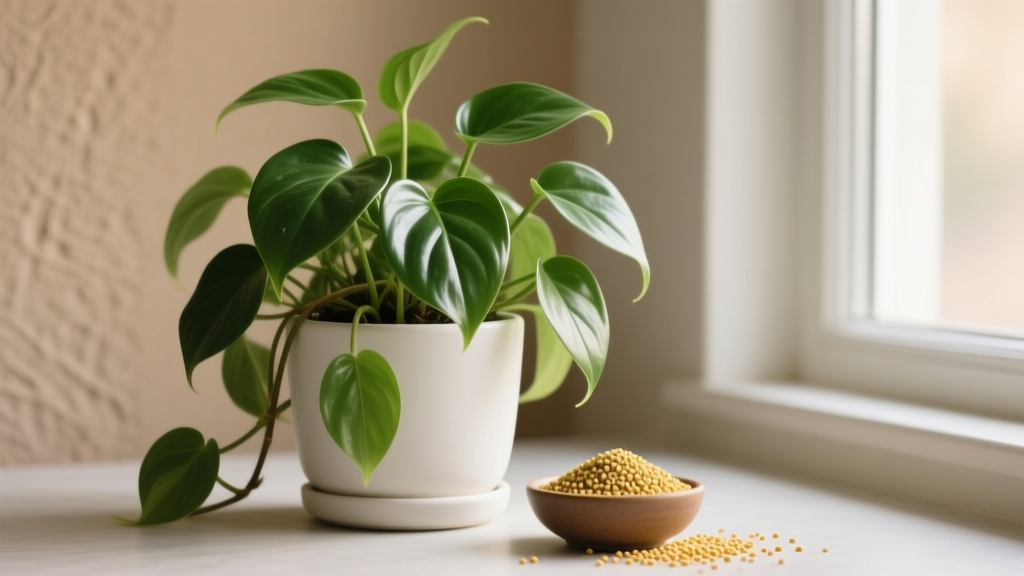
Alfalfa Meal Benefits for Pothos
You know that moment when your pothos looks “fine” from across the room, but up close it’s all leggy stems, tiny new leaves, and that tired yellow-green color? You water like clockwork, it sits in a bright window, and still it just… coasts. I see this constantly in homes: pothos surviving, not thriving. One surprisingly effective nudge—when used correctly—is alfalfa meal. It’s not a magic dust, but it can be a steady, gentle way to support fuller growth, better leaf size, and healthier roots without the salt burn that comes from heavy-handed synthetic fertilizers.
This article is the practical version—the “what I’d do at my own sink and potting bench” version. We’ll talk how alfalfa meal works, how to apply it safely indoors, what changes to expect (and when), plus the other fundamentals that determine whether your pothos actually uses the nutrients you give it.
What alfalfa meal actually does for pothos (and what it doesn’t)
Alfalfa meal is a plant-based, slow-release organic amendment made from ground alfalfa (Medicago sativa). Typical N-P-K values are modest (often around 2-1-2, though it varies by brand). It’s not a “quick green-up” like a synthetic 20-20-20. Instead, it feeds the soil biology, which then feeds the plant over time.
Two reasons gardeners love it:
- Gentler nutrient release: Lower risk of root burn compared to high-salt fertilizers—especially important for pothos grown indoors where flushing is inconsistent.
- Growth-supporting compounds: Alfalfa contains triacontanol (a natural fatty alcohol) that has been studied for plant growth effects in various crops.
Two important limits:
- It won’t fix poor light. If your pothos is living in a dim corner, extra nutrition often just leads to weak, stretched growth.
- It won’t fix soggy soil. In constantly wet mix, roots can’t use nutrients properly and you invite fungus gnats and rot.
“Plants respond to nutrients only when other growth factors—light, water, temperature, and oxygen at the roots—are in balance. Fertilizer can’t compensate for chronic low light or waterlogged media.” — Extension horticulture guidance on houseplant care (University of Minnesota Extension, 2023)
That principle is the backbone of using alfalfa meal well: it’s a helper, not a rescuer.
Real-world scenarios: when alfalfa meal shines (and when I skip it)
Scenario 1: The ‘healthy but stalled’ pothos. Your plant hasn’t been repotted in 18–24 months, it’s in decent light, and new leaves are getting smaller. Alfalfa meal can help reintroduce steady nutrition without shocking roots.
Scenario 2: The heavy-handed fertilizer history. You used liquid fertilizer a bit too often, and now you see brown crispy tips and white crust on the soil surface. Switching to a mild, slow-release option (after flushing) is safer than continuing with strong liquids.
Scenario 3: The winter slump that turns into spring hunger. In winter, pothos often slows down. When days lengthen and indoor temps rise above 65°F (18°C), growth ramps up and the plant benefits from renewed feeding—just not all at once.
When I don’t use alfalfa meal: if the pot already has active fungus gnats, if the soil stays wet for more than 10–12 days between waterings, or if the plant is in very low light. In those cases, fix the basics first.
Watering: the make-or-break factor for nutrient use
If you only change one thing for a happier pothos, change how you water. Overwatering and underwatering both reduce nutrient uptake. Alfalfa meal works best when the soil cycles from moist to partially dry in a predictable rhythm.
My pothos watering targets (simple and repeatable)
- Water when the top 2 inches (5 cm) are dry. For most indoor pothos, that’s roughly every 7–14 days, depending on season, pot size, and light.
- Water thoroughly: Pour until you get 10–20% runoff out the drainage holes, then empty the saucer.
- Temperature matters: Keep water near room temp, roughly 65–75°F (18–24°C). Cold water can shock roots in winter.
Practical tip: If your pothos takes more than 12–14 days to need water, your mix is likely too water-retentive for indoor conditions. That’s a soil issue, not a thirst issue.
Soil and potting: set the stage for alfalfa meal to work
Because alfalfa meal relies on microbial activity to break down, it performs better in a potting mix that’s airy, warm enough, and not chronically saturated. Indoors, oxygen at the roots is often the limiting factor.
A pothos-friendly mix (easy indoor recipe)
For a chunky, forgiving blend, aim for:
- 60% quality indoor potting mix
- 25% orchid bark (small/medium)
- 15% perlite or pumice
This dries more evenly, resists compaction, and reduces fungus gnat pressure compared to straight peat-based mix.
Pot size and repot timing
Pothos like being slightly snug. I usually size up by 1–2 inches (2.5–5 cm) in diameter when repotting. If you jump from a 6-inch pot to a 10-inch pot, you’ve created a swampy soil volume that roots can’t drink fast enough.
Repot most pothos every 18–30 months depending on growth rate. If roots are circling densely or the plant dries out in 2–3 days, move up a size sooner.
Light: the “engine” that turns alfalfa meal into growth
Pothos tolerate low light, but they don’t build lush vines there. If you want visible results from feeding, aim for bright, indirect light.
Actionable light benchmarks
- Best range: about 100–200 foot-candles for maintenance, 200–500 foot-candles for stronger growth (a bright room near a window, not direct sun blasting leaves).
- Avoid harsh direct sun: especially hot afternoon sun, which can scorch leaves and dehydrate pots quickly.
- Rotate the pot: a quarter turn every 1–2 weeks to prevent the “one-sided vine” look.
If you use grow lights, a simple, reliable pattern is 10–12 hours per day during the active growing season.
Feeding pothos with alfalfa meal: how to do it safely indoors
Alfalfa meal is mild, but indoor pots are closed systems. Too much organic matter can sour the soil, attract gnats, or create a crust that slows water penetration. The goal is small amounts, applied consistently, and matched to the season.
How much alfalfa meal to use (real measurements)
These rates are conservative—exactly where you want to be with houseplants:
- 4–6 inch pot: 1 teaspoon as a top-dress
- 8 inch pot: 2 teaspoons
- 10–12 inch pot: 1 tablespoon
Timing: Apply every 6–8 weeks during active growth (often spring through early fall). In winter, either pause completely or stretch to every 10–12 weeks if the plant is under strong light and still growing.
Two application methods (and when I choose each)
-
Top-dressing (my default):
- Scratch the surface gently with a fork (top 1/4 inch only).
- Sprinkle the measured alfalfa meal evenly, keeping it 1 inch away from the stem base.
- Cover with a thin layer of fresh mix or worm castings (optional but helps reduce odor/gnats).
- Water lightly to settle it in.
-
Mixing into new soil (best at repotting):
- Add 1 tablespoon per gallon of potting mix.
- Blend thoroughly so you don’t get “hot pockets.”
- Repot, then water normally.
What to expect: With decent light and warm temperatures, you may notice improved leaf size and color in 3–6 weeks. Don’t expect changes in 3 days; this is slow-release nutrition.
Citations that ground the practice
Alfalfa meal is widely used as an organic nutrient source, and triacontanol in alfalfa has documented plant growth activity in research contexts. For home use, the key is careful rates and good cultural conditions. Organic amendments and their nutrient contributions are commonly discussed in extension resources, including compost/manure and organic nutrient management guidance (University of California Agriculture and Natural Resources, 2020). Houseplant growth limitations tied to light/water balance are also emphasized in extension education materials (University of Minnesota Extension, 2023).
Alfalfa meal vs other feeding options (with real trade-offs)
If you’re deciding between alfalfa meal and more typical pothos fertilizers, here’s a practical comparison. The “best” choice depends on your habits: are you consistent, or do you forget for months and then overcorrect?
| Feeding option | Typical N-P-K | Release speed | Risk of burn | Best use case |
|---|---|---|---|---|
| Alfalfa meal (top-dress) | ~2-1-2 | Slow (weeks) | Low (when lightly dosed) | Steady growth, gentle feeding, salt-sensitive plants |
| Liquid houseplant fertilizer | Commonly 10-10-10 or 20-20-20 | Fast (days) | Medium-high (overuse) | Quick correction for pale growth when light/watering are already right |
| Worm castings | Varies (often mild) | Slow | Very low | Soil health boost, gentle nutrition; pairs well with alfalfa meal |
| Slow-release pellets (synthetic) | Varies (often higher N) | Medium (weeks-months) | Medium (over-application) | People who want “set it and forget it” feeding with predictable dosing |
A simple comparison with actual numbers: liquid feed vs alfalfa meal
Here’s what “too much too fast” looks like in real life. If you apply a liquid fertilizer at half-strength every week, you’re effectively delivering frequent soluble salts to a small soil volume. With alfalfa meal, you might apply 2 teaspoons once every 6–8 weeks and rely on soil microbes to release nutrients gradually. The pothos response is usually steadier, with less leaf-tip burn—provided your soil isn’t kept wet.
Common problems (and how to troubleshoot with specifics)
Feeding is only helpful if you can read the plant’s signals. Here are the pothos issues I see most often when people add organic amendments like alfalfa meal.
Problem: Fungus gnats after top-dressing
Symptoms: Tiny black flies near the soil, larvae in the top inch, soil staying damp.
Why it happens: Organic matter on the surface + consistently moist soil = buffet and nursery.
Fix it (step-by-step):
- Let the top 2 inches dry fully between waterings for the next 2–3 cycles.
- Add a 1/2 inch layer of coarse sand or fine orchid bark on top (physical barrier).
- Use yellow sticky traps at soil level for adults.
- If infestation is heavy, drench with BTI (mosquito bits) weekly for 3 weeks following label directions.
Prevention: Keep alfalfa meal lightly covered with fresh mix, and don’t apply it to already damp, slow-drying pots.
Problem: Sour smell or crusty surface
Symptoms: Musty odor, water beads up and runs off, gray/white crust.
Why it happens: Too much top-dressed material, poor aeration, or mineral buildup from hard water.
Fix:
- Remove the top 1/2 inch of soil and replace with fresh mix.
- Flush the pot: run clean water through for 2–3 minutes to dissolve salts, then drain thoroughly.
- If the mix is compacted, repot into a chunkier blend with bark/perlite.
Problem: Yellowing leaves after feeding
Symptoms: Older leaves turning yellow, sometimes multiple at once.
Possible causes (and what to check):
- Overwatering: Soil wet for more than 10–12 days. Fix drainage and reduce watering.
- Low light: Plant can’t use nutrients. Move within 2–4 feet of a bright window (no harsh sun) or add a grow light.
- Normal leaf cycling: If it’s just 1–2 older leaves and new growth looks good, it may be normal.
Problem: Brown leaf tips or edges
Symptoms: Crispy brown tips, edge burn, sometimes curling.
Most common reasons: inconsistent watering, fertilizer salt buildup, very dry air, or a pot that’s gone hydrophobic (water channels through).
Fix:
- Flush soil with room-temp water until you get strong runoff (aim for 20% runoff).
- Check watering frequency—don’t let it go bone-dry repeatedly, then flood.
- Trim brown tips with clean scissors, following the leaf shape.
How I build a simple care routine around alfalfa meal
If you like predictable routines, this one works for most homes.
Warm season routine (typical spring through early fall)
- Light: bright, indirect; rotate every 1–2 weeks
- Water: when top 2 inches dry; water to 10–20% runoff
- Feed: alfalfa meal top-dress every 6–8 weeks (rates by pot size above)
- Prune: pinch or cut back leggy vines by 3–6 inches to encourage branching; propagate cuttings if you want a fuller pot
Cool season routine (late fall and winter)
- Water: expect longer intervals; don’t keep soil wet
- Feed: pause, or reduce to every 10–12 weeks only if plant is actively growing under strong light
- Temperature:
More Articles