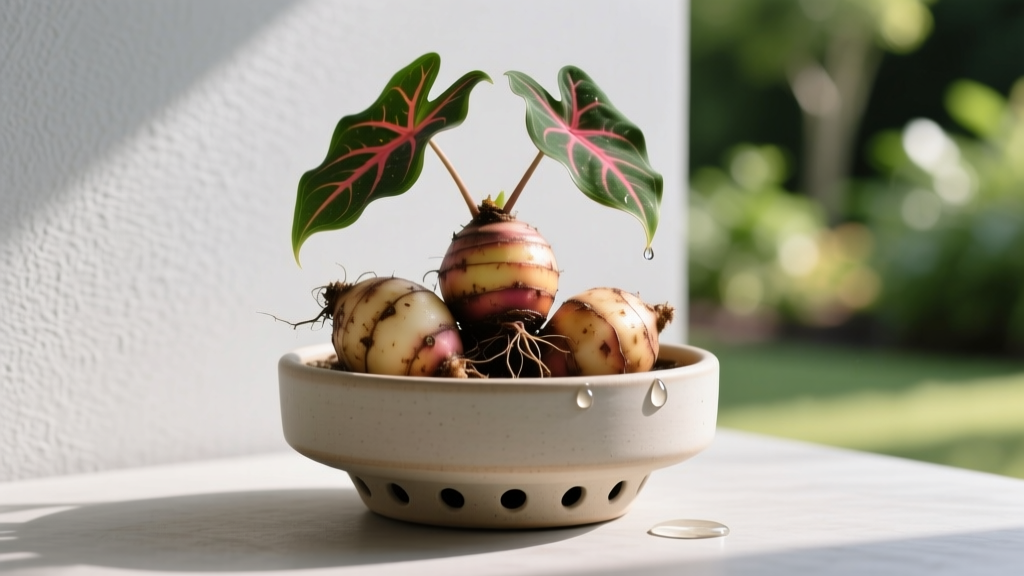
How to Drain Pots Properly for Caladiums
You bring home a caladium with perfect, paper-thin leaves—then two weeks later the stems soften, the soil smells sour, and the whole plant collapses like it was unplugged. Most folks blame “overwatering,” but the real culprit is usually drainage: water that can’t leave the pot fast enough. Caladiums are thirsty in active growth, yet they’re also quick to rot if their roots sit in soggy soil for even a couple of days. Getting pot drainage right is the difference between a lush, full season and a mushy disappointment.
This article is practical on purpose: how to build a pot setup that drains reliably, how to water without guessing, and how to troubleshoot the exact symptoms caladiums show when drainage is off. I’ll also include a few real-world cases I see every summer—because caladium problems tend to repeat themselves in the same ways.
What “proper drainage” actually means for caladiums
For caladiums, proper drainage is not a layer of rocks at the bottom (more on that later). Proper drainage means:
- A pot with a real exit: at least 1–3 unobstructed drainage holes (more is better on larger pots).
- A mix that drains and re-wets: water moves through in seconds, but the mix doesn’t turn bone-dry within hours.
- A watering routine that matches temperature: caladiums are tropical—when it’s warm they drink; when it’s cool they sulk and rot.
- No standing water at the bottom: a saucer is fine, but it can’t become a mini-pond.
A good rule of thumb: when you water thoroughly, you should see drainage within 10–30 seconds, and you should get 10–20% of the water you applied coming out the bottom. That “runoff” is not waste—it’s proof the whole root ball got wet and salts are being flushed.
“Good drainage is as much about oxygen as it is about water—roots need air in the pore spaces of the potting mix.” — Extension horticulture guidance summarized from UF/IFAS (2023)
Drainage starts with the container (not the soil)
Pick a pot size that matches the root system
Oversized pots are a sneaky drainage problem. A small root system in a big pot leaves a large volume of mix staying wet for too long—especially in a cool room or shaded porch.
- For a single tuber or small plant, start with a 6–8 inch pot.
- For a fuller display with multiple tubers, use a 10–12 inch pot, but only if you have enough heat and light to drive water use.
When in doubt, step up pot size gradually. A caladium that’s actively growing can be shifted up by 2 inches in diameter at a time.
Drainage holes: what “enough” looks like
Caladiums do best when water can leave fast and evenly. One tiny hole in the center of a decorative pot is rarely enough.
- 6–8 inch pot: at least 3–5 holes of about 1/4 inch each (or equivalent slots).
- 10–12 inch pot: 6–10 holes, and avoid pots with raised “feet” that pinch off the exit path.
If you love a pot that has no holes (many decorative cachepots), don’t “make it work” by watering lightly. Use it as a cover pot and keep the plant in a nursery pot with holes inside.
Skip the gravel layer myth
Putting rocks in the bottom doesn’t improve drainage; it reduces the volume of usable mix and can keep the wet zone higher in the pot, right where roots are. This is consistent with container drainage physics discussed in Extension education materials (for example, Washington State University Extension container media guidance, 2020).
Instead of gravel, use:
- A pot with adequate holes
- A mix that holds structure
- A mesh screen only if needed to keep mix from washing out (not to “hold water”)
Soil mix that drains fast but doesn’t dry out overnight
Caladiums like moisture, but they hate stagnation. Your goal is a chunky, airy mix with enough fine material to hold water between waterings. Most bagged “potting soil” is too dense on its own for caladiums unless you amend it.
A reliable caladium potting mix recipe
Here’s a mix I’ve used for years that drains cleanly and supports steady growth:
- 50% high-quality peat or coco-based potting mix
- 25% perlite
- 25% fine orchid bark (or pine bark fines)
If your home is very dry or you’re growing outdoors in heat, swap 5–10% of the perlite for worm castings or compost to increase water-holding slightly. If you’re growing indoors in low light, increase perlite by 10% to avoid staying wet too long.
Target pH and why it matters
Caladiums generally perform well in slightly acidic media. A practical target is pH 5.5–6.5. Outside that range, you’ll see more stubborn nutrient issues (yellowing, weak growth) even if you’re feeding.
The University of Florida notes caladiums prefer warm conditions and consistent moisture during growth, but not waterlogged media (UF/IFAS caladium guidance, 2023).
How to test drainage at home (the 60-second test)
- Fill your pot with your intended mix and plant (or test before planting).
- Slowly pour water over the surface until water begins to exit the drainage holes.
- Time it: you should see the first steady drips within 10–30 seconds.
- If it takes longer than 60 seconds to drip, your mix is too dense, your holes are blocked, or the pot is sitting flat against a surface.
Watering caladiums with drainage in mind
Here’s the straight truth: caladiums like a steady rhythm. Drought-stress followed by a big soak invites rot because the plant can’t use water fast enough, and the mix stays saturated.
When to water (and when to wait)
Use your finger and your eyes—not the calendar.
- Water when the top 1 inch of mix is dry, but the pot still feels slightly heavy.
- In hot weather (75–85°F), that might be every 2–4 days outdoors.
- Indoors at 68–72°F with lower light, it might be every 5–10 days.
A key temperature number: caladium growth slows sharply when nights dip below about 65°F. When growth slows, your watering must slow too—or drainage problems show up fast.
How to water properly (so the whole root ball drains)
- Water slowly until you get runoff. Don’t “sip-water” the top only.
- Let it drain for 5–10 minutes.
- Empty the saucer or cachepot. Don’t leave standing water longer than 15–30 minutes.
If you’re feeding with fertilizer, this same method prevents salt buildup that can crisp leaf edges.
Real-world scenario #1: The saucer that quietly drowns the plant
This is the most common indoor failure I see. The plant is in a pot with holes, but the saucer stays full because “humidity.” After a week or two, lower stems get soft, and leaves yellow from the bottom up.
- Fix: Empty the saucer every time. If you need humidity, use a humidity tray with pebbles under the pot so the pot bottom isn’t in water.
- Upgrade: Raise the pot on small feet or a plant stand so holes aren’t sealed against the saucer.
Light and heat: the hidden partners of drainage
Drainage and watering don’t exist alone—light and temperature control how fast a caladium uses water.
Best light for potted caladiums
- Bright, indirect light indoors (near an east window or set back from a south window).
- Outdoors, morning sun + afternoon shade is a safe standard for most varieties.
Low light slows water use, so the mix stays wet longer. If you can’t give bright light, compensate with a chunkier mix and more cautious watering.
Temperature targets
- Ideal growth range: 70–85°F
- Soil/media temperature for strong growth: roughly 70°F+
- Rot risk rises when soil stays wet below: about 65°F
This lines up with common Extension guidance that caladiums are warm-season tropicals and decline in cool conditions (UF/IFAS, 2023).
Feeding without creating drainage problems
Fertilizer doesn’t directly “ruin drainage,” but it can create symptoms that mimic drainage failure—burnt edges, weak growth, and salt-crusted soil that repels water.
A practical feeding plan for container caladiums
- Use a balanced liquid fertilizer at 1/4 to 1/2 strength every 2–3 weeks during active growth.
- Or use a controlled-release fertilizer at the label rate for containers, applied once and refreshed around 8–10 weeks if needed (varies by product).
Once a month, water more deeply than usual to flush salts: aim for 20% runoff. This is especially helpful if you have hard water.
Comparison: drainage methods that actually work (with real numbers)
Not all “drainage fixes” are equal. Here’s a clear comparison using measurable outcomes (drainage speed and runoff behavior) from common home setups.
| Method | What you do | Typical time to first drip (after thorough watering) | Runoff consistency | Best use case |
|---|---|---|---|---|
| Chunky mix (50/25/25) + multiple holes | Pot with 3–10 holes; add perlite + bark | 10–30 seconds | Even runoff around the base; 10–20% easily | Most indoor/outdoor caladium pots |
| Bagged potting soil alone | No amendments; standard plastic pot | 45–90+ seconds | Often channels; top stays wet; lower zone stays soggy | Only works in high heat/outdoor sun with careful watering |
| Rocks/gravel layer at bottom | 1–2 inches gravel under soil | Varies; often still slow | Water “perches” higher; root zone stays wetter longer | Mostly decorative—rarely helps caladiums |
| Nursery pot inside cachepot (no holes) | Keep inner pot with holes; lift to drain; empty cachepot | 10–30 seconds (inner pot) | Excellent if you empty the outer pot within 15–30 min | Indoor décor setups |
If you take only one thing from the table: amending the mix + adequate holes beats “drainage hacks” every time.
Common drainage-related problems (symptoms and fixes)
Caladiums are expressive. They’ll tell you what’s wrong—if you know what the signals mean.
Symptom: stems get soft at the base, leaves flop even though soil is wet
- Likely cause: Root or tuber rot from saturated mix and low oxygen.
- Immediate action: Stop watering. Move to brighter light and warmer conditions (aim 72–80°F).
- Best fix: Unpot the plant. Trim mushy roots/tuber tissue with clean scissors. Repot into fresh, airy mix. Use a pot with better holes.
If the tuber itself is soft and smells foul, it may not be salvageable. This is why drainage is the first line of defense.
Symptom: yellowing leaves, especially lower leaves, and a sour smell
- Likely cause: Chronic over-saturation; anaerobic conditions in the pot.
- Fix: Repot with extra perlite/bark. Make sure you’re not leaving water in a saucer longer than 15–30 minutes.
- Check: Are drainage holes blocked by compacted soil? Poke gently with a chopstick from the bottom to clear.
Symptom: brown, crispy edges but soil seems consistently damp
- Likely cause: Fertilizer salts accumulating; inconsistent watering that leaves salts concentrated.
- Fix: Flush with enough water to get 20% runoff. Repeat in 7 days if crusting persists. Reduce fertilizer to 1/4 strength for a month.
Symptom: leaves curl, plant looks thirsty, but water runs straight through
- Likely cause: Hydrophobic peat (dried too much) or severe channeling—water bypasses the root ball.
- Fix: Bottom-water for 20–30 minutes once to rehydrate evenly, then return to top-watering with runoff.
- Long-term: Add bark and a little compost to improve re-wetting, or repot if the mix is old and collapsing.
Three real-world drainage cases (and exactly what to do)
Case #1: New caladium in a decorative pot with no holes
You water carefully, but the plant declines anyway. The bottom stays wet because there’s nowhere for water to go.
- Slide the plant out and check if it’s in a nursery pot with holes. If yes, keep it there.
- Add a spacer in the cachepot (inverted jar lid, plant riser, or a few pebbles) so the nursery pot doesn’t sit in drained water.
- After watering, pour off collected water within 15 minutes.
Case #2: Outdoor patio caladium in a big pot that stays wet after rain
Summer storms can saturate a pot for days—especially if it’s a dense mix. If your caladium is outdoors, rain can undo your careful watering schedule.
- Fix 1: Move the pot under cover when multi-day rain is forecast.
- Fix 2: Increase drainage by top-dressing with 1 inch of bark fines and mixing perlite into the top few inches (or repot).
- Fix 3: Ensure the pot is elevated so holes aren’t blocked by the patio surface.
Case #3: Indoor caladium that was fine, then “suddenly” declines in fall
This is classic seasonal drainage trouble. Light levels drop, indoor temps often dip, and the plant uses less water. Your old schedule becomes too much.
- Stretch watering intervals. Let the top 1–2 inches dry.
- Stop feeding after growth slows (often 6–8 weeks before expected dormancy behavior).
- If your home is cool (below 68°F), keep the plant warmer or accept dormancy and reduce watering sharply.
Many caladiums naturally head toward dormancy. Trying to keep them “summer-wet” in cool, dim conditions is a recipe for rot.
Step-by-step: repotting for better drainage (without shocking the plant)
If your caladium is struggling, repotting into a better-draining setup can turn things around fast—if you do it gently.
- Choose the right pot: Only 1–2 inches wider than the current root ball, with multiple holes.
- Mix fresh media: Use the 50/25/25 blend (or similar).
- Inspect roots/tuber: Healthy tissue is firm. Remove any black, slimy, or foul-smelling parts.
- Set planting depth: Keep the tuber/crown at the same depth it was growing—don’t bury deeper “for stability.”
- Water in: Water thoroughly once to settle the mix, then let the top 1 inch dry before watering again.
If the plant is already wilting from rot, hold off on heavy watering after repotting—give it warmth and bright shade, and let it re-root into the new mix.
Common mistakes that sabotage drainage (even with a good pot)
- Letting the pot sit flat on a saucer so holes can’t breathe. Elevate it slightly.
- Compacting the mix when potting. Keep it fluffy; press lightly only to remove big air gaps.
- Reusing old, broken-down potting soil. After a season, many mixes collapse and hold too much water.
- Watering in low light as if it’s midsummer. Match water to growth.
Sources worth trusting (and why I use them)
When I’m deciding what’s “best practice” versus a garden rumor, I lean on Extension research and crop specialists because they deal with plant failure at scale.
- University of Florida IFAS Extension caladium cultivation guidance (2023) — warm-season growth, moisture needs, and cultural considerations.
- Washington State University Extension container media and drainage education materials (2020) — explains why gravel layers don’t improve drainage and how container physics works.
Those two points—caladiums’ warm, active growth habit and the physics of container drainage—are the backbone of keeping them thriving in pots.
If you set up your caladium with real drainage holes, a chunky mix, and a watering routine that changes with heat and light, you’ll stop losing plants to “mystery” collapse. And once you’ve watched a caladium push out bigger leaves week after week in a pot that drains perfectly, you won’t go back to guessing—or to pots that trap water where roots can’t escape it.