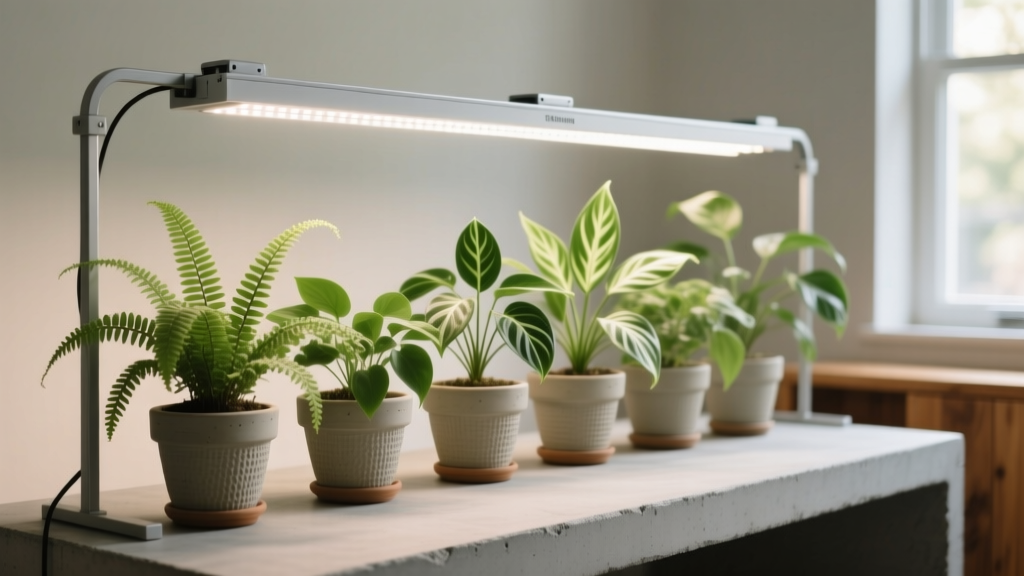
Grow Light Setup for Starting Shade Plants
You set up a shop light, sowed your favorite “shade” perennials, and expected calm, slow growth. Instead: leggy seedlings that flop over, pale leaves, and trays that stay wet for days. The surprising part is that many shade plants don’t want dim light as seedlings—they want bright light without heat stress. Outdoors they live in bright, dappled light, and under grow lights they often need more intensity than gardeners assume.
This guide lays out a practical, repeatable grow-light setup for starting shade plants from seed or divisions—plus the watering, soil, feeding, and troubleshooting details that actually make the setup work.
Shade plants under lights: what “shade” really means
As a benchmark, many seedlings (including shade perennials) do well at around 100–200 µmol/m²/s of photosynthetic photon flux density (PPFD) at canopy level, depending on species and temperature. If you don’t own a PPFD meter, you can still dial things in with fixture height, plant response, and a few measurable rules of thumb.
For the science-minded: the American Society for Horticultural Science notes that seedling quality improves with adequate daily light integral (DLI)—in plain language, seedlings need enough total light each day to build sturdy tissue (ASHS resources summarized in extension literature). A practical indoor target for many seedlings is a DLI in the neighborhood of 8–12 mol/m²/day, which you can reach by pairing moderate PPFD with long photoperiods.
Choosing a grow light: LED vs fluorescent vs “window plus lamp”
If you want compact seedlings, prioritize a light that can provide steady intensity across the tray. Modern LEDs make this easier, but you can get good results with fluorescents if you keep them close.
Here’s a comparison with real-world numbers you can use when planning a shelf setup.
| Setup | Typical wattage (2 ft shelf) | Fixture distance from seedlings | Photoperiod | Expected results for shade-plant seedlings |
|---|---|---|---|---|
| 2-ft LED bar (full spectrum) | 20–40 W | 8–14 in (20–35 cm) | 14–16 hrs/day | Sturdy growth, good color; easiest to manage heat |
| T5 HO fluorescent (2-tube) | 48–96 W | 2–4 in (5–10 cm) | 14–16 hrs/day | Strong seedlings if kept close; more heat, higher power use |
| Sunny window + small LED desk lamp | 5–15 W (lamp only) | 4–10 in (10–25 cm) | Natural + 4–8 hrs supplemental | Often uneven, leaning seedlings; works for slow growers if rotated daily |
Energy note: a 40 W LED running 16 hours/day uses 0.64 kWh per day. At $0.15/kWh, that’s about $0.10/day. A 96 W fluorescent at 16 hours/day uses 1.54 kWh/day (about $0.23/day). That difference matters over a 10–12 week start season.
Color spectrum: don’t overthink it
For seedlings, “full spectrum” LEDs or cool-white fluorescents work well. What matters more than a perfect spectrum is intensity + duration + distance. If your seedlings are stretching, spectrum isn’t the first lever—light is too weak or too far away.
Setting up the shelf: a dependable blueprint
Most home gardeners succeed fastest with a simple rack: one shelf, one tray, one light. Add complexity after your first strong batch.
Step-by-step setup (the version that prevents 80% of problems)
- Pick a stable surface (wire rack or sturdy table). Aim for a shelf depth that fits a standard 1020 tray (about 10 x 20 in).
- Hang or mount the light so you can adjust height easily (chains, rope ratchets, or shelf clips).
- Start at the right distance:
- LED bars: 10–12 in above the canopy.
- T5 fluorescents: 2–3 in above the canopy.
- Set a timer for 14–16 hours/day. I like 6 a.m. to 10 p.m. so you can check plants morning and evening.
- Add airflow: a small oscillating fan on low, aimed to move leaves gently for 8–12 hours/day (not a windstorm).
- Keep temperatures steady: most shade perennials germinate well at 65–72°F (18–22°C). After emergence, many do well a touch cooler: 60–68°F (16–20°C).
- Use a waterproof tray under cells to catch drainage. Standing water is the fast track to fungus gnats and damping off.
Practical benchmark: if your seedlings cast a crisp shadow under the light, you’re usually in a workable intensity range. If shadows are fuzzy and weak, intensity is likely low.
A real-world scenario: the “bright shade” misconception
A gardener starts hosta, heuchera, and foxglove under a single window. Germination happens, but within 10 days the seedlings lean hard and stretch. Fix: move them under a 2-ft LED bar set at 12 inches, run 16 hours/day, and rotate the tray once a day for the first week. Within another 10–14 days, new growth is shorter and darker, and stems thicken.
Soil and containers: light + wet soil is where trouble starts
Shade plant seedlings are often slower than sun-loving annuals. Slow growth + warm rooms + soggy mix is a recipe for damping off and gnats.
Seed-starting mix that behaves under lights
- Use a sterile seed-starting mix, not garden soil or heavy potting soil.
- Aim for a mix that drains but holds moisture evenly—peat/coir-based with perlite/vermiculite is typical.
- Pre-moisten so it feels like a wrung-out sponge (moist, not dripping).
If you’re mixing your own, a workable ratio is 2 parts coco coir or peat to 1 part perlite to 1 part fine vermiculite. That’s not sacred—what you’re after is even moisture without a bog.
Cell size: go a bit bigger for slow shade perennials
For many shade perennials (hosta, primula, hellebore, astilbe, brunnera), seedlings benefit from more root room than tiny plug trays provide. Consider:
- 72-cell trays for most perennials (good balance).
- 50-cell trays for slower growers you’ll hold indoors longer than 8 weeks.
- Pot up to 3–4 inch pots once roots knit the plug.
Watering: the #1 skill for shade seedlings indoors
Under grow lights, evaporation can be deceptively low—especially without airflow. Shade seedlings hate being alternately flooded and bone-dry. The goal is steady moisture with oxygen at the roots.
Best method: bottom watering with a time limit
- Pour 1/4–1/2 inch of water into the bottom tray.
- Let the cells wick water for 10–20 minutes.
- Pour off any leftover water. Don’t leave the tray sitting in water all day.
How often? In an average home at 65–70°F, many trays need water every 2–4 days. With a fan and warmer room, it may be every 1–2 days. Don’t water by calendar—water by tray weight and surface color (lightening mix is your cue).
Common watering mistakes (and how they look)
- Too wet: algae on the surface, fungus gnats, seedlings collapse at the soil line, roots smell sour.
- Too dry: seedlings stall, leaf edges crisp, plugs pull away from cell walls.
“Most seedling losses I see are not from lack of light, but from overwatering in low airflow conditions—pathogens love still, wet media.” — summarized from University extension seed-starting guidance (e.g., University of Minnesota Extension, 2023)
Light management: distance, duration, and reading the plant
Instead of chasing a “perfect” setting, use measurable starting points and adjust based on plant response.
Distance and intensity targets
- Start: LED at 10–12 in, T5 at 2–3 in.
- If seedlings stretch (long internodes, leaning): lower the light by 2–4 inches or increase photoperiod to 16 hours.
- If leaves bleach or curl upward: raise the light by 2–4 inches and check temperature at canopy level.
Timing: keep lights on a consistent schedule. Plants do fine with a dark period. I avoid 24-hour lighting; it can stress seedlings and doesn’t fix weak intensity as well as you’d hope.
Scenario: “My shade seedlings are purple”
Heuchera, violas, and some primulas can show purple tones under bright light and cool temps. If growth is steady, it’s often harmless anthocyanin response. If seedlings are stalled and purple, look for cold roots (below 60°F) or nutrient shortage. Warm slightly and begin light feeding (details below).
Feeding: tiny plants need tiny doses (but they do need some)
Most sterile seed-starting mixes have little to no nutrition. Once seedlings have their first set of true leaves, a gentle, regular feed prevents that pale, stalled look.
A simple feeding schedule that works
- When: start at 7–14 days after emergence or when true leaves appear.
- What: balanced liquid fertilizer (something like 10-10-10 or 20-20-20) or a seedling-specific formula.
- How much: 1/4 strength every 7–10 days, or 1/8 strength with every other watering.
If you’re using a fertilizer with nitrogen in the 100–200 ppm range at full strength, your 1/4 strength feed lands around 25–50 ppm N, which is a safe starting range for many seedlings.
Salt buildup tip: once every 3–4 weeks, water from the top enough to flush the plug (let it drain fully). This helps prevent crusty white salts and root burn.
Common problems (and exactly what to do)
Damping off: seedlings fall over at the soil line
Symptoms: seedlings look fine, then suddenly keel over; stems look pinched, watery, or dark right at the soil surface.
Likely causes: overly wet mix, stagnant air, contaminated trays, warm soil with low light.
Fix now:
- Increase airflow (fan on low) and give seedlings more space if overcrowded.
- Let the surface dry slightly between waterings; bottom-water with a 10–15 minute soak, then drain.
- Remove collapsed seedlings immediately.
Prevent next time: wash trays with soap and water, then sanitize (many growers use a diluted bleach solution; follow label safety). Use sterile mix and avoid covering trays with domes after emergence.
University extension programs consistently flag sanitation and moisture control as the main damping-off preventers (University of Maryland Extension, 2022).
Leggy seedlings: long stems, floppy growth
Symptoms: seedlings stretch toward the light, fall over, pale green, weak stems.
Fix:
- Lower LED to 8–10 in (or T5 to 2 in) above canopy.
- Increase photoperiod to 16 hours if you were running 12–14.
- Add gentle airflow for part of the day.
- Keep temps in check—too warm (75°F+) plus low light is stretch city.
Pale leaves: “They’re alive, but they look washed out”
Symptoms: light green leaves, slow growth; sometimes lower leaves yellow first.
Fix:
- Begin feeding at 1/4 strength weekly once true leaves appear.
- Check light distance—pale plus stretch usually means not enough light; pale plus compact can be hunger.
- Confirm your watering isn’t keeping roots cold and waterlogged.
Leaf scorch or bleaching under LEDs
Symptoms: whitish patches, crispy tips, upward-cupping leaves; often happens when lights are too close or seedlings are suddenly moved into high intensity.
Fix:
- Raise the light by 3–6 inches.
- Reduce photoperiod temporarily to 12–14 hours for 3–4 days, then return to 16 hours.
- Check canopy temperature; keep it near 60–70°F for most shade seedlings.
Fungus gnats: tiny flies, larvae in wet mix
Symptoms: small black flies when you disturb trays; slow seedlings; algae on the surface.
Fix:
- Let the surface dry more between waterings; stop leaving standing water in catch trays.
- Use yellow sticky cards to trap adults.
- Top-dress with a thin layer (about 1/4 inch) of coarse sand or fine grit to discourage egg-laying (works best alongside drier surfaces).
Three real-world setup cases (and what changed everything)
Case 1: Starting hosta indoors for an early jump
The issue: hosta seedlings were slow, and the gardener kept watering “just in case,” leading to algae and gnats by week 3.
The fix: switched to bottom-watering with a strict 15-minute soak, added a small fan for 10 hours/day, and raised the temperature slightly to 68°F. The surface dried between waterings, gnats dropped dramatically within two weeks, and root systems thickened enough to pot up at week 8.
Case 2: Foxglove (Digitalis) getting too tall indoors
The issue: foxglove germinated fast but stretched, then flopped.
The fix: LED lowered from 16 in to 10 in; photoperiod increased from 12 to 16 hours; daytime temps reduced from 74°F to 66–68°F. New growth came in compact, and plants were sturdy enough to harden off without snapping in the breeze.
Case 3: Primula and hellebore: slow growers that punish impatience
The issue: the gardener fed too early and too strong, causing tender, stressed growth and salt crusting.
The fix: waited for true leaves, then fed at 1/8 strength every other watering; flushed from the top once a month. Kept lights steady at 14–16 hours and avoided letting trays sit in water. The seedlings stayed slow—but healthy, which is what you want with these long-haul perennials.
Hardening off shade plants started under lights
Shade plants still need hardening off. Indoor leaves are thin-skinned, and even “shade” outdoors can be brighter and windier than your shelf.
- Start 7–10 days before planting out.
- Day 1–2: place outside in full shade for 1–2 hours, out of wind.
- Increase outdoor time by 1–2 hours per day.
- By day 7–10: aim for a full day outside in shade/bright shade, with gentle morning sun only if the species tolerates it.
If a cold snap is coming, pause. Many shade perennials tolerate cool weather, but seedlings in small pots are more vulnerable to freezes than established garden plants.
Quick-reference troubleshooting checklist (printable in your head)
- Stretching? Lower the light 2–4 in, run 16 hrs/day, cool the room a bit.
- Collapsing at soil line? Less water, more airflow, remove affected seedlings, sanitize next round.
- Pale but compact? Start 1/4 strength feed weekly; flush monthly.
- Gnats? Drain trays, dry surfaces, sticky traps, grit top-dress.
- Bleaching? Raise the light 3–6 in, reduce hours briefly, watch canopy temps.
Two reliable references worth keeping bookmarked: University of Minnesota Extension’s seed-starting guidance (2023) for watering/airflow fundamentals, and University of Maryland Extension’s sanitation and damping-off prevention notes (2022). They’re written for home growers but reflect commercial greenhouse practices.
Once you’ve run one successful batch, you’ll notice something: shade plants started under consistent, bright indoor light don’t act “shade-y” at all. They act like any well-grown seedling—compact, deep-colored, and ready to settle into the garden. Get the light distance right, keep the mix on the moist-but-aerated side, and you’ll stop fighting weak growth and start growing plants you’re proud to plant out.