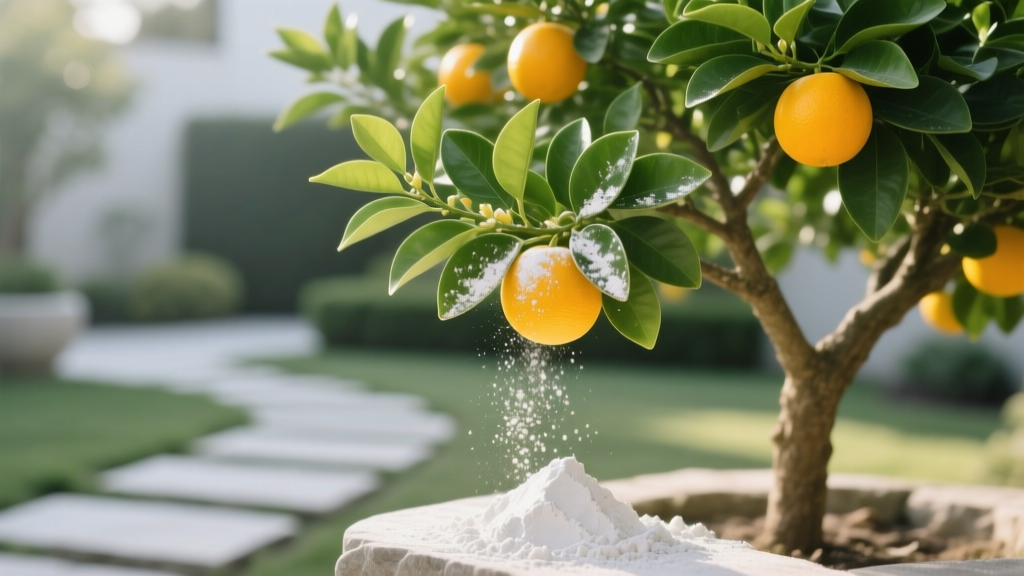
How to Use Kaolin Clay on Citrus Trees
One July, a neighbor called me over in a panic: her beautiful Meyer lemon was suddenly dropping fruit and the remaining lemons looked sunburned—bronzed, rough patches on the south-facing side. She’d been watering, fertilizing, “doing everything right.” The surprise was that the tree wasn’t starving or diseased. It was simply getting cooked. That’s where kaolin clay earns its keep: it’s less like a pesticide and more like a lightweight sunscreen and physical barrier that can take the edge off heat stress and reduce pest pressure at the same time.
Kaolin clay (often sold as a wettable powder like Surround WP) is a processed, refined clay that dries into a thin white film on leaves and fruit. The film reflects light and heat, reduces sunburn, and makes it harder for certain insects to feed or lay eggs. It’s not a magic shield—coverage and timing matter—but used correctly, it can save a crop in a hot spell and help you get cleaner fruit with fewer sprays.
Research supports these practical uses. For example, University of California Agriculture and Natural Resources notes that kaolin particle films can reduce sunburn damage on fruit and can affect pest behavior (UC ANR, 2023). Washington State University Extension also describes kaolin clay’s role as a particle film that can deter insect pests and reduce heat load when applied with good coverage (WSU Extension, 2022).
When kaolin clay makes sense (and when it doesn’t)
I reach for kaolin clay when I’m dealing with heat, sun exposure, and nuisance pests—not when I need a fast knockdown of a heavy infestation. Think of it as prevention and pressure reduction. You’ll get the best results if you apply before the problem peaks.
Good reasons to use it
- Sunburn prevention on exposed fruit during heat waves (especially above 90°F and when fruit is on the outside of the canopy).
- Heat stress reduction on young or recently pruned trees with suddenly exposed bark and leaves.
- Pest deterrence for pests that rely on landing, tasting, or laying eggs on clean surfaces (coverage matters more than “strength”).
- Organic-leaning tool as a physical barrier (always check the product label and any certification rules you follow).
Times to skip or rethink it
- Right before heavy rain—a downpour can wash it off and waste your effort.
- During bloom if bees are working heavily (not because it’s toxic, but you don’t want to coat flowers and interfere with pollination activity).
- If you can’t spray thoroughly (a light dusting in patches won’t do much).
“Particle films like kaolin work best as a preventative—coverage before pest pressure or heat peaks is what makes them effective.” — University Extension guidance on particle film use (WSU Extension, 2022)
Watering: kaolin clay helps, but hydration still drives fruit quality
Kaolin clay can lower leaf temperature a bit, but it won’t rescue a citrus tree that’s cycling between drought and flood. Most citrus problems I’m called to diagnose—fruit drop, split fruit, leaf curl—trace back to uneven watering.
Baseline watering targets (home garden citrus)
Use these as starting points and adjust for soil type and weather:
- Newly planted citrus (first year): deep water 2–3 times per week in warm weather, keeping the root zone evenly moist but not soggy.
- Established in-ground trees: deep water every 7–14 days in summer, less often in cooler seasons.
- Container citrus: check moisture every 1–2 days during heat; water when the top 2 inches are dry.
If you’re applying kaolin primarily for sunburn, pair it with steady irrigation. Sunburn worsens when the tree is water-stressed because leaves and fruit can’t cool themselves as effectively.
Real-world scenario: fruit drop during a heat wave
What it looks like: small green fruit drops after temperatures spike above 95°F.
What usually happened: the tree was slightly dry going into the heat event, then the sun hammered exposed fruit.
What to do:
- Deep water the day before extreme heat if your soil is drying (don’t waterlog).
- Apply kaolin clay 24–48 hours before the hottest days so it dries into a uniform film.
- Mulch with 2–4 inches of wood chips, keeping mulch 6 inches away from the trunk to prevent rot.
Soil: the root zone decides how well kaolin “works”
Kaolin is applied to leaves and fruit, but a citrus tree’s resilience is built in the soil. If roots are struggling—poor drainage, high salinity, compacted clay—your canopy won’t handle heat well and pests will take advantage.
Soil drainage and texture
- Citrus prefers well-drained soil. If water stands for more than 4 hours after irrigation, address drainage before expecting great results from any foliar tool.
- In heavy clay, build a wide mulched basin and water slowly so moisture penetrates rather than runs off.
Soil pH and micronutrients
Citrus commonly struggles with iron and zinc availability in higher pH soils. Kaolin won’t fix chlorosis, and a pale tree is more stress-prone.
- If new leaves are yellow with green veins, consider iron chlorosis and check pH. Many citrus do best roughly in the pH 6.0–7.0 neighborhood (local conditions vary).
Light and heat: where kaolin clay shines
Citrus loves full sun—until the fruit and leaves are pushed past their comfort zone. In many backyards, pruning opens the canopy and suddenly fruit that was shaded is now exposed. That’s when kaolin clay is most useful.
Sunburn basics
Sunburn on citrus shows up as:
- Bronzed or bleached patches on fruit (usually on the sunniest side)
- Rough, leathery texture later
- In severe cases, cracking or secondary rot
Kaolin’s white film reflects a portion of sunlight and can reduce surface heating. The key is an even coat on the fruit and the most exposed leaves—spotty coverage gives spotty protection.
Real-world scenario: “I pruned, and now everything is sunburning”
What it looks like: after a hard prune, exposed branches and fruit start showing sunburn within 7–10 days during hot weather.
What to do:
- Use kaolin clay on newly exposed areas (fruit and outer canopy).
- For trunk/major limb sunscald risk, consider a separate trunk protection strategy (whitewash or wrap) rather than relying solely on kaolin film.
- Avoid heavy pruning right before peak heat whenever possible.
Feeding: don’t over-fertilize a stressed tree
Overfeeding citrus is a classic mistake when gardeners see leaf curl or fruit drop. They assume “it needs food,” then push soft growth that’s more attractive to pests and more prone to stress.
Practical feeding rhythm
- Feed established citrus during active growth. Many home gardeners do well with 2–3 feedings from spring into mid-summer.
- Avoid heavy nitrogen applications during extreme heat. If daytime highs are holding above 95°F, focus on watering and stress reduction first.
If you’re using kaolin for pest deterrence, especially on tender new flush, balanced nutrition helps the tree outgrow minor feeding damage.
Kaolin clay application: materials, mixing rates, and step-by-step
This is where most people go wrong: too little product, weak coverage, or a sprayer that can’t keep the clay in suspension. Kaolin needs to be mixed well and sprayed thoroughly.
What you’ll need
- Kaolin clay product labeled for plants (follow the label—rates vary by formulation)
- Pump sprayer, backpack sprayer, or hose-end sprayer capable of handling wettable powders
- Measuring scoop or scale
- Clean bucket for pre-mixing (“slurry”)
- Optional but helpful: a spreader-sticker (only if label allows)
Mixing: a reliable home-garden rate
Always follow your specific product label first. As a practical reference point for many kaolin particle film products, gardeners commonly use about:
- 3 cups per 1 gallon of water (for small sprayers), or
- 6–12 lb per 100 gallons for larger spray volumes (orchard-scale guidance varies by product and target)
For small backyard trees, you’re aiming for coverage, not drenching runoff. Expect to use roughly 1–3 gallons of mixed spray for a medium backyard tree depending on canopy size and sprayer output.
Step-by-step: applying kaolin clay so it actually works
- Pick your timing. Spray early morning when temps are below 85°F and wind is calm. Avoid spraying during the heat of the day.
- Pre-mix a slurry. In a bucket, add a small amount of water and slowly whisk in the kaolin powder until it’s smooth—no dry lumps.
- Fill sprayer halfway with water. Add the slurry, then top off with water to your final volume.
- Agitate often. Kaolin settles quickly. Shake your sprayer every few minutes or use a sprayer with agitation.
- Spray to an even white film. Coat upper and lower leaf surfaces and fruit. You want a visible white layer, not a faint speckling.
- Let it dry. Plan for at least 2–4 hours of dry weather after spraying.
- Reapply on schedule. Recoat every 7–14 days during high pressure (heat/pests) and after heavy rain or vigorous new growth.
Comparison table: kaolin clay vs shade cloth vs horticultural oil
| Method | Main purpose | Typical timing | How long it lasts | Best use case |
|---|---|---|---|---|
| Kaolin clay (particle film) | Reduce sunburn + deter some pests via barrier/reflectance | Before heat spikes; reapply every 7–14 days | Until washed off; often 1–2 weeks without rain | Exposed fruit, heat waves, light-to-moderate pest pressure |
| Shade cloth (30–50%) | Reduce light/heat load physically | Install before hottest months | Season-long if secured | Extreme heat regions; young trees; patios with reflected heat |
| Horticultural oil | Smother scale/mites (contact control) | When pests present; avoid high heat | Days to a week; requires direct contact | Scale outbreaks; mite flare-ups (with correct timing) |
Common problems kaolin clay can help with (and what it won’t)
Kaolin’s strength is physical coverage. It can reduce feeding, egg-laying, and heat load. It won’t cure disease, and it won’t replace good scouting.
Pests and issues where gardeners often see benefits
- Sunburn on fruit and leaves
- Leaf-footed bugs and other “piercing-sucking” pests (deterrence varies; coverage helps)
- Some thrips pressure (more effective as a preventative barrier)
- General heat stress on exposed canopies
Problems kaolin won’t solve by itself
- Citrus leaf miner inside the leaf tissue (kaolin may reduce activity on new flush, but it’s not a stand-alone fix)
- Root rot or poor drainage
- Nutrient deficiencies from high pH or depleted soil
- Heavy scale infestations already established (you’ll likely need horticultural oil or targeted measures)
Troubleshooting: symptoms, likely causes, and what to do next
If you’re going to use kaolin clay, you also need a plan for when results are disappointing. Most “it didn’t work” stories come down to timing, coverage, or wash-off.
Symptom: white coating is patchy and doesn’t stick
- Likely causes: not enough powder, poor agitation, oily residues on leaves, or spraying in wind/heat.
- Fix: increase to label rate, pre-mix a slurry, shake sprayer every few minutes, and spray in calm conditions below 85°F. Consider a label-approved spreader-sticker.
Symptom: coating rinsed off after a storm
- Likely causes: heavy rain or overhead irrigation soon after application.
- Fix: reapply once foliage is dry. If you rely on overhead sprinklers, switch to drip or soaker hoses during kaolin season.
Symptom: leaves look dusty and photosynthesis seems reduced
- Likely causes: overly heavy application, repeated coats without weathering, or spraying shaded interior foliage unnecessarily.
- Fix: focus applications on the outer canopy and fruit. Don’t overdo reapplications if coverage is still solid. If you need to remove it, a strong water spray can help, but you’ll also remove protection.
Symptom: fruit still sunburns after spraying
- Likely causes: sprayed too late (after damage began), missed fruit on the hottest side, or heat was extreme with reflected light from walls/paving.
- Fix: apply earlier (at least 24–48 hours before heat). Recoat every 7–10 days during severe heat. Add 30–50% shade cloth on the hottest exposure if your site is a furnace.
Three real-world application cases (what I’d do in each yard)
Case 1: Backyard lemon against a west-facing wall (reflected heat)
The setup: Tree is 3–6 feet from stucco, fruit hangs on the west side, and temps run 90–105°F in summer. This is prime sunburn territory.
My plan:
- Spray kaolin clay on fruit and west/south outer canopy in late spring, before the first heat wave.
- Reapply every 10–14 days (or after rain).
- Add a
- Deep water on a steady cadence; mulch heavily to keep roots cool.
Case 2: Young mandarin with sudden exposure after pruning
The setup: A gardener cleans up the canopy in early summer, and tender bark and new leaves are suddenly in full sun.
My plan:
- Kaolin spray within a few days of pruning (not during peak heat).
- Don’t strip interior shade again until cooler weather.
- Keep nitrogen modest until the tree settles—push too much soft growth and pests show up.
Case 3: Mixed citrus with light pest pressure and cosmetic fruit goals
The setup: The tree is generally healthy, but the gardener wants cleaner fruit and fewer blemishes with minimal insecticide use.
My plan:
- Start kaolin when fruit is marble-sized, before blemishes begin.
- Maintain coverage through the main pressure window with 7–14 day reapplications.
- Scout weekly: check new flush, underside of leaves, and young fruit.
- Use targeted controls only if scouting shows a real outbreak (for example, horticultural oil for scale—timed and applied correctly).
Cleaning up, harvest notes, and sprayer care
Kaolin clay leaves fruit with a white film. That’s normal. Most of it rinses off with water, and a little gentle rubbing helps. If you’re selling or gifting fruit and want it spotless, plan your last spray accordingly.
- Before harvest: Stop applications about 1–2 weeks before you want pristine-looking fruit, then rinse at picking time.
- Sprayer cleanup: Don’t leave kaolin mix sitting overnight. It settles into a concrete-like layer. Rinse immediately and spray clean water through the nozzle for 1–2 minutes.
- Nozzle clogs: Strain your slurry if you’re using a fine nozzle, and keep agitation frequent.
Using kaolin clay as part of a simple citrus care routine
The most successful gardeners I know treat kaolin as one tool in a steady routine: consistent watering, decent soil, smart pruning, and quick response when weather turns extreme. If you apply kaolin early (before the heat or pest surge), coat thoroughly, and reapply on a sensible schedule, it can be the difference between a tree that limps through summer and one that holds onto its fruit.
If you want to read more from science-based sources, start with University of California Agriculture and Natural Resources citrus pest and sunburn resources (UC ANR, 2023) and Washington State University Extension’s particle film guidance (WSU Extension, 2022). Then adapt the timing to your own yard—because the best spray schedule is the one that matches your microclimate, not a generic calendar.