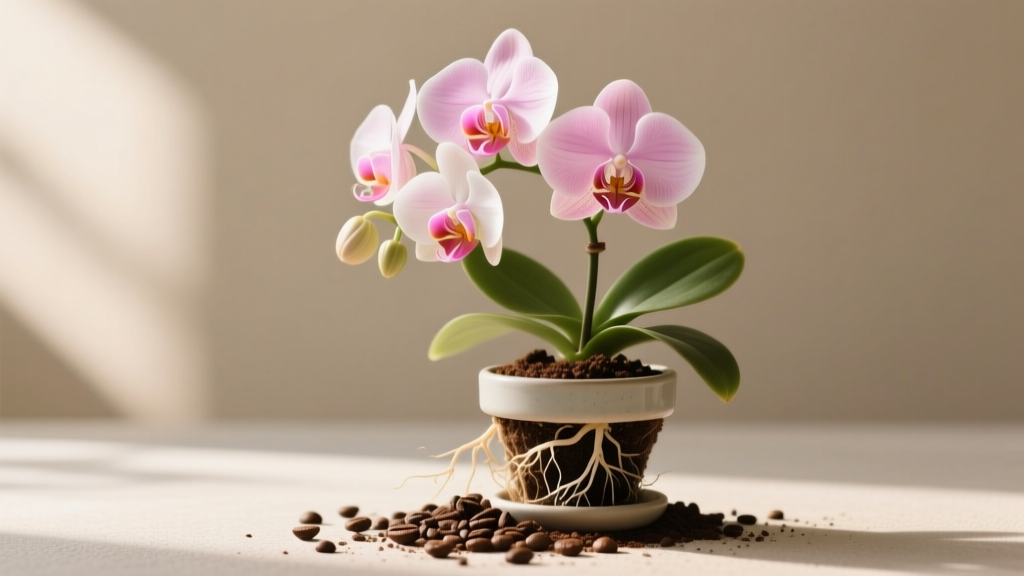
Using Coffee Grounds on Orchids
You finish your morning coffee, knock the damp grounds into the compost bucket, and pause—because you’ve heard people swear that orchids “love coffee.” Then you look at your Phalaenopsis on the windowsill: roots half silver, half green, a few buds dropping, and bark that dries out fast. Do coffee grounds help… or are they one of those internet tips that quietly kills plants?
Here’s the hard-won truth: orchids can benefit from coffee in very limited, carefully controlled ways—but used wrong, coffee grounds are a reliable path to sour media, fungus gnats, and root rot. Orchids aren’t like garden shrubs that tolerate a little mess. Most common home orchids are epiphytes; their roots want air first, water second, and fertilizer in light doses.
This guide focuses on what works in real homes: how to use coffee grounds safely (if you insist), what to do instead when you want the same benefits with less risk, and how to troubleshoot the classic “coffee + orchid” problems.
Before You Add Coffee Grounds: Know What Orchids Actually Need
Most orchids sold for windowsills (especially Phalaenopsis) naturally grow on trees, not in soil. Their roots are designed for fast wet/dry cycles and abundant oxygen. Anything that packs down, stays wet, or turns acidic quickly can stress them.
Also: “coffee grounds” and “coffee” aren’t the same. Coffee grounds are organic matter that can mat and break down. Brewed coffee is a dilute liquid that can be used like a weak, occasional drench if managed carefully.
A practical target range for many common orchids is a root-zone pH around 5.5–6.5 in bark-based mixes. That’s not a license to acidify constantly—it’s a reminder that orchids tolerate mildly acidic conditions, but they still need stable, airy media. The University of Florida IFAS notes that orchids generally perform best in slightly acidic conditions and emphasizes proper media and watering practices to prevent root issues (University of Florida IFAS Extension, 2023).
Real-World Scenarios: When People Reach for Coffee Grounds
Let’s get specific. These are the situations I see most often in homes, and how coffee fits (or doesn’t fit).
Scenario 1: “My orchid won’t bloom—should I add coffee grounds?”
Bloom issues are almost never solved by coffee grounds. The usual culprits are:
- Light too low (bright shade isn’t enough for consistent reblooming).
- No night temperature drop (Phalaenopsis often set spikes with a drop of about 10°F (5–6°C) for a couple of weeks).
- Fertilizer routine is random (orchids prefer “weakly, weekly”).
Use coffee only if you’re already getting light and watering right—and even then, coffee is not a bloom trigger.
Scenario 2: “I have fungus gnats in my orchid pot.”
This is where coffee grounds make things worse. Gnats love moist decomposing organic material. If you’re dealing with gnats, do not top-dress with grounds, and do not mix grounds into the pot. You’ll be feeding the problem.
Scenario 3: “I want to reduce kitchen waste and ‘feed’ my orchid naturally.”
I get it. But orchids are not compost bins. If your goal is sustainability, the better move is to compost coffee grounds (or use them in outdoor beds) and fertilize orchids with measured doses. If you still want a coffee-based approach, brewed coffee (diluted) is safer than grounds.
Watering: The Make-or-Break Factor (Especially if You Use Coffee)
If there’s one reason coffee grounds fail with orchids, it’s moisture management. Grounds hold water and can form a dense layer that slows drying. Orchid roots respond to that with rot.
How to Water Orchids Correctly in Bark Media
Use this as your baseline before experimenting with coffee:
- Water in the morning so leaves and crown dry before night.
- Drench thoroughly until water runs freely out the bottom for 10–20 seconds.
- Drain completely. Never let the inner pot sit in water more than 5 minutes.
- Wait until roots shift silvery (in clear pots) or the pot feels noticeably lighter.
In a typical home (65–75°F / 18–24°C), many Phalaenopsis in bark need watering about every 7–10 days. In warmer, brighter conditions, it may be every 4–6 days. In winter, it can stretch to 10–14 days. Don’t lock yourself to a calendar—use the roots and pot weight.
If You Use Coffee at All, Treat It Like a “Watering Event”
Never add coffee grounds and then water as usual. If you choose to use brewed coffee, count it as one of your waterings and keep it weak.
Potting Media (“Soil”): Where Coffee Grounds Usually Go Wrong
Orchid media is not soil. The goal is structure and airflow. Coffee grounds break down into fine particles that plug air spaces—especially in bark and sphagnum setups.
What Happens When Coffee Grounds Sit in an Orchid Pot
- Compaction: grounds settle and create a dense zone with low oxygen.
- Water retention: damp pockets stay wet longer than surrounding bark.
- Fungal growth: a damp organic layer is prime territory for mold and gnats.
- Unpredictable pH shifts: decomposition changes chemistry over time, not always in the direction you want.
The Oregon State University Extension highlights that proper potting media and avoiding waterlogged conditions are essential for preventing root disease in orchids (Oregon State University Extension, 2022). Coffee grounds increase the odds of waterlogging unless used with extreme restraint.
Safer Media Choices If You Want to “Add Organic Matter”
If you’re trying to hold moisture a bit longer, use materials designed for orchids:
- Medium fir bark (classic for Phalaenopsis)
- Perlite (adds air)
- Charcoal (helps keep mix sweet and airy)
- Small amount of sphagnum (for dry homes, used strategically—not packed)
Light: The Bloom Lever Coffee Can’t Replace
If your orchid is healthy but refuses to rebloom, look at light before you look at coffee.
Practical Light Targets for Phalaenopsis
- Bright, indirect light near an east window is ideal.
- South/west windows can work if filtered by a sheer curtain.
- Leaves should be medium green, not dark forest green.
For spike initiation in many Phalaenopsis, a small seasonal cooling helps: aim for night temperatures around 60–65°F (16–18°C) for 2–3 weeks, while keeping days in the low 70s°F (around 22–24°C).
Feeding Orchids: Coffee Grounds vs. Orchid Fertilizer (With Actual Numbers)
Coffee grounds contain nutrients, but they’re not a balanced orchid fertilizer. More importantly, orchids in bark have limited microbial activity compared to garden soil, so nutrient release from grounds is slower and less predictable.
“Epiphytic orchids respond best to regular, dilute fertilization and excellent drainage; organic amendments that hold moisture can increase disease pressure if the medium stays wet.” — University extension guidance summarized from orchid culture recommendations (University of Florida IFAS Extension, 2023)
Comparison: Coffee Grounds, Brewed Coffee, and Proper Fertilizer
| Method | Typical Mix/Amount | Frequency | Main Upside | Main Risk |
|---|---|---|---|---|
| Dry coffee grounds in potting media | Max 1/4 tsp (about 1 g) mixed into top layer only (if used at all) | No more than every 8–12 weeks | Minor organic input | Compaction, gnats, mold, root rot |
| Top-dressing with coffee grounds | A “pinch” is still too much for most pots | Not recommended | Convenient | Creates a wet cap that blocks airflow |
| Diluted brewed coffee (cooled) | 1 part coffee : 3 parts water (25% strength) | Once per month, then plain water next time | Less compaction; easy to control | Salt buildup if repeated; crown rot if splashed |
| Balanced orchid fertilizer | 1/4 strength of label rate (often ~1/4 tsp per gallon, depending on product) | Every 1–2 weeks during active growth | Predictable nutrition | Salt buildup if not flushed |
The “Weakly, Weekly” Fertilizing Routine (Reliable and Boring—in a Good Way)
If you want results, do this instead of chasing kitchen hacks:
- Use a balanced orchid fertilizer (often 20-20-20 or similar, or a urea-free orchid formula).
- Apply at 1/4 strength every 7–14 days when the orchid is actively growing.
- Flush the pot with plain water every 4 weeks to prevent salt buildup—run at least 2–3 pot-volumes of water through the mix.
If you insist on using coffee, treat it as an occasional, diluted drench—more like a curiosity than a primary feeding plan.
How to Use Coffee Grounds on Orchids (Safest Methods First)
I’m going to say it plainly: mixing coffee grounds into orchid media is usually more trouble than it’s worth. But if you’re determined, here are the least risky approaches.
Method A (Preferred): Use Diluted Brewed Coffee as an Occasional Drench
This avoids the compaction problem of grounds.
- Brew coffee as usual, then let it cool to room temperature (65–75°F / 18–24°C).
- Dilute to 25% strength: 1/4 cup coffee + 3/4 cup water (or 1:3 ratio).
- Water the orchid as you normally would—soak, then drain thoroughly.
- Do this no more than once per month.
- Next watering should be plain water to help prevent buildup.
Method B (If You Must): Micro-Amount of Grounds, Then Remove
This is the only “grounds” method I’ll use on a healthy orchid in a very airy bark mix.
- Dry used coffee grounds completely (they should be crumbly, not damp).
- Sprinkle 1/8–1/4 teaspoon on the surface of a 5–6 inch pot—no more.
- Do not pack it down. Keep it away from the crown and exposed roots at the base.
- Water normally, then remove any grounds that clump or form a “cap” after 7–10 days.
- Wait at least 8–12 weeks before considering it again.
If this sounds fussy, that’s because it is. Orchids reward consistency, not clever shortcuts.
Common Problems When Coffee Grounds Meet Orchids (And How to Fix Them)
If you’ve already used coffee grounds and things are going sideways, don’t panic. Most orchids can recover if you act early.
Symptom: Sour smell from the pot, blackened roots
Likely cause: media staying wet too long; grounds decomposing and cutting airflow.
Fix:
- Unpot the orchid and inspect roots.
- Trim mushy/black roots with sterilized scissors.
- Repot into fresh, chunky orchid bark (avoid reusing the old mix).
- After repotting, wait 3–5 days before watering if many roots were removed (this helps cuts callus).
Symptom: Fungus gnats (tiny flies), especially after watering
Likely cause: damp organic layer from grounds; mix staying constantly moist.
Fix:
- Remove any visible grounds from the surface.
- Let the pot dry more between waterings (roots silvering is your cue).
- Use yellow sticky traps near the pot to catch adults.
- If infestation is heavy, repot and rinse the pot thoroughly.
Symptom: White crust on bark or pot rim
Likely cause: mineral/salt buildup (from fertilizer, hard water, and sometimes repeated coffee use).
Fix:
- Flush with plain water: run 2–3 pot-volumes through the mix.
- Switch to rainwater, distilled, or RO water if your tap is hard.
- Reduce feeding to 1/4 strength and keep monthly flushing.
Symptom: Leaves limp but roots look “okay”
Likely cause: inconsistent watering (too dry too long, then too wet), or root stress from decomposing pockets in the media.
Fix:
- Check the media texture—if it’s breaking down into fines, repot.
- Water when roots are mostly silver, not bone dry for weeks.
- Keep humidity moderate if possible: 40–60% is a comfortable target in homes.
Case Notes From Homes: What Actually Happens
Case 1: The “coffee top-dress” experiment. A homeowner sprinkled a tablespoon of damp grounds on a 6-inch Phalaenopsis weekly. Within a month: gnats, mold fuzz, and a sour smell. Repotting into fresh bark and switching to a 1/4-strength fertilizer every 2 weeks stabilized the plant. It rebloomed the following season after improving light.
Case 2: Diluted coffee once a month in a bright kitchen. Another grower used cooled coffee diluted 1:3 monthly, with plain-water flushes. Because the orchid was in chunky bark and dried within 6–8 days, there were no gnats and no rot. Was the coffee the magic? Probably not—but it didn’t hurt because the fundamentals were solid.
Case 3: Coffee grounds mixed into sphagnum. This is the fastest route to trouble. Sphagnum already holds water; adding grounds makes it denser and slower to dry. The plant declined in 2–3 weeks with yellowing lower leaves and root loss. Repotting into bark with a small sphagnum “plug” only around remaining roots helped recovery.
Best Practices If You Still Want to Use Coffee in an Orchid Routine
If you take only a few habits from this article, make them these:
- Never use damp grounds in the pot. Damp grounds cake and mold quickly.
- Never create a thick top layer. A “mulch cap” is great outdoors and terrible for orchid airflow.
- Keep coffee away from the crown (the center where leaves meet). Water sitting there invites crown rot.
- Don’t use coffee to fix a struggling orchid. Use it only on healthy plants with strong roots.
- Repot on schedule: bark-based mixes typically need refreshing about every 12–18 months as they break down.
A Practical Alternative: Get the “Coffee Effect” Without the Risks
Most people reach for coffee grounds because they want gentle feeding and slightly acidic conditions. You can get that with far fewer headaches:
- Use a reputable orchid fertilizer at 1/4 strength during growth.
- Flush monthly to prevent crusty salts.
- Repot into airy media before it breaks down.
- Improve light—because light is what turns fertilizer into growth and blooms.
If you love the ritual of “something from the kitchen,” keep coffee grounds for the compost pile and give your orchid what it actually recognizes: clean water, airy roots, steady light, and small, regular meals.
And if you do try coffee, keep it measurable and occasional. Orchids forgive a lot, but they rarely forgive a pot that stays wet and airless.