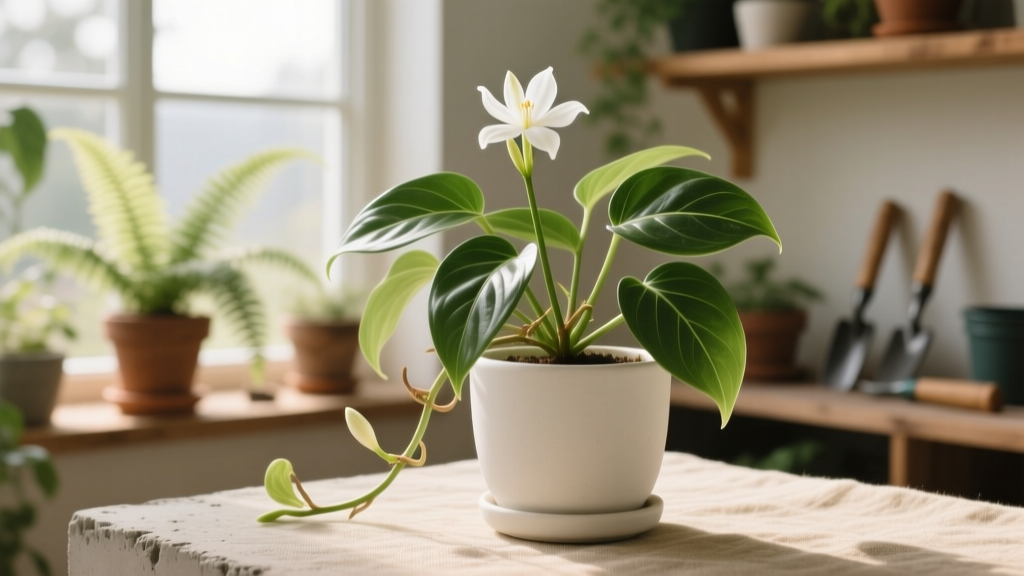
How to Prune Pothos After Flowering
It happens rarely enough that most people don’t believe it: your pothos throws a flower (or what looks like one), then a few weeks later the vine stalls, drops a couple leaves, and starts looking tired. You didn’t “do anything wrong”—but you do need to respond. After flowering, pothos often shifts resources, and older vines can get leggy or sparse. A smart prune right after the bloom fades is one of the quickest ways to trigger fresh branching and bring the plant back to that full, cascading look.
Before we get into cuts and timing, one grounded truth: pothos (Epipremnum aureum) almost never flowers indoors. When it does, it’s usually because the plant is older, conditions are unusually stable, or it’s been allowed to climb and mature. The flower itself isn’t the prize—what matters is what your plant does after. Pruning is how you steer that next phase.
Quick safety note: pothos sap can irritate skin and is toxic if ingested. Keep pets and kids away while you work, and wash hands after. The ASPCA lists Epipremnum aureum as toxic to cats and dogs (ASPCA Animal Poison Control, 2024).
First: Confirm What You’re Seeing (And When to Prune)
“After flowering” sounds straightforward, but with pothos it can be confusing. The true inflorescence is a spadix/spathe structure (like a tiny peace lily bloom), not a typical petaled flower. Sometimes people mistake a new leaf sheath, a deformed leaf, or even a dried cataphyll for a bloom.
Best timing
Prune when the spathe/spadix has faded, browned, or collapsed—usually 7–21 days after it first appears. If you cut too early, you may interrupt the plant’s natural cycle; if you wait too long, you’re just letting the vine spend energy maintaining tissue that’s already on the way out.
- Ideal season: Spring through early fall, when indoor growth is strongest.
- Temperature window for fastest recovery: 18–27°C (65–80°F).
- Avoid major pruning if your home is regularly below 16°C (60°F)—regrowth slows and cut points can sulk.
Tools and Prep: Set Yourself Up for Clean Cuts
Pothos is forgiving, but dull scissors make ragged cuts that take longer to heal. A little prep saves weeks of “why isn’t it bouncing back?”
What you’ll need
- Sharp pruning snips or scissors
- 70% isopropyl alcohol (or soap and hot water)
- A clean towel or paper towels
- A jar of water if you plan to propagate cuttings
Wipe blades with 70% alcohol before you start and between plants. Clean tools matter. Disease issues indoors are less common than outdoors, but they do happen—especially if you’ve ever battled root rot or bacterial leaf spots.
“Pruning is a growth management tool: by removing shoot tips, you reduce apical dominance and encourage lateral buds to grow.” — University of Minnesota Extension (2023)
Step-by-Step: How to Prune Pothos After Flowering
Here’s the practical method I use when a vine has flowered and then looks a little spent. The goal is to remove fading bloom tissue, redirect growth, and stimulate branching from nodes.
1) Identify nodes and growth points
Nodes are the slightly swollen points along the stem where leaves and aerial roots form. New branches push from nodes after you prune.
- Look for aerial root nubs (little brown bumps).
- Note where leaves are sparse—those sections are prime candidates for cutting back.
2) Remove the spent bloom and the weak section beneath it
Don’t just snip off the flower structure. Often the stem section supporting it is tired. Cut 1–2 cm above a healthy node below the bloom. That node is your “restart button.”
3) Decide how hard to prune (light vs. rejuvenation)
Use this rule: if a vine still has good leaf spacing (tight internodes), prune lightly. If it’s leggy with long gaps, prune harder.
- Light prune: remove 10–20% of total vine length.
- Moderate prune: remove 25–35%, focusing on legginess.
- Rejuvenation prune: remove up to 50% if the plant is severely sparse (do this only if roots are healthy and the plant is in good light).
4) Make cuts correctly
- Cut at a slight angle, just above a node.
- Aim to leave at least 2–4 nodes on the remaining vine section attached to the pot.
- If the vine is very long, divide it into multiple cuttings rather than one long piece.
5) Use the cuttings to thicken the pot (highly recommended)
The fastest way to make pothos look lush after pruning is to replant rooted cuttings back into the same pot. Root cuttings in water until roots are 2.5–5 cm (1–2 in) long, then pot them up.
Most cuttings root in 10–21 days in warm conditions.
Comparison: Water Propagation vs. Direct-to-Soil After Pruning
Both methods work. The “best” option depends on your habits. Here’s a practical comparison with numbers you can use.
| Method | Typical time to visible roots | Success rate (home conditions) | Aftercare workload | Best for |
|---|---|---|---|---|
| Water propagation | 10–21 days | High (often 80–95% with warm temps) | Medium (change water every 5–7 days) | People who like to “see progress” and catch rot early |
| Direct-to-soil cuttings | 14–28 days (rooting is hidden) | Moderate to high (often 60–85% depending on moisture control) | Low to medium (keep evenly moist, not wet) | People who forget jars, or want less transplant shock |
My take: Water rooting is forgiving if you’re attentive; soil rooting is cleaner and faster long-term if you’re good at not overwatering.
Watering After Pruning: The Biggest Mistake to Avoid
Most pothos problems after pruning come down to water. People either panic-water because the plant “looks smaller,” or they forget it entirely. After pruning, the plant has less leaf surface, so it uses less water.
What to do instead
- Water only when the top 2.5–5 cm (1–2 in) of mix is dry.
- Water thoroughly until 10–20% drains out the bottom, then empty the saucer.
- Expect the interval to be longer for 1–2 weeks post-prune.
Real-world scenario #1: “I pruned and now the leaves are yellowing.”
Most common cause: overwatering during the recovery window. Less foliage means slower drying, so roots stay wet longer. Let the pot dry more between waterings, increase light slightly, and confirm the pot has drainage holes.
Soil and Potting: Give Roots the Air They Need
Pruning fixes the top, but your recovery speed is controlled by roots. A pothos recovering after flowering and pruning wants an airy mix that drains fast but doesn’t become bone-dry overnight.
A reliable mix (by volume)
- 50% quality indoor potting mix
- 25% perlite or pumice
- 25% orchid bark or coco chunks
If you’d rather buy instead of mix: choose an aroid-style blend or a “houseplant chunky mix.” Pothos isn’t as fussy as philodendrons, but it still hates compacted, soggy soil.
When to repot
Don’t automatically repot the same day you prune. Stack too many stressors and recovery slows. Repot if:
- Roots circle the pot heavily or emerge from drainage holes
- Soil stays wet for more than 7–10 days after watering
- You smell sour, swampy odor (a root-rot warning)
If repotting, go up only 2–5 cm (1–2 in) in diameter. Oversized pots hold excess moisture—one of the fastest ways to turn a healthy pothos into a mushy one.
Light After Flowering: Keep It Bright, Not Harsh
Flowering (rare as it is) suggests your pothos had stable, decent light. After pruning, light becomes even more important because the plant needs energy to push new shoots from nodes.
- Best: bright, indirect light near an east or north window, or a few feet back from a south/west window.
- Target: enough light to cast a soft shadow, not a sharp one.
- Rotation: turn the pot a quarter turn every 7–14 days for even regrowth.
Real-world scenario #2: “It flowered, I pruned, and now it’s doing nothing.”
Most common cause: not enough light. The plant can survive in low light, but it won’t bounce back fast. Move it closer to a window or add a simple LED grow light for 10–12 hours daily. You’ll often see new buds swelling at nodes within 2–4 weeks.
Feeding After Pruning: Don’t Fertilize on a Wound
Fertilizer is helpful—but timing matters. Right after pruning, roots may be slightly out of sync with the reduced canopy. Give the plant a short rest, then feed lightly as new growth starts.
Practical feeding schedule
- Wait 10–14 days after pruning before fertilizing.
- Use a balanced houseplant fertilizer (for example, 10-10-10 or similar) at 1/4 to 1/2 strength.
- Feed every 4 weeks during active growth (spring/summer), and reduce in winter.
Salt buildup is real indoors. Flush the pot with plain water every 8–12 weeks (water thoroughly until it runs freely for a minute) to wash out excess fertilizer salts.
The University of Florida’s IFAS Extension notes that Epipremnum is generally low-maintenance and responds well to moderate fertility rather than heavy feeding (UF/IFAS Extension, 2022).
Common Problems After Pruning (Symptoms + Fixes)
These are the issues I see most often in the month after a post-flower prune—and what actually fixes them.
Symptom: Cut ends turn black or mushy
- Likely cause: stem rot from overly wet soil, poor airflow, or a dirty blade.
- Fix: cut back to firm, green tissue; let the plant dry to the “top 2 inches dry” mark; improve drainage; sanitize tools.
Symptom: Leaves curl and feel thin
- Likely cause: underwatering or hot, dry air (especially near vents).
- Fix: water deeply; move away from heat vents; aim for indoor humidity around 40–60% if possible.
Symptom: Long bare stretches (legginess) return quickly
- Likely cause: low light or infrequent pruning.
- Fix: increase light; pinch tips every 4–6 weeks during growth; add rooted cuttings back into the pot.
Symptom: New leaves are smaller than before
- Likely cause: light is weaker than the plant wants, or the plant is rootbound.
- Fix: brighter indirect light; consider repotting if roots are tightly packed; feed lightly once growth resumes.
Symptom: Yellow leaves near the base after pruning
- Likely cause: overwatering, or natural shedding of older leaves on stressed vines.
- Fix: let soil dry more; remove yellow leaves; confirm pot drains; avoid fertilizing until you see new growth.
Three Real-World Pruning Plans (Pick One That Fits Your Situation)
Not every pothos needs the same approach after flowering. Here are three common cases and exactly what I do.
Case #1: Hanging basket pothos that flowered and looks thin at the top
Goal: make the crown (top of the pot) fuller, not just the ends of vines.
- Prune 20–30% off the longest vines, cutting above nodes.
- Root at least 6–10 cuttings in water (each with 2 nodes submerged or one node submerged and one above water).
- Replant rooted cuttings around the rim and center once roots reach 1–2 inches.
Case #2: Climbing pothos on a pole that flowered (rare, but it happens)
Goal: keep mature leaf size and encourage controlled branching.
- Remove the spent bloom and cut back only to the next strong node (10–15% pruning).
- Keep the plant attached to support; don’t take it off the pole unless you’re restructuring completely.
- Increase light slightly and keep feeding modestly (half strength monthly).
Case #3: Office pothos that flowered, then went leggy in low light
Goal: reset the plant and restart growth with better conditions.
- Do a rejuvenation prune up to 40–50%, leaving multiple nodes on each remaining vine.
- Move it to brighter indirect light or add a grow light for 10–12 hours.
- Hold fertilizer for 2 weeks, then feed lightly once new buds show.
Aftercare Checklist: The 30-Day Recovery Window
If you want a pothos to look better a month from now, this is the routine that gets you there.
- Days 1–3: keep it out of hot sun; no fertilizer; water only if soil is already dry.
- Week 1: watch cut points; they should dry and callus, not darken and spread.
- Weeks 2–3: look for swelling buds at nodes; begin light feeding if new growth appears.
- Week 4: tip-pinch new shoots if you want more branching; root and tuck cuttings if you’re thickening the pot.
One more practical point: pothos responds beautifully to consistent care, not heroic interventions. Stable light, sensible watering, and a clean prune do more than any supplement.
If your pothos managed to flower indoors, you’re already doing something right. Prune with intention, propagate what you remove, and use the recovery window to tighten up light and watering. In a few weeks, you’ll usually see exactly what you want: multiple new shoots pushing from nodes, shorter gaps between leaves, and a plant that looks fuller than it did before it ever tried to bloom.
Sources: ASPCA Animal Poison Control (2024); University of Minnesota Extension (2023); University of Florida IFAS Extension (2022).