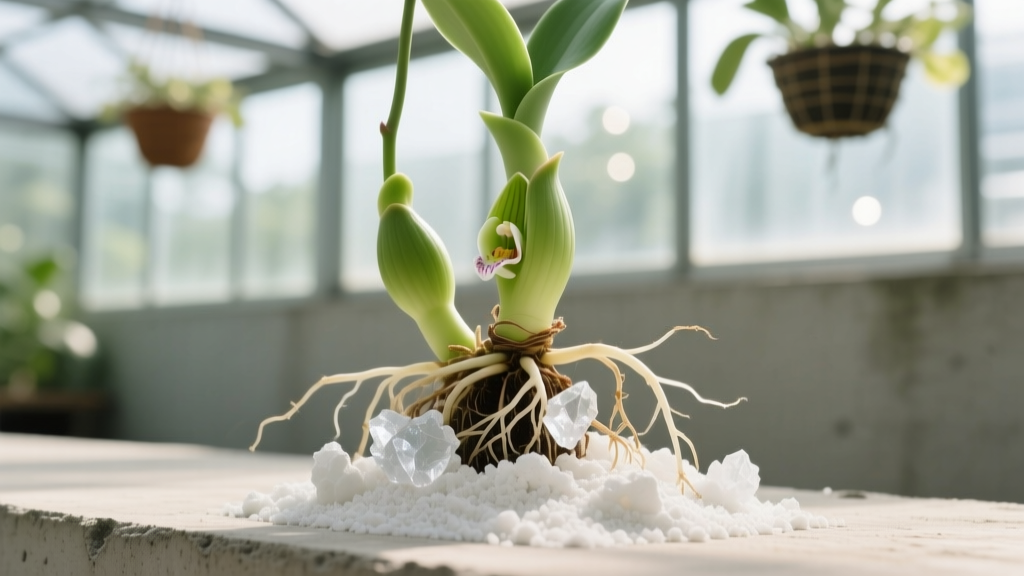
How to Use Silica Supplements for Orchids
The first time most orchid growers notice silica, it’s not because someone raved about it on a label—it’s because the plant keeps failing in the same annoying way: new leaves look fine until summer, then a heat wave hits and the foliage goes limp, pests move in, and flowers don’t last. You tweak watering, you swap fertilizer, you even buy a fan… and still, the plant feels “soft.” Silica is one of those behind-the-scenes nutrients that can toughen orchids up—if you use it correctly and don’t accidentally lock out calcium and magnesium along the way.
I’ll walk you through exactly how I use silica on orchids at home: what it does, what it doesn’t do, which products actually make sense, and the step-by-step mixing methods that prevent the most common mistake (pH crash and nutrient lockout). We’ll also cover real-world scenarios I see constantly: crispy leaf tips from hard water, phalaenopsis that rot if you look at them wrong, and cattleyas that refuse to hold blooms in heat.
What silica actually does for orchids (and what it won’t do)
Silicon (Si) isn’t classified as an “essential” nutrient for most plants, but it’s widely recognized as a beneficial element. In orchids, the practical effects growers notice are usually structural: firmer leaves, better tolerance to heat and drought swings, and sometimes reduced pest pressure because the tissues are less tender.
Silica won’t fix a rotten root system, a dark corner, or an overstuffed pot of decomposed moss. Think of it like upgrading the plant’s “armor,” not changing the rules of the game.
“Silicon is recognized for improving plant tolerance to abiotic and biotic stresses… often through deposition in epidermal tissues and effects on plant defense responses.” — EPPO Bulletin review on silicon in plant protection (2017)
For orchid growers, that stress tolerance matters because our plants live in artificial conditions: potting media instead of trees, indoor humidity instead of breezy forests, and water quality that can vary wildly from one faucet to the next.
Silica vs. silicon vs. silicate—quick clarity
- Silicon (Si): the element plants take up (mostly as monosilicic acid in solution).
- Silica: a general term often used on products; sometimes refers to silicon dioxide (SiO2), which is not very plant-available.
- Potassium silicate: common liquid supplement; strongly alkaline; works but must be mixed properly.
- Monosilicic acid: usually more “ready to use,” often marketed as stabilized silica; typically gentler on pH and easier to dose.
University-based guidance for greenhouse production notes silicon can benefit many crops under stress, but availability depends heavily on the form applied and solution chemistry (University of Florida IFAS Extension, 2020). That chemistry piece is why orchid growers sometimes get burned by silica: mixed wrong, it can cause precipitates and nutrient lockouts.
Three real-world orchid scenarios where silica helps (and where it doesn’t)
Here are three situations where silica supplementation is worth considering, plus what else must be fixed first.
Scenario 1: Phalaenopsis with soft leaves and recurring bacterial spots
What you see: Leaves feel thin, plants slump after watering, and you get small watery spots that spread in warm weather (especially above 80°F (27°C)).
What silica can do: Firmer tissue and improved stress tolerance can reduce “easy entry” for opportunistic problems. It won’t cure an infection, but it can make plants less prone.
What you must fix first: Airflow and leaf-wetness timing. Avoid water sitting in crowns overnight; aim to water early so foliage dries within 3–4 hours.
Scenario 2: Cattleyas and oncidiums that crisp in heat and drop buds
What you see: New growth looks fine until a hot spell; then leaf edges scorch and buds blast. This often happens when daytime highs hit 90°F (32°C) with low humidity.
What silica can do: Better tolerance to heat and water stress swings. I see the most benefit when silica is used consistently for 6–8 weeks leading into the hottest part of summer.
What you must fix first: Light and watering rhythm. High light with erratic watering is a scorch recipe, silica or not.
Scenario 3: Hard-water growers fighting salt stress and stalled roots
What you see: Leaf tip burn, crusty media surface, and roots that stop branching. Tap water TDS is often 250–500 ppm or higher.
What silica can do: Sometimes improves resilience, but hard water already carries minerals that can complicate nutrient balance. The bigger win is managing salts and pH.
What you must fix first: Leaching and water quality. Use a flushing routine and consider mixing with RO/distilled water.
Light: silica won’t compensate for dim conditions
Silica can help a plant handle stress, but it won’t produce spikes in a dark room. If your orchid is not blooming or growing slowly, confirm light first.
- Phalaenopsis: bright shade; roughly 800–1,500 foot-candles.
- Cattleya: brighter; roughly 2,000–3,500 foot-candles.
- Oncidium alliance: middle range; roughly 1,500–2,500 foot-candles.
If you’re using grow lights, a practical target for many common orchids is 100–200 µmol/m²/s at leaf level for phals, and 200–400 µmol/m²/s for cattleyas—adjust based on leaf color and temperature.
Watering: where silica fits into your routine
Silica works best as a small, steady input rather than an occasional “boost.” In practice, you’re adding it to your watering can or reservoir at a consistent dose.
Water quality checkpoints (do this before you buy anything)
If you only do one nerdy thing for your orchids, make it this: understand your water.
- Measure TDS/EC: For many home growers, staying around 50–150 ppm TDS (or roughly 0.1–0.3 mS/cm EC) before fertilizer is a comfortable baseline.
- Know your pH: Most orchids do well when the root zone solution lands around pH 5.5–6.5 after mixing fertilizer.
- Flush salts: Run at least 2–3× the pot volume of water through the media every 3–4 weeks, especially in bark or moss.
Silica products—especially potassium silicate—can push pH up fast. That’s not “bad,” but you have to manage it.
Soil/media: silica can’t rescue broken potting mix
Orchids aren’t in soil, but your potting media plays the same role: air, water, and stability. If your media stays soggy for days, silica won’t prevent rot.
Media basics for silica users
- Phalaenopsis: medium bark blend or high-quality moss packed loosely. If using moss, repot roughly every 9–12 months (sooner if it turns sour).
- Cattleyas: chunky bark with lots of air; repot when new roots are just starting.
- Oncidiums: medium bark with some moisture retention (a little sphagnum or fine bark) if your home is dry.
Silica can slightly encourage stronger, more resilient root growth in good conditions, but it will not overcome low oxygen in decomposed media.
Feeding: how to use silica supplements without causing nutrient problems
This is where most mistakes happen. The number one rule: silica goes into water first (especially potassium silicate), then other nutrients. If you dump silica into fertilizer concentrate or into calcium-containing solutions, you can get cloudy precipitates—those are nutrients falling out of solution, meaning your orchid doesn’t get them.
Two common silica options (with practical dosing)
| Silica product type | Typical dose for orchids | pH impact | Best use case | Watch-outs |
|---|---|---|---|---|
| Potassium silicate (liquid) | 0.5–1.0 mL per gallon (start low) | Raises pH strongly | Budget-friendly; good for growers comfortable adjusting pH | Can precipitate with Ca/Mg; easy to overdose; may require acid to bring pH back to 5.8–6.2 |
| Stabilized monosilicic acid | 1–2 mL per gallon (follow label) | Usually mild | Simple routine; less mixing drama | More expensive; still don’t mix directly into concentrates |
| Silica-enhanced “complete” fertilizers | Use to deliver about 50–100 ppm N per watering | Depends on formula | One-bottle simplicity | Harder to control silica dose; still need flushing |
Comparison analysis with real numbers: weekly silica vs. no silica (what to expect)
Here’s a realistic, home-grower comparison for phalaenopsis in bark under lights, assuming everything else is equal (light, temperature, repot timing). This isn’t a promise—plants vary—but it reflects what many growers report when silica is used correctly for a full season.
- Method A (no silica): Fertilize at 75 ppm N every watering; flush monthly.
- Method B (with silica): Add potassium silicate at 0.5 mL/gal weekly + same fertilizer program; adjust final solution to pH 5.8–6.2; flush monthly.
What changes most often in Method B:
- Leaves feel firmer by about 4–8 weeks.
- Less leaf edge damage during brief dry-downs or heat spikes.
- Flower longevity may improve modestly (often +3 to +10 days in stable indoor conditions), especially if heat stress was shortening blooms before.
What doesn’t reliably change: spike initiation timing (mostly light/temp driven), and recovery from existing root rot (media and watering driven).
Step-by-step: the safest way to mix silica for orchids
This is the routine I use to avoid cloudy mixes and lockouts.
- Start with water in your watering can or bucket (not fertilizer concentrate). Use room-temperature water, roughly 65–75°F (18–24°C).
- Add silica first:
- Potassium silicate: start at 0.5 mL per gallon.
- Monosilicic acid: typically 1 mL per gallon (label-dependent).
- Stir well for 15–30 seconds.
- Add fertilizer next (enough to reach roughly 50–100 ppm nitrogen for most orchids in active growth).
- Check pH if you can. Aim for pH 5.8–6.2 for bark/moss culture. If pH is high (common with potassium silicate), adjust down with pH-down product or a tiny amount of citric acid solution.
- Apply and drench thoroughly so the whole root mass gets solution, then let it drain completely.
If you don’t own a pH meter, use a gentler silica form (stabilized monosilicic acid) and start with half-label strength. Potassium silicate without pH awareness is where people most often get into trouble.
Timing: how often and when to pause
- Active growth (new roots/leaves): silica weekly or every other watering.
- Winter slow-down: reduce to once a month or pause entirely if growth has stopped and the plant is drying slowly.
- After repotting: wait 7–10 days before resuming supplements if roots were trimmed; focus on clean water and stable moisture first.
Research and extension writing on silicon use in horticulture repeatedly emphasizes consistency and correct solution chemistry over heavy dosing (University of Florida IFAS Extension, 2020). More is not better here.
Common problems with silica supplements (symptoms → fixes)
When silica causes trouble, it usually looks like a nutrient problem rather than an obvious “burn.” Here’s how to diagnose it quickly.
Symptom: White crust on media, leaf tips browning faster than usual
- Likely causes: salts building up; hard water; fertilizer too strong; not enough flushing.
- Fix:
- Flush with plain water using 3× pot volume.
- For the next 2 weeks, fertilize at half strength (aim closer to 50 ppm N).
- If tap water TDS is over 250 ppm, cut it with RO/distilled water (try a 50/50 blend) and reassess.
Symptom: New leaves look pale, growth slows, even though you’re fertilizing
- Likely causes: pH drift too high (common with potassium silicate), making micronutrients less available.
- Fix:
- Measure your mixed solution pH once. If it’s above 6.8, that’s your smoking gun.
- Reduce potassium silicate dose to 0.25–0.5 mL/gal.
- Use pH-down to bring the final mix to pH ~6.0.
- Consider switching to stabilized monosilicic acid if you don’t want to chase pH.
Symptom: Cloudy mix, flakes in the watering can, clogged sprayer
- Likely causes: silica mixed in the wrong order; reaction with calcium/magnesium; combining concentrates.
- Fix:
- Dump it—don’t feed precipitates to orchids.
- Rinse equipment.
- Next time: water → silica → stir → fertilizer → pH check.
- If you use Cal-Mag, add it after silica is fully diluted, and keep doses modest.
Symptom: Root tips blacken after you started silica
- Likely causes: not silica itself—more often drying too slowly, stale media, or fertilizer concentration too high; sometimes pH shock from strong potassium silicate in low-volume watering.
- Fix:
- Check media condition; repot if it smells sour or stays wet more than 7 days in your conditions.
- Reduce total feed strength; target 50–75 ppm N.
- Use silica at the low end (0.25–0.5 mL/gal) and ensure thorough drainage.
Feeding programs that work (three practical templates)
If you want specific, repeatable routines, here are three that suit most home collections. Adjust for your light and temperature—orchids under stronger light can eat more.
Template 1: “Weekly weakly” + silica (my default)
- Every watering in active growth: fertilizer at 50–100 ppm N.
- Once per week: add silica (potassium silicate 0.5 mL/gal or stabilized silica per label).
- Every 3–4 weeks: flush with plain water (no supplements) using 2–3× pot volume.
Template 2: Low-maintenance monthly silica
- Fertilize lightly most waterings (50–75 ppm N).
- Silica only once a month (good for winter or slower growers).
- Flush monthly.
Template 3: Summer stress-buffer program (heat-prone homes)
- Start silica 6 weeks before your hottest season.
- Use silica weekly at low dose (0.25–0.5 mL/gal potassium silicate) and keep solution pH near 6.0.
- Increase airflow; keep nights below 75°F (24°C) if possible to reduce stress.
Common orchid problems silica can’t fix (but people expect it to)
Let’s save you time and disappointment. If any of these are the real issue, silica is at best a side helper.
- No blooms on phalaenopsis: usually needs a temperature drop—about 5–10°F (3–6°C) cooler nights for a few weeks—to initiate spikes, plus adequate light.
- Bud blast: drafts, heater vents, sudden drying, or ethylene exposure (ripening fruit nearby) are common triggers.
- Persistent root rot: media breakdown, oversized pots, and low oxygen are the drivers.
Silica is most useful when the basics are already solid and you want sturdier growth under real home conditions—hot windows, inconsistent humidity, and the occasional missed watering.
Safety and realism: avoid overdoing it
More silica is not a flex. With potassium silicate especially, overdosing can jack up pH, skew potassium levels, and create the “my plant is deficient even though I feed it” spiral. If you’re seeing issues, the first move is to cut doses in half and increase flushing, not to add more products.
If you keep notes, track just three things for 8 weeks: your silica dose, your fertilizer strength (ppm N if you can), and how long the pot takes to dry. Those three numbers explain most orchid outcomes.
Silicon use in horticulture is widely discussed as a stress-management tool rather than a magic yield button, and extension material consistently frames it that way: helpful, but dependent on proper application and overall culture (University of Florida IFAS Extension, 2020). When used with good light, airy media, and sane watering, silica can be one of the simplest upgrades you make—especially for orchids that have to tolerate the ups and downs of a normal home.
Start small, mix it right (water first, silica first), keep the pH in a reasonable range, and judge results over months—not days. Orchids reward patience, and silica is no different.