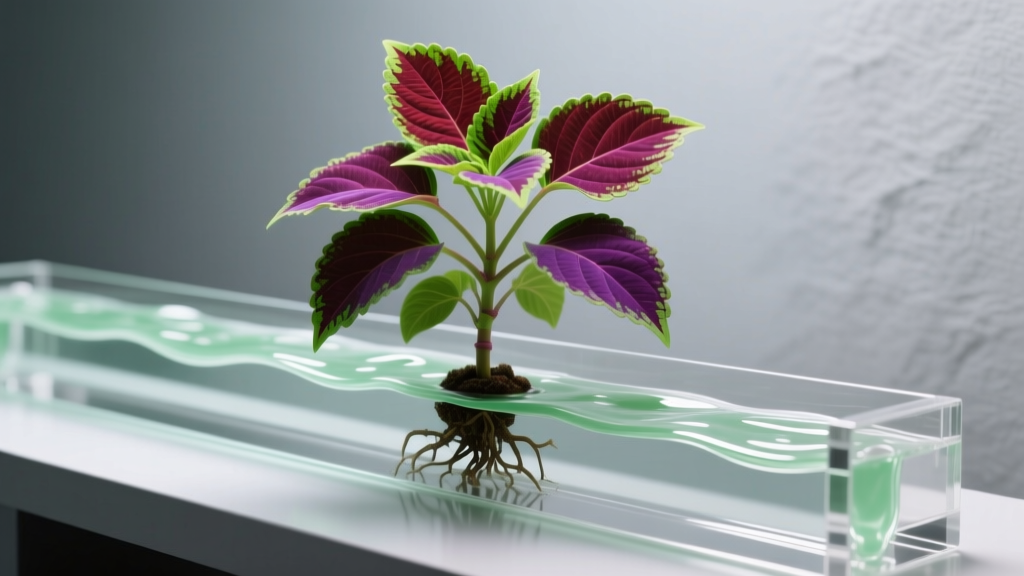
Nutrient Film Technique for Coleus
You bring your coleus inside for winter, take a few cuttings, and set them under lights—only to watch the stems stretch, the colors fade, and the leaves get smaller by the week. Then you see someone grow coleus in an NFT channel and it looks like a paintbox exploded: tight nodes, huge leaves, neon color, zero fungus gnats. The surprising part isn’t that coleus can grow hydroponically—it’s that coleus often grows better in Nutrient Film Technique than it does in a pot of “good” mix, as long as you respect two things: oxygen at the roots and a steady (not sloppy) nutrient balance.
This guide is written for home gardeners who want repeatable results. I’m going to assume you already like coleus and you’re here because you want vibrant foliage, fast turnaround from cuttings, and fewer soil-borne headaches.
How NFT changes the rules for coleus
NFT (Nutrient Film Technique) runs a thin sheet of nutrient solution along the bottom of a channel. Roots sit in net cups and dangle into that moving film. In a pot, you manage wet/dry cycles with soil structure. In NFT, you manage oxygen and nutrients through flow rate, channel slope, and solution strength.
Coleus is forgiving, but NFT is not forgiving of pump failures or overheating. If you accept that and build in a few safety habits, it becomes one of the easiest foliage crops to keep lush year-round.
System setup that works for coleus (and doesn’t bite you later)
Channel slope, flow, and spacing
A common beginner mistake is running NFT like a tiny river. Coleus prefers a thin film and lots of air around the roots.
- Slope: aim for 1–3% (that’s roughly 1–3 cm drop per meter of channel). Too flat creates pooling; too steep rushes the solution and dries root sections.
- Flow rate: target 0.5–1.0 L/min per channel (small home channels). You want a moving film, not a flooded pipe.
- Plant spacing: coleus fills fast. Start at 15–20 cm between sites for compact varieties; give big-leaf types 25–30 cm.
Reservoir size and temperature control
Small reservoirs swing fast. For coleus, stability is the whole game.
- Reservoir volume: use at least 15–30 L for a small home setup (4–8 plants). Bigger is more forgiving.
- Solution temperature: keep it 18–22°C. Once you creep above 24°C, root disease pressure rises and dissolved oxygen drops.
That temperature window is practical for most basements and spare rooms. In a hot garage, you’ll need insulation, a larger reservoir, or to run at night when it’s cooler.
Watering in NFT: what it really means (and how to avoid disasters)
In NFT, “watering” is flow + runtime + oxygen. Most home setups run continuously, and that’s my preference for coleus because it hates drying at the root crown.
Recommended runtime
- Best practice: run the pump 24/7 with a thin film.
- If you must cycle: start with 15 minutes on / 15 minutes off during lights-on, then monitor. In warm rooms, cycling increases risk because roots dry faster.
Real-world scenario #1: “My pump stopped for 2 hours and everything wilted”
This happens most often with small net cups and young cuttings that don’t have long roots yet.
- Why it happens: young roots aren’t reaching the film consistently, and NFT channels don’t hold moisture like media beds.
- Fix: for the first 7–10 days after transplanting rooted cuttings, add a strip of rockwool, coco plug, or a small collar of moist media in the net cup so roots stay humid while they “find” the film.
- Prevention: put the pump on a surge protector, keep a spare pump on hand, and consider a battery backup if outages are common.
“Soil” for NFT coleus: choosing the right rooting media
NFT doesn’t use soil, but you still choose a starter media. The job is to hold the cutting steady and keep the crown from staying soggy.
Media options that behave well
- Rockwool cubes: reliable and uniform. Don’t keep them soaked—coleus stems can rot if the cube is saturated 24/7.
- Coco plugs: friendlier to handle, less alkaline than new rockwool, but can hold more water—watch stem moisture.
- Clay pebbles (LECA): great for airflow, but cuttings need to be well-rooted first or they wobble and stall.
As a reference point, many hydroponic guidelines recommend a nutrient solution pH in the mid-5s to mid-6s for best nutrient availability. The University of Florida IFAS Extension notes that hydroponic nutrient solutions are commonly maintained around pH 5.5–6.5 depending on crop and system (UF/IFAS Extension publication, 2021).
Light: what makes coleus color up in NFT
Coleus will grow in surprisingly low light, but “growth” and “color” are two different results. In NFT, the plant grows fast—so you must give enough light to keep it compact and vivid.
Indoor lighting targets
- Photoperiod: 12–16 hours/day. For steady vegetative growth, 14–16 hours is the sweet spot.
- Intensity (practical target): aim for 150–300 µmol/m²/s at canopy for most coleus varieties. Brighter light often increases color but can scorch tender cultivars if nutrients are off.
- Distance: many LED grow lights land around 30–45 cm above the canopy—adjust based on your fixture and leaf response.
Real-world scenario #2: “My coleus is growing, but it’s washed-out and leggy”
This is the most common indoor complaint.
- Likely causes: light too weak, photoperiod too short, EC too low, or nitrogen too high relative to light (soft growth).
- Fix checklist:
- Increase light to the upper end of your comfortable range (work toward 250–300 µmol/m²/s).
- Run 14–16 hours daily.
- Pinch growing tips every 7–14 days to force branching.
- Keep EC moderate (see feeding section) so you’re not “starving” the color.
Feeding coleus in NFT: EC, pH, and a workable recipe
Coleus is a foliage plant, so it enjoys nitrogen—but in hydroponics, heavy nitrogen without enough light gives you floppy stems and muted color. The goal is steady, moderate feeding.
Target pH and EC (start here)
- pH: 5.8–6.2 is a solid working range for NFT coleus.
- EC for rooted cuttings: 0.8–1.2 mS/cm.
- EC for established plants: 1.2–1.8 mS/cm. If you’re pushing fast growth under strong light, you can try 1.8–2.0, but don’t jump there suddenly.
These ranges line up with common hydroponic management principles used across leafy and herb crops. Kansas State University’s hydroponics guidance emphasizes maintaining appropriate nutrient concentration (often monitored by EC) and keeping pH in a crop-friendly range to avoid nutrient lockout (K-State Research and Extension hydroponics resources, 2020).
Mixing and maintenance timing
- Top-off: add plain water (pH-adjusted) as the reservoir drops; plants drink water faster than nutrients.
- Full reservoir change: every 7–14 days. If your reservoir is small or your room is warm, closer to 7 days keeps things cleaner.
- Check pH: at least 3x per week (daily is better in small reservoirs).
“In recirculating systems, small pH shifts happen quickly—catch them early and plants never miss a beat.” — University Extension hydroponics training notes (2021)
Comparison analysis: NFT vs potting mix vs DWC for coleus
If you’re deciding whether NFT is worth the build, here’s the practical comparison most home gardeners care about: speed, risk, and daily attention.
| Method | Typical growth speed (coleus) | Daily attention | Failure risk | Notes (real numbers) |
|---|---|---|---|---|
| NFT (recirculating) | Fast: often ready to pinch within 10–14 days after transplant | Low–moderate (pH/EC checks) | Higher if pump fails | Keep solution 18–22°C, pH 5.8–6.2, EC 1.2–1.8 |
| Potting mix (containers) | Moderate | Moderate (watering cycles) | Lower sudden failure | Overwatering invites fungus gnats; underwatering causes leaf drop in 24–48 hours indoors |
| DWC (deep water culture) | Fast | Moderate (air stones, reservoir) | Medium (oxygen issues if aeration fails) | Requires strong aeration; warm water above 24°C is trouble |
My grounded take: NFT is the cleanest, fastest way to produce dense coleus if you can keep the pump reliable and the reservoir cool.
Pinching, pruning, and training: the difference between “growing” and “showing off”
Coleus in NFT will try to become a small shrub. If you don’t intervene, you get long stems and bare ankles.
A simple pinching schedule
- First pinch: when the plant has 4–6 true leaves and is actively growing (often 10–14 days after transplant).
- Ongoing: pinch tips every 7–14 days to keep it bushy.
- Flower spikes: remove as soon as you see them unless you’re intentionally letting it bloom. Flowering often dulls foliage color.
Save those trimmings. Coleus roots quickly, and NFT is perfect for running a “mother plant + cutting line” setup.
Common problems in NFT coleus (with symptom-based troubleshooting)
When coleus looks bad in NFT, it’s usually one of five things: temperature, pH drift, EC mismatch, light imbalance, or roots staying too wet at the crown.
Yellowing leaves (especially lower leaves)
- Symptom: older leaves fade yellow, drop early; new growth is smaller.
- Most likely causes:
- EC too low (underfeeding)
- pH too high (iron/micronutrient availability drops)
- Root issues from warm solution
- Fix:
- Confirm pH is 5.8–6.2; adjust slowly (avoid big swings).
- Raise EC by 0.2–0.3 mS/cm, then watch for 3–5 days.
- Get solution temperature back under 22°C.
Brown, crispy leaf edges
- Symptom: margins dry out; leaf tips burn.
- Most likely causes: EC too high, inconsistent water uptake, or low humidity with strong airflow.
- Fix:
- Drop EC by 0.3–0.5 and top off with water.
- Check that flow is continuous and not channeling around roots.
- If indoor air is very dry, aim for 45–60% relative humidity.
Wilting even though the pump is running
- Symptom: leaves droop midday; stems feel soft.
- Most likely causes:
- Roots not reaching the film (new transplants)
- Channel has dry spots (uneven slope)
- Heat stress from hot solution or hot lights
- Fix:
- Lift a net cup and confirm the root tips are in the film.
- Re-level the channel to 1–3% slope; remove sags.
- Lower solution temp to 18–22°C; increase airflow over canopy, not directly blasting the cups.
Root rot / slime (the NFT nightmare)
- Symptom: roots turn tan/brown and slippery; plant stalls; reservoir smells “off.”
- Most likely causes: solution too warm (> 24°C), low dissolved oxygen from poor circulation, light leaks into channels, or infrequent reservoir changes.
- Fix now:
- Do a full reservoir change today.
- Block light from channels/reservoir (light drives algae, algae drives problems).
- Cool the solution (frozen water bottles can help in a pinch).
- Trim obviously dead roots; don’t be shy—coleus regrows roots fast when conditions improve.
Pests and disease: what still shows up in hydroponic coleus
NFT won’t magically prevent pests. What it does do is remove a lot of soil-related stress, which helps plants resist.
Common indoor pests
- Spider mites: stippling, webbing, leaves look dusty. Often worse when humidity is under 40%.
- Aphids: clustered on tips; sticky honeydew.
- Whiteflies: tiny white moth-like insects that flutter when disturbed.
Practical control that won’t wreck your reservoir
- Rinse foliage in the sink or shower first (physical removal is underrated).
- Use insecticidal soap or horticultural oil as a foliar spray, applied with lights off and good airflow. Keep sprays out of the reservoir.
- Quarantine new plants/cuttings for 7–10 days.
Three home-gardener cases (and how to handle them)
Case #1: Fast indoor color for winter pots
You want vibrant coleus for mixed containers but it’s January. Start 6–8 weeks before you need them. Root cuttings in cubes, transplant into NFT, run 14–16 hours of light, and pinch weekly. You’ll have dense, branchy plants that transition to pots with minimal setback—just harden them to outdoor sun over 5–7 days so you don’t scorch those tender indoor leaves.
Case #2: A single “mother plant” for endless cuttings
Keep one strong variety in NFT at moderate EC (1.2–1.5) and pinch every 7 days. Take cuttings 7–10 cm long, remove lower leaves, and root them. This gives you uniform starts without the fungus gnats that love mother plants in potting mix.
Case #3: Outdoor heat in summer wrecking your NFT
If your setup lives in a greenhouse or garage, summer heat is the stress test. When solution temps climb past 24°C, you’ll see wilting, slower growth, and root issues. Your best moves are: increase reservoir size, insulate it, block light, and run the system during the coolest parts of the day. Sometimes the honest answer is: grow coleus in NFT indoors for summer “stock,” then pot it up for outdoor display.
A steady weekly routine (simple enough to stick with)
- Daily (2 minutes): glance at flow, listen for pump noise changes, check that channels aren’t pooling.
- 3x per week: measure pH and EC; adjust pH back to 5.8–6.2.
- Weekly: pinch tips, remove any flower spikes, wipe algae from accessible areas.
- Every 7–14 days: change reservoir, rinse debris, check roots for early slime.
NFT coleus is one of those setups that rewards consistency more than tinkering. Keep the solution cool, the pH steady, and the light strong enough to support the growth you’re feeding. Once you hit that balance, you’ll start taking cuttings because you can’t stand to throw away perfectly good tops—and that’s when you know the system is doing what it should.
Sources cited: University of Florida IFAS Extension hydroponics publications (2021); Kansas State University Research and Extension hydroponics resources (2020).