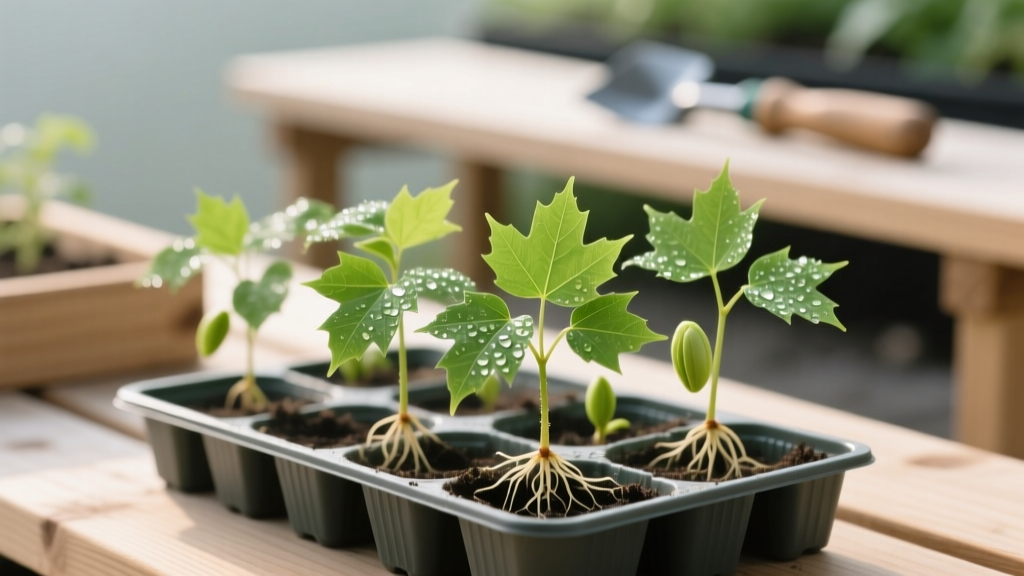
Preventing Damping Off in Maple Trees Seedlings
You check your maple seed tray at breakfast and everything looks fine—tiny green hooks pushing up, a little row of hope. By dinner, half of them have collapsed like someone snipped them at the soil line. If you’ve ever watched maple seedlings fall over overnight, you’ve met damping off. It feels like failure, but it’s really a predictable collision of wet soil, cool temperatures, and opportunistic fungi-like pathogens that thrive in seed-starting setups.
The good news: damping off is one of the most preventable seedling problems you’ll ever deal with—if you get disciplined about moisture, airflow, and sanitation from day one. This guide focuses on practical, home-gardener steps that work for maple seedlings (Acer spp.), which can be slower and more sensitive than many annuals.
What damping off looks like (and why maples are vulnerable)
Damping off usually shows up in two phases:
- Pre-emergent damping off: seeds rot before sprouting; you get patchy germination even with viable seed.
- Post-emergent damping off: seedlings emerge, then suddenly collapse at the soil line, often with a pinched, water-soaked stem.
The usual culprits include Pythium, Rhizoctonia, and Phytophthora, which are common in potting media, dirty trays, and splashy watering. These organisms don’t need much of an opening—just consistently wet conditions and tender tissue.
“Damping-off fungi are most active in cool, wet soils and can kill seedlings quickly; prevention depends on sanitation, well-drained media, and careful watering.” — University of Minnesota Extension (2020)
Maples can be especially prone because many growers stratify seed and then sow into cool rooms or basements. Cool + wet + low airflow is exactly what damping off wants.
Real-world scenarios I see all the time (and how to fix them)
Scenario 1: “I used a humidity dome and watered every day.”
This is the classic setup: a dome keeps humidity near 90–100%, the surface never dries, and stems stay soft. The fix isn’t to abandon domes entirely—it’s to use them with intention.
- Use a dome only until 50% of seeds have germinated, then vent it for 2 days, then remove it.
- Run a small fan on low for 8–12 hours/day to keep air moving across the soil surface.
- Switch to bottom watering (details below) so the stem stays drier.
Scenario 2: “They sprouted fine, then toppled after I fertilized.”
Feeding too early (or too strong) pushes soft, fast growth and can raise salt levels—both can stress seedlings and invite disease.
- Wait until seedlings have 2–3 true leaves before feeding.
- Use 1/4-strength liquid fertilizer at first, no more than every 10–14 days.
Scenario 3: “I reused last year’s cells and potting mix.”
Reused trays and leftover mix are frequent sources of spores. If last year’s seedlings had any disease, assume the tray is contaminated.
- Scrub trays with soap, then disinfect (method below).
- Start maples in fresh, sterile seed-starting mix—not garden soil, not compost-heavy blends.
Watering: the #1 lever for stopping damping off
If you remember one thing, make it this: damping off is rarely about “not enough fungicide” and almost always about “too much water for too long.” Your goal is a moist root zone with a slightly drier soil surface.
How often to water maple seedlings (a practical schedule)
Instead of watering by the calendar, water by the tray weight and surface look:
- Water when the top 1/4 inch (6 mm) of mix is dry to the touch.
- In a typical home setup at 68–72°F (20–22°C), that’s often every 2–4 days after germination.
- If you’re cooler (like 60–65°F / 15–18°C), it may be every 4–6 days.
Bottom watering (the method I trust most)
Bottom watering reduces stem splash and keeps the surface drier—two big wins for damping off prevention.
- Set cell packs in a tray with 1/2 inch (1.25 cm) of water.
- Let them drink for 15–25 minutes.
- Remove the packs and let them drain for 5 minutes. Don’t leave them sitting in water.
Tip: If algae starts to form, you’re keeping things too wet and/or too bright at the soil surface. Cut back on time in the water tray and increase airflow.
Water quality and temperature
Cold water can keep the root zone chilly, slowing growth and extending the “danger window” when seedlings are most vulnerable.
- Use water near room temperature: 65–75°F (18–24°C).
- If you have chlorinated municipal water, it’s usually fine for seedlings. If you’re using rainwater, store it cleanly—stagnant barrels can harbor pathogens.
Soil and containers: drainage, cleanliness, and smart setup
Choose the right seed-starting mix
For maple seedlings, use a fine, sterile, well-draining seed-starting mix. Avoid mixes heavy in compost for the earliest stage; compost can be great later, but early on it can increase microbial load and stay wetter.
A good texture target: the mix should feel light, not muddy, and should crumble when squeezed—not smear.
Container depth and spacing
Crowding creates a humid thicket at soil level. Give seedlings breathing room.
- Use cell packs at least 2 inches (5 cm) deep.
- Thin or transplant so seedlings are spaced about 1–2 inches (2.5–5 cm) apart once they’ve got true leaves.
Sanitation: the unglamorous step that saves trays of seedlings
If you reuse trays, disinfect them. University extension guidance commonly recommends a bleach solution for hard surfaces. For home use:
- Wash trays and pots with hot soapy water, rinse well.
- Soak in a solution of 1 part household bleach to 9 parts water for 10 minutes.
- Rinse and air-dry completely.
This approach aligns with common extension sanitation recommendations for plant propagation areas (University of Maryland Extension, 2023; University of Minnesota Extension, 2020).
Light and airflow: make seedlings sturdy, not soft
Leggy, thin-stemmed seedlings are easier for damping off organisms to attack. The goal is compact, slowly hardened growth.
Light intensity and timing
- Provide 14–16 hours of light per day with a dark period at night.
- Keep LED grow lights about 2–4 inches (5–10 cm) above seedlings (follow your fixture’s guidance; many LEDs can be close without heat).
If you’re using a sunny window alone, expect trouble: stems stretch toward the light, airflow is often poor, and watering tends to be inconsistent. A small shelf light setup is a big upgrade for damping off prevention.
Air movement (don’t skip this)
Still air equals lingering moisture on stems and soil. Add gentle airflow:
- Run a small oscillating fan on low for 8–12 hours/day.
- Aim for a faint leaf tremble, not a windstorm.
Feeding: when to fertilize (and how not to overdo it)
Maple seedlings don’t need fertilizer at germination. Most damping off “mysteries” I troubleshoot involve seedlings kept too wet and fed too early.
Simple feeding plan
- Start when seedlings have 2–3 true leaves.
- Strength: 1/4-strength balanced liquid fertilizer (for example, 10-10-10 or 20-20-20 diluted accordingly).
- Frequency: every 10–14 days.
If growth is pale but the mix stays wet, don’t reach for more fertilizer—fix the moisture and temperature first. Roots can’t take up nutrients well in cold, soggy conditions.
Comparison analysis: prevention methods that actually change outcomes
Here’s a practical comparison of common damping-off prevention strategies. These numbers are based on typical home setups and conservative, real-world expectations (not lab perfection). Use them to decide where to put your effort first.
| Method | What you do | Cost | Time/effort | Expected damping-off reduction (typical home setup) | Notes for maple seedlings |
|---|---|---|---|---|---|
| Bottom watering + airflow | Water from below; fan 8–12 hrs/day | Low ($10–$25 for a small fan) | Low | High (often 50–80% fewer losses) | Biggest payoff; keeps stems drier and toughens growth |
| Sanitize trays + fresh seed mix | Bleach soak 1:9 for 10 min; new sterile mix | Low–moderate | Moderate (one-time) | High (often 40–70% fewer losses) | Essential if you’ve had damping off before |
| Humidity dome left on too long | Keep dome on for weeks | Low | Low | Negative (often increases losses) | Use only until germination, then vent/remove |
| Preventive biological drench | Apply labeled biofungicide (e.g., Bacillus-based) | Moderate ($15–$30) | Low | Medium (often 20–50% fewer losses) | Helpful as backup; works best combined with good watering |
Notice what’s missing: “water more carefully” isn’t glamorous, but it beats most add-on products. Many extension resources emphasize cultural controls first—sanitation, drainage, and moisture management—because they address the real cause (University of Minnesota Extension, 2020; North Carolina State Extension, 2022).
Temperature targets: keep seedlings growing (not sitting)
Slow seedlings stay tender longer, and tender seedlings are the easiest targets.
- Germination and early growth: aim for 65–72°F (18–22°C) ambient temperature.
- Avoid keeping trays at 55–60°F (13–16°C) with constantly wet mix. That combination is a damping-off invitation.
If your seed-starting area runs cool, use a heat mat set around 68°F (20°C)—but only if you can also keep watering under control. Warm + soggy can also explode disease; warmth works best with good drainage and airflow.
Common problems and troubleshooting (symptoms → causes → fixes)
Symptom: Seedlings fall over at the soil line
- Likely cause: Post-emergent damping off (Pythium/Rhizoctonia), high moisture, low airflow.
- Fix now:
- Remove collapsed seedlings immediately (don’t compost indoors).
- Let the surface dry until the top 1/4 inch is dry before watering again.
- Add airflow (fan 8–12 hrs/day).
- Switch to bottom watering (15–25 minutes then drain).
- Prevent next round: sanitize trays (bleach 1:9, 10 minutes) and start with fresh mix.
Symptom: Soil surface grows green algae or white fuzzy mold
- Likely cause: Surface stays wet; too much humidity; low airflow.
- Fix now:
- Remove dome or vent it fully.
- Increase fan time and reduce watering duration.
- Scrape off the top 1/8 inch (3 mm) of affected surface and replace with dry seed-starting mix.
Symptom: Patchy germination, seeds turn to mush
- Likely cause: Pre-emergent damping off; sowing too deep; overly wet media; poor sanitation.
- Fix next sowing:
- Sow maple seeds at a depth about 1/4–1/2 inch (6–12 mm) (adjust for species/seed size).
- Moisten mix before sowing so it’s evenly damp, then water lightly after sowing.
- Use fresh mix and disinfected containers.
Symptom: Seedlings look stretched (leggy) and weak
- Likely cause: Not enough light; lights too far away; too warm without enough light.
- Fix now:
- Give 14–16 hours of light daily.
- Lower LEDs to 2–4 inches above seedlings.
- Add gentle airflow to strengthen stems.
Symptom: Leaf tips brown or seedlings stall after feeding
- Likely cause: Fertilizer too strong; salt buildup; roots stressed by overwatering.
- Fix now:
- Flush once with plain water (bottom water, then drain well).
- Resume feeding at 1/4-strength no more than every 10–14 days.
- Let the surface dry slightly between waterings.
Step-by-step: a damping-off-resistant maple seedling routine
If you want a simple routine you can follow without overthinking, this is it.
- Start clean: disinfect trays (bleach 1:9 for 10 minutes), rinse, dry.
- Use fresh seed-starting mix: pre-moisten so it’s damp like a wrung-out sponge.
- Sow at the right depth: generally 1/4–1/2 inch, then gently firm the surface.
- Light immediately: don’t wait for sprouting—give 14–16 hours of light from day one.
- Dome strategy: dome on until about 50% germination, then vent/remove over 2–3 days.
- Bottom water: 15–25 minutes, then drain. Water again only when the top 1/4 inch dries.
- Airflow: fan on low 8–12 hours/day.
- Feed late and light: at 2–3 true leaves, 1/4-strength, every 10–14 days.
When products help (and when they don’t)
I’m not anti-product; I’m anti “product instead of practice.” If you’ve tightened up watering, airflow, and sanitation and still lose seedlings, a labeled preventive biological fungicide can help—especially against Pythium in chronically damp environments. Look for products labeled for damping off and seedlings, and follow label directions exactly.
What doesn’t work reliably: cinnamon, chamomile tea, and other folk remedies. They may suppress some surface mold, but they don’t fix the underlying conditions that cause damping off in the root zone.
Smart next moves once seedlings are stable
Once your maple seedlings have made it past the delicate stage (usually after they’ve put on several sets of true leaves), your job shifts from “prevent collapse” to “build a resilient little tree.” That means slightly less pampering and a bit more hardening:
- Gradually increase airflow and reduce humidity so stems lignify (toughen).
- Transplant before roots circle—often when roots reach the bottom of a 2-inch cell.
- Water deeply, then allow modest drying at the surface rather than constant moisture.
If you take nothing else from this: the seedlings that survive damping off are rarely the “lucky ones.” They’re the ones grown on the drier side, in clean conditions, with bright light and moving air. Get those four things right, and maple seedlings go from heartbreak to habit.
Sources: University of Minnesota Extension (2020); North Carolina State Extension (2022); University of Maryland Extension (2023).