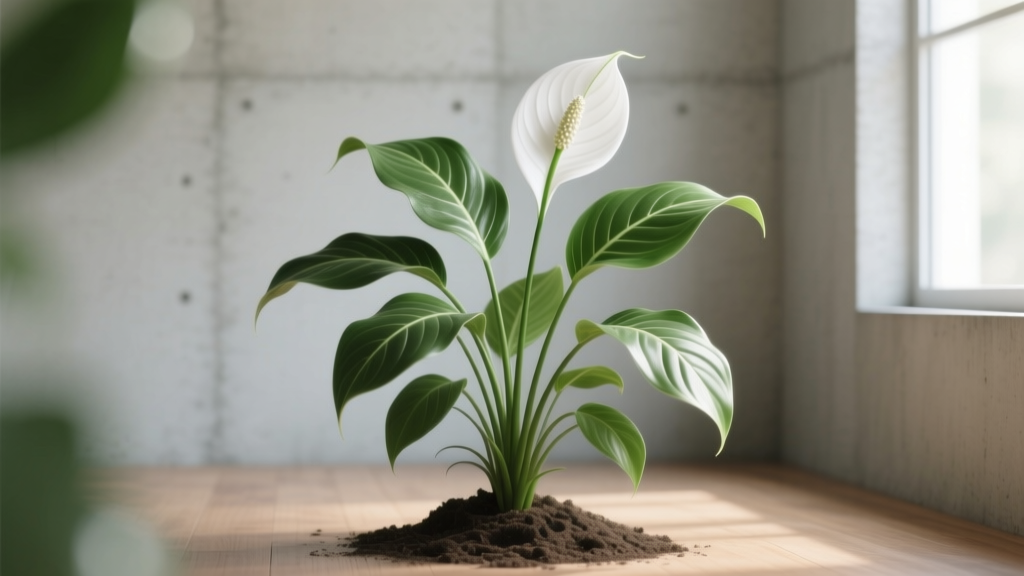
Thinning Out Peace Lilies to Improve Airflow
You bring your peace lily to the sink for watering and notice a sour, swampy smell rising from the pot. The leaves look fine at first glance—lush, green, almost too full—but when you part the foliage, you find yellowing stems, collapsed leaf bases, and a couple of black, mushy spots hiding in the center. That’s the trap: peace lilies (Spathiphyllum) can look “healthy” from the outside while the interior stays damp, stagnant, and primed for rot. In many homes, the fix isn’t more fertilizer or a brighter window. It’s airflow—and sometimes the most practical way to get it is careful thinning.
Thinning isn’t “hacking your plant back.” Done correctly, it’s targeted removal of crowded, aging, or damaged growth so air and light can reach the crown and soil surface. Better airflow dries leaf bases faster, slows fungus and bacteria, and makes your watering routine more forgiving. It also helps you see what’s actually happening in the pot.
Before we get into the how-to, here’s a surprising fact many houseplant owners miss: peace lilies are not built like woody shrubs. They grow as clumps of individual crowns (growth points) emerging from a rhizome. That means thinning is usually about removing entire weak crowns or leaves at the base—not shortening stems midway like you would on a dracaena.
What “thinning for airflow” really means (and what it doesn’t)
When peace lilies get crowded, three things tend to happen:
- Leaf bases stay wet after watering or misting, especially in the center of the clump.
- Soil dries unevenly—the edges may dry while the middle stays soggy for 10–14 days.
- Pests and disease hide (fungus gnats in wet soil; scale and mealybugs tucked at leaf bases).
Thinning for airflow means:
- Removing yellowing, damaged, or disease-prone leaves at the base.
- Optionally removing 1–3 entire weak crowns from a very dense clump.
- Opening “windows” through the canopy so air can move and you can water accurately.
It does not mean:
- Shaving the plant down to half its size overnight.
- Cutting flower stalks halfway (they should come out cleanly from the base).
- Thinning repeatedly during the same month—peace lilies recover best with rest between cuts.
“Most houseplant leaf spot and crown issues are encouraged by extended leaf wetness and poor air movement around dense foliage.” — University of Florida IFAS Extension guidance on managing foliar diseases indoors (UF/IFAS Extension Publication, 2020)
Three real-world situations where thinning changes everything
Scenario 1: The “bathroom peace lily” that never dries
If your peace lily lives in a bathroom, humidity can run 60–80% after showers. That’s not automatically bad (peace lilies like humidity), but combined with a tight clump, it slows drying at the crown. Thinning a few interior leaves and removing one weak crown often stops the cycle of yellow leaves and soft stems within 2–3 weeks.
Scenario 2: The office plant under constant low light
In low light (think 200–400 foot-candles near interior office lighting), peace lilies stretch and stack leaves close together. The plant looks full, but it’s actually weak—more prone to fungal issues and overwatering damage. Thinning plus adjusting watering (smaller volume, longer intervals) is usually more effective than fertilizer.
Scenario 3: The “rescued clearance plant” with hidden rot
Many bargain peace lilies are overpotted or kept too wet at the store. The outer leaves may look great, but the center is compromised. Thinning lets you inspect the crown and soil surface. If you see blackened leaf bases or a fermented smell, thinning is step one before you even think about feeding.
When to thin (timing matters)
The best time to thin is when the plant can recover steadily:
- Best season: spring through early summer, when indoor light is stronger.
- Temperature window: aim for 65–80°F (18–27°C) during recovery.
- Wait time after repotting: give it 2–3 weeks before thinning, unless you’re removing rotting tissue.
Rule of thumb: don’t remove more than 20–30% of total foliage in one session. If the plant is severely overgrown, thin in two rounds spaced 3–4 weeks apart.
Tools and prep (small details prevent big problems)
You don’t need fancy gear, but you do need clean cuts.
- Sharp pruners or floral snips
- A narrow knife for separating crowns (optional)
- 70% isopropyl alcohol for tool sanitizing
- Paper towels and a trash bag (peace lily sap is mildly irritating)
Sanitize blades before you start and between any suspicious cuts. If you’ve ever dealt with soft rot or leaf spot, don’t skip this—indoor pathogens spread fast when you reuse blades.
Step-by-step: how to thin a peace lily for airflow
Set the pot on a table, rotate it, and look down into the center. You’re hunting for congestion points: overlapping leaf bases, yellow leaves trapped inside, and weak, narrow leaves that never reach the outer canopy.
- Start with the obvious: remove fully yellow leaves by cutting the petiole (leaf stem) as close to the soil line as you can without gouging the crown.
- Remove spent flower stalks: cut the stalk at the base once the spathe is green or brown. Leaving them doesn’t “feed the plant”—it just crowds the clump.
- Open the center: choose 2–6 interior leaves that block airflow and remove them at the base.
- Assess crowns (optional): if the plant is extremely dense, identify 1–3 weakest crowns (smallest leaves, poor color, floppy growth). Wiggle gently to see if it’s loose enough to separate.
- Remove or divide weak crowns: if you can separate a crown with roots attached, you can pot it up; otherwise, cut it away carefully with a clean knife.
- Clean the surface: remove fallen debris and any leaf bits sitting on the soil—this is where fungus gnats and mold get their start.
After thinning, your peace lily should still look full from a normal viewing angle—but when you look down from above, you should see small “air channels” into the center and a clearer view of the soil surface.
Watering after thinning (this is where most people undo the benefits)
Thinning changes the plant’s water use. Less foliage means slightly less transpiration, and increased airflow means the crown dries faster. Your job is to water based on the soil, not the calendar.
How much to water
Use a soak-and-drain method, then let the pot lighten before watering again:
- For a 6-inch pot, a typical thorough watering is about 2–3 cups (475–710 mL), poured slowly until water runs from the drainage holes.
- For an 8–10 inch pot, expect 4–8 cups (950 mL–1.9 L) depending on soil and root density.
Don’t leave the pot sitting in a saucer of water for more than 10 minutes. Peace lilies tolerate short wet periods, but constant saturation plus a crowded crown is a recipe for rot.
When to water
Check moisture at least 2 inches down:
- If the top 2 inches are dry and the pot feels noticeably lighter, water thoroughly.
- If it’s still cool and damp at 2 inches, wait 2–4 days and check again.
Peace lilies famously droop when thirsty, but don’t rely on droop as your main signal. Repeated wilt cycles weaken roots over time.
Water quality tip
Peace lilies can show brown tips from salts and fluoride in some tap water. If you see consistent tip burn, try switching to filtered water or letting tap water sit out 24 hours (helpful for chlorine, not fluoride) and flush the pot monthly until water runs freely. Clemson Cooperative Extension notes that many foliage plants are sensitive to soluble salts buildup in containers (Clemson Cooperative Extension, 2021).
Soil and potting: airflow starts at the root zone
You can thin perfectly and still struggle if the soil holds water like a sponge. Peace lilies like evenly moist soil, but they do best when excess water drains and oxygen returns quickly.
A practical soil mix for most homes
- 2 parts high-quality potting mix
- 1 part perlite or pumice
- 1 part fine orchid bark (or pine bark fines)
This mix usually dries in a more predictable rhythm—often 7–12 days in average indoor conditions—without staying swampy in the center.
Pot size: don’t “upgrade” too far
After thinning, resist the urge to move into a much bigger pot unless roots are truly packed. Jumping more than 1–2 inches in pot diameter often creates a wet outer zone the roots can’t use, which keeps the soil cold and damp.
Light: thinning helps, but light sets the pace
Airflow is part of the puzzle; light is the other half. If light is too low, the plant stays wet longer and grows weaker, denser foliage that crowds itself again.
- Best indoor light: bright, indirect light near an east window or a few feet back from a south/west window.
- Low-light survival: it will live in lower light, but expect slower drying and fewer flowers.
If you’re using a grow light, aim for 10–12 hours daily. Keep many LED grow lights roughly 12–18 inches above the foliage (adjust based on intensity and plant response).
Feeding: don’t fertilize right after a heavy thinning
When you thin a peace lily, you’ve reduced leaf mass and sometimes disturbed crowns. Fertilizing immediately can push soft growth at the wrong time or aggravate salt stress.
- Wait time after thinning: hold fertilizer for 2–3 weeks if the plant looks stable; longer if it’s recovering from rot.
- Routine feeding: use a balanced houseplant fertilizer at 1/4 to 1/2 strength every 4–6 weeks in spring/summer.
- Flush schedule: every 6–8 weeks, water heavily to rinse accumulated salts (especially if you fertilize regularly).
If your plant is in low light, feed less. Fertilizer doesn’t replace light; it just raises the stakes if roots are already stressed.
Common problems thinning helps prevent (and what it won’t fix)
Thinning is a powerful tool, but it’s not magic. Here’s what it’s great for:
- Reducing crown moisture and discouraging soft rot
- Making watering more accurate (you can actually see the soil)
- Reducing leaf spot pressure by shortening wet periods
- Improving pest detection (mealybugs and scale can’t hide as easily)
What thinning won’t fix by itself:
- Chronically waterlogged soil with no drainage
- Root rot from a pot with no drainage holes
- Severe low light (plant stays weak and slow)
Comparison: two thinning methods (with real trade-offs)
| Method | What you remove | Typical amount removed | Recovery time | Best for | Main risk |
|---|---|---|---|---|---|
| A) Leaf-base thinning | Yellow/damaged leaves + a few interior leaves | ~10–20% of foliage in one session | 7–14 days to look “normal” again | Most home plants; mild crowding; airflow improvement without shock | Cutting too high leaves stubs that rot; leaving debris on soil |
| B) Crown removal/division | 1–3 entire weak crowns (with roots if possible) | ~20–30% of total plant mass | 14–28 days; sometimes a pause in flowering | Severely overcrowded clumps; recurring crown issues; sharing divisions | Root disturbance; increased wilt if roots are damaged |
If your peace lily has ongoing yellowing from the center outward, method B often succeeds where method A only buys time. If your plant is generally healthy but “too bushy,” method A is plenty.
Troubleshooting by symptom (specific fixes that work at home)
Symptom: Yellow leaves hidden in the center, outer leaves fine
- Likely cause: poor airflow + shaded interior leaves aging early; sometimes mild overwatering.
- Fix: remove yellow leaves at the base; thin 2–6 interior leaves; switch to watering only when the top 2 inches are dry.
- Watch for: improvement within 10–21 days. If yellowing continues and bases feel soft, inspect for crown rot.
Symptom: Black, mushy leaf bases; plant smells sour
- Likely cause: bacterial soft rot/crown rot encouraged by constant moisture and poor air movement.
- Fix: remove affected leaves and any collapsing crowns immediately; discard (don’t compost indoors). Unpot and check roots—trim brown, mushy roots. Repot into a faster-draining mix and a pot with drainage.
- Aftercare: keep at 70–78°F, bright indirect light, and water lightly until new growth appears.
Symptom: Brown tips on many leaves after thinning
- Likely cause: salt buildup or inconsistent watering; sometimes a dry heat vent nearby.
- Fix: flush the pot with 2–3x the pot’s volume of water (for a 6-inch pot, that’s roughly 1.5–2 liters run through). Move plant at least 3 feet from heat/AC vents.
Symptom: Fungus gnats hovering; soil stays wet a long time
- Likely cause: persistently damp top layer and decomposing debris.
- Fix: thin to open the canopy, remove surface debris, let the top 2 inches dry between waterings, and consider a 1/2-inch layer of coarse sand or mosquito bits (BTi) as a biological control.
- Note: If soil takes more than 14 days to dry, repotting into a chunkier mix is usually the real solution.
Symptom: Leaves droop often, even though soil is moist
- Likely cause: root stress from low oxygen (overwatering/compact soil) or root rot.
- Fix: don’t keep watering. Check drainage and root health. Thin to increase airflow, then repot if roots are brown and mushy. Healthy roots are typically firm and pale.
Aftercare: the 14-day reset that keeps problems from returning
Thinning is only half the job. The next two weeks are when you lock in the benefits.
- Day 1: Water only if needed. If you watered within the last 3–4 days, usually wait.
- Days 2–7: Keep foliage dry. Skip misting (it raises leaf wetness time without meaningfully raising humidity in most homes).
- Days 7–14: Re-check the center for any new yellowing and remove single problem leaves immediately.
If you want more humidity, use a room humidifier and aim for 40–60%. That supports the plant without constantly wetting the crown.
Common questions I hear in real homes (quick, practical answers)
Should I thin every time I see one yellow leaf?
No. Remove the yellow leaf, yes—but don’t keep “styling” the plant weekly. Thinning is most useful when you have crowding: leaves layered tightly, soil hidden, and the center staying damp. Most peace lilies only need a real thinning session 1–2 times per year.
Can I propagate what I remove?
Individual leaves won’t root into a new plant the way pothos can. For propagation you need a crown/division with roots attached. If you remove a weak crown and it has roots, pot it into a small container (often 4–5 inches) and keep it evenly moist—never soggy—until new growth appears.
Is airflow really that important indoors?
Yes, because indoor air is often still. Dense foliage plus still air means long drying times at the crown. Many university extension recommendations for reducing disease pressure start with lowering leaf wetness duration and improving air circulation (see UF/IFAS Extension Publication, 2020; Clemson Cooperative Extension, 2021).
A peace lily that’s thinned thoughtfully is easier to water, easier to inspect, and far less likely to surprise you with hidden rot. If you can look down into the plant and see the soil, and the crown dries within a day after watering, you’ve created the kind of airflow that keeps peace lilies steady for the long haul—without turning your living room into a greenhouse.