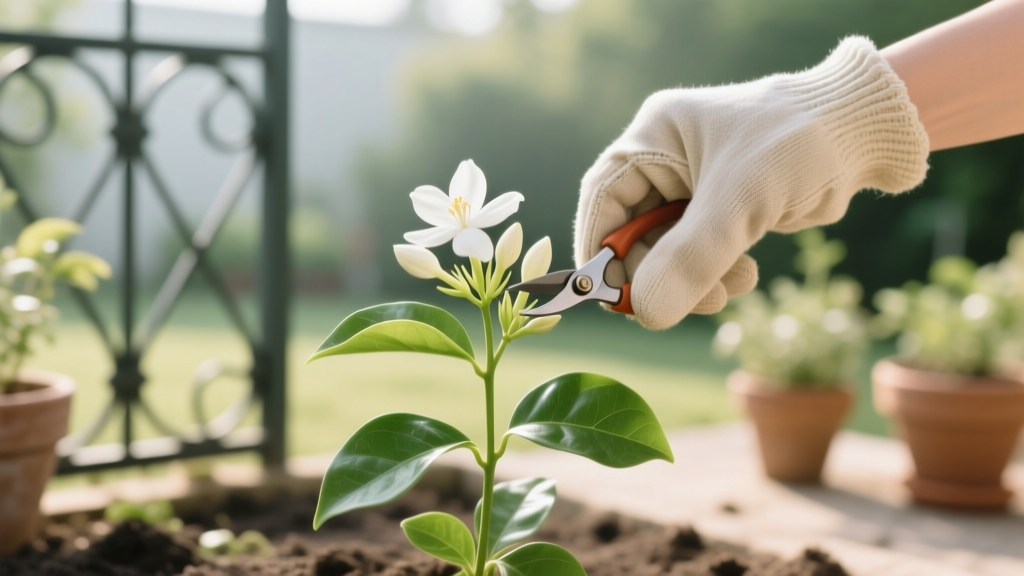
The Right Way to Deadhead Jasmine
You step outside at dusk expecting that sweet jasmine perfume—and instead you get a faint whiff, a few tired blooms, and a whole lot of brown, shriveled flowers clinging to the vine. Here’s the surprising part: with jasmine, leaving spent blooms on the plant doesn’t just look messy. It can also slow down repeat flowering because the plant starts putting energy into seed production instead of new buds. Deadheading isn’t busywork; it’s one of the simplest ways to keep jasmine blooming longer and looking cared for.
This is a hands-on, “do it this way” deadheading guide based on what works in real gardens—containers, trellises, hedges, and indoor pots—and it covers the care basics (watering, soil, light, feeding) that make deadheading actually pay off.
Deadheading Jasmine: What It Really Does (and When It Matters)
Deadheading means removing fading flowers before they turn into seed. On many jasmine types, especially those grown for long bloom seasons (like Arabian jasmine), regular deadheading helps encourage new flushes of flowers.
Two important notes from the start:
- Not all jasmine blooms the same way. Some bloom heavily in a short seasonal window (like common jasmine, Jasminum officinale), while others repeat with warmth and good care (like Jasminum sambac).
- Deadheading is not the same as pruning. Deadheading is light, frequent, and flower-focused. Pruning is structural and timed for growth cycles.
According to the Royal Horticultural Society’s jasmine growing advice (RHS, 2023), most jasmines benefit from trimming after flowering, and regular removal of spent blooms keeps plants tidy and can encourage further flowering on repeat-blooming types.
Know Your Jasmine’s Bloom Habit Before You Snip
If you deadhead the right way but at the wrong time (or on the wrong growth), you can reduce next year’s flowers. Use this quick guide:
| Jasmine type (common example) | Typical bloom timing | Where it flowers | Best deadheading approach | Risk if you prune wrong |
|---|---|---|---|---|
| Jasminum sambac (Arabian jasmine) | Late spring to fall in warmth | New growth and active tips | Pinch spent blooms weekly; light tip-prune | Low risk; responds well to frequent grooming |
| Jasminum officinale (Common jasmine) | Mid/late summer | Mostly on new season growth from mature wood | Deadhead during bloom; prune after flowering | Hard pruning too early can reduce flowering |
| Trachelospermum jasminoides (Star jasmine; not a true jasmine) | Late spring/early summer | On established framework, short laterals | Deadhead lightly; shape after bloom | Heavy pruning can delay blooms for a season |
If you’re unsure what you have, watch the plant for one cycle: does it rebloom repeatedly once warm weather arrives? That’s a good sign weekly deadheading will pay off.
Tools and Timing: The Small Details That Keep Plants Healthy
You don’t need fancy gear, but you do need clean cuts and good timing.
Best time of day
Deadhead in the cool morning or early evening. Avoid midday heat above about 85°F (29°C), when the plant is already stressed and stems can wilt faster after handling.
What to use
- Fingers for soft stems and fresh spent blooms (common on sambac)
- Snips/hand pruners for woody or thicker flowering stems
- Rubbing alcohol (70%) or disinfectant wipes for blades, especially if you’ve seen leaf spot or dieback
Sanitation isn’t optional if you’re troubleshooting disease. Many home gardeners spread problems plant-to-plant with dirty pruners. University of Minnesota Extension notes that cleaning tools helps reduce disease transmission during pruning (University of Minnesota Extension, 2022).
Step-by-Step: The Right Way to Deadhead Jasmine
The goal is to remove the spent flower and, when appropriate, the little stalk behind it without hacking off future buds.
- Find the spent bloom: Look for petals turning tan, limp, or papery. Don’t wait until the whole cluster is brown.
- Follow the flower down to the first junction: Trace the little flower stem (pedicel) back to where it meets a larger stem or a leaf pair.
- Make the cut (or pinch) just above a leaf node: Leave about 1/8 inch (3 mm) of stem above the node—close, but not so close you damage the bud at the node.
- Remove any developing seed pods: If you see swelling at the base of the bloom, take it off. That’s the plant switching to seed-making mode.
- Collect debris: Don’t leave spent blooms on the soil surface in pots—this invites fungus gnats and mold.
For clusters: If you have a stem with multiple flowers and most are spent, cut the whole cluster stem back to the first strong set of leaves. It looks cleaner and often triggers a new flush from the node below.
“Deadheading is less about perfection and more about timing—remove the fading flowers while the plant is still in bloom mode, and it keeps pushing new buds instead of switching gears to seed.” — advice summarized from RHS deadheading guidance (RHS, 2023)
Deadheading vs. Light Tip-Pruning: A Practical Comparison (with real numbers)
Home gardeners often ask: should I only remove dead flowers, or should I also pinch back the tips a little? Here’s how the two methods compare in day-to-day results.
| Method | What you remove | How often | Time per plant | Expected effect on blooms | Best for |
|---|---|---|---|---|---|
| Method A: Basic deadheading | Spent flower + short stalk | Every 5–7 days in peak bloom | 3–8 minutes (medium vine) | Cleaner look; reduces seed set; steady rebloom on repeaters | Common jasmine, star jasmine, tidy maintenance |
| Method B: Deadhead + tip-prune | Spent bloom + 1–2 inches (2.5–5 cm) of soft tip | Every 10–14 days | 6–12 minutes | Encourages branching; often increases bud sites after 2–3 weeks | Arabian jasmine, vigorous container plants, leggy growth |
If your jasmine is lush but stingy with blooms, Method B often helps by creating more flowering tips. If it’s already flowering well, Method A is usually plenty.
Watering: The Deadheading Payoff Depends on Moisture
Deadheading tells the plant “keep flowering,” but watering is what gives it the fuel to obey. Jasmine that dries hard between waterings will often drop buds or pause blooming.
Outdoor in-ground jasmine
- Water deeply when the top 2 inches (5 cm) of soil is dry.
- Aim for roughly 1 inch (2.5 cm) of water per week from rain/irrigation in warm weather, adjusting for heat and soil type.
Container jasmine (very common for sambac)
- Check moisture every 2–3 days in summer.
- Water until it runs from the drainage holes, then empty saucers.
- If it wilts by late afternoon but rebounds at night, you’re likely under-watering or root-bound.
Real-world scenario #1: “My jasmine has buds, but they dry up and fall off.” In containers, this is often inconsistent watering—too dry, then a flood. Keep it evenly moist (not soggy) during bud set. If daytime highs hit 90°F (32°C), you may water daily in small pots.
Soil and Potting: Set the Stage for Repeat Blooms
Jasmine likes soil that holds moisture but drains well. If the roots are either drowning or drying to dust, deadheading won’t matter much.
In-ground soil
- Work in 2–3 inches (5–7.5 cm) of compost over the root zone in spring.
- Mulch with 2 inches (5 cm) of bark or leaf mold, keeping mulch a couple inches away from the main stem.
Container mix (simple and effective)
Use a high-quality potting mix and improve drainage and longevity:
- 70% potting mix
- 20% fine bark or coco chips
- 10% perlite/pumice
Repot every 2 years (or at least refresh the top 2 inches of mix annually) if growth slows. A root-bound jasmine can look healthy but bloom poorly.
Light: The Most Common Reason Deadheading “Doesn’t Work”
If jasmine doesn’t get enough light, it can grow green and stubbornly refuse to flower no matter how faithfully you pinch off spent blooms.
- Most jasmines bloom best with 6–8 hours of sun.
- In very hot climates, morning sun + afternoon shade can prevent leaf scorch.
- Indoors, place it at the brightest window you have; weak light means fewer buds.
Real-world scenario #2: “My indoor jasmine grows vines but never flowers.” Indoors, light intensity is usually the issue. Move it closer to the window, rotate the pot weekly, and consider a grow light positioned about 12–18 inches (30–45 cm) above the plant for 12–14 hours daily during active growth.
Feeding: Fertilizer That Supports Blooming (Without Going Overboard)
Jasmine responds well to feeding during active growth, especially in containers where nutrients wash out quickly.
For repeat-blooming jasmines (like sambac)
- Use a balanced fertilizer (example: 10-10-10 or similar) at half strength every 2–4 weeks from spring through late summer.
- Or use a slow-release granular fertilizer in spring (follow label rates), then supplement lightly mid-season.
For once-a-season bloomers
- Feed in spring as new growth starts, then again right after flowering if the plant is vigorous and you’re encouraging growth for next year.
Don’t push nitrogen too hard. Overfeeding makes long, leafy growth that looks impressive but often flowers less.
Real-world scenario #3: “My jasmine is huge, healthy, and all leaves.” If you’ve been using lawn fertilizer or high-nitrogen feeds, switch to a bloom-supporting approach: reduce nitrogen, increase light, and tip-prune after deadheading to promote branching.
Common Problems That Show Up During Deadheading (and What to Do)
Deadheading is when most gardeners finally look closely at their jasmine—so it’s often when you spot pests and disease early. Here are the big ones.
Problem: Yellow leaves and slow growth
Likely causes: waterlogged soil, low nutrients in containers, or low light.
- Check drainage: If the pot feels heavy and stays wet for days, repot into a faster-draining mix.
- Adjust watering: Don’t water again until the top 1–2 inches are dry.
- Feed lightly: Half-strength balanced fertilizer every 3–4 weeks during active growth.
Problem: Buds form but don’t open
Likely causes: inconsistent moisture, sudden heat spikes, or thrips.
- Stabilize watering (especially in pots).
- Provide temporary shade if temperatures jump above 95°F (35°C).
- Tap buds over white paper; if tiny insects fall out, treat with insecticidal soap, repeating every 5–7 days for 3 rounds.
Problem: Sticky leaves, black sooty coating
Likely causes: aphids, scale, or mealybugs producing honeydew; soot is secondary.
- Hose off foliage with a firm spray.
- Treat with horticultural oil, coating stems and leaf undersides. Repeat in 7–10 days.
- Deadhead and remove heavily infested tips to reduce pest load quickly.
Problem: Browning petals, gray fuzz on spent blooms
Likely cause: botrytis (gray mold), encouraged by poor airflow and wet flowers.
- Deadhead more frequently—every 3–4 days during humid spells.
- Water at soil level, not overhead.
- Thin a few crossing stems to improve airflow.
Troubleshooting Deadheading: Symptoms and Fixes
Symptom: “I deadheaded, and now it stopped flowering.”
What happened: You likely removed developing buds along with spent blooms, or pruned too hard at the wrong time.
Fix:
- Switch to removing only the spent bloom and its short stalk.
- Wait for the next flush; many jasmines cycle blooms every 2–4 weeks in warm weather.
- Make sure it’s getting at least 6 hours of sun (or bright indoor light).
Symptom: “Cuts turn black and stems die back.”
What happened: Dirty tools, cutting into old wood, or existing fungal issues.
Fix:
- Disinfect blades with 70% alcohol between plants.
- Cut back to healthy green tissue; make cuts just above a node.
- Avoid deadheading when the plant is wet from rain or irrigation.
Symptom: “It’s all tangled—deadheading is impossible.”
What happened: The plant needs training and a light structural prune, not just deadheading.
Fix:
- After the main bloom flush, remove up to 20% of the most chaotic growth (crossing, inward-growing stems).
- Retie long shoots to the trellis, spacing stems for airflow.
- Then return to weekly deadheading during the bloom season.
Three Case Notes from Real Gardens (and What Worked)
Case 1: Patio sambac in a 12-inch pot. The plant bloomed once, then stalled. The fix was a combo: deadhead weekly, tip-prune 1 inch off soft ends every two weeks, and fertilize half-strength every 3 weeks. Within about 3 weeks, new branching showed up, and blooms followed on the new tips.
Case 2: Star jasmine hedge with brown flowers stuck all over. Deadheading each flower individually was unrealistic. The practical approach was to shear very lightly right after the bloom season (taking off only the spent flower layer), then do spot-deadheading on visible clusters. The hedge looked cleaner immediately and thickened up without losing its shape.
Case 3: In-ground common jasmine on an arbor, lots of growth but few flowers. The plant was in partial shade and fed with a high-nitrogen fertilizer. Shifting it to more sun (by selectively thinning an overhanging shrub), switching to a balanced feed, and saving major pruning until after flowering improved bloom count the following season. Deadheading helped the plant look better during bloom, but light was the real lever.
Seasonal Rhythm: What to Do in Spring, Summer, and Fall
Spring
- Refresh compost and mulch.
- Start feeding when you see active new growth and nights stay above about 55°F (13°C).
- Begin gentle training on supports so later deadheading is easy to reach.
Summer (peak deadheading season)
- Deadhead every 5–7 days (or more often in humidity).
- Water consistently; containers may need watering every 1–2 days in heat waves.
- Watch for aphids and thrips—treat early.
Fall
- Reduce feeding by late summer/early fall so growth can harden off.
- Keep deadheading if the plant is still flowering, but stop heavy tip-pruning about 6 weeks before expected cold weather.
Deadheading Etiquette: How Far Is Too Far?
When you’re standing there with pruners, it’s tempting to keep cutting until the vine is “fixed.” For jasmine, restraint pays. Deadheading should be fast, regular, and light—like grooming. Save major reshaping for the correct window (typically right after flowering for many types), and you’ll avoid cutting off next season’s display.
If you build one habit: take a slow walk past your jasmine once a week with a small container for spent blooms. Remove what’s faded, snip just above a node, and then step back. With steady moisture, enough sun, and modest feeding, jasmine usually responds by doing what we wanted all along—making more flowers, not more brown ones.
Sources: Royal Horticultural Society (RHS), “Jasmine: grow guide” (2023). University of Minnesota Extension, plant pruning and tool sanitation guidance (2022).