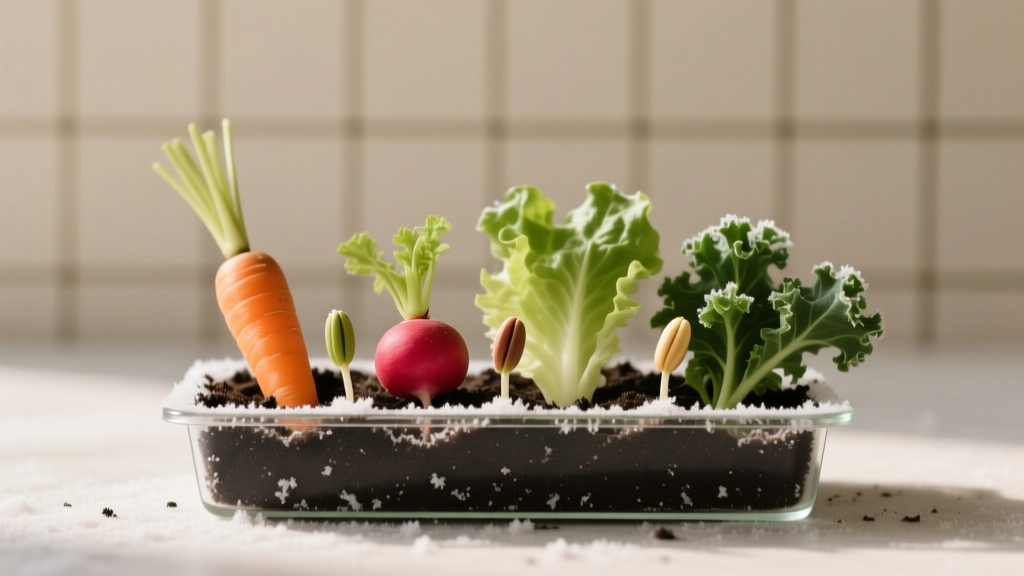
Cold Stratification for Vegetable Gardens Seeds
You sowed carefully. You kept the seed tray warm, misted like clockwork, and waited. And waited. Meanwhile the lettuce popped in 3 days, but those other seeds just sat there like little stones. It’s maddening—especially when the packet promised good germination. Here’s the surprise many home gardeners learn the hard way: some edible crops and many common “vegetable garden companions” (herbs, perennial alliums, and a few specialty veggies) germinate better—sometimes only—after a period of cold, moist rest called cold stratification.
Cold stratification isn’t a gimmick or old wives’ tale. It’s a way to copy winter. In nature, seeds drop in late summer or fall, get soaked by rain, then sit cold and damp for weeks. That cold period changes internal hormones and softens barriers that keep seeds dormant. Once spring warmth returns, they sprout quickly. When we skip that cold step indoors, the seed can stay asleep.
This article focuses on practical cold stratification for home vegetable gardens: which edible seeds respond to it, how to do it reliably, what temperatures and timelines work, and how to troubleshoot when things go sideways.
What Cold Stratification Actually Does (and When You Need It)
Cold stratification is moist chilling, typically at refrigerator temperatures, for a set time. Most home gardeners confuse it with simply “storing seeds in the fridge.” Dry storage helps longevity, but it doesn’t break dormancy. Stratification requires moisture plus cold.
For true annual vegetable staples (tomato, pepper, beans, squash), stratification is usually unnecessary. But it matters for:
- Perennial or biennial edible crops (many alliums, some brassicas grown for seed, some perennials)
- Hard-to-germinate herbs often grown in veggie beds (parsley is the classic “why won’t it sprout?” seed)
- Wild or specialty edibles (ramps/wild leeks, sea kale, some medicinal edibles)
- Seeds with physiological dormancy that naturally overwinter
University-backed seed guidance often frames stratification as a standard dormancy-breaking technique. For example, the University of Maryland Extension (2020) describes cold moist stratification as mimicking natural winter conditions to improve germination of dormant seeds, typically in the 34–41°F (1–5°C) range. Similarly, the USDA Forest Service Nursery Manual (2014) outlines moist prechilling (stratification) as a reliable dormancy-breaking method for many species, with detailed emphasis on moisture control and sanitation.
Seeds in the Vegetable Garden Most Likely to Benefit
Here are seeds home gardeners commonly grow in or near vegetable beds where cold stratification can help. (Seed lots vary—always read your packet and supplier notes.)
- Parsley (Petroselinum crispum): not always “required,” but stratification often speeds and evens sprouting.
- Lovage (Levisticum officinale): frequently improved by cold, moist chilling.
- Chives/garlic chives (Allium schoenoprasum / tuberosum): can germinate without, but a short chill can improve uniformity.
- Ramps / wild leeks (Allium tricoccum): typically need a warm-cold sequence; plain fridge stratification alone may not be enough.
- Sea kale (Crambe maritima): often benefits from chilling and sometimes scarification.
If you’re unsure whether your seed needs stratification, do a quick test: sow 10 seeds without stratification and 10 seeds with a 21–30 day moist chill. If the stratified batch germinates faster or at a higher percentage, you’ve got your answer without gambling your whole planting.
Two Reliable Cold Stratification Methods (with Real Numbers)
You’ll see lots of creative hacks online. These two are the workhorses because they control moisture well and let you track timing.
Method A: Bag-and-Towel Refrigerator Stratification (Most Reliable)
- Label a zip-top bag with seed name and start date.
- Moisten a paper towel so it’s damp like a wrung-out sponge (not dripping). A good target is no free water in the bag.
- Spread seeds on the towel, fold, and slide into the bag.
- Put the bag in the refrigerator at 34–40°F (1–4°C). Avoid the freezer compartment and the warm fridge door.
- Check weekly for mold, drying, or early sprouting.
- After the target time (often 14, 21, or 30 days), sow immediately.
Moisture rule: if you squeeze the towel and water drips, it’s too wet. Too much water is the #1 cause of mold.
Method B: Stratification in a Seed-Starting Mix (Best for Tiny Seeds)
- Fill a small container with sterile seed-starting mix and pre-moisten it (again: damp, not muddy).
- Sow seeds at their normal depth (many herbs are 1/8 inch deep or surface-sown; follow packet depth).
- Cover with a lid or slip into a plastic bag to hold humidity.
- Refrigerate at 35–41°F (2–5°C) for the required duration.
- Move the container to your normal germination setup (often 65–72°F / 18–22°C for many herbs) and provide light if the seed needs it.
This method avoids handling tiny seeds after chilling. The drawback is you can’t easily see mold or early sprouting unless you open the container.
Method Comparison (Time, Success, and Hassle)
| Factor | Method A: Bag + Paper Towel | Method B: In Potting Mix |
|---|---|---|
| Typical fridge temperature | 34–40°F (1–4°C) | 35–41°F (2–5°C) |
| Moisture control | High (easy to re-wet or dry) | Medium (mix can stay too wet if overwatered) |
| Mold risk | Lower if towel is wrung out | Moderate (mix can harbor spores if not sterile) |
| Best for | Medium/large seeds; test batches; easy monitoring | Tiny seeds; seeds that dislike handling after sprout |
| Ease of sowing after chill | Moderate (seeds can stick to towel) | Easy (already sown) |
| Real-world success rate (home gardener typical) | Often higher due to monitoring and moisture control | Often good, but failures happen from soggy mix |
Watering: The Moisture Sweet Spot During and After Stratification
Cold stratification is basically a moisture management game. You want seeds fully hydrated, but not suffocated.
During stratification
- Aim for even dampness—no standing water.
- Check bags/containers once per week.
- If the towel dries at the edges, mist lightly (a few sprays), then reseal.
- If you see droplets pooling, open the bag for 30–60 minutes to vent, or replace the towel.
After stratification (germination phase)
Once you move seeds to warmth, they can sprout fast. Keep the surface consistently moist for the first 7–14 days, then gradually let the top 1/4 inch dry slightly between waterings to discourage fungus gnats and damping-off.
If you use bottom watering, add water to the tray for 10–20 minutes, then drain. Seedlings hate being waterlogged.
Soil: Mix, Depth, and Drainage That Prevent Rot
Cold + wet + low airflow is perfect for mold. Your soil/mix choices matter as much as the cold treatment.
- Use a sterile seed-starting mix for small seeded herbs and slow germinators.
- Avoid heavy garden soil in pots; it stays too wet in the fridge.
- For outdoor fall sowing (a natural stratification approach), choose a bed with good drainage. Seeds that sit in winter puddles often rot before spring.
Planting depth matters too. Many herb seeds fail because they’re buried like peas. A good rule: plant at 2–3x the seed’s thickness unless the packet says “needs light.” Parsley is typically sown shallow (around 1/8–1/4 inch).
Light: What Happens After the Cold Period
Cold stratification doesn’t replace proper germination light. It simply removes dormancy.
- After stratification, many seeds germinate best at 65–72°F (18–22°C).
- Once seedlings emerge, provide 14–16 hours of bright light per day (a shop light kept 2–4 inches above seedlings works well).
- If you’re direct sowing outdoors in spring, watch soil temperature. Cold soil can delay sprouting even after stratification.
Feeding: When (and When Not) to Fertilize
Don’t feed during stratification. Seeds contain the food they need to germinate, and fertilizer salts in a cold, wet environment can encourage rot.
After true leaves appear (not just the first seed leaves), start feeding lightly:
- Use a balanced liquid fertilizer at 1/4 strength every 7–10 days, or
- Top-dress with a small amount of worm castings once seedlings are established.
If seedlings are in a quality potting mix (not a bare seed mix), you can often wait 2–3 weeks before feeding.
Common Problems You’ll Actually See (and How to Fix Them)
“The most common stratification failures I see are not about cold—they’re about moisture: either the medium dries out or it stays waterlogged and seeds rot.” — USDA Forest Service Nursery Manual (2014)
Problem 1: Mold in the bag or container
Symptoms: white fuzz on towel, seeds, or mix; sour smell.
Fix:
- Replace the paper towel with a fresh damp (not wet) one.
- Rinse seeds quickly in clean water and pat dry before re-bagging.
- Vent the bag for 10 minutes every few days if your fridge is very humid.
- Start with sterile mix if using Method B.
Problem 2: Seeds sprout in the fridge
Symptoms: tiny white root (radicle) emerges during chilling.
Fix:
- Sow immediately—carefully. Don’t break the root.
- Reduce stratification time next round by 7 days.
- Confirm fridge temperature. Many “warm” fridges run at 42–45°F (6–7°C), which can trigger sprouting for some seeds.
Problem 3: No germination even after stratification
Symptoms: seeds look intact, but nothing emerges after 21–30 days at warm temps.
Fix checklist:
- Too cold after stratification: move to a warmer spot (target 68–72°F for many herbs).
- Too deep: some seeds can’t push through. Try sowing shallower.
- Old seed: do a damp paper towel germination test with 20 seeds.
- Wrong dormancy type: some species need a warm-cold sequence (common with woodland perennials like ramps).
Problem 4: Damping-off (seedlings collapse at the soil line)
Symptoms: seedlings fall over; stem pinches and thins; fuzzy growth sometimes visible.
Fix:
- Increase airflow (a small fan on low helps).
- Water from below and let the surface dry slightly.
- Provide strong light; weak light makes weak stems.
- Use clean pots and sterile mix for slow germinators.
Three Real-World Scenarios (What I’d Do in Each Case)
Scenario 1: “Parsley takes forever—can I speed it up?”
Yes, often. If your parsley routinely takes 3–4 weeks, try a 14-day moist chill in the fridge (Method A), then sow at 1/8–1/4 inch depth and keep at 70°F (21°C). Maintain steady moisture for the first 10 days after moving to warmth. Many gardeners see sprouting tighten into a more predictable window (often 10–20 days depending on seed freshness).
Scenario 2: “I winter-sowed in milk jugs and got uneven sprouting.”
Winter sowing is basically outdoor stratification in a mini greenhouse. Uneven results usually come from moisture swings or temperature spikes on sunny days.
- Make sure the jug has 4–8 drainage holes in the bottom.
- Use 3–4 inches of seed-starting mix (not garden soil).
- Place jugs where they get precipitation but not reflected heat (south-facing walls can cook seedlings in March).
- On warm spells above 60°F (16°C), crack the lid for ventilation so seedlings don’t overheat and dry out.
Scenario 3: “I’m trying ramps (wild leeks) from seed and nothing happens.”
Ramps are a different beast. They commonly require a warm moist period followed by a cold moist period, and they can take a long time to show growth. If you’ve only done refrigerator chilling, you may be missing the warm phase that lets the embryo develop.
What tends to work better is sowing outdoors in a protected woodland bed in late summer or fall, letting nature run the cycle. Expect ramp seeds to test your patience—sprouting can be delayed until the following spring or later depending on conditions. Keep the bed evenly moist, mulched with 1–2 inches of shredded leaves, and protected from slugs.
Stratification Timing: A Practical Starting Point
Exact timing depends on the species and seed source. Still, for many veggie-garden-adjacent herbs and perennials, these are sensible starting ranges:
- Short chill: 7–14 days (often improves speed/uniformity for “fussy but not truly dormant” seeds)
- Standard chill: 21–30 days (common for seeds with stronger dormancy)
- Long chill: 60–90 days (more common for woody plants, but some perennials respond)
When in doubt, start at 21 days at 35–40°F, then adjust based on what you observe.
Cold Stratification Outdoors: Let Winter Do the Work (Without Losing the Seed)
If you’d rather skip refrigerator juggling, you can stratify outdoors. The trick is protecting seeds from washing away, rodents, and deep freezes that heave trays out of the soil.
- Sow in pots or cell trays, water well, then place them in a protected spot outdoors.
- Cover trays with hardware cloth to deter digging.
- Check monthly to ensure the mix is not bone dry. Winter wind can dry pots even when it’s cold.
Outdoor stratification is especially handy when you’re doing large batches or when your fridge is already packed with real food.
Troubleshooting Cheat Sheet (Fast Diagnosis)
- Seeds moldy: too wet + low airflow → wring out towel, swap to sterile materials, vent briefly.
- Seeds shriveled: too dry → re-moisten, reseal, check weekly.
- Seeds sprouting in fridge: stratification ran long or fridge is warm → sow immediately; shorten by 7 days next time.
- Nothing sprouts after chilling: wrong temperature/light/depth or seed requires warm-cold sequence → correct environment; test viability; research species-specific dormancy.
Keeping Records (This Is Where Your Results Improve Fast)
If you only do one “master gardener habit,” make it note-taking. Stratification success is very sensitive to small changes. Write down:
- Seed source and pack year
- Start date and end date of chilling
- Fridge temperature (a $10 fridge thermometer is worth it)
- Method used (towel vs mix)
- Days to first sprout and total germination % (even a rough estimate)
After one season, you’ll have your own local playbook—and it’ll beat generic advice every time.
Cold stratification is one of those techniques that feels finicky until you do it twice. Then it becomes just another tool you pull out when a seed refuses to cooperate. When you match moisture, cold (around 35–40°F), and time (often 14–30 days) to the seed’s needs, you stop gambling with germination and start getting predictable trays—exactly what a vegetable garden schedule depends on.
Sources: University of Maryland Extension (2020); USDA Forest Service, Nursery Manual (2014).