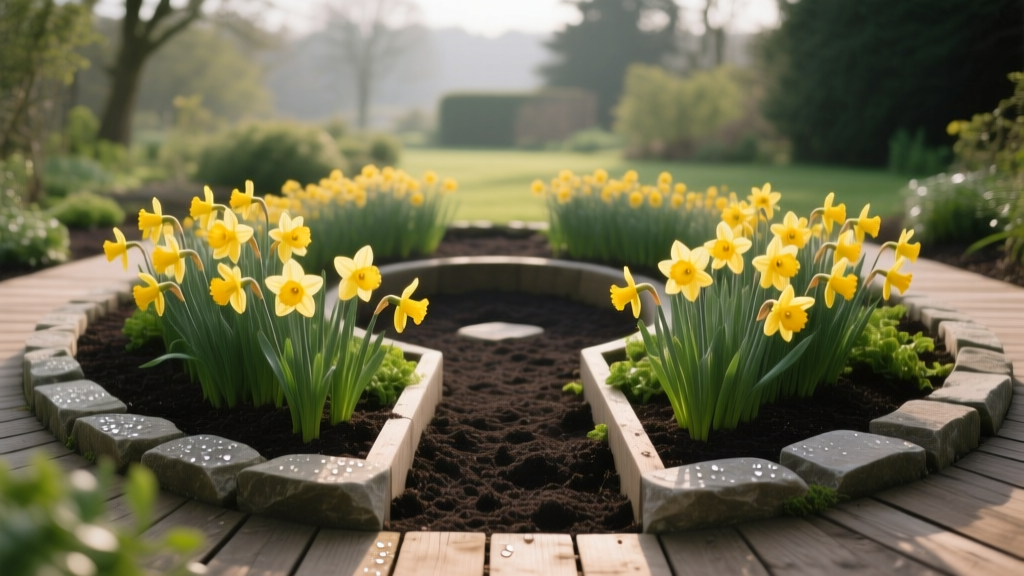
Keyhole Garden Design with Daffodils
The first time most gardeners try a keyhole bed, they do what I did: build a beautiful circular raised bed, fill it with rich compost, and plant it like a regular vegetable patch. Then spring arrives—everything is lush—until you step into the “keyhole” path after a rain and sink an inch into mud. Or you realize your compost basket is feeding the bed unevenly. Or your early greens look great, but by June the center runs dry while the edge stays damp. A keyhole garden is forgiving, but it’s not magic; it’s a system. Adding daffodils (Narcissus) to that system can solve a few problems at once—if you place them right and treat them like bulbs, not bedding plants.
Daffodils give you early-season color, a reliable “do not dig here” border marker, and a surprisingly practical line of defense against some digging pests. They’re also tough: cold hardy, spring-blooming, and generally ignored by deer and rabbits because the bulbs and foliage contain alkaloids. But daffodils also have one non-negotiable need: they hate sitting wet in summer. Keyhole beds, especially those with a compost basket, can run wetter than you expect. The trick is designing the bed so vegetables get steady moisture while bulbs get good drainage and a dry-down period after bloom.
How a keyhole garden works (and where daffodils fit)
A classic keyhole garden is a circular raised bed (often 6–8 ft across) with a narrow “keyhole” path that lets you reach the center. In the middle sits a compost basket (a perforated wire cylinder) where you add kitchen scraps and water; nutrients and moisture seep outward through the bed.
Daffodils are best used in three places:
- Outer ring planting to define the bed edge and keep bulbs drier than the center.
- On the sunny side of the keyhole opening as a bright spring “welcome,” without shading summer crops.
- As a protective perimeter near crops that get dug up (like tulips or some edible bulbs), because daffodil bulbs are typically left alone by many rodents.
One design note: avoid planting daffodils within 18–24 inches of the compost basket. That zone tends to stay the wettest and richest—great for leafy greens, not great for bulbs that need summer dormancy.
Design plan: dimensions, layout, and plant spacing that actually works
If you’re building from scratch, here’s a layout I’ve seen succeed in real home gardens repeatedly—productive, easy to manage, and kind to daffodils.
Recommended bed measurements (simple, buildable numbers)
- Bed diameter: 6 ft (small yard) to 8 ft (higher yield)
- Bed height: 18–24 inches (enough soil volume for vegetables and good drainage)
- Keyhole path width: 18 inches (comfortable footing)
- Compost basket diameter: 12–18 inches
- Compost basket height: 3 ft (so it holds enough material and is easy to fill)
Daffodil spacing and depth (the bulb rules)
Plant daffodil bulbs in fall when soil temperatures cool—ideally when the soil is 55°F (13°C) or colder. That’s the sweet spot where roots grow well but top growth doesn’t surge.
- Depth: 6 inches deep (measured from bulb base); in sandy soil, go 7 inches
- Spacing: 4–6 inches apart for a dense ring; 6–8 inches for a looser, natural look
- Outer-ring placement: 6–10 inches in from the outer wall so the bulbs aren’t baked against stone/brick in hot climates
For a 6-ft bed, a full outer ring takes roughly 30–45 bulbs depending on spacing. For an 8-ft bed, expect 45–70 bulbs. That sounds like a lot until you see the spring impact—and how nicely it frames the bed year-round.
Soil: build it for vegetables, tweak it for bulbs
Keyhole beds typically use a layered fill (often called “lasagna gardening”), but the long-term success comes from what the soil becomes after a season of watering and settling. Vegetables love moisture-holding organic matter. Daffodils want drainage and air in the root zone after bloom.
Target soil texture and pH
- Texture: loam-ish—crumbly, not gummy; add grit if your mix compacts
- pH: about 6.0–7.0 is a reliable range for daffodils and most vegetables
If your keyhole bed is heavy (lots of compost, not much mineral soil), mix in one of these in the outer ring zone where daffodils go:
- Coarse sand or granite grit: 10–20% by volume in the outer ring band
- Fine pine bark (not fresh wood chips): improves structure and drainage
Colorado State University Extension notes that bulbs perform best in “well-drained soils” and that excessively wet conditions encourage bulb rots (Colorado State University Extension, 2023). That’s exactly why daffodils belong toward the outside of a keyhole design rather than near the compost basket.
Light: keep blooms strong and avoid shading summer crops
Daffodils bloom best with at least 6 hours of sun in spring. In a keyhole bed, the center basket and taller summer crops can cast shade, so use daffodils where they’ll get early sun and won’t interfere with peak-season production.
- Best placement: outer ring on the south or east side (in the Northern Hemisphere)
- Avoid: planting daffodils where you’ll later trellis beans or tomatoes directly behind them—your spring show gets shaded and your bulb foliage can get tangled during summer maintenance
One practical trick: plant daffodils on the “viewing side” of the bed and reserve the opposite side for your tallest summer crops. You get both beauty and harvest without fighting shade.
Watering: the keyhole advantage—and the daffodil exception
Keyhole beds often use the compost basket as a watering funnel. That’s helpful in hot weather, but daffodils need a different rhythm than lettuce or basil.
Watering schedule that respects bulb dormancy
- Fall after planting: Water the bulb zone with 1 inch of water right after planting if soil is dry, then let rainfall handle most of it.
- Winter: No watering unless you’re in a dry winter climate and the bed is under a roof/overhang.
- Spring growth and bloom: Aim for about 1 inch of water per week total (rain + irrigation) in the outer ring.
- After bloom: Reduce watering in the bulb zone once foliage starts yellowing. Keep watering vegetables nearer the center instead of soaking the entire bed.
- Summer dormancy: Keep the bulb ring on the dry side. This is where drip lines with zones or hand-watering makes a huge difference.
If you’re using the compost basket to water, do it more often in small amounts rather than occasional floods. Flooding the basket can saturate the entire bed, including the bulb ring, and that’s when basal rot shows up.
Penn State Extension emphasizes that daffodil bulbs need good drainage and are prone to rot in waterlogged soils (Penn State Extension, 2022). In a keyhole bed, “waterlogged” can happen simply because the compost basket is treated like a sump.
Feeding: compost basket strategy for vegetables and daffodils
Keyhole beds naturally run fertile. That’s wonderful for leafy crops, but overfeeding can lead to floppy daffodil leaves and fewer blooms over time. Daffodils don’t need much nitrogen; they do appreciate potassium and phosphorus, but only in reasonable doses.
What to add to the compost basket (and what to avoid)
- Good inputs: chopped vegetable scraps, coffee grounds in moderation, dried leaves, crushed eggshells, small amounts of grass clippings mixed with browns
- Avoid: large amounts of greasy food, meat, or dairy (odor and pests), and big dumps of high-nitrogen material (can create a soggy, anaerobic basket)
Targeted bulb feeding (simple and effective)
- When: early spring at shoot emergence, and/or right after bloom
- What: a low-nitrogen bulb fertilizer (for example, something close to 5-10-10)
- How much: about 1 tablespoon per square foot scratched into the surface in the bulb ring, then watered in lightly
If your keyhole bed is already rich, you can skip fertilizer entirely for daffodils and simply top-dress the outer ring with 1/2 inch of finished compost in fall—lightly, not a deep bury.
“For bulbs, drainage is more important than fertility. Too much richness—especially in wet soil—can cost you bulbs faster than a cold winter ever will.” — advice summarized from multi-extension bulb culture recommendations (e.g., Penn State Extension, 2022; Colorado State University Extension, 2023)
Method comparison: watering and fertility management (with real numbers)
If you’re deciding how to irrigate a keyhole garden that includes daffodils, here’s the practical tradeoff.
| Approach | Typical watering amount | Best for | Risk for daffodils | What I do in mixed beds |
|---|---|---|---|---|
| Compost-basket flood watering only | 2–4 gallons per watering, 2–3x/week in summer heat | Quick hydration for the whole bed | Higher rot risk if bulb ring stays damp into summer | Use only in spring; avoid heavy soaking after bloom |
| Drip line ring + basket occasionally | 0.5–1 inch/week delivered slowly | Consistent moisture where vegetables need it | Lower risk if drip is kept away from bulb ring in summer | Run drip in 2 zones: inner vegetable zone and outer bulb ring |
| Hand watering targeted zones | 1–2 gallons directed to inner zone as needed | Small beds; gardeners who like to observe daily | Lowest risk if you keep the bulb ring mostly dry in summer | Great for the first year while you learn bed behavior |
Three real-world scenarios (and how to handle them)
Scenario 1: “My keyhole bed stays wet—daffodils rot or disappear”
This happens in rainy climates, clay-heavy fills, or beds where the compost basket is overwatered. The first sign is weak spring growth, then fewer blooms, then nothing.
- Fix the design: move daffodils to the outer ring and keep them 18–24 inches away from the compost basket.
- Fix the soil: incorporate grit or coarse sand into the bulb band (10–20% by volume).
- Fix watering: after bloom, stop soaking the basket. Water vegetables directly near the center.
Scenario 2: “I want daffodils, but I also want summer peppers right where they’d be”
In a keyhole bed, space is precious. Daffodils take spring space and then leave foliage that needs time to recharge the bulb.
- Best pairing: plant daffodils in the outer ring and set warm-season transplants (peppers, eggplant) 12–18 inches inward from the bulbs.
- Hide the fading foliage: edge the bulb ring with low summer herbs (thyme, oregano) that won’t need deep digging.
- Don’t braid or tie foliage tightly: let it yellow naturally; remove only when it slips away easily (often 6–8 weeks after bloom).
Scenario 3: “Deer eat everything—will daffodils help?”
Daffodils won’t protect your lettuce, but they can anchor the bed with something deer and rabbits usually avoid. They also give you a reliable early-season win when other ornamentals get nibbled.
- Plant a thick outer ring: 4–6 inch spacing for a strong visual border.
- Use daffodils as ‘bed markers’: they remind you where not to disturb soil when you’re eager to plant early spring greens.
- Still protect vegetables: consider a low fence or netting during peak browsing; daffodils aren’t a force field.
Common problems in keyhole gardens with daffodils (symptoms and fixes)
No blooms, lots of leaves
- Likely causes: too much shade, too much nitrogen, bulbs planted too shallow, or foliage removed too soon
- What to do:
- Make sure the daffodil zone gets 6+ hours of spring sun.
- Stop high-nitrogen feeding in the outer ring; keep fertility focused near the center basket.
- Replant at 6 inches deep in fall if bulbs are heaving upward.
- Let foliage ripen for 6–8 weeks after bloom.
Bulbs mushy or foul-smelling (rot)
- Likely causes: waterlogged soil, overwatering the compost basket, poor drainage, heavy compost-only outer ring
- What to do:
- Remove affected bulbs; don’t compost them.
- Improve drainage with grit and reduce summer moisture in the bulb zone.
- Shift irrigation to inner-zone watering after bloom.
Leaves yellow early in spring
- Likely causes: dry soil during active growth, nutrient imbalance, or root damage from digging/planting nearby
- What to do:
- Provide steady spring moisture: about 1 inch/week.
- Avoid digging within 6–8 inches of bulb clumps.
- If soil is very lean (rare in keyholes), apply a light bulb fertilizer at shoot emergence.
Flopping stems and blooms
- Likely causes: too much shade (reaching), too much nitrogen, or oversized varieties in windy sites
- What to do:
- Move taller varieties to a slightly more sheltered section of the outer ring.
- Stop feeding nitrogen-heavy compost close to bulbs.
- Choose shorter cultivars for exposed beds; plant bulbs a touch deeper (up to 7 inches in sandy soils) for sturdier anchoring.
Step-by-step: planting daffodils into an existing keyhole bed
If your bed is already built and planted, you can still add daffodils without wrecking the system. Do it in fall when summer crops are coming out.
- Pick the ring: choose the outer 8–12 inches of the bed for bulbs, avoiding the keyhole path edge where you might step and compact soil.
- Check drainage: dig a test hole 8 inches deep. If it holds water longer than 4 hours after filling, amend with grit and reduce compost-heavy fill in that band.
- Plant at depth: set bulbs at 6 inches deep, points up.
- Space: 4–6 inches apart for a bold border.
- Water once: give about 1 inch of water if the soil is dry; otherwise let fall rains do the job.
- Mulch lightly: 1–2 inches of shredded leaves is plenty; don’t bury the ring under heavy, soggy mulch.
Practical crop pairing: what to plant near daffodils in a keyhole bed
The easiest way to keep daffodils happy is to pair them with plants that don’t require constant summer irrigation right at the bed edge.
- Good neighbors (outer ring): thyme, oregano, chives, strawberries (if you can keep summer watering moderate), calendula
- Better kept inward (inner zone): lettuce, spinach, basil, cilantro, cucumbers (higher water demand)
- Be cautious near bulbs: root crops that need deep cultivation (carrots, parsnips) right through the bulb ring—digging damages bulbs
One more hard-won tip: mark daffodil clumps with a small stone or label after the foliage dies back. In a keyhole bed, summer growth hides everything, and it’s easy to spear bulbs when fall planting time comes around again.
A keyhole garden is at its best when it looks like a garden and works like a system. Daffodils can be more than decoration—they can be a living border, a seasonal cue for spring chores, and a reminder to shift your watering strategy as the year turns. Place them where the bed naturally drains, feed them lightly, let the foliage finish its job, and you’ll get that dependable spring ring of color year after year—without sacrificing the vegetables you built the keyhole for.
Sources: Penn State Extension (2022); Colorado State University Extension (2023).