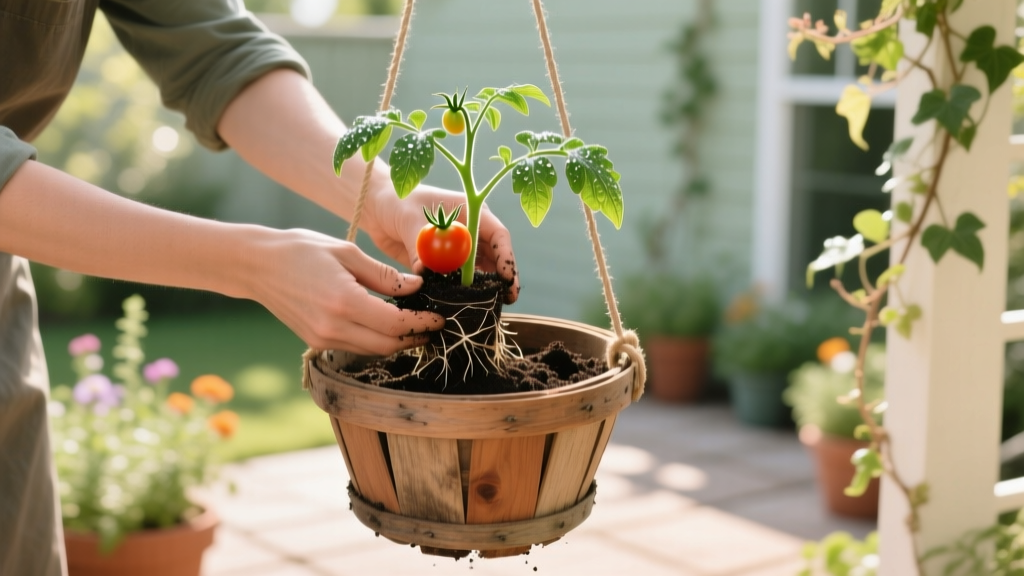
Transplanting Hanging Baskets Seedlings Outdoors
You’ve babied a hanging basket on the porch for weeks—daily watering, pinching, turning it for even growth. Then you move it outside for “fresh air,” and two days later the whole thing looks like it lost a bar fight: limp stems, crispy edges, flowers dropping, and the soil pulling away from the sides of the pot. The surprise for most home gardeners isn’t that seedlings can struggle outdoors—it’s how quickly a hanging basket can go from lush to stressed because wind and sun hit it from every direction.
Transplanting hanging basket seedlings outdoors isn’t hard, but it is unforgiving. Baskets dry faster than beds, heat up faster than patio pots, and the plants are often crowded (by design). Below is how I do it when I want baskets that keep blooming through summer instead of peaking in May and limping into July.
Before You Move Anything: What “Ready” Actually Looks Like
The biggest mistake I see is treating the move outdoors like a single event instead of a short process. Your seedlings need two things before they’re exposed to full outdoor conditions: maturity and conditioning.
Seedling readiness checklist (quick but honest)
- Night temperatures: reliably above 50°F (10°C) for warm-season plants like petunias, calibrachoa, basil, and most mixed annual baskets.
- Root fill: roots hold the root ball together when you slide the plant from a cell pack—white roots visible at the edges, but not a tight knot circling.
- Stem strength: seedlings don’t flop when you gently wiggle the tray. A little movement is fine; total collapse means they’re not hardened off.
- True leaves: at least 3–4 sets of true leaves on most bedding annuals before up-potting or basket planting.
If you’re growing mixed baskets (spill, fill, thrill), choose plants with similar outdoor tolerance. A shade-loving impatiens and a sun-loving verbena in the same basket is an argument waiting to happen.
Hardening Off: The Step People Skip (and Pay For)
Hardening off is simply teaching indoor-grown plants to cope with outdoor sun, wind, and temperature swings. Indoor seedlings have tender tissue and wide-open stomata; the outdoors can dehydrate them in hours.
“The primary cause of transplant shock is water stress. Wind, sun, and low humidity increase transpiration faster than young roots can replace water.” — Colorado State University Extension, Gardening Fact Sheet (2020)
A practical 7-day hardening-off schedule
- Days 1–2: 1–2 hours outside in bright shade; keep out of wind. Bring in before late afternoon.
- Days 3–4: 3–4 hours outside; allow 1 hour of gentle morning sun (before 11 a.m.).
- Days 5–6: 6–8 hours outside; increase sun exposure to 2–4 hours, still avoiding harsh afternoon sun.
- Day 7: Full day outdoors in the basket’s future location (or very close). If nights stay above 50°F, leave them out overnight.
Wind is the sneaky one. A breezy deck can dry a basket as fast as a hot day. If your site is windy, harden off in a sheltered spot, then “graduate” to the final hook location.
Soil and Basket Setup That Prevents Mid-Summer Struggles
Hanging baskets fail most often because the potting mix can’t hold a consistent moisture and nutrient supply. Garden soil is too heavy and compacts; cheap mixes can be too fluffy and hydrophobic once dry.
Potting mix: what to use (and what to avoid)
- Use: a quality soilless potting mix labeled for containers. Look for peat/coir plus perlite, and ideally a small amount of composted bark for structure.
- Avoid: straight compost (too dense, can stay wet and sour), topsoil (compacts), and “moisture crystals” as a substitute for good mix (they help a little, not a lot).
How much volume and spacing matters
Most standard hanging baskets are 12 inches across and hold roughly 3–5 gallons of mix depending on shape. Crowding more plants looks great for two weeks, then you get humidity problems and uneven drying. As a general, workable target:
- 12-inch basket: 4–6 small annuals, or 3–4 larger/transplants
- 14-inch basket: 6–8 small annuals
If you love a packed look, accept that you’ll water and feed more aggressively. There’s no free lunch in a hanging basket.
Planting steps (this keeps roots happy)
- Pre-moisten potting mix so it feels like a wrung-out sponge.
- Fill the basket to within 1 inch of the rim (you need a watering lip).
- Loosen circling roots on each transplant—just a light tease at the bottom is enough.
- Set plants so the original soil line sits level with the basket mix (don’t bury stems unless it’s a plant that roots along the stem, like some tomatoes—rare in baskets).
- Water slowly until you get steady drainage out the bottom.
Light: Choosing the Spot That Matches the Plants (Not the Catalog Photo)
Outdoor light on a hook is often more intense than you think because the basket is surrounded by reflective surfaces—house siding, patio concrete, even a light-colored deck.
Quick light targets (realistic numbers)
- Full sun baskets: aim for 6–8 hours of direct sun. If afternoons are brutal (over 90°F), morning sun + light afternoon shade often performs better.
- Part sun: 3–5 hours direct sun, ideally morning.
- Shade baskets: bright indirect light; 0–2 hours gentle morning sun at most.
One practical trick: hang the basket temporarily where you can observe it for 2 days. If it dries out by mid-afternoon even after a morning soak, you’re in a high-stress sun/wind pocket and should either move it or adjust your watering plan.
Watering: The Make-or-Break Skill for Hanging Baskets
Most “my basket died” stories are really “my basket dried out once, then never recovered.” When soilless mixes dry completely, they can repel water and create dry pockets. The roots die back, and then even regular watering won’t fully fix it.
How often to water (with honest variables)
- First week outdoors: check twice daily (morning and late afternoon). Water when the top 1 inch is dry.
- Typical summer pattern: once daily in moderate weather; twice daily during hot/windy stretches.
- Heat waves: above 90–95°F, a basket in full sun may need water morning and evening.
How much water is “enough”
You’re aiming to fully wet the root zone. For many 12-inch baskets, that’s roughly 0.5–1 quart per watering, applied slowly. The sign you’re done is consistent drainage from the bottom for several seconds—not a quick spit and stop.
Comparison: top-watering vs bottom-soaking (with real tradeoffs)
| Method | Time per 12-inch basket | Best for | Risk | What I’ve observed in summer |
|---|---|---|---|---|
| Slow top-watering until drainage | 2–4 minutes | Daily maintenance, feeding with liquid fertilizer | Water can channel down the sides if mix is very dry | Most reliable if you don’t let baskets fully dry out |
| Bottom-soaking in a tub/bucket | 10–20 minutes soak + drain time | Rescuing dried-out/hydrophobic mixes | Over-saturation if done repeatedly; can encourage root rot in cool weather | Best “reset button” after missed waterings or heat spikes |
Rescuing a basket that dried out (this works)
- Move it to bright shade immediately.
- Bottom-soak in a tub for 15 minutes (water level about halfway up the pot).
- Let it drain thoroughly.
- Do not fertilize for 48 hours—stressed roots burn easily.
After rescue, expect a few ugly leaves. The goal is new growth within 7–10 days.
Feeding: Hanging Baskets Are Hungry (Especially After Heavy Watering)
Every time water runs out the bottom, nutrients leave too. Most potting mixes include a starter charge, but it doesn’t last long in a basket exposed to daily watering.
University recommendations consistently point to steady, moderate fertility for container plants rather than big, infrequent doses. Purdue University Extension notes that containers leach nutrients quickly and benefit from regular fertilizing (Purdue Extension Publication, 2021).
Two feeding systems that actually work
- Slow-release granules: mix in at planting. A common rate is about 1–2 tablespoons per gallon of potting mix (always follow your product label).
- Liquid feed: apply every 7–14 days during active growth. Many gardeners use a balanced fertilizer at about 1/2 strength weekly rather than full strength every other week.
Comparison analysis: slow-release only vs slow-release + weekly liquid feed
In real gardens, the difference shows up by mid-season. With slow-release alone, baskets often look great for the first 4–6 weeks outdoors, then flowering slows and foliage pales. Combining slow-release with weekly liquid feeding typically maintains bloom density longer, especially for calibrachoa, petunias, and lobelia.
- Slow-release only: simpler; fewer steps; moderate performance into mid-summer.
- Combo approach: more work; better sustained color and flowering under daily watering.
Three Real-World Scenarios (and What I’d Do)
Scenario 1: The windy front porch that bakes by 2 p.m.
Symptoms: leaves feel dry by lunch, blooms shrivel, soil dries unevenly, and one side of the basket always looks worse (the windward side).
- Move the basket so it gets morning sun and afternoon shade.
- Water in the morning, then check again at 4–6 p.m. during hot spells.
- Add a windbreak: even a porch railing panel or lattice can cut transpiration dramatically.
Scenario 2: The shaded patio basket that grows leaves but barely flowers
Symptoms: lush green growth, long stems, fewer blooms than expected.
- Measure light honestly: if it’s less than 3 hours of sun, switch plant choices (begonias, fuchsia, impatiens) or move to brighter shade.
- Reduce nitrogen-heavy feeding; use a bloom-supporting fertilizer and don’t overdo it.
- Pinch or trim back leggy stems by 1–2 inches to encourage branching (then water well).
Scenario 3: You planted, it rained for a week, and now things look “mushy”
Symptoms: yellowing leaves, slow growth, stems that look water-soaked, fungus gnats, or a sour smell from the basket.
- Stop watering until the top 1–2 inches dry out.
- Make sure drainage holes are open; baskets can clog with roots and debris.
- If the mix is dense, poke a few holes with a pencil to improve oxygen temporarily (gentle—don’t shred roots).
- Remove any rotting plant material to reduce disease pressure.
Common Problems Outdoors (and Fixes That Don’t Waste Your Time)
Troubleshooting: wilting
Symptom: plants wilt during the day but recover at night.
- Cause: heat/wind transpiration exceeding root uptake.
- Fix: water early; provide afternoon shade during heat waves; consider a second light watering on days above 90°F.
Symptom: plants wilt and do not recover after watering.
- Cause: severe dry-out (roots damaged) or root rot (roots dead from lack of oxygen).
- Fix: check soil moisture 2 inches down. If bone dry, bottom-soak 15 minutes. If wet and sour, let dry and improve drainage; you may need to replace the worst plants.
Troubleshooting: yellow leaves
Symptom: older leaves yellowing evenly, slow growth.
- Cause: low fertility or heavy leaching from frequent watering.
- Fix: begin a weekly feeding routine; include iron if you see yellow leaves with green veins (common in petunias when pH is high).
Symptom: yellow leaves plus soft stems, wet soil.
- Cause: waterlogging/low oxygen.
- Fix: pause watering, increase airflow, verify drainage. Don’t fertilize until new growth resumes.
Troubleshooting: flowers stop, plants get leggy
- Cause: low light, inconsistent watering, or the plant needs a haircut.
- Fix: shear back by about 1/3 (yes, it feels harsh). Water thoroughly and feed lightly. Many annuals rebloom in 10–14 days.
Troubleshooting: pests you’ll actually see in baskets
- Aphids: clustered on soft tips. Blast off with water; follow with insecticidal soap if they return.
- Spider mites: stippled leaves, fine webbing in hot dry conditions. Increase humidity locally (rinse foliage), and use miticide/soap labeled for mites.
- Whiteflies: tiny white insects that flutter when disturbed. Yellow sticky traps help monitor; treat undersides of leaves.
For pesticide guidance and integrated pest management principles, university extension resources are the most grounded starting point; for example, University of Minnesota Extension emphasizes correct identification and least-toxic control first (University of Minnesota Extension, 2023).
Timing: When to Transplant Outdoors Without Regretting It
Timing is less about the calendar and more about temperature and the type of plants in your basket.
- Warm-season annual baskets (petunia, calibrachoa, verbena): transplant when nights are consistently above 50°F. Below that, growth stalls and roots sulk.
- Cool-tolerant plants (pansy, violas): can handle cooler nights, but still harden off to prevent sun scorch.
If you’re itching to get baskets outside early, keep a stash of frost cloth or bring baskets into a garage when a surprise cold snap threatens. A single night near 32°F can ruin tender blooms even if the plant survives.
Small Habits That Keep Baskets Looking “Freshly Planted”
- Rotate weekly: turn baskets 1/4 turn to even out light exposure.
- Deadhead and tidy: spend 3 minutes twice a week removing spent blooms and yellow leaves.
- Check hooks and chains: wet baskets are heavy—often 20–30 lb for a large, saturated basket. Make sure hardware is rated and secure.
- Keep notes: if a basket needs twice-daily water in June, it will not magically need less in July.
Transplanting hanging basket seedlings outdoors is really about managing extremes: faster drying, stronger sun, and higher feeding demand in a small volume of mix. Get the hardening-off right, commit to thorough watering (not sips), and feed on a schedule, and your baskets won’t just survive outside—they’ll hit that steady stride where they look good every time you walk past them.
When you find a routine that works for your porch and your climate, write it down. Next spring, you’ll transplant with confidence instead of crossing your fingers—and that’s when hanging baskets go from “finicky” to one of the most satisfying things you grow.