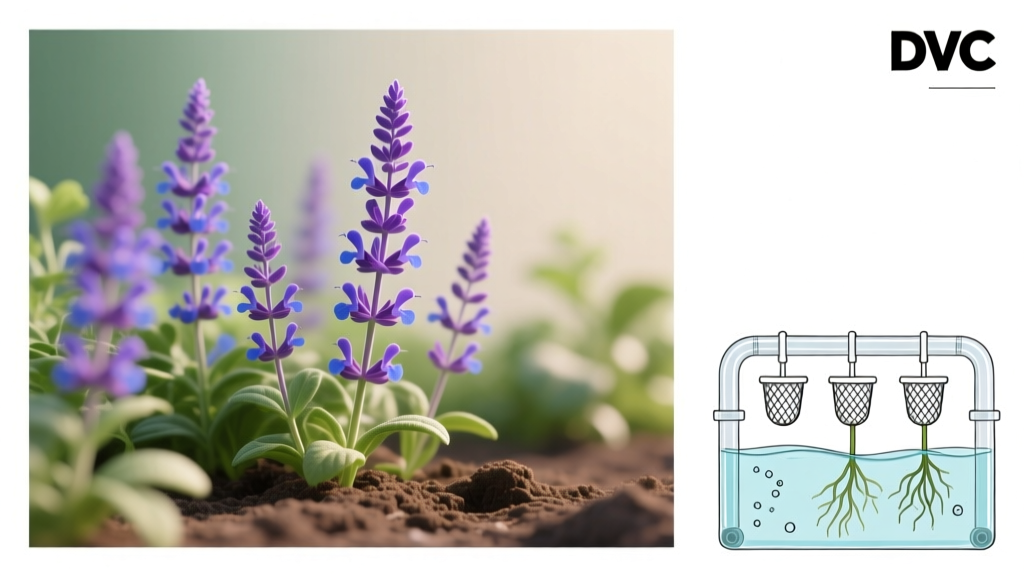
DWC System Guide for Salvia
The first time I tried salvia in a deep water culture (DWC) bucket, it looked like a miracle for about 10 days—then it fell over like it had been unplugged. Leaves went limp at noon, stems softened, and the roots turned from bright white to the color of weak tea. The surprise? The water was “full,” the pump was running, and my nutrient mix was right on the bottle label. What failed wasn’t effort—it was oxygen, temperature, and a few small setup details that soil growers never have to think about.
If you’ve grown salvia in the ground (and watched it shrug off heat, wind, and mediocre soil), DWC can feel backwards: a hardy plant suddenly becomes picky. The good news is that salvia responds beautifully once you hit a stable rhythm. This guide is built from what actually works on a home scale—5-gallon buckets, tote reservoirs, simple air pumps—and it focuses on the numbers and habits that keep salvia upright, blooming, and fragrant.
Before you fill the reservoir: pick the right salvia and set realistic goals
Most ornamental salvias can be grown hydroponically, but they don’t all behave the same. Tender, fast-growing types (like Salvia splendens) adapt quicker than woody, shrubby perennials (like Salvia greggii). If your goal is lush foliage and blooms for months, choose vigorous cultivars and plan on regular pruning.
Real-world scenario #1: “I want a patio salvia that blooms nonstop.” Go with a bedding-type salvia or a vigorous hybrid. Keep it compact with pruning and you’ll get consistent flowering. If you try to DWC an older woody salvia cutting, expect slower rooting and more sensitivity to root temperature swings.
Basic DWC gear that matters (and what you can skip)
- Reservoir: 5-gallon (19 L) bucket per plant, or a 17–27 gallon (64–102 L) tote for multiple plants.
- Net pot: 3–6 inch net pot; 6 inch is forgiving for top-heavy salvias.
- Air pump + airstone: Don’t undersize. Aim for at least 1 L/min of air per gallon of nutrient solution as a practical home benchmark.
- Water thermometer: Root temp is a make-or-break detail.
- pH meter + EC/TDS meter: Strips are fine for a quick check, but meters make troubleshooting faster.
- Helpful but optional: Water chiller (only if you can’t keep solution under 72°F/22°C), beneficial microbes (only if you keep temps stable).
Watering in DWC: it’s not “watering,” it’s managing oxygen and temperature
In DWC, the plant is never thirsty in the traditional sense. When a salvia wilts in DWC, it’s usually oxygen starvation, root disease, or heat stress—not low water level. Your job is to keep a constant supply of dissolved oxygen and a temperature that discourages pathogens.
Target water level and air gap
For established plants, keep the solution level about 1 inch (2.5 cm) below the bottom of the net pot. That small air gap encourages the upper roots to breathe while the lower roots feed.
For seedlings or fresh cuttings, you can run the water level slightly higher for the first week—just make sure the airstone is strong. Once you see roots hanging down into the reservoir, drop the level back to maintain that air gap.
Water temperature: the quiet killer
Keep nutrient solution between 65–70°F (18–21°C). Above 72°F (22°C), dissolved oxygen drops and root pathogens become more aggressive. This is consistent with hydroponic best practices summarized by university programs and industry references, including recommendations to keep root-zone temps in the high 60s°F for oxygen retention and disease suppression (Purdue University Extension publication on hydroponic food production, 2020).
- If your reservoir hits 75–80°F (24–27°C): expect droop in the afternoon even with plenty of air.
- Quick fixes: wrap buckets in reflective insulation, move reservoirs off hot concrete, add frozen water bottles (swap daily), increase airflow around the reservoir.
How often to top off and change the reservoir
Top off with plain, pH-adjusted water as the level drops. In warm weather, a salvia can drink 0.25–0.75 gallons (1–3 L) per day depending on size, light, and airflow.
Do a full reservoir change every 10–14 days at home scale. If you’re seeing salt buildup, pH drift, or odd leaf symptoms, tighten that to every 7 days. Keeping a consistent solution is one of the easiest ways to prevent mysterious problems.
Root support media: not “soil,” but it still matters
You’re not using soil in DWC, but the media in the net pot still affects oxygen, moisture around the crown, and stability. Salvias get top-heavy; weak support leads to stem lean, crown stress, and breakage.
Best media choices for salvia in DWC
- Expanded clay pebbles (LECA): My go-to for salvia. Great airflow, reusable, stable.
- Rockwool cubes: Excellent for starting cuttings/seedlings, but keep the top dry to prevent algae and stem rot.
- Coco chips: Holds more moisture; use only if you’re good at keeping the crown dry and the solution cool.
Tip from experience: keep the top layer of media dry. If algae forms on top, it’s a sign the crown area is staying too wet or too bright—both increase disease risk.
Light: push it hard, but don’t cook the reservoir
Salvia is a sun-lover. In DWC, good light drives fast growth and heavy bloom—but it also increases water temperature and nutrient demand. Balance matters.
Outdoor sun vs grow lights
Outdoors, aim for 6–8 hours of direct sun. In very hot climates, afternoon shade can keep the reservoir cooler and reduce midday wilt.
Indoors under LEDs, a solid starting point is:
- 12–14 hours of light daily for strong vegetative growth
- Keep LEDs about 12–18 inches (30–45 cm) above the canopy (adjust based on fixture strength and leaf response)
Real-world scenario #2: “My salvia looks great indoors, then crashes when I move it outside.” That’s usually a light-and-heat double whammy. Hardening off matters even in hydro. Move it to morning sun for 3–4 days, then gradually increase exposure. And shade the reservoir immediately—sun on a black bucket can push solution temps into the danger zone by mid-afternoon.
Feeding salvia in DWC: EC, pH, and a bloom-friendly approach
Salvia in DWC does best when you feed steadily, not aggressively. Overfeeding shows up as leaf edge burn and stalled flowering; underfeeding gives pale leaves and weak stems.
Target pH and EC (use these as starting points)
- pH: keep between 5.8–6.3. If you can hold 6.0 steady, you’ll save yourself a lot of troubleshooting.
- EC (vegetative growth): 1.2–1.6 mS/cm
- EC (flowering focus): 1.6–2.0 mS/cm for vigorous varieties, assuming temps and oxygen are under control
These ranges align with common hydroponic management targets used across many crops; university guidance consistently emphasizes stable pH in the high-5 to low-6 range for nutrient availability in hydro systems (University of Florida IFAS Extension hydroponics publications, 2019).
A practical feeding schedule that works
- Week 1 (new transplants/cuttings): EC 0.6–0.9, keep lights gentle, watch for root growth.
- Week 2–4 (build the plant): EC 1.2–1.6, prune once the plant has 6–8 nodes to encourage branching.
- Bud and bloom: EC 1.6–2.0, keep potassium and phosphorus adequate, but don’t “hammer” it—salvia blooms best when it isn’t stressed.
Comparison: DWC vs soil for salvia (with real, practical numbers)
| Factor | DWC (home bucket/tote) | Soil in containers |
|---|---|---|
| Typical watering frequency | Top-off daily to every 2 days; full change every 10–14 days | Every 2–5 days in summer; weekly in cooler weather |
| Root-zone temperature target | 65–70°F (18–21°C) | More buffered; often 60–80°F (16–27°C) depending on pot and weather |
| pH target | 5.8–6.3 (tight range) | ~6.0–7.0 (broader tolerance depending on mix) |
| Growth speed (typical home observation) | Fast once rooted; can double canopy size in 2–3 weeks under strong light | Moderate; steady but slower in average potting mix |
| Common failure mode | Root rot from warm solution + low oxygen | Underwatering/overwatering cycles; compacted mix |
“When water temperatures climb, dissolved oxygen drops—and that’s when root disease takes off. Most ‘mystery’ hydro problems are oxygen problems in disguise.”
—Paraphrased from common hydroponic management guidance emphasized in extension education (Purdue University Extension, 2020)
Common problems in DWC salvia (and how to fix them fast)
This is where most people either quit or get good. The key is to match the symptom to the most likely cause, then change one or two variables—not everything at once.
Problem: Wilting even though the reservoir is full
Symptoms: Leaves droop midday, may recover at night. Stems feel soft. Roots may look tan.
Most likely causes:
- Solution too warm (over 72°F/22°C)
- Insufficient aeration (small pump, clogged stone)
- Early-stage root rot
Fix (in order):
- Check solution temperature immediately. If it’s 75°F+, cool it today (frozen bottle swap, shade, insulation).
- Upgrade aeration: add a second airstone or stronger pump; clean/replace stones every 4–6 weeks.
- Do a full reservoir change and rinse the bucket. Keep EC moderate (1.2–1.4) for a week while roots recover.
Problem: Yellowing leaves (chlorosis)
Symptoms: Pale new growth, yellowing between veins, slow growth.
Most likely causes:
- pH drift out of range (often above 6.5) causing nutrient lockout
- Low nitrogen (overall pale plant)
- Low iron/micronutrient availability (yellow new growth with green veins)
Fix:
- Measure pH and adjust back to 5.8–6.3.
- Verify EC isn’t too low (below 1.0 for an established plant). If it is, increase gradually by 0.2 mS/cm.
- If pH is stable but new growth stays yellow, switch to a complete hydroponic nutrient that includes chelated micros.
Problem: Leaf tips burnt, edges crispy
Symptoms: Brown tips, curling edges, dark green leaves, stalled flowering.
Most likely causes:
- EC too high (salt stress)
- Reservoir level too low causing rapid concentration swings
- Heat + intense light compounding water demand
Fix:
- Dilute the reservoir to drop EC by 0.3–0.5 mS/cm (top off with pH’d water).
- Keep the water level stable; mark a “fill line” and top off at the same time each day.
- Raise lights by 2–4 inches or provide light shade during heat spikes.
Problem: Brown slime on roots, foul smell
Symptoms: Slimy roots, odor, rapid decline, leaves droop regardless of EC.
Cause: Root rot (often Pythium) encouraged by warm solution, low oxygen, and dirty equipment.
Fix (act the same day):
- Remove plant and rinse roots gently with cool water.
- Sanitize reservoir and airstones. (At home scale, many gardeners use a dilute peroxide rinse; if you do, rinse well and don’t mix peroxide with beneficial microbes.)
- Refill with fresh solution at EC 1.0–1.2, pH 6.0, and keep temp 65–68°F.
- Increase aeration immediately. If you can’t cool the solution, you’ll be fighting this again.
Pruning and training: keep salvia from turning into a top-heavy sail
DWC-grown salvia can grow fast and get lanky if you don’t shape it. Pruning isn’t just cosmetic—it prevents stem snap and improves airflow around the crown.
Simple shaping routine
- Pinch when the plant has 6–8 nodes to encourage branching.
- Remove spent flower spikes weekly to push new blooms (many salvias rebloom faster when deadheaded promptly).
- Stake early if the variety is tall. A bamboo stake and soft tie saves a lot of heartbreak.
Real-world scenario #3: “My salvia flowers, then it gets leggy and flops.” That’s usually high nitrogen, not enough light intensity, and no pruning. Reduce veg-heavy feeding (keep EC steady but don’t overdo N), give stronger light, and pinch back by 20–30% to force branching. Within two weeks, you should see a sturdier shape.
Step-by-step: starting salvia in DWC from seed or cutting
You can start salvia from seed, but for predictable results in DWC, cuttings are faster and more uniform.
From cuttings (my preferred method)
- Take a 4–6 inch (10–15 cm) cutting from a healthy stem (non-flowering is easiest).
- Remove lower leaves, leaving 2–3 sets at the top.
- Root in a moist cube (rockwool or similar). Keep temps around 70–75°F (21–24°C) and bright indirect light.
- Once roots are 2–3 inches (5–7.5 cm) long, transplant to the net pot and run EC 0.6–0.9 for the first week.
From seed (slower, but doable)
- Sow in cubes; keep evenly moist, not soaked.
- Maintain 70–75°F (21–24°C) for germination (varies by species, but this range is a solid home baseline).
- Transplant when seedlings have 2–3 true leaves and roots are showing.
Routine maintenance: the habits that prevent 90% of headaches
DWC rewards consistency more than fancy additives. If you only adopt a few habits, make them these:
- Daily (2 minutes): check reservoir temp and water level; quick look at leaf posture.
- Twice weekly: measure pH and EC; adjust slowly (big swings stress plants).
- Every 10–14 days: full reservoir change; rinse bucket walls; check airstone output.
- Monthly: deep clean tubing/airstones; replace anything that’s biofilm-coated.
If you’re the kind of gardener who likes a simple logbook, write down four numbers: date, pH, EC, water temp. Patterns show up fast, and troubleshooting becomes straightforward instead of guesswork.
Once you’ve dialed in oxygen and temperature, salvia in DWC is a joy: fast growth, clean feeding, and blooms you can steer with pruning and a steady hand on the nutrients. Keep the solution cool, keep the air roaring, don’t chase every minor pH wiggle, and your salvia will reward you with the kind of vigorous, flower-packed plant that makes people ask what you’re feeding it. You can tell them the truth: mostly air, cool water, and consistency.