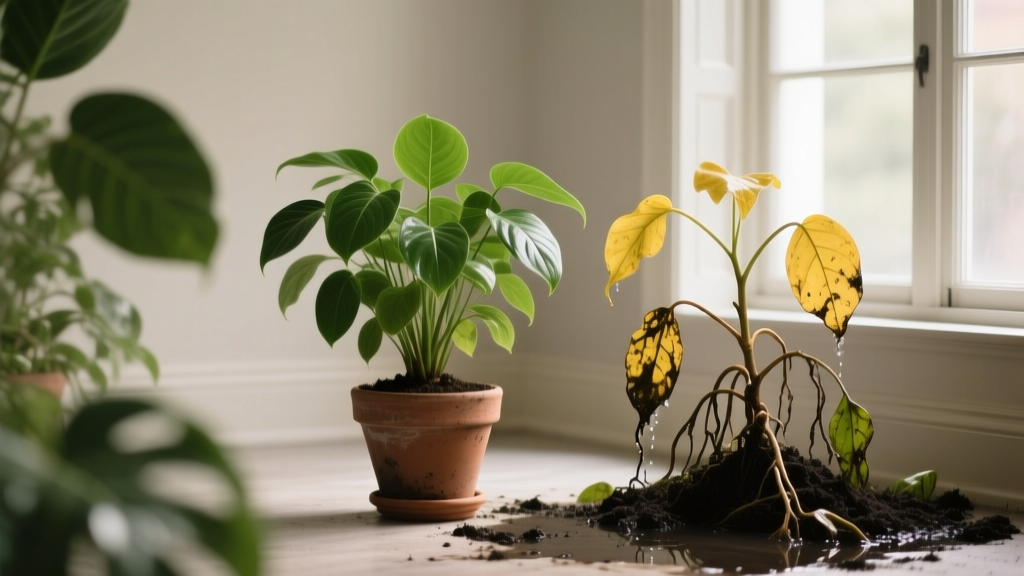
Signs Your Shade Plants Is Overwatered
You tucked your hostas and ferns into that cool, shady side yard because it “stays moist,” right? Then one day you notice something that doesn’t make sense: leaves are yellowing, the plant looks limp, and the soil still feels wet. Most gardeners assume shade plants need constant water because they’re not in hot sun. In reality, shade slows evaporation, so the soil can stay wet long after your watering can is put away—and roots can start suffocating.
I’ve seen more shade gardens decline from kindness than neglect. Overwatering doesn’t always look like a soggy mess; it often shows up as slow growth, faded color, or a plant that never quite perks up. Let’s walk through what overwatering looks like in shade, how to confirm it, and what to do—step by step.
Why shade plants get overwatered so easily
Shade changes the whole watering equation. With less sun and wind, soil dries slowly, and many shade beds are tucked near downspouts, AC drip lines, or low spots where water naturally collects. Add heavy mulch or clay soil, and you’ve got the perfect setup for waterlogged roots.
When soil pores stay filled with water, roots can’t access oxygen. That stress invites root rot organisms (like Pythium and Phytophthora) and leads to nutrient issues because the plant can’t take up what it needs. University guidance consistently flags poor drainage and excess moisture as major drivers of root disease (Cornell Cooperative Extension, 2020; University of Minnesota Extension, 2023).
The clearest signs your shade plants are overwatered
1) Leaves yellow from the bottom up (and feel soft)
Yellowing can mean lots of things, but overwatering has a common pattern: older leaves go pale first, and the leaf tissue often feels softer than usual. In shade, gardeners sometimes mistake this for “not enough sun” and water even more, which compounds the problem.
2) Wilting in wet soil
This is the classic “wait, what?” symptom. A plant droops as if thirsty, yet the soil is wet. That droop is often oxygen deprivation or root rot—not a lack of water.
3) Mushy stems, crown softness, or a sour smell
Check the crown (where stems meet the soil). If it’s soft, darkening, or smells swampy, you’re beyond “a little too much water.” Crown rot spreads quickly in hostas, heuchera, and some woodland perennials.
4) Fungus gnats hovering near the soil
Those tiny black flies aren’t the cause, but they’re a strong clue. Fungus gnat larvae thrive in consistently damp potting mixes and shaded, wet beds.
5) Edema: blisters or corky bumps on leaves
Edema happens when plants take up water faster than they can transpire. In shade and high humidity, that imbalance is common. You’ll see water-soaked bumps that turn corky, especially on tender foliage.
6) Slow growth and “stalled” plants
Shade already slows growth. Add saturated soil, and plants can pause for weeks. New leaves may emerge smaller, distorted, or fewer in number.
7) Roots look brown and sloughy instead of crisp and light-colored
If you can gently lift a plant (or check a pot), healthy roots are usually white to tan and firm. Overwatered roots often turn brown/black and pull apart like wet paper.
Quick tests to confirm overwatering (before you change everything)
Don’t rely on surface soil alone—shade beds often look dry on top while staying wet 3–6 inches down. Use one of these practical checks:
- Finger test (fast): Push your finger 2–3 inches into the soil. If it feels cool and wet, skip watering.
- Trowel test (more accurate): Dig a small plug 6 inches deep. If soil forms a muddy ball or glistens, it’s too wet.
- Moisture meter (helpful in pots): Insert to root depth and water only when it reads in the “dry to slightly moist” range for that plant type.
- Weigh the pot: For container shade plants, learn the “light pot” feel. A wet pot is dramatically heavier.
One practical benchmark: for many established shade perennials in the ground, watering is typically needed only when the top 2 inches are dry and the next few inches are trending dry—not when the surface looks dusty after one warm afternoon.
Watering shade plants: how much is too much?
Most shade beds do best with deep, infrequent watering—not daily sips. A common target for established gardens is around 1 inch of water per week total from rain plus irrigation, adjusted for soil type and temperature. During cool spells (say 55–70°F days), shaded areas may need far less. During heat waves (85–95°F), shade beds can still dry, but usually slower than sunny borders.
Better schedule: “Check first, then water”
Here’s a reliable routine I use in shade gardens:
- Check soil moisture at 8–9 a.m. (before heat skews your read).
- Water only if needed based on a 2–6 inch soil check.
- Water early so leaves dry by afternoon; this reduces disease pressure.
- Soak slowly for 20–40 minutes with a soaker hose (timing varies by flow rate and soil).
- Pause 10 minutes, then recheck infiltration—if water is pooling, you’re applying too fast.
Method A vs Method B: what changes in real gardens
| Approach | Typical frequency | Typical amount per watering | Root zone result | Common outcome in shade |
|---|---|---|---|---|
| Method A: Daily light watering | 5–7 days/week | 0.1–0.2 inches/day (roughly 0.5–1 inch/week) | Top 1–2 inches stay damp; deeper roots stay shallow | More gnats, more crown/root rot, more wilting in wet soil |
| Method B: Deep watering only after a soil check | Every 5–10 days (varies by weather/soil) | 0.5–1 inch per event | Moisture reaches 6–8 inches; roots grow deeper | Fewer disease issues, steadier growth, better drought tolerance |
Those numbers aren’t magic; they’re a practical starting point. If you’re on clay, you may water less often. If you’re on sandy soil under tree roots, you may water more often—but still based on a soil check, not a calendar.
“Most plant problems start with the soil staying wet too long, not with one heavy watering. Oxygen is as important to roots as water.” — Extension guidance summarized from University of Minnesota Extension (2023)
Soil and drainage: the real culprit behind most overwatering
In shade, drainage problems hide in plain sight. Leaf litter, heavy mulch, and compacted soil can create a slow-draining layer that keeps roots wet for days.
Signs your soil holds too much water
- Puddles remain more than 4–6 hours after irrigation or rain
- Soil is sticky and smears when you rub it (classic clay saturation)
- Mulch layer is thicker than 3 inches and stays damp underneath
- Plants fail repeatedly in the same spot
Fixes that actually work (without rebuilding the whole bed)
Pick what matches your situation:
- Reduce mulch depth: Keep mulch at 2 inches in shade beds. Pull it back 2–3 inches from crowns/stems.
- Improve structure: Top-dress with 1–2 inches of finished compost in spring or fall (don’t dig aggressively around tree roots).
- Redirect water: Extend downspouts at least 6–10 feet away from shade beds that stay wet.
- Create a slight grade: Even a gentle slope can move water away from crowns.
- Use raised pockets: For rot-prone plants (heuchera, some hostas), plant in a mound 3–6 inches above surrounding grade.
If you suspect root rot organisms, remember that saturated soil is what gives them the advantage. Cornell Cooperative Extension notes that improving drainage and avoiding overwatering are key cultural steps in managing root rots (Cornell Cooperative Extension, 2020).
Light and microclimate: shade isn’t always “low water”
Not all shade behaves the same. Dry shade under maples is a different world than damp shade beside a north wall.
Three shade microclimates and what they mean for watering
- Dry shade under trees: Tree roots steal moisture. Soil may be dry at 4–6 inches even if the surface looks cool. Water deeply, but less often.
- Damp shade near structures: Downspouts, poor grading, and less airflow keep soil wet. Overwatering is common here.
- Bright shade (dappled light): More leaf transpiration and warmer soil means slightly faster drying than deep shade.
Practical tip: if the area never sees sun and rarely gets a breeze, treat it like a “slow evaporation zone.” Watering needs can drop by half compared to your sunny beds.
Feeding and fertilizing: how overwatering messes with nutrients
Overwatered plants often look “hungry,” but adding fertilizer to a stressed root system is like stepping on the gas when the engine is flooded.
What overwatering does to nutrition
- Leaches nutrients in sandy soils—especially nitrogen.
- Locks up nutrients in cold, saturated soils; roots can’t take them up well.
- Encourages soft growth if you fertilize heavily, making plants more disease-prone in shade.
A safer feeding approach for shade beds
- Fix moisture first. Wait until the plant is actively pushing healthy new growth.
- Use compost as a baseline: 1 inch top-dressed once or twice per year.
- If using granular fertilizer, keep it light: a slow-release applied at 1/2 the label rate is often plenty in shade.
- Avoid fertilizing right before long rainy periods.
Troubleshooting: match the symptom to the right fix
Symptom: Yellow leaves + wet soil + drooping
- Likely cause: Oxygen-starved roots from soggy soil
- Do this today: Stop watering. Pull mulch back from the crown. Check drainage with a 6-inch trowel test.
- Do this this week: Aerate gently with a garden fork around (not through) root zones; make shallow holes 4–6 inches deep to improve gas exchange.
Symptom: Blackened stems at soil line (crown rot)
- Likely cause: Crown staying wet + fungal/oomycete rot
- Do this today: Remove damaged tissue if possible; improve airflow; keep water off leaves and crowns.
- Do this next: Replant slightly higher (3–6 inches mound) or move to a better-drained spot. Discard plants that are mushy throughout—composting may spread issues in some cases.
Symptom: Fungus gnats in pots + algae on soil surface
- Likely cause: Potting mix staying wet for too long
- Do this today: Let the container dry until the top 2 inches are dry. Bottom-water only if needed.
- Upgrade: Repot with a sharper draining mix and ensure drainage holes are open. Consider reducing saucer use so pots don’t sit in water more than 30 minutes.
Symptom: Leaf blisters or corky patches (edema)
- Likely cause: Water uptake exceeds transpiration (common in humid shade)
- Fix: Water less frequently, increase spacing/airflow, and avoid watering late in the day.
Three real-world scenarios (and what I’d do)
Scenario 1: Hostas near a downspout keep collapsing
You water “normally,” but every heavy rain turns that bed into a sponge. Hostas wilt, then get yellow and thin. In this case, your watering isn’t the main issue—your site is.
- Extend the downspout 6–10 feet away or route it to a splash block that directs water downhill.
- Lift hosta crowns slightly above grade and keep mulch at 2 inches.
- Water only after a 6-inch soil check; in that spot it might be every 10–14 days in mild weather.
Scenario 2: Ferns in a shady corner look yellow, not lush
Gardeners often assume ferns want constant moisture. Many do like evenly moist soil, but not stagnant wet. If the corner is deep shade with poor airflow, the soil can stay saturated.
- Check drainage: if water pools longer than 4–6 hours, address grade or soil structure.
- Top-dress compost 1 inch and reduce mulch thickness.
- Water in the morning and aim for soil that’s moist, not shiny-wet. A soaker hose run 20 minutes once a week may beat daily sprinkling.
Scenario 3: Potted caladiums on a shaded porch keep getting fungus gnats
Porch shade is notorious: warm air, less sun on the pots, and lots of “just a little water” every day. Potting mix never gets a chance to breathe.
- Switch to a pot with multiple drainage holes and a mix with added perlite/bark for faster drainage.
- Water only when the top 2 inches are dry; then water thoroughly until it drains.
- Don’t let pots sit in a saucer of water longer than 30 minutes.
How to save an overwatered shade plant (step-by-step rescue)
If the plant is only mildly stressed, you can often turn it around. If it’s severely rotted, the goal shifts to saving a division or cutting.
- Stop watering immediately and pause any fertilizing for 2–3 weeks.
- Expose the crown: Pull mulch back so the top of the root zone can dry and breathe.
- Improve airflow: Thin nearby plants if the bed is packed; even a few inches of extra space helps leaves dry.
- Check roots (if feasible): For potted plants, slide it out and inspect. Trim black, mushy roots with clean snips.
- Repot or replant correctly: Use fresh, well-draining mix for containers; in-ground, replant on a small mound if the site stays wet.
- Water smartly after recovery: When new growth appears, water deeply but only when the soil check says it’s time.
If you need a simple rule while the plant recovers: don’t water again until the top 2–3 inches are dry and the soil below is only slightly moist.
Common problems that mimic overwatering (so you don’t treat the wrong thing)
Some issues look similar at first glance. Before you blame water, scan these:
- Too much fertilizer: Can cause limp, dark growth and dieback. Check for crusty fertilizer on soil surface.
- Cold shock: Spring cold snaps can yellow leaves, especially in tender shade plants. If nights are below 45°F, growth slows and soil stays wet longer.
- Root competition: In dry shade under trees, wilting can happen even when you’re watering—because water never reaches the plant’s root zone.
- Slugs/snails: Chewed leaves plus wet mulch can make plants look “sick” when the real culprit is night feeding.
A few shade-plant-specific watering notes
Not all shade plants want the same moisture level:
- Hosta: Likes even moisture, hates a wet crown. Keep mulch off the crown and avoid daily watering.
- Heuchera (coral bells): More rot-prone than people realize in wet shade; plant high and avoid soggy mulch.
- Astilbe: Tolerates moisture better than many, but still dislikes stagnant, airless soil.
- Ferns: Many prefer consistent moisture, but drainage matters; “moist” is not the same as “waterlogged.”
If you’re repeatedly struggling in one spot, match the plant to the moisture reality. A plant that tolerates damp shade will outperform a rot-prone plant no matter how carefully you water.
Sources that back up the “too wet” problem
Overwatering and poor drainage aren’t just folklore—they’re consistently flagged in extension resources as key contributors to root decline and rot:
- Cornell Cooperative Extension. Phytophthora Root Rot (2020). Emphasizes saturated soils and poor drainage as major disease drivers and highlights cultural control through drainage improvement.
- University of Minnesota Extension. Root rots in the home garden (2023). Notes that overly wet soils promote root rot and that correcting watering and drainage is central to management.
Once you’ve seen a shade bed rebound after you reduce watering and improve drainage, you won’t forget it. The goal isn’t to keep shade plants constantly wet—it’s to keep the root zone comfortably moist, oxygenated, and stable. If you check the soil first, keep mulch reasonable (about 2 inches), and water deeply only when needed, you’ll trade yellow leaves and mystery wilts for sturdier plants that actually look like they belong in the shade.