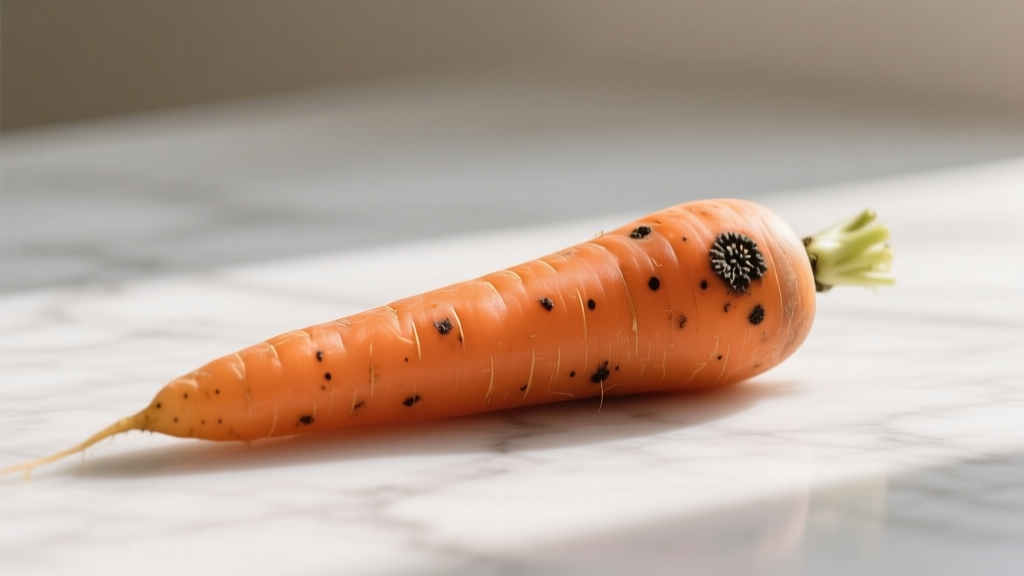
Treating Black Spot on Carrots
You pull a carrot and it looks fine—until you wash it. Dark, scabby spots pepper the shoulders and roots, and the tops have those smoky brown blotches that weren’t there last week. Sometimes the leaves yellow and collapse fast, leaving you with skinny, under-sized carrots. Home gardeners often assume they “overwatered,” but black spot on carrots usually comes down to a tight trio: leaf wetness, poor airflow, and infected residue that keeps re-infecting your bed year after year.
The good news: you can stop the spread in-season and dramatically reduce the odds of seeing it again next spring. This guide walks you through what black spot is (and what it isn’t), how watering and soil choices make it worse or better, and the practical steps I’ve used in real gardens to salvage crops.
First, confirm what you’re dealing with
“Black spot” is a common gardener label for a few different carrot problems. Most often, it’s one of these:
- Alternaria leaf blight (Alternaria dauci): irregular dark brown to black lesions on leaves; foliage can collapse late in the season.
- Cercospora leaf spot (Cercospora carotae): smaller, more defined tan-to-brown spots with darker margins; can look peppered.
- Black rot (often Alternaria radicina): can affect roots—dark lesions, sometimes starting at the crown/shoulder; more common in storage issues too.
These diseases overlap in symptoms and management. The same cultural fixes—reduce leaf wetness, improve spacing/airflow, rotate, sanitize—help across the board. If the “spots” are actually tunnels or scabs that feel corky, you may be looking at insect feeding or scab (a different problem entirely).
Quick ID checklist (what you’ll see)
- Leaves: small dark lesions that expand; older leaves go first; in humid weather, the canopy looks “burned.”
- Petioles (leaf stems): elongated dark streaks, especially when infection is advanced.
- Roots: dark surface lesions near the shoulder; sometimes cracked or slightly sunken.
“Most foliar pathogens of carrot are driven by long periods of leaf wetness—if you can shorten that wet window, you cut disease pressure dramatically.” — Penn State Extension vegetable pathology guidance (2023)
Real-world scenarios I see in home gardens (and what they point to)
Scenario 1: “It showed up right after a week of evening watering.”
That’s classic. Watering late keeps foliage wet overnight when temperatures drop and dew forms. Many fungal spores germinate when leaves stay wet for 8–12 hours.
Scenario 2: “My carrots were perfect until the canopy got dense.”
Overcrowded rows trap humidity. Once leaves touch, airflow drops and wet leaves don’t dry. This is common with broadcast sowing.
Scenario 3: “It happens in the same bed every year, even in dry summers.”
That points to inoculum: infected plant debris, volunteer carrots/Queen Anne’s lace, or contaminated seed. Carrot pathogens can survive on residue and re-infect new crops. Crop rotation and cleanup are huge here.
Scenario 4: “Roots have black spots, tops look mostly OK.”
Often storage-related black rot, physical damage, or soil splash infecting shoulders. Harvest handling and soil cover (mulch) matter.
Watering: the fastest lever you can pull
If you only change one thing this week, change how you water. Your goal is to water the soil deeply while keeping leaves as dry as possible.
Best watering method for carrots with black spot
- Use drip irrigation or a soaker hose under a thin mulch layer.
- Water early so any splashed foliage dries fast—aim for 6–10 a.m.
- Avoid overhead sprinklers during outbreaks. If you must, do it early and keep duration short.
How much water (numbers you can use)
Carrots do best with steady moisture, not swings.
- Target 1.0–1.5 inches of water per week (rain + irrigation) during active growth.
- In hot, windy weather, check soil moisture 2–3 times per week; sandy soils dry faster.
- Water to moisten the root zone down 6–8 inches. A trowel check beats guessing.
Practical tip: Put out a cheap rain gauge and write down weekly totals. When black spot is active, “a little every day” often keeps leaves damp and invites trouble. Deep watering less often is usually better, provided your soil drains well.
Soil and bed prep: keep carrots growing steadily (without helping disease)
Black spot doesn’t start in soil the way some root diseases do, but soil conditions influence stress, splash, and plant vigor—three things that affect how hard the disease hits.
Drainage and texture
- Loosen soil to 10–12 inches for straight roots and good drainage.
- If you have heavy clay, consider raised beds 6–8 inches tall to reduce standing water and splash.
- Mulch with clean straw or shredded leaves in a 1–2 inch layer once seedlings are established; this reduces soil splash onto foliage and shoulders.
Soil pH and fertility basics
Carrots generally prefer a slightly acidic to neutral pH. Aim for pH 6.0–7.0. Extreme pH doesn’t “cause” black spot, but it can weaken growth and make the crop less resilient.
If you haven’t soil-tested in the last 2–3 years, it’s worth doing. Over-fertilized, lush tops can also stay wetter longer and be more disease-prone.
Light and airflow: sun is your quiet disease-fighter
Carrots tolerate partial sun, but disease pressure drops when plants dry quickly.
- Sun: aim for 6+ hours of direct sun per day.
- Row orientation: north–south rows can improve drying in some gardens.
- Weed control: weeds block airflow and hold humidity. Keep the bed clean, especially along edges.
Spacing that actually works
Overcrowding is one of the most common triggers for recurring leaf spot issues.
- Thin carrots to 1.5–3 inches apart (larger varieties need more room).
- Keep rows 12–18 inches apart for hand access and airflow.
- If you broadcast sow, plan on a serious thinning session when seedlings hit 2–3 inches tall.
Feeding: keep growth even, avoid a floppy jungle
Carrots don’t need heavy feeding, and too much nitrogen can create a thick canopy that dries slowly—exactly what leaf spot fungi love.
Simple feeding plan (home-garden practical)
- Before sowing: mix in compost at about 1 inch over the bed (avoid fresh manure).
- At 3–4 weeks after emergence: if growth is pale or slow, side-dress lightly with a balanced fertilizer (for example, 5-5-5) at label rates.
- Stop pushing nitrogen once roots are sizing; focus on steady watering instead.
Excess nitrogen can also increase susceptibility to foliar diseases in many crops by creating tender growth. University Extension recommendations for carrots routinely emphasize balanced fertility and avoiding over-application of N, particularly in beds with rich compost history (University of Minnesota Extension, 2022).
Common problems that get mistaken for black spot
If you treat “black spot” as fungal leaf blight but it’s actually something else, you’ll waste time. Here’s a quick comparison to keep you on track.
| Issue | Where you see it | What it looks like | Best first action |
|---|---|---|---|
| Alternaria/Cercospora leaf spot | Leaves, petioles; sometimes shoulders via splash | Dark brown/black lesions; foliage “burns” in humid weather | Switch to drip, thin plants, remove worst foliage |
| Bacterial leaf blight | Leaves | Water-soaked spots that turn brown; may look greasy | Avoid overhead watering; sanitize tools; copper may help |
| Carrot rust fly damage | Roots | Tunnels and rusty streaks; not surface “spots” | Use row cover; harvest promptly; rotate |
| Scab (Streptomyces) | Roots | Corky, raised scabs; often worse in dry, alkaline soils | Maintain even moisture; check pH; add organic matter |
Step-by-step: what to do the moment you notice black spot
When gardeners ask me how to “cure” black spot, I’m honest: you won’t erase lesions already formed. What you can do is slow or stop new infections so the plant keeps enough leaf area to size up roots.
Immediate triage (today or tomorrow)
- Stop overhead watering and switch to drip/soaker if possible.
- Water early and aim at the soil only.
- Remove the worst leaves (not all leaves). Clip heavily spotted outer foliage and discard it in the trash—don’t compost if disease is active.
- Thin for airflow if plants are touching. Yes, it hurts to pull seedlings, but it helps the rest survive.
- Mulch lightly to reduce soil splash during rain.
Fungicide options for home gardeners (when cultural steps aren’t enough)
If disease is advancing fast—especially in warm, humid weather—you can consider fungicides labeled for carrots and the specific disease. Always follow the product label (that’s the law). In many home gardens, cultural controls plus sanitation are enough, but not always.
- Copper-based products are commonly available for home use and may help slow leaf spot spread, especially for bacterial issues. Coverage matters: spray both upper and lower leaf surfaces.
- Chlorothalonil has historically been used for leaf blights in vegetables, but availability and homeowner labeling vary by region; check local regulations and label approvals.
From a practical standpoint: if you’re going to spray, do it preventatively at the first signs, and repeat at label intervals—often every 7–10 days during wet periods. Spraying after the canopy is already collapsing is usually too late to matter.
Extension guidance routinely emphasizes integrated control—rotation, residue management, and moisture control first, with fungicides as support when conditions favor disease (Penn State Extension, 2023; University of California IPM, 2021).
Troubleshooting by symptom (fast diagnosis, real fixes)
Symptom: Spots start on older leaves, then the whole top looks scorched
- Likely cause: Alternaria leaf blight taking off in humid weather.
- Fix:
- Thin to 2 inches minimum spacing.
- Switch to morning soil-level watering only.
- Remove the worst outer leaves.
- If wet weather persists, consider a labeled protectant spray on a 7-day interval.
Symptom: Small tan spots with a darker border; leaves look “speckled”
- Likely cause: Cercospora leaf spot.
- Fix:
- Improve airflow: weed and thin.
- Keep foliage dry; avoid evening watering.
- Do not apply high-nitrogen fertilizer—keep growth steady, not lush.
Symptom: Root shoulders have dark spots after heavy rains
- Likely cause: splash-borne infection and/or minor injury followed by rot organisms.
- Fix:
- Mulch with 1–2 inches of clean straw.
- Hill soil lightly around exposed shoulders (don’t bury the crown too deeply).
- Harvest carefully—nicks and scrapes invite storage rot.
Symptom: Disease keeps returning in the same bed each season
- Likely cause: infected residue, short rotation, or nearby wild carrot/Queen Anne’s lace acting as a reservoir.
- Fix:
- Rotate out of carrots and close relatives (Apiaceae) for 2–3 years if you can.
- Remove and trash crop residue; don’t leave carrot tops in the bed over winter.
- Control nearby wild carrot and volunteer carrots around the garden perimeter.
- Buy high-quality seed; if you suspect seedborne issues, purchase fresh seed for next season.
Comparison analysis: overhead watering vs drip (what changes in the garden)
Gardeners sometimes resist switching to drip because it feels like “extra setup.” But the difference in leaf wetness is the whole game with black spot. Here’s a practical comparison with numbers you can plan around.
| Factor | Overhead sprinkler | Drip/soaker hose |
|---|---|---|
| Typical leaf wetness per watering | High (often 1–4 hours or more, longer in shade) | Low (near 0 if placed under mulch) |
| Best time to water | Morning only; evening is risky | Morning preferred; more flexible |
| Water efficiency | Moderate; wind and evaporation losses common | High; delivers to root zone |
| Disease pressure (leaf spots) | Higher in humid spells; splash spreads spores | Lower; less splash and faster drying |
| Setup effort | Low | Moderate (but reusable for years) |
In plain gardener terms: if you’re fighting black spot and you keep wetting the leaves, you’re working against yourself. Drip doesn’t guarantee a spotless crop, but it stacks the odds in your favor.
Seasonal prevention plan (so you’re not fighting this every summer)
Before planting (late winter to spring)
- Rotate beds: don’t plant carrots in the same spot more often than every 2–3 years if black spot has been persistent.
- Clean up: remove old carrot debris; pathogens overwinter on residue.
- Plan spacing: decide your thinning strategy now—rows at 12–18 inches and final spacing 2 inches is a solid baseline.
During growth (spring through midsummer)
- Water at soil level and early in the day.
- Scout weekly: check lower leaves first; remove a few infected leaves early rather than dozens later.
- Weed control keeps airflow up and humidity down.
Late season and harvest
- Don’t leave diseased tops in the bed after harvest.
- Harvest on a dry day if possible; let roots dry off briefly before storing.
- Storage basics: store carrots cold and humid: about 32–40°F with high humidity (a perforated bag in the fridge works for most home gardeners). Discard damaged roots first—injuries are prime infection points.
When to pull the plug (and when to keep going)
If your carrots are within a few weeks of harvest size and the disease is mostly on older leaves, you can often keep the crop moving with better watering and a bit of cleanup. Carrots can tolerate some foliage loss and still size up, as long as the top isn’t completely wiped out.
If the canopy is collapsing early—say when roots are still pencil-thin—take it as a signal to adjust your next planting. In my experience, the biggest long-term wins come from:
- Switching to drip/soaker irrigation
- Thinning more aggressively
- Rotating beds and removing infected residue
Black spot on carrots is frustrating because it feels sudden, but it’s usually been setting up for weeks: leaf wetness here, crowding there, old debris lingering. Fix those basics, and you’ll be surprised how often the problem fades into a manageable nuisance instead of a crop-ruiner.
Sources: Penn State Extension vegetable disease management guidance (2023); University of California Agriculture and Natural Resources, Integrated Pest Management program (UC IPM) carrot disease resources (2021); University of Minnesota Extension home garden/vegetable fertility and crop rotation recommendations (2022).