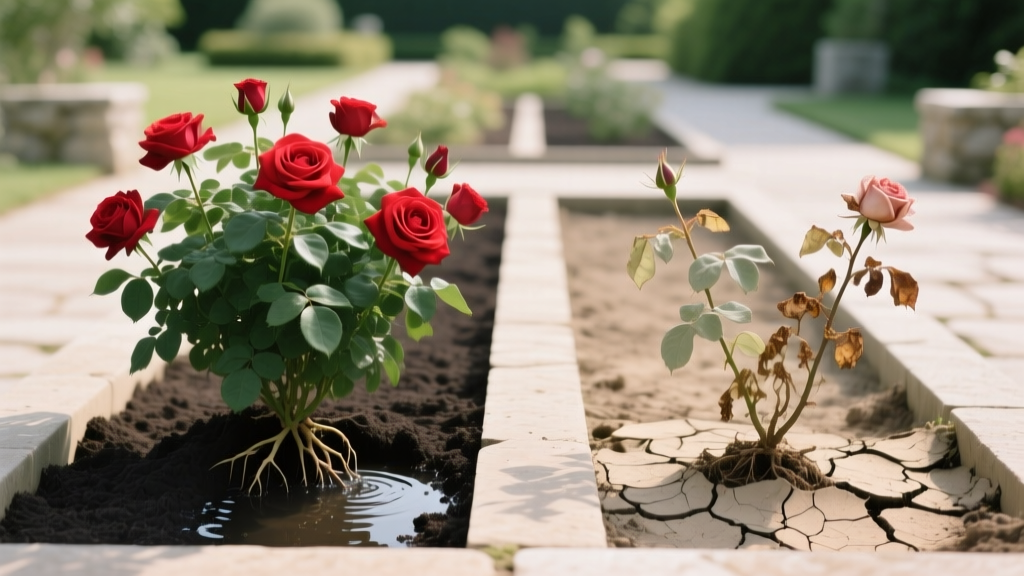
Deep Watering vs Frequent Watering for Roses
It’s a familiar scene: you step outside on a hot afternoon, see a rose looking a little droopy, and give it a quick sprinkle with the hose. It perks up for a few hours—then looks tired again the next day. Meanwhile, another rose across the yard gets watered “only once a week,” yet it’s pushing glossy new leaves and bigger blooms. The difference usually isn’t the rose variety. It’s the watering style.
Roses don’t just need water—they need water delivered in a way that trains roots to grow deep, keeps oxygen in the soil, and reduces disease pressure on foliage. Deep watering and frequent shallow watering can both “add up” to the same total gallons, but they don’t behave the same in real gardens.
This guide lays out exactly how each method affects roses, how much water to apply (with real numbers), and how to adjust for soil, weather, containers, and common rose problems.
Deep watering vs frequent watering: what it really means for roses
Let’s define terms the way they play out in the yard:
- Deep watering: applying enough water in one session to moisten the root zone to roughly 8–12 inches deep (sometimes deeper in sandy soil), then allowing the surface to dry somewhat before the next irrigation.
- Frequent watering: applying small amounts often—daily or every other day—usually wetting only the top 1–3 inches of soil.
Roses are not cacti, but they’re also not lettuce. Most established landscape roses perform best when the top layer dries a bit between waterings and the moisture is carried deeper where roots can access it steadily.
“Watering deeply and infrequently encourages deeper rooting and helps plants better withstand dry periods.” — Colorado State University Extension fact sheet (2020)
Quick comparison table: deep vs frequent watering
| Factor | Deep watering (1–2x/week) | Frequent watering (3–7x/week) |
|---|---|---|
| Typical wetting depth | 8–12+ inches | 1–3 inches |
| Root growth pattern | Deeper, more resilient | Shallow, drought-prone |
| Disease risk (foliage staying damp) | Lower if watered at soil level | Often higher (more frequent wet periods) |
| Heat-wave performance | Usually better (more stored moisture) | Usually worse (surface dries fast) |
| Best fit for | In-ground roses, most soils | New plantings, containers, extreme heat/sand (with strategy) |
How much water roses actually need (with workable numbers)
If you want a target you can use today: many established in-ground roses do well with roughly 1–2 inches of water per week from irrigation + rainfall during active growth. That’s a general horticultural benchmark echoed widely in Extension guidance for landscape plants.
The trick is converting “inches of water” into something you can apply. Here are practical ways to measure:
- Rain gauge / tuna can method: place straight-sided cans near your roses; run sprinklers until you collect 0.5 inch in the can for a half-week watering.
- Drip irrigation: if you have 1 gallon-per-hour emitters, running two emitters for 60 minutes delivers about 2 gallons to that plant’s area (before accounting for soil spread).
- Hose “slow soak”: a pencil-thick trickle for 20–40 minutes at the base can wet a surprising amount of soil, especially in loam and clay-loam.
Also keep this in mind: a rose in sandy soil may need the same weekly total, but split into more events because sand can’t hold as much plant-available water. Clay can hold plenty of water, but it needs time between watering for air to return to the root zone.
For temperature context: when daytime highs are consistently 85–95°F, water use climbs quickly, and a once-a-week schedule often needs adjustment. During mild weather (65–80°F), many gardens can stretch intervals comfortably if soil is improved and mulched.
Deep watering: the method I trust for established roses
Deep watering is less about heroically dumping water and more about getting slow, even penetration into the root zone. Your goal is moist soil down where most feeder roots are, without keeping the crown soggy.
Step-by-step: deep watering an in-ground rose
- Check moisture first: push your finger or a trowel into the soil. If it’s dry at 2–3 inches, it’s time. If it’s still cool and damp, wait.
- Water at the base: keep water off leaves when possible. Drip, soaker hose, or a low hose trickle beats overhead watering for disease control.
- Soak slowly: apply water for 30–60 minutes depending on soil and delivery rate. Fast watering runs off and fools you.
- Confirm depth: 30 minutes after watering, dig a small “inspection hole” 6–10 inches from the plant. You want moisture down to about 8–12 inches.
- Mulch: keep a 2–3 inch layer of mulch over the root zone, pulled back an inch or two from canes.
This approach aligns with drought-resilience fundamentals promoted by Extension programs that emphasize deep, infrequent irrigation to encourage deep rooting (Colorado State University Extension, 2020).
When deep watering goes wrong
Deep watering isn’t automatically “better” if the soil can’t drain. In heavy clay or low spots, deep watering too often can keep roots oxygen-starved.
Red flags you’re overdoing it:
- Leaves yellowing from the bottom up while soil feels wet
- New growth is soft, pale, and sluggish
- Musty smell or algae on soil surface
Fix: extend the interval between deep waterings, improve drainage (raised bed, compost, coarse mulch), and avoid puddling at the crown.
Frequent watering: when it helps, and when it backfires
Frequent watering has a place, but most gardeners accidentally do it shallow—just enough to dampen the crust. That trains roots to live at the surface, where soil temperatures swing harder and moisture disappears faster.
When frequent watering is the right tool
- Newly planted roses: the root ball can dry out faster than surrounding soil. For the first 2–3 weeks, check daily and water when the top couple inches begin to dry.
- Containers: pots can dry in a day during 90°F weather and wind. A container rose may need water daily or even twice daily in heat waves.
- Very sandy soil: water drains quickly; you may need smaller, more frequent irrigations—still aiming for depth, but achieved through multiple cycles.
How to “frequent water” without keeping it shallow
If you must water more often, use a cycle-and-soak approach:
- Run drip/soaker for 10–15 minutes.
- Stop for 30–60 minutes to let water infiltrate.
- Run again for 10–15 minutes.
This reduces runoff and pushes water deeper than one quick daily sprinkle.
Real-world scenarios: choosing the right watering strategy
Scenario 1: Heat wave with drooping blooms (in-ground roses)
You’re seeing wilted blooms and slightly limp leaves by late afternoon during a run of 95°F days. The soil surface looks dry, so you water daily for 5 minutes—yet the rose looks stressed.
What’s happening: you’re wetting the top inch, which evaporates quickly. Deep roots remain under-watered.
What to do instead (next 7 days):
- Water deeply 2 times that week (for example, Tuesday and Saturday).
- Use a soaker hose for 45–60 minutes per session (adjust for your flow rate).
- Add or refresh 2–3 inches of mulch to reduce evaporation.
- If the rose still flags at 4–6 pm but recovers by morning, that can be normal heat response—don’t panic-water unless soil is actually dry below 3 inches.
Scenario 2: New bare-root rose planted this spring
A newly planted bare-root rose is not “established,” even if it looks fine today. The developing root system needs consistent moisture, but it also needs oxygen.
Practical schedule:
- Week 1–2: check daily; water when the top 1–2 inches start drying.
- Week 3–6: transition to deeper watering every 3–4 days, verifying moisture depth.
- After 6–8 weeks (weather depending): move toward deep watering 1–2 times per week.
Don’t rely on a calendar alone—wind and soil type can change the drying rate dramatically.
Scenario 3: Container rose on a sunny patio
A potted rose in full sun is a different beast. The root zone is limited, potting mix drains fast, and the pot heats up. In warm weather, frequent watering is often necessary, but you still want deep saturation.
Container best practice:
- Water until you see steady drainage for 5–10 seconds from the bottom holes.
- In 85–95°F weather, expect watering once daily (sometimes more in wind).
- Use a pot at least 18–24 inches wide for most bush roses; tiny pots create constant stress.
- Mulch the surface with fine bark or compost (1 inch) to slow evaporation.
Soil: the hidden factor that decides whether deep watering works
Watering advice falls apart when soil is ignored. A rose in sandy soil and a rose in compacted clay can receive the same gallons and have totally different results.
Quick soil behavior guide
- Sandy soil: drains fast, holds less water. Needs either more total water or more frequent deep cycles. Mulch is non-negotiable.
- Loam: the sweet spot. Deep watering 1–2 times per week usually works well in summer.
- Clay / clay-loam: holds water but can suffocate roots if kept constantly wet. Deep water, but extend the interval and focus on drainage and soil structure.
Soil upgrade that pays off: topdress with 1–2 inches of compost around roses (not piled on canes) once or twice a year. This improves infiltration in clay and water-holding in sand over time.
For broader watering efficiency principles and avoiding runoff, the EPA’s WaterSense program emphasizes matching irrigation to site conditions and reducing waste (U.S. EPA WaterSense, 2023).
Light and heat: watering changes in full sun vs partial shade
Roses generally bloom best with at least 6 hours of direct sun. More sun usually means more water demand.
- Full sun (6–8+ hours): plan on deeper, more regular watering during hot spells; mulch heavily.
- Partial shade (4–6 hours): soil stays moist longer; overwatering is more common here, especially in clay.
One practical habit: check soil moisture early morning. If it’s damp at 3 inches, skip watering even if the surface looks dusty.
Feeding roses without sabotaging your watering plan
Fertilizer changes how fast roses use water. Nitrogen-heavy feeding pushes soft growth that needs steady moisture—great when managed well, a headache when watering is inconsistent.
Practical feeding rhythm (general home garden)
- Spring: start feeding when new growth is 4–6 inches long.
- During bloom cycles: a balanced rose fertilizer or compost topdress can be applied every 4–6 weeks through mid-summer (follow label rates).
- Late summer/fall: ease off high nitrogen about 6–8 weeks before your average first frost to avoid tender growth.
Watering tie-in: always water thoroughly before and after applying granular fertilizer to prevent root burn, especially when temperatures are above 85°F and soils dry quickly.
Common watering-related rose problems (symptoms & fixes)
This is where the “deep vs frequent” decision shows up fast—through leaves, buds, and cane health.
Problem: Wilting even though you water often
Symptoms: afternoon droop, dry crusty soil, flowers crisping at edges, plant never looks fully refreshed.
Likely cause: shallow frequent watering creating shallow roots.
Fix:
- Switch to deep watering 1–2 times per week.
- Use a soaker hose/drip for 45 minutes rather than a quick splash.
- Mulch 2–3 inches.
Problem: Yellow leaves and slow growth (wet soil)
Symptoms: lower leaves yellowing, some leaf drop, soil stays damp for days, fungus gnats or algae on surface.
Likely cause: overwatering or poor drainage; frequent watering is often the culprit.
Fix:
- Skip watering until soil is barely moist at 3 inches.
- Improve drainage: loosen soil gently, add compost, avoid saucers under pots.
- In clay, water less often but longer, and don’t water again just because the surface looks dry.
Problem: Buds dry up or drop (“bud blast”)
Symptoms: buds turn brown/crumbly before opening, petals stick, blooms are smaller.
Likely causes: inconsistent moisture (dry-wet swings), heat stress, or thrips.
Fix:
- Stabilize watering: deep soak, then re-water when soil dries to 2–3 inches.
- During extreme heat (95°F+), add a second deep watering that week.
- Inspect buds for thrips; if present, remove damaged blooms and consider insecticidal soap in the evening (follow label).
Problem: Black spot and powdery mildew flare-ups
Symptoms: black spots with yellow halos, leaf drop; or white powdery coating on leaves.
Watering link: overhead watering late in the day and frequent wet foliage periods raise risk.
Fix:
- Water at soil level, not over the plant.
- Water early morning so any splashed leaves dry quickly.
- Prune for airflow; remove infected leaves from the ground.
A simple decision rule you can use every week
If you want a reliable “master gardener” shortcut, use these three checks before you touch the hose:
- Soil feel at depth: is it dry at 2–3 inches? If yes, water. If no, wait.
- Plant stage: new plantings and containers need more frequent attention; established in-ground roses prefer deeper intervals.
- Weather reality: in a week with multiple days above 90°F or strong wind, increase total water (either longer deep soaks or an extra session).
And don’t underestimate measurement. A $10 rain gauge, a known emitter rate (like 1 GPH), and one quick inspection hole tell you more than guesswork ever will.
Deep watering wins for most established roses because it builds the kind of root system that gets through July and August without constant babysitting. Frequent watering still has its place—especially for pots and brand-new roses—but it works best when you’re still pushing moisture down into the root zone, not just dampening the dust.
Once you get the rhythm right, roses stop acting like drama queens. They bloom more consistently, handle heat with fewer setbacks, and reward you with the kind of sturdy growth that makes pruning and pest control easier all season long.
Sources: Colorado State University Extension fact sheet (2020); U.S. EPA WaterSense program guidance (2023).