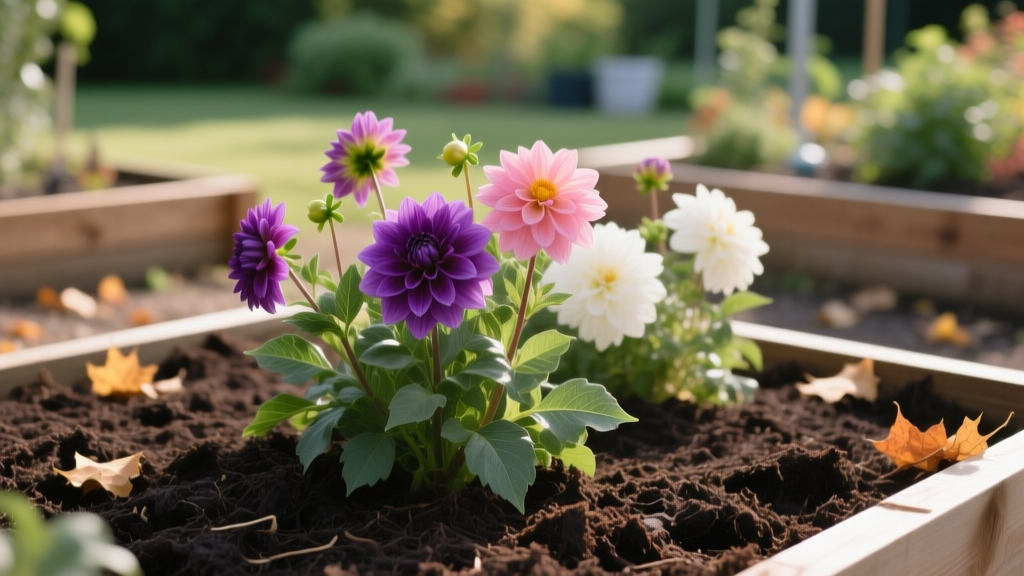
Using Leaf Mold as Mulch for Dahlias
The first time I tried leaf mold around dahlias, it wasn’t because I was chasing some trendy “soil hack.” It was because I was tired of watering every day in July, tired of watching buds abort after a hot spell, and tired of crusty soil that turned into a brick between waterings. I had a pile of half-rotted leaves behind the shed, and on a whim I spread a layer around my dahlia row. A week later, the soil under that mulch was cool and damp while the bare ground beside it was hot and dusty. Same sun, same plants—different root-zone reality.
Leaf mold isn’t a fertilizer miracle. It’s a moisture manager, a soil softener, and (when used right) a quiet helper for steady dahlia growth. Used wrong, it can also invite slugs, keep tubers too wet, or tie up nitrogen if you mix it into soil at the wrong time. This guide walks you through how to use leaf mold mulch in a way that matches how dahlias actually grow: fast, thirsty, and prone to sulking when conditions swing.
What leaf mold does (and doesn’t) do for dahlias
Leaf mold is decomposed leaves—usually 1–2 years old—broken down mostly by fungi. It’s different from leaf compost (which is often mixed materials and bacteria-driven). Leaf mold’s strengths are structure and moisture holding, not feeding.
- Does: Reduce evaporation, buffer soil temperature, improve soil crumb structure over time, keep irrigation more efficient, support beneficial soil fungi.
- Doesn’t: Replace a balanced fertilizer program for big, bloom-heavy dahlias.
Here’s the practical takeaway: leaf mold is your “steady conditions” tool. Dahlias reward steadiness.
“Mulches moderate soil temperature, reduce evaporation, and can improve soil structure as they break down.” — Washington State University Extension publication on mulches (2020)
Mulch benefits are well documented in extension literature. For example, Washington State University Extension emphasizes moisture conservation and temperature moderation from mulches (WSU Extension Publication, 2020). And the Royal Horticultural Society notes leaf mold’s value as a soil conditioner and mulch, particularly for improving moisture retention and soil structure (RHS Gardening Advice, 2023).
Timing: when to apply leaf mold mulch around dahlias
The best time depends on whether your dahlias are just planted, actively growing, or heading into late summer bloom.
After planting (spring)
Wait until shoots are up and the soil has warmed. If you mulch too early in cold, wet spring conditions, you can slow warming and keep tubers damp—two things dahlias don’t love.
- Soil temp target: about 60°F (15–16°C) before dahlias really take off.
- Apply mulch when: shoots are 4–6 inches tall and you’re past prolonged cold rains.
Early summer (ideal for most gardens)
This is my favorite window: plants are rooted, growth is accelerating, and the weather is warming. Mulch now, and you cut down the “dry-hot-dry” rollercoaster that causes leaf stress and bud drop.
Late summer (heat insurance)
If you missed earlier mulching, don’t skip it—just apply carefully (keep it off the crown) and watch slug pressure.
How much leaf mold to use (thickness, spacing, and coverage)
For dahlias, you want enough mulch to slow evaporation, but not so much that the crown stays wet and airless.
- Pull back from the stem: Leave a 2–3 inch bare ring around each stem/crown.
- Depth: Spread leaf mold 2–3 inches deep for most beds.
- Hot/dry sites: You can go up to 4 inches, but only if drainage is good and you keep that crown collar clear.
- Reapply: Top up with 1–2 inches mid-season if it’s broken down or washed thin.
If you’re mulching a row, I aim for full coverage in a band at least 18–24 inches wide centered on each plant. Dahlias feed and drink across a surprisingly wide root zone once they’re moving.
Watering dahlias with leaf mold mulch (and how it changes your schedule)
Mulch changes watering more than anything else. Leaf mold acts like a sponge at the surface: it slows evaporation, reduces crusting, and helps water soak in rather than run off. But it also means you can’t judge moisture by looking at the top inch of soil.
My rule: water deeply, less often
- Newly sprouted dahlias: about 0.5–1 inch of water per week (rain + irrigation), depending on wind and soil type.
- Once plants are 12–18 inches tall: typically 1–1.5 inches per week.
- Heat waves (90°F / 32°C+): expect up to 2 inches per week, especially in sandy soil or containers.
Use a soil probe, a trowel, or your finger: check moisture at 4–6 inches deep. If it’s dry there, water. If it’s cool and slightly moist, wait—even if the mulch surface looks dry.
Best method with leaf mold: soaker hoses or drip
Leaf mold pairs beautifully with drip lines or soaker hoses under the mulch. You get slow infiltration and fewer wet leaves (which helps disease control).
- Run time guideline: many soaker hoses need 30–60 minutes to deliver a meaningful soak, but test your output (it varies wildly by brand and water pressure).
- Goal: moisten soil to 8–10 inches deep for established plants.
Soil and drainage: setting leaf mold up to succeed
Dahlias like moisture, but they hate sitting in it. Leaf mold helps most in soils that either crust (clay) or dry too fast (sand). The key is to match mulch depth to your drainage reality.
Clay soil beds
Leaf mold is excellent on top of clay because it reduces surface cracking and keeps water from beading and running. But avoid burying the crown.
- Keep mulch to 2 inches early in the season.
- Water less often, longer—let it soak in.
- If water puddles for more than 4–6 hours after irrigation, you need drainage help (raised beds, compost incorporation, or planting on a slight mound).
Sandy soil beds
Leaf mold is a game changer on sand because it slows the “water through a sieve” effect.
- Use 3–4 inches of leaf mold, topped up midseason.
- Plan on more frequent watering than clay, but less frequent than unmulched sand.
Should you mix leaf mold into the planting hole?
I don’t. I prefer to use it as a surface mulch around dahlias. Mixed into the soil, leaf mold is usually fine, but any not-fully-finished leaf material can temporarily tie up nitrogen as microbes finish breaking it down. Surface mulching avoids most of that issue and protects soil structure.
Light and temperature: how mulch supports the “root zone climate”
Dahlias want full sun—6–8 hours is a solid target. But many dahlia problems blamed on “too much sun” are really root-zone heat and inconsistent moisture.
Leaf mold helps by shading soil and keeping root temperatures steadier. That matters during:
- Early summer growth spurts when plants build their framework
- Mid-summer heat when buds can abort if the plant swings between drought stress and heavy watering
- Late season when nights cool and dampness rises—mulch can either help (stable moisture) or hurt (if crowns stay soggy)
Feeding dahlias when you’re using leaf mold mulch
Leaf mold is not a high-nutrient amendment. Dahlias are hungry, especially tall varieties pumping out flowers. Think of leaf mold as your water/soil tool; use fertilizer for nutrition.
Practical feeding plan (beds)
- At planting (optional): mix a balanced, slow-release fertilizer into the bed, following label rates. If you prefer numbers, a common target is around 1–2 tablespoons of a granular balanced fertilizer per plant, but always match your product’s concentration.
- When plants hit 12 inches tall: start regular feeding.
- Bloom phase: shift toward lower nitrogen and higher potassium to support flowering rather than lush, floppy growth.
If you want one simple approach: apply a bloom-oriented fertilizer every 2–4 weeks from early summer until about 4–6 weeks before your expected first frost. Stop late feeding so plants can naturally slow down.
Leaf mold on top will gradually contribute trace nutrients, but it won’t push bloom production on its own. The RHS notes leaf mold is primarily a soil conditioner, valued for structure and moisture retention rather than nutrient content (RHS Gardening Advice, 2023).
Leaf mold vs other mulches for dahlias (with real-world tradeoffs)
Not all mulches behave the same. Here’s how leaf mold stacks up against two common choices in dahlia beds: straw and bark fines.
| Mulch type | Typical depth for dahlias | Moisture holding | Weed suppression | Common downside | Best use case |
|---|---|---|---|---|---|
| Leaf mold | 2–3 inches (up to 4 in sandy soil) | High | Moderate | Can harbor slugs if too wet/thick | Moisture stability, improving soil texture over time |
| Straw (seed-free) | 3–5 inches | Moderate | High (when thick) | Blows around; can introduce seeds if not clean | Fast weed control in big beds, hot climates |
| Bark fines | 2–3 inches | Low–moderate | High | Can shed water if it dries out; slower soil improvement | Paths/edges, long-lasting tidy look |
Comparison analysis with actual data: watering frequency in midsummer
In my own beds, the biggest measurable difference is how often you need to water to keep soil moist at 6 inches deep during hot spells. Here’s a realistic pattern many home gardeners see in 85–95°F weather with no rain:
- Bare soil: deep watering every 1–2 days (especially in sand)
- Leaf mold (3 inches): deep watering every 3–4 days
- Straw (4 inches): deep watering every 3 days, sometimes 4 if wind is low
Your numbers will vary with wind, soil type, and plant size, but the direction is consistent: mulch buys you time and keeps stress down.
Three real-world scenarios (and how to handle them)
Scenario 1: You planted dahlias, mulched right away, and now they’re slow
What’s happening: In cool springs, a thick mulch layer can keep soil cold and damp, delaying growth and risking tuber issues.
- Fix: Pull mulch back until shoots are 6–8 inches tall and the weather settles.
- Keep: A thin 1 inch ring outside the crown zone is fine if weeds are exploding.
- Watch for: Soft stems at soil line, sour smell, or poor emergence—signs of excess moisture.
Scenario 2: Your dahlias look great, but buds shrivel in a heat wave
What’s happening: Bud abortion is often drought stress followed by a sudden heavy watering, or consistently hot root-zone temperatures.
- Fix: Apply 3 inches of leaf mold, widen the mulched area to 24 inches, and water to 8–10 inches deep.
- Timing: Water early morning; avoid late evening soaking that keeps foliage damp overnight.
- Extra help: In extreme heat (several days above 95°F), temporary afternoon shade cloth can prevent scorching while plants recover.
Scenario 3: You mulched with leaf mold and suddenly have slug damage
What’s happening: Leaf mold is a cool, moist habitat—exactly what slugs like, especially in wet summers or shaded beds.
- Fix: Thin mulch to 2 inches and keep the 2–3 inch crown collar absolutely clear.
- Set traps: Boards on soil overnight; scrape slugs in the morning.
- Use barriers: Copper tape around raised beds or pots; keep grass and weeds trimmed back.
- If pressure is high: Iron phosphate bait used according to label can be effective while staying relatively low risk for pets compared with older chemistries.
Common problems when mulching dahlias with leaf mold (and exactly what to do)
Problem: Yellowing lower leaves, weak growth
Likely causes: Nitrogen shortage (common in fast growth periods), overwatering in cool weather, or soil that stayed too wet under mulch.
What to do:
- Check moisture at 6 inches deep before watering again.
- If soil is appropriately moist and growth is pale, feed with a balanced fertilizer at label rate; reassess in 7–10 days.
- Keep leaf mold as a surface mulch; don’t dig it in midseason.
Problem: Stems rot at the base or plants collapse
Likely causes: Crown kept wet, poor drainage, or mulch piled against stems.
What to do:
- Immediately pull mulch back to restore a 3–4 inch dry collar around the crown.
- Let the soil surface dry slightly between waterings; switch to morning watering.
- If your bed puddles after rain, consider lifting plants next season into a raised bed or planting on a 4–6 inch mound.
Problem: Powdery mildew shows up in late summer
Likely causes: Crowding, poor airflow, and overhead watering. Mulch isn’t the direct cause, but overly lush, nitrogen-heavy growth plus damp nights can tip the balance.
What to do:
- Space plants generously (often 18–24 inches apart for medium dahlias; more for giants).
- Avoid wetting foliage; use drip or soaker hoses under the mulch.
- Remove the worst affected leaves to improve airflow (don’t strip the plant bare).
Problem: Earwigs and pill bugs hiding under mulch
Likely causes: The habitat is too perfect—cool, damp, and protected.
What to do:
- Let the top of the mulch dry between waterings; water deeply but not constantly.
- Use rolled damp newspaper traps or small containers with oil + soy sauce near plants; empty daily for a week.
- Keep mulch from touching stems and remove nearby debris piles.
Step-by-step: mulching dahlias with leaf mold the way I do it
- Weed first. Mulch suppresses weeds best when you start clean. Hand weed or hoe on a dry day.
- Water the bed. Apply mulch after a good soak so you’re “locking in” moisture.
- Spread leaf mold. Aim for 2–3 inches deep across the root zone.
- Keep crowns clear. Leave 2–3 inches bare around each stem.
- Set irrigation under the mulch. Drip line or soaker hose goes down first, leaf mold on top.
- Check moisture weekly. Probe at 4–6 inches deep; adjust watering based on soil feel, not surface appearance.
- Top up midseason. Add 1–2 inches if the layer has broken down or thinned.
Small-space and container dahlias: leaf mold tweaks
Containers are their own beast: they heat up faster, dry faster, and can stay too wet if the potting mix is heavy.
- Mulch depth in pots: keep it to 1–2 inches. Too thick can slow drying too much and invite fungus gnats.
- Pot size for full dahlias: aim for at least 12–16 inches wide for many varieties; bigger is easier to keep evenly moist.
- Watering reality: in 90°F heat, many potted dahlias still need water daily—even with mulch—because the entire root zone is above ground.
Leaf mold quality: what good material looks like (and what to avoid)
Good leaf mold is dark brown, crumbly, and smells earthy. It shouldn’t be a slimy mat.
- Ready to use: leaves mostly unrecognizable, squeezes like a damp sponge, no sour smell.
- Avoid: piles that smell anaerobic (rotten/acidic), or material contaminated with herbicide-treated lawn clippings.
- Best leaves: deciduous tree leaves (maple, oak, beech). Thick waxy leaves break down slower, but they still work if aged.
If your leaf mold is only partially broken down (still lots of leaf shapes), it can still be used as mulch—just keep it on the surface and don’t bury dahlia crowns.
Once you get the hang of leaf mold, it becomes one of those garden materials you start guarding like treasure. It won’t replace feeding, staking, deadheading, or good spacing—but it makes the daily care of dahlias less frantic. Your soil stays workable, your watering becomes more efficient, and your plants ride out summer swings with fewer tantrums. That’s the kind of “improvement” I’ll take any season: not flashy, just reliable.
Sources: Washington State University Extension publication on mulches (2020); Royal Horticultural Society (RHS) guidance on making and using leaf mould as a soil conditioner and mulch (2023).