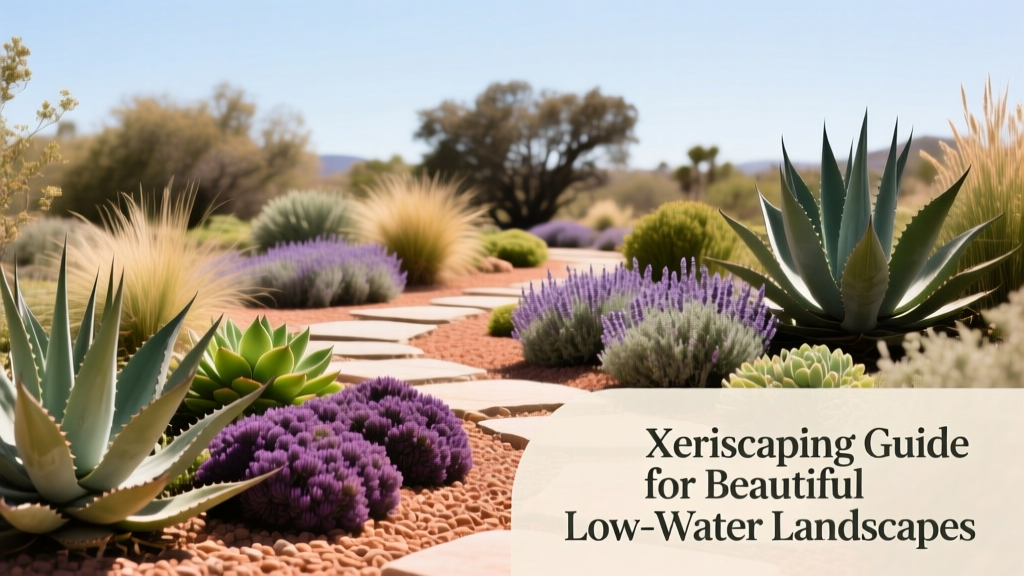
Drought-Tolerant Garden: Xeriscaping Guide for Beautiful Low-Water Landscapes
What Is Xeriscaping?
Xeriscaping (from Greek xeros = dry) is landscaping designed to reduce or eliminate the need for irrigation. A well-designed xeriscape uses 50-75% less water than a traditional lawn and garden while looking equally (or more) attractive. It's not about barren desert landscapes — it's about choosing plants adapted to your natural rainfall.
The 7 Principles of Xeriscaping
- Plan and design: Map sun, shade, slope, and water availability zones
- Improve soil: Add compost for water retention, gravel for drainage
- Limit turf areas: Replace lawn with groundcovers, gravel, or permeable hardscape
- Choose efficient irrigation: Drip lines, not sprinklers
- Select appropriate plants: Native and adapted species
- Use mulch: 2-3 inches to reduce evaporation
- Maintain properly: Less water doesn't mean no maintenance
30 Best Drought-Tolerant Plants
Perennials
| Plant | Water Need | Sun | Bloom Season |
|---|---|---|---|
| Lavender | Very low | Full | Summer |
| Russian sage | Very low | Full | Summer-fall |
| Sedum (stonecrop) | Very low | Full | Late summer-fall |
| Yarrow | Low | Full | Summer |
| Echinacea | Low | Full | Summer-fall |
| Salvia | Low | Full | Spring-summer |
| Black-eyed Susan | Low | Full-part | Summer-fall |
Shrubs
- Rosemary, Cistus (rock rose), California lilac, Manzanita
- Oleander, Butterfly bush, Smoke tree, Juniper
Groundcovers (Replace Lawn)
- Creeping thyme, sedum, ice plant, dichondra
- Native grasses: buffalo grass (warm zones), blue grama (cool zones)
Trees
- Olive, crape myrtle, desert willow, palo verde, mesquite
Soil Preparation
Most drought-tolerant plants need well-drained soil:
- Heavy clay: Amend with gravel and compost (50/50)
- Sandy soil: Add compost for water retention
- All soils: Mulch 3 inches deep after planting
Watering Strategy
Even drought-tolerant plants need water to establish:
- Week 1-2: Water every 2-3 days
- Month 1-2: Water twice a week
- Month 3-6: Water once a week
- After establishment: Water once a month or rainfall only
Final Thoughts
Xeriscaping is the future of gardening in a changing climate. A well-designed drought garden is lower maintenance, lower cost, and often more beautiful than a traditional water-hungry landscape. Start by replacing one lawn area with gravel, ornamental grasses, and lavender.