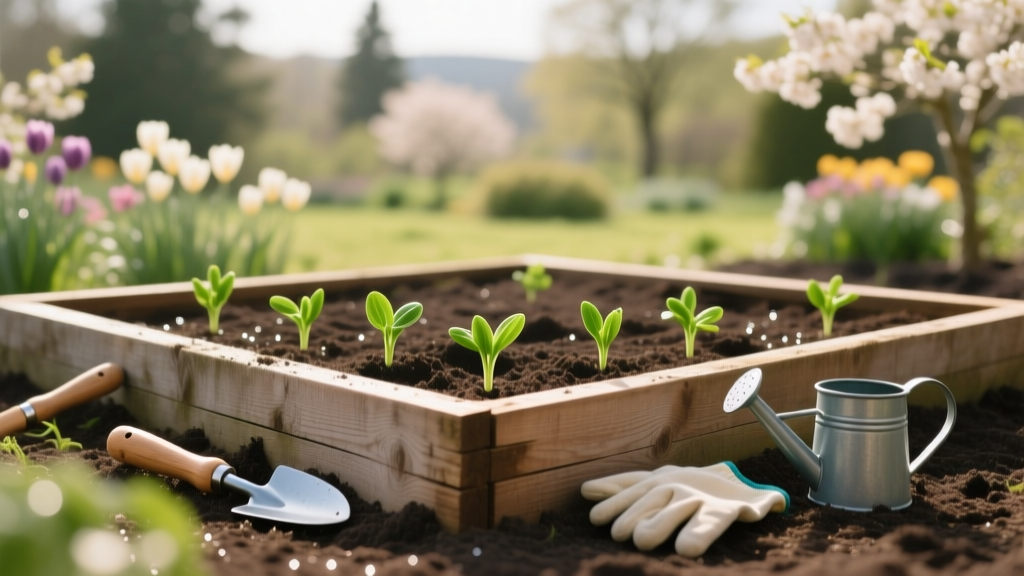
Spring Garden: Prepping Raised Beds for New Season
The window between “soil is finally workable” and “everything needs planting yesterday” is short. Raised beds warm earlier than in-ground soil, so spring prep starts sooner—and small delays (like skipping a quick soil test or planting before a cold snap) can set you back for weeks. Use this checklist-driven plan to get beds producing fast while protecting seedlings from late frosts, wind, and early-season pests.
Use your average last frost date as your anchor. In many Zone 5–7 gardens, that’s often between April 15 and May 15; Zone 3–4 may run May 20 to June 10; and mild Zone 8–10 gardens may have already passed frost by February. Your local date matters more than the calendar—then we layer in soil temperature thresholds so you plant at the right moment.
Priority #1: Prepare the beds first (so planting actually sticks)
Week 1 (4–6 weeks before last frost): Clean, assess, and reset the bed
Start when soil is no longer saturated. A quick test: squeeze a handful of bed soil—if it forms a sticky ball that doesn’t crumble, wait a few days. Working soil too wet destroys structure, even in raised beds.
- Remove winter covers (tarps, leaves, low tunnels) on a dry, breezy day so beds can air out.
- Pull weeds early. Tiny chickweed and henbit become seed factories fast in spring.
- Rake off crusted debris and old mulch from the planting strip. Keep disease-free leaves for compost.
- Inspect bed frames for bowing corners, rotted boards, or loose hardware. Tighten now—wet spring soil is heavy.
- Check drainage. If water pools in a bed for more than 24 hours after rain, loosen compacted zones with a garden fork (avoid deep tilling) and consider adding more compost.
Week 1–2: Do a fast soil test (or at least a targeted amendment plan)
If you haven’t tested in the last 2–3 years, spring is a good time. Many gardeners over-apply phosphorus; soil tests prevent that and save money. The University of Minnesota Extension notes that phosphorus and potassium often build up in gardens due to repeated fertilizer use, and recommends soil testing to guide additions (University of Minnesota Extension, 2020).
Targets for most vegetables: soil pH 6.0–7.0. If your pH is below 6.0, you may need lime; if above 7.5, focus on compost, sulfur (carefully), and crop choices that tolerate alkalinity.
- Quick fix if you can’t test: add 1–2 inches of finished compost across the bed and mix into the top 2–4 inches.
- Go easy on “complete” fertilizers unless you know you need them; too much nitrogen drives leafy growth and weakens flowering crops.
- Avoid fresh manure in spring beds used for edible crops; it can carry pathogens and can burn seedlings.
“Soil temperature is a better guide than air temperature for seeding and transplanting—cold soil slows germination and root growth even when days feel warm.” — Extension planting guidance summarized from multiple land-grant recommendations (e.g., University of Minnesota Extension, 2020; University of California Agriculture and Natural Resources, 2019)
Week 2–3: Warm and condition the soil (raised beds can overshoot—use that)
Raised beds often run 5–10°F warmer than surrounding soil on sunny days. That’s an advantage—if you manage moisture and temperature swings.
- To warm faster: cover beds with clear plastic or a low tunnel for 7–14 days before sowing. Vent on warm days to avoid cooking beneficial microbes.
- To stabilize moisture: water deeply once, then cover lightly with straw or leaf mold after planting to reduce crusting.
- To prevent nutrient lockup in cold soil: don’t over-fertilize early; wait until plants are actively growing.
Priority #2: What to plant right now (by soil temperature and frost timing)
Use a soil thermometer at a depth of 2 inches for seeds and 4 inches for transplants. Take readings in the morning for a conservative number.
As soon as soil hits 40°F (often 4–6 weeks before last frost)
These crops tolerate cold soils and light frosts. In many Zone 5 gardens, this can be late March to early April; in Zone 3–4, it may be late April to mid-May.
- Peas (direct sow): best germination around cool temps; use netting early.
- Spinach and arugula: fast and forgiving; cover for flea beetles.
- Radishes: sow every 10–14 days for steady harvest.
- Onion sets and shallots: plant early for larger bulbs.
When soil reaches 50°F (about 2–4 weeks before last frost)
- Carrots: keep the seedbed consistently damp for 7–21 days until germination.
- Beets and Swiss chard: soak seeds overnight to speed sprouting.
- Lettuce: plant in blocks for easier harvesting; shade cloth later if heat arrives early.
- Potatoes (in deeper beds): plant when soil is workable and around 45–50°F; hill as they grow.
After last frost, or when nights stay above 50°F
Warm-season crops stall in cold beds even if they survive. A common mistake is transplanting tomatoes and peppers on a warm April weekend, then losing two weeks of growth to cold nights.
- Tomatoes: transplant after last frost and when soil is consistently 60°F for best root activity.
- Peppers and eggplant: wait for warm nights; they prefer 65–70°F soil.
- Beans: direct sow when soil is 60°F to avoid rot.
- Cucumbers, squash, melons: sow or transplant when soil is 65°F.
Research-based timing matters: University of California Agriculture and Natural Resources emphasizes using soil temperature thresholds to time warm-season planting and reduce seed rot and transplant stress (UC ANR, 2019).
Comparison table: Fast spring crops vs. warm-season crops (raised bed timing)
| Crop group | Minimum soil temp to start | Frost tolerance | Typical timing relative to last frost | Raised-bed tip |
|---|---|---|---|---|
| Peas, spinach, radish | 40°F | High (light frosts OK) | 4–6 weeks before | Use row cover to speed growth and block pests |
| Carrots, beets, lettuce | 50°F | Moderate | 2–4 weeks before | Keep seedbed evenly moist; mulch lightly after emergence |
| Tomatoes, beans | 60°F | Low (frost kills) | 0–2 weeks after | Pre-warm bed with plastic for 7–14 days |
| Peppers, cucurbits | 65°F | Very low | 2–4+ weeks after | Use black mulch or landscape fabric to hold heat |
Priority #3: What to prune (and what not to touch yet)
Spring pruning in raised-bed gardens often means nearby perennials, berries, and small fruit plantings that share space with vegetables. Timing is crucial because many plants set flower buds early.
Prune now (late winter through early spring, before bud break)
- Raspberries: remove dead canes; thin to improve airflow. Summer-bearing types keep last year’s canes; fall-bearing can be cut to the ground if you want one big fall crop.
- Grapes: prune while dormant; bleeding sap later is common but avoid major cuts after leaf-out.
- Apple/pear espaliers (if you grow them along bed edges): remove crossing branches and water sprouts before growth starts.
Wait to prune (common spring mistakes)
- Spring-flowering shrubs (lilac, forsythia): prune after bloom or you’ll remove flower buds.
- Lavender: in colder zones (Zone 5 and below), wait until you see green growth; heavy early pruning can kill stems.
- Herb perennials like sage and thyme: trim lightly after new growth begins, not into old wood.
Priority #4: What to protect (late frosts, wind, and spring pests)
Spring protection is less about babying plants and more about keeping growth consistent. In raised beds, roots warm faster but also dry out faster, and seedlings are exposed to wind.
Frost and temperature swings: plan for at least one surprise cold snap
Many regions routinely see a frost after the “first warm week.” Keep supplies ready through at least 2 weeks after your average last frost date.
- Row cover (floating fabric): adds roughly 2–6°F of protection depending on weight; secure edges so wind can’t lift it.
- Low tunnels: great for early greens; vent when temps inside exceed 75°F on sunny days to prevent bolting.
- Wall-o-water or cloches: useful for the first tomato transplant if you’re pushing the season.
Wind protection: the hidden spring stressor
If your beds are on an exposed deck, driveway edge, or open yard, wind can desiccate seedlings in a single afternoon.
- Add temporary windbreaks on the windward side: burlap, shade cloth, or lattice for the first 3–4 weeks of growth.
- Water in the morning before windy days; avoid frequent shallow watering that encourages weak roots.
Pest and disease prevention: act before you see damage
Spring pests arrive early and reproduce fast. Start with barriers and sanitation, then escalate only if needed.
- Slugs and snails: remove boards and dense mulch hiding spots now; use iron phosphate bait if damage starts. Water in the morning so the surface dries by night.
- Flea beetles (on arugula, radish, broccoli family): use row cover from day one; damaged seedlings rarely “catch up.”
- Cutworms: protect transplants with collars (cardboard rings) pushed 1 inch into soil.
- Damping-off (seedling disease): avoid overwatering and sow into well-drained, not-overly-rich seedbed; thin promptly for airflow.
- Clubroot risk (brassicas): don’t plant cabbage-family crops repeatedly in the same bed; rotate at least 3 years if you’ve had issues.
Extension guidance consistently emphasizes sanitation and crop rotation as first-line prevention for vegetable diseases, especially in intensive garden spaces like raised beds (e.g., University of Minnesota Extension, 2020).
Priority #5: Prepare systems that save time all season (irrigation, layout, and succession)
Install or tune irrigation before you plant densely
Raised beds reward steady moisture. A simple drip line or soaker hose under mulch reduces leaf wetness (which helps prevent foliar disease) and cuts down on hand-watering.
- Goal: deliver deep watering 1–2 times per week depending on rainfall and temperature.
- Check output: run irrigation for 30 minutes and dig a small test hole—moisture should reach 4–6 inches down for most vegetables.
- Mulch after seedlings are established (usually when they have 2–3 true leaves) to avoid burying tiny plants.
Lay out beds for spring-to-summer handoffs
Spring crops finish right when warm-season crops want space. Plan it now so you aren’t ripping out thriving greens too late.
- Succession plan: radish → bush beans; spinach → cucumbers; lettuce → peppers; peas → summer squash.
- Use “placeholder” plantings: fast greens in spots where tomatoes will go after frost.
- Mark permanent spacing (tomatoes, peppers) so you don’t crowd them with spring sowings you can’t bear to remove.
Monthly schedule table (adjust by your frost date and USDA zone)
| Timing | Raised bed tasks (highest impact first) | Planting focus | Protection to keep ready |
|---|---|---|---|
| 4–6 weeks before last frost | Clean beds; top-dress 1–2 inches compost; weed; set hoops | Peas, spinach, radish, onion sets (soil ~40°F) | Row cover, slug control, frost cloth |
| 2–4 weeks before last frost | Install drip; direct-sow in blocks; thin early | Carrot, beet, lettuce, chard (soil ~50°F) | Row cover for flea beetles; vented low tunnel |
| Last frost week | Harden off transplants for 7–10 days; pre-warm soil | Brassica transplants; herbs; potatoes if not done | Cloches; extra cover for surprise frost |
| 2–4 weeks after last frost | Mulch once soil is warm; tie in trellises | Tomatoes/beans (soil ~60°F), cucurbits (soil ~65°F) | Insect netting; consistent irrigation |
Regional and real-world scenarios (so you’re not guessing)
Scenario 1: Cold climate (USDA Zone 3–4) with late frosts and short summers
If your last frost is commonly May 25–June 10, raised beds are your season extender—but only if you protect early plantings.
- Do not rush warm-season crops. Prioritize cold crops early, then use tunnels to warm soil for tomatoes.
- Use low tunnels as standard equipment from May through mid-June.
- Choose fast varieties: bush tomatoes, early peppers, and compact squash help you harvest before fall cool-down.
Scenario 2: Temperate, swingy spring (Zone 5–7) with warm spells and surprise freezes
This is the classic “April teaser” pattern: 75°F days followed by a 28°F night. Your strategy is flexibility.
- Stagger plantings: sow greens weekly; transplant half your brassicas, then the other half 10–14 days later.
- Keep covers within reach through at least May 15 in many Zone 6 locations (adjust to your area).
- Resist nitrogen spikes early; fast, soft growth is more frost-prone and pest-attractive.
Scenario 3: Mild winter / early spring (Zone 8–10) with heat arriving fast
Your spring problem isn’t cold—it’s that the garden jumps from perfect to too warm quickly, and pests never really took a winter break.
- Start warm-season crops earlier once nighttime lows are reliably above 50°F.
- Keep lettuce and spinach shaded with 30–40% shade cloth as soon as days regularly exceed 80°F.
- Watch for aphids on tender spring growth; blast off with water early before colonies explode.
Scenario 4: Wet spring or heavy-clay yard soil (raised beds help, but drainage can still fail)
Even raised beds can stay too wet if the mix is compacted or the base is sealed by landscape fabric. If seedlings look yellow and stalled, oxygen is often the missing ingredient.
- Remove barriers under beds that block drainage (avoid plastic). If using fabric for weeds, ensure it’s permeable and not clogged.
- Fork the top 6–8 inches gently to open channels; top-dress with compost rather than mixing in lots of peat.
- Delay direct seeding until the surface is crumbly; cold, wet soil rots seeds.
Spring raised-bed checklists (printable and fast)
One-hour bed reset checklist
- Pull weeds and remove last year’s crop debris
- Check irrigation lines and connectors
- Top-dress 1–2 inches finished compost
- Rake level; mark planting rows or blocks
- Set hoops/stakes now (before plants get in the way)
Pre-planting readiness checklist (do this the day before sowing)
- Soil is workable (crumbles, not sticky)
- Soil temp confirmed: 40°F / 50°F / 60°F / 65°F depending on crop
- Row cover and clips staged nearby
- Slug/flea beetle plan ready (barriers first)
- Water source checked; irrigation tested for 5 minutes
7–10 day timeline for transplanting (hardening off)
- Days 1–3: 1–3 hours outside in bright shade; protect from wind
- Days 4–6: half-day sun; reduce watering slightly (don’t wilt)
- Days 7–10: full day outside; introduce cooler nights above crop threshold (tomatoes/peppers prefer >50°F)
Small details that make raised beds outperform in spring
Don’t over-loosen the whole bed. Raised beds can become fluffy, then settle hard after rains. Mix compost into the top few inches and let deeper layers stabilize.
Edge effects are real. Bed edges warm faster but dry faster. Put drought-sensitive seedlings (like carrots during germination) closer to irrigation lines and away from the very edge.
Label spring sowings. Early beds fill with small seedlings quickly. Labels prevent accidental hoeing and help you time thinning and succession plantings.
Plan one bed as a “nursery.” A small section under row cover for early greens and brassica transplants lets you replant gaps quickly after cold snaps or pest hits.
Spring raised-bed success is mostly timing: wait for workable soil, plant by soil temperature, protect through the last frost window, and set up irrigation before growth explodes. Do those four things, and you’ll be harvesting greens while neighbors are still “getting around to it,” with warm-season beds ready to take over right on schedule.
Sources: University of Minnesota Extension (2020), home garden soil testing and nutrient management guidance; University of California Agriculture and Natural Resources (2019), recommendations emphasizing soil temperature thresholds and seasonal planting timing for vegetables.