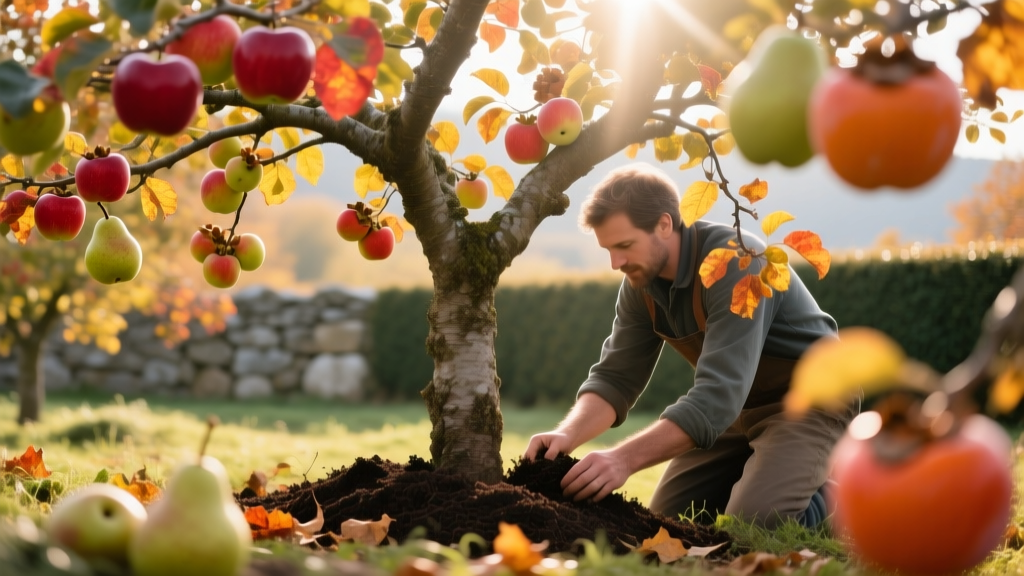
Fall Fruit Tree Care: Post-Harvest Feeding
The window between the last harvest and the first hard freeze is when fruit trees quietly decide how strong next spring’s bloom will be. Leaves are still photosynthesizing, roots are still active, and the tree is rebuilding carbohydrate reserves after fruiting. If you feed, water, and protect intelligently now—without pushing tender new growth—you set up better bud formation, sturdier wood, and fewer winter losses.
Use this guide as a “do it this week” playbook. The priorities below assume harvest is finishing or just finished, and you’re working in the 6–10 week stretch before your average first frost date (often sometime between September 15 and November 15 depending on region). When temperatures drop consistently below about 40°F, root uptake slows; once soil dips near 32°F, most nutrient movement nearly stops. Aim to complete feeding and major soil work 4–6 weeks before your typical ground-freeze conditions.
Right Now: Your Post-Harvest Priority List (Do These First)
Post-harvest feeding is not just “add fertilizer.” The fastest wins come from (1) sanitation, (2) targeted nutrients based on real need, (3) moisture management, and (4) preventing late-season pests and diseases from overwintering.
- Within 7 days of harvest: pick up dropped fruit (“mummies”), rake out disease debris, and remove codling moth–infested fruit.
- Within 2–3 weeks of harvest: soil test (or at least do a quick pH test) and apply post-harvest nutrients strategically.
- Before nights regularly hit 28–30°F: protect trunks from sunscald/rodents and stabilize irrigation as soils cool.
- After leaf drop but before deep winter: apply dormant disease sprays where appropriate and refresh mulch.
What to Prepare (Feeding & Soil Work): The Core of Post-Harvest Care
1) Soil test first—especially if you’re tempted to add nitrogen
Post-harvest is a great time to correct pH and rebuild potassium (K) and phosphorus (P) if they’re low. It’s also the easiest time to overdo nitrogen (N). Too much nitrogen in fall can push late, tender growth that’s more likely to winterkill.
Collect soil samples while the ground is workable. If you can only do one number, test pH. Many fruit trees perform best around pH 6.0–7.0 (species and soil type vary). Adjustments like lime or sulfur take time; fall applications often show results by spring.
Research-supported caution: Extension guidance commonly warns against late-season nitrogen that promotes growth rather than hardening off. For example, Washington State University Extension recommends timing nitrogen to avoid late-season flushes that reduce cold hardiness (WSU Extension, 2019).
2) Post-harvest feeding: focus on K, moderate N (or none), and micronutrients only if needed
General rule: If your trees grew vigorously (12–18 inches of new shoot growth on apples/pears; often less on stone fruit depending on training system) and leaves stayed dark green, you likely do not need fall nitrogen. If growth was weak and leaves were pale early, you might need modest nitrogen—but apply it early enough that the tree can use it without triggering soft growth.
- Potassium (K): supports fruiting, carbohydrate movement, and stress tolerance. If your soil test shows low K, fall is a good time to correct it.
- Phosphorus (P): helps root development; apply only if soil test indicates deficiency.
- Calcium (Ca): important for fruit quality; most calcium correction happens via soil pH management and in-season foliar programs, not heavy fall applications.
- Boron (B) / Zinc (Zn): only apply if a test indicates deficiency—micronutrients are easy to overdose.
“Late-season nitrogen can delay dormancy and increase the risk of winter injury. Manage nitrogen to support growth early, then allow trees to harden off.” (Extension guidance summarized from WSU Extension, 2019)
Timing target: Finish any nitrogen applications by about 6 weeks before your average first frost, and earlier in short-season climates (USDA Zones 3–5). In milder climates (Zones 8–10), nitrogen timing is still important—late flushes can invite aphids, fire blight susceptibility (pears/apples), and poor wood maturity.
3) How to apply nutrients without wasting them
Apply nutrients over the root zone, not against the trunk. For most mature trees, active feeder roots extend to or beyond the drip line. Use these steps:
- Weed and grass control: pull weeds and keep a 2–4 foot weed-free circle for young trees; larger for semi-dwarf/dwarf plantings.
- Water first if soil is dry: applying fertilizer to powder-dry soil reduces uptake and increases root burn risk.
- Broadcast and lightly incorporate: scratch pellets into the top 1–2 inches if feasible, avoiding root damage.
- Water in: a deep soak helps move nutrients into the rooting zone.
Moisture checkpoint: If your area has been dry, give trees a deep watering before the soil cools below 40°F. Drought-stressed trees are more prone to winter injury and bark cracking.
Monthly schedule: post-harvest through dormant season
| Month | Primary goal | Do this now | Weather/timing triggers |
|---|---|---|---|
| September | Restore reserves without stimulating tender growth | Sanitation; soil test; correct K/P if needed; irrigate deeply | After harvest; finish N by ~6 weeks before avg first frost |
| October | Harden off and reduce overwintering pests | Remove mummies; clean up leaf litter in disease-prone blocks; trunk guards; refresh mulch | When nights approach 35°F consistently; before first freeze events |
| November | Protect bark/roots; prep dormant sprays | Whitewash or trunk wrap; protect from rodents; final deep watering if dry | Before sustained 28°F nights; before soil nears 32°F |
| December–February | Dormant-season disease suppression and structure planning | Dormant oil/copper where appropriate; plan pruning; repair trellises | Apply sprays on dry days above label minimums (often > 40°F) |
What to Protect (Winter Prep That Starts in Fall)
1) Prevent sunscald and southwest injury
Sunscald often happens in late winter, but prevention starts now. Warm winter sun heats bark during the day; rapid nighttime cooling cracks or kills cambium. Young trees and thin-barked species (apples, some stone fruits) are most vulnerable.
- Trunk protection timing: install trunk guards or apply white latex paint diluted 1:1 with water by November 1 in cold-winter regions (Zones 3–6) and before the first sustained cold snap in milder regions.
- Keep guards dry and vented: moisture trapped under wraps invites disease and borers.
2) Rodent and deer defense before food gets scarce
Voles and rabbits start girdling when grass cover is thick and snow arrives. Deer browse can destroy next year’s framework.
- Mow and remove tall grass within 3 feet of trunks.
- Set hardware cloth cylinders (1/4-inch mesh) around trunks, sunk 1–2 inches into soil.
- Install deer fencing or individual cages before rut activity peaks (often October–November).
3) Mulch correctly—don’t create a vole hotel
Mulch moderates soil temperature and moisture, but piled mulch against bark causes rot and encourages rodents.
- Apply 2–4 inches of wood chips or leaf mold over the root zone.
- Keep mulch pulled back 3–6 inches from the trunk flare.
- In vole-prone sites, use a thinner mulch layer and keep the area closely mowed.
What to Prune (And What to Leave Until Dormancy)
Fall pruning: minimal and strategic
Major pruning in fall can stimulate growth or reduce cold hardiness on some species. Keep it light.
- Do now: remove broken limbs, hazards, and obviously diseased wood you can clearly identify.
- Wait until late winter: structural pruning for apples and pears is typically best during dormancy (often late February to March in cold climates, earlier in mild climates).
Species-specific notes
Stone fruit (peach, nectarine, apricot, sweet cherry): In wet climates, pruning at the wrong time increases canker and disease risk. Many growers prefer pruning stone fruit in late winter to early spring or during dry summer windows depending on disease pressure.
Apples/pears: Safer for dormant pruning; avoid heavy fall cuts. Focus fall effort on sanitation and nutrition management instead.
What to Plant (Fall Additions That Support Fruit Trees)
1) Plant cover crops in the orchard row middles
If you have space between rows or around widely spaced trees, fall is prime for cover crops that protect soil, improve infiltration, and add organic matter.
- Best window: sow 4–8 weeks before your average first frost date.
- Good choices: winter rye for erosion control; crimson clover in milder zones for nitrogen fixation; oats for a winter-kill mulch in colder regions.
2) Plant garlic or beneficial borders away from trunks
Garlic goes in when soil temperatures cool to roughly 50°F and below (often October). Keep it outside the main feeder-root zone of young trees to reduce competition.
3) Replace or add trees only when you can manage water
Fall planting works well in many climates because roots can establish while tops are dormant. In Zones 7–9 with mild winters, fall planting can be excellent. In Zones 3–5, fall planting is possible but riskier if you can’t mulch well and irrigate before freeze-up. Aim to plant at least 4–6 weeks before the ground freezes.
Pest and Disease Prevention: Fall Actions That Cut Next Year’s Problems
1) Sanitation: the cheapest spray you’ll ever use
Remove overwintering sources now:
- Pick up dropped fruit weekly until hard freezes stop activity.
- Remove and destroy mummified fruit in trees.
- Rake and dispose of heavily diseased leaves (especially where apple scab or cherry leaf spot is chronic).
University extension programs consistently emphasize orchard sanitation as a core integrated pest management practice. For apple scab, for instance, leaf litter management reduces the amount of overwintering inoculum (Cornell Cooperative Extension, 2020).
2) Codling moth, apple maggot, and fruit flies: break the life cycle
If you had “wormy apples” this year, don’t wait until next summer. Fall cleanup reduces larvae that exit fruit to pupate.
- Collect and destroy infested fruit (do not compost unless you hot-compost reliably).
- Remove corrugated cardboard trunk bands if you used them for trapping, and destroy them by late September to October.
3) Fire blight (apples/pears): stop feeding it
If your pears or apples had fire blight strikes, avoid nitrogen now. Mark blighted limbs and remove them during dormant pruning (sanitizing tools as recommended). Also remove rootstock suckers and vigorous watersprouts next season—lush growth is more susceptible.
4) Peach leaf curl and fungal diseases: dormant spray planning starts at leaf drop
Peach and nectarine issues often hinge on dormant-season management. Copper sprays are commonly timed around leaf drop and again in late winter where pressure is high—always follow your local extension recommendations and label directions.
Michigan State University Extension notes dormant copper applications are a key timing for peach leaf curl management (MSU Extension, 2018). In rainy winter regions, timing and coverage matter more than product choice.
Regional Scenarios: Adjust the Same Tasks to Your Climate
Scenario 1: Cold winters, short fall (Upper Midwest, Northern New England, Zones 3–5)
Your biggest risk is running out of time. Once nights regularly drop below 28°F, you’re in protection mode.
- Feeding: prioritize soil test and K/P correction early (often by mid-September to early October). Avoid fall nitrogen.
- Water: give a final deep watering before soil temperatures fall below 40°F, especially for young trees.
- Protection: trunk guards on by October 15–November 1; mulch after the first light frosts but before the ground freezes hard.
Actionable checkpoint: if your average first frost is around October 1, aim to finish nutrient applications by about mid-August to early September for any N, and by mid-September for K/P and soil amendments.
Scenario 2: Wet fall and mild winter (Pacific Northwest, coastal regions, Zones 7–9)
You have a longer season, but disease pressure is higher and soils can stay saturated.
- Feeding: focus on soil structure and drainage; avoid applying nutrients right before heavy rain (leaching/runoff risk).
- Sanitation: be aggressive with leaf litter management where scab, canker, or leaf spot are recurring.
- Pruning: avoid pruning stone fruits during wet spells; canker pathogens spread readily.
Actionable checkpoint: if your first frost is often November 15 or later, you can still do soil corrections in October—but don’t use that as an excuse to apply nitrogen late.
Scenario 3: Warm fall, sudden cold snaps (Intermountain West, High Plains, Zones 4–7 at elevation)
These areas can swing from 70°F afternoons to 20°F nights quickly. Trees may not harden off evenly.
- Feeding: avoid late N; focus on K if soil tests low. Keep irrigation steady but not excessive—drought followed by heavy watering can trigger growth spurts.
- Sunscald: high priority—strong sun plus cold nights is a classic setup. Paint/wrap trunks early.
- Mulch: use mulch to moderate soil temperature swings, but keep it back from trunks.
Scenario 4: Hot climates with long growing seasons (South, parts of CA/AZ/TX/FL, Zones 8–10)
Your challenge is managing extended growth and late-season pests. “Fall” may still be actively growing weather.
- Feeding: prioritize leaf and soil testing; split applications are often safer than one heavy dose. Watch for late flushes that attract aphids and scale.
- Irrigation: don’t shut water off too early—roots remain active well into fall when soil is warm.
- Disease: sanitation still matters; also watch for trunk/limb sunburn and borers in stressed trees.
Checklist: Post-Harvest Feeding and Fall Care (Print This)
Within 1 week of last pick
- Remove dropped fruit and mummies (start compost only if it gets hot).
- Flag branches with disease cankers or suspected fire blight for later pruning.
- Weed and grass control in a ring around trunks.
Within 2–3 weeks
- Collect soil samples for pH and nutrients.
- Apply K/P based on soil test (or hold until results arrive).
- Deep water if rainfall is under about 1 inch per week and soils are dry.
4–6 weeks before first hard freeze
- Stop nitrogen unless your local extension specifically recommends late-season timing for your system.
- Refresh mulch (2–4 inches), keeping it 3–6 inches off the trunk.
- Install vole/rabbit guards and check fencing.
At leaf drop to early dormancy
- Remove diseased leaves where scab/leaf spot is chronic.
- Plan dormant sprays (copper/oil) based on last season’s issues and label temperature requirements (often > 40°F on a dry day).
- Inspect for scale on twigs; note hotspots for dormant oil.
Practical Notes on Fertilizer Choices (So You Don’t Overdo It)
If you’re choosing products right now, keep it simple and evidence-based:
- Compost: great for soil biology and structure; apply as a thin topdress (1/2–1 inch) under mulch. Avoid piling against trunks.
- Balanced granular fertilizer: use only if a soil test supports it; don’t assume a “fruit tree blend” is appropriate for your site.
- High-nitrogen lawn fertilizer: avoid around fruit trees in fall—especially within the drip line.
- Wood ash: use cautiously; it can raise pH quickly and overapply potassium. Only use if you know your pH is low and you can measure amounts.
When in doubt, remember: the most reliable fall “feeding” is correcting deficiencies, not pushing growth. Your goal is a tree that enters dormancy well-hydrated, pest-clean, and nutritionally balanced.
Timeline Example: If Your First Frost Is October 15
Adjust to your own location, but here’s a workable rhythm for many Zone 5–7 gardeners:
- Aug 30–Sept 15: finish harvests; start sanitation; soil test.
- Sept 15–Sept 30 (2–4 weeks before frost): apply K/P if needed; deep watering during dry spells.
- Oct 1–Oct 15: install trunk guards; mow and reduce vole habitat; light mulch refresh after first cool-down.
- Oct 15–Nov 15: leaf drop cleanup; plan dormant sprays during appropriate weather windows.
If you do only three things this fall, make them these: clean up fruit and leaves that carry disease, correct nutrients based on a soil test (especially K and pH), and protect trunks from rodents and sunscald before freezing nights become routine. Spring performance is built in the quiet weeks after harvest—use them.