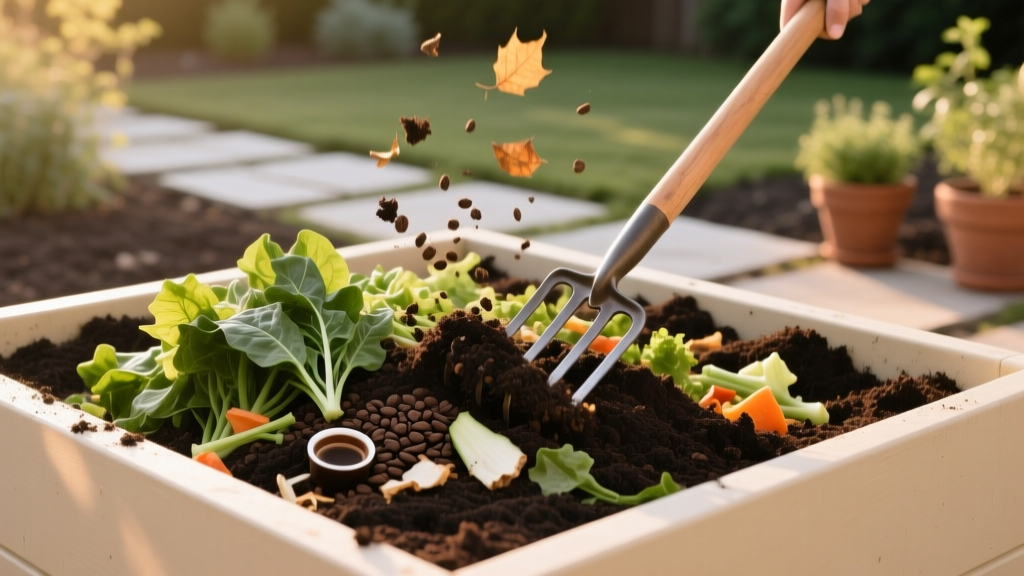
Seasonal Compost Turn Schedule for Best Results
When the pile is warm and oxygen is running low, you have a narrow window to turn compost and convert “kitchen scraps and leaves” into finished, sweet-smelling compost fast. Miss that window and you’ll still get compost—just slower, smellier, and with more pests. This seasonal schedule is built for gardeners who want to know what to do this week: when to turn, what to add, what to protect, and how to match your turning rhythm to temperature, rainfall, and frost dates in your USDA zone.
Use this article like an almanac. Start by checking two numbers: your average last spring frost date and first fall frost date (local extension calendars are best). Then use the temperature thresholds below to decide when to turn, when to leave the pile alone, and when to “feed” it.
Right-now priorities (read this first)
Priority 1: Turn by temperature—use these hard numbers
Compost turning isn’t “every X days” all year. It’s driven by heat and oxygen demand.
- Turn when the pile’s core temperature drops from its peak back down to 110–120°F after being hot (130–160°F) for several days.
- Sanitizing target: Aim for 131°F (55°C) or higher for several days to reduce pathogens/weed seeds; turning helps move outer material into the hot core. (EPA composting guidance widely uses 131°F as a key threshold.)
- High-heat caution: If the core exceeds 160°F, turn immediately and/or add bulky browns to avoid killing beneficial microbes.
- Moisture rule: If a squeezed handful feels like a wrung-out sponge (moist but not dripping), you’re close. If it crumbles and won’t hold shape, water it. If it drips, add dry browns and turn.
Priority 2: Feed the pile like a crop—balance greens and browns
A practical target is roughly 2–3 parts browns (dry leaves, shredded cardboard, straw) to 1 part greens (kitchen scraps, fresh weeds, coffee grounds, manure) by volume. Don’t obsess over perfect ratios—obsess over air spaces and moisture.
“The composting process is most efficient when the pile has adequate oxygen and moisture; turning is a tool to restore aeration and re-mix materials so decomposition stays active.” — Extension composting guidance summarized from multiple land-grant programs (e.g., Washington State University Extension, 2010; University of Illinois Extension, 2019)
Priority 3: Protect your pile from the season’s biggest spoiler
- Too wet (common in spring/fall): Cover with a tarp or lid, but leave some side ventilation. Turn and add shredded leaves.
- Too dry (common in summer/windy climates): Water in layers as you turn. A pile that never heats is often dry, not “bad.”
- Freezing (winter): Insulate with straw bales or bagged leaves; build bigger (at least 3 ft x 3 ft x 3 ft) so it holds heat.
Seasonal compost turn schedule (monthly table)
This schedule assumes a backyard “hot compost” pile of at least 3x3x3 feet, built with mixed materials and monitored with a compost thermometer. Adjust using the regional scenarios later in this article.
| Month | What to do right now | Turn frequency target | Temperature / weather trigger |
|---|---|---|---|
| January | Insulate, stockpile browns, keep food scraps protected from pests | 0–1x (only if thawed) | Turn only during a thaw above 35–40°F |
| February | Prep for spring build; shred leaves/cardboard | 0–1x | If core is >110°F, a quick turn can help |
| March | Start first hot pile as soon as materials are available | Every 7–10 days | Turn when core drops to 110–120°F after a heat peak |
| April | Peak spring composting—add spring weeds before they seed | Every 5–7 days | Rainy week: cover; if soggy, add browns and turn |
| May | Keep it hot; screen finished compost for beds | Every 5–10 days | Turn if core exceeds 160°F or drops below 110°F |
| June | Summer watering strategy; watch for dryness | Every 7–14 days | If core won’t rise above 120–130°F, likely too dry or too airy |
| July | Fastest decomposition month in many climates | Every 7 days (or more) | Turn at 110–120°F; keep moisture consistent |
| August | Plan fall “leaf pile” strategy; avoid drying out | Every 7–14 days | Heat waves: water during turning; cover lightly |
| September | Restart hot piles as nights cool; collect browns | Every 7–10 days | When nights drop below 55°F, expect slower reheats |
| October | Leaf season: build larger piles and layer greens | Every 10–21 days | Before first frost (28–32°F), do a major turn and water check |
| November | Last efficient turns; set up winter insulation | Every 2–4 weeks | Stop frequent turning once daytime highs stay below 45°F |
| December | Let it rest; protect from saturation and rodents | 0–1x | If frozen, don’t fight it—focus on storage and cover |
What to plant (and how compost turning fits your planting calendar)
Compost work should support planting deadlines. The trick is to time your “fast-turn” period so finished compost is ready when beds open up.
2–4 weeks before your last spring frost date
In many temperate zones, your last frost might fall between April 10 (USDA Zone 7) and May 25 (USDA Zone 4), but local variation is huge. Count back 4 weeks and aim to have a hot pile actively turning.
- Plant: peas, spinach, radish, onion sets (as soil is workable).
- Compost action: Start or reheat a pile; turn every 7 days if it’s heating.
- Use compost: If you have finished compost already, apply 1–2 inches as a top-dress; avoid digging deep into wet soil.
At last frost to 2 weeks after (soil warming window)
- Plant: potatoes, hardy annuals, and later warm-season transplants when nights stay above 50°F.
- Compost action: Keep turning—this is often when piles go anaerobic due to spring rain. Cover and add shredded browns.
6–10 weeks before first fall frost date
If your first frost is around October 15, that puts this window between mid-August and early September.
- Plant: fall carrots, beets, kale, and other cool-season crops.
- Compost action: Turn and water-check to keep decomposition moving as nights cool below 55°F.
What to prune (compost inputs and disease-safe rules)
Prunings are valuable compost ingredients, but not all plant material belongs in a hot pile—especially when disease pressure is high.
Prune and compost: “safe” inputs
- Small twigs and stems (shred or chip for faster breakdown)
- Non-diseased perennial cutbacks
- Spent annuals that are not heavily diseased
Prune and do NOT compost (or compost only if you can verify a sustained hot pile)
- Diseased foliage (tomato blight, powdery mildew-covered leaves): many home piles don’t maintain uniform sanitizing temperatures.
- Weeds with mature seeds unless you reliably reach and maintain 131°F+ and turn so everything hits the hot center.
- Invasive species (regional examples: bindweed rhizomes, Japanese knotweed pieces): bag and dispose per local guidance.
Extension services consistently warn that home compost piles may not heat evenly enough to kill all pathogens and weed seeds without proper management. For example, University of California Agriculture and Natural Resources compost resources emphasize temperature management and thorough mixing/turning for pathogen reduction (UC ANR, 2016), and Washington State University Extension notes that turning improves aeration and helps maintain active decomposition (WSU Extension, 2010).
What to protect (from weather, pests, and odor problems)
Protect the pile from pests—season by season
Pests are usually a “management” problem, not a composting problem. Tighten the routine during the season when your pests are most active.
- Spring: Rodents nest in cozy, undisturbed piles. Turn on schedule and avoid adding greasy food scraps. Bury fresh scraps in the center and cap with 4–6 inches of browns.
- Summer: Flies and gnats spike when fruit scraps sit near the surface. Freeze scraps first or keep a lidded kitchen container, then bury additions deep and cover immediately.
- Fall: Raccoons and rats get bold as natural food declines. Use a bin with a secure lid and 1/4-inch hardware cloth if pressure is high.
- Winter: If you continue adding scraps, keep them in a sealed bucket and add only during warmer spells so you can bury them in the core, not on frozen edges.
Protect compost quality: disease prevention in the pile and the garden
- Prevent anaerobic “sour pile”: Avoid thick mats of grass clippings. Mix clippings with shredded leaves at least 2:1 by volume, then turn.
- Prevent fungus gnat breeding: Don’t keep the surface constantly wet; cap with dry browns.
- Prevent re-infestation in beds: Screen compost for unfinished chunks that may harbor pests, and don’t top-dress plants prone to fungal issues with visibly unfinished compost.
What to prepare (materials, tools, and a turn-by-turn workflow)
Tools that actually change results
- Compost thermometer (20-inch stem helps reach the core)
- Fork or compost aerator
- Tarp (makes turning faster and cleaner)
- Shredder (optional, but shredded leaves compost dramatically faster)
Simple turning method (works for bins or freestanding piles)
- Check core temperature mid-pile, not near the edge.
- Lay out a tarp next to the pile.
- Peel off the outer 6–12 inches (cool material) onto the tarp.
- Move the hot core into a new pile location or back into the bin.
- Put the cool outer layer on top and into the center as you rebuild—this is the whole point of turning.
- Correct moisture as you rebuild: sprinkle water if dry; add shredded browns if wet.
- Recheck temperature 24–48 hours later. A healthy hot pile often rebounds quickly.
Timeline: “Hot pile in 30–60 days” (when conditions are right)
This is achievable in late spring through early fall in many USDA zones if you have enough material and you turn with discipline.
- Day 0: Build pile (aim for at least 3 ft in all dimensions).
- Day 3–5: Temp should climb into 130–150°F. If it doesn’t: add greens, water, and mix.
- Day 7–10: First turn when temps start falling toward 110–120°F.
- Weeks 2–4: Turn every 5–10 days depending on heat and moisture.
- Weeks 6–8: Many piles enter curing: temps stabilize nearer ambient; turning can drop to every 2–3 weeks.
Regional and real-world scenarios (adjust the schedule)
Scenario 1: Cool-spring climates (Upper Midwest, New England; USDA Zones 3–5)
If your last frost is late (often May 10–June 5) and spring soil stays cold, compost piles can stall. Your best move is to build bigger and turn less often until it’s truly active.
- Start date: When daytime highs regularly reach 45–50°F.
- Turn frequency: Every 10–14 days until you consistently hit 130°F+.
- Material strategy: Save fall leaves in bags so you have dry browns ready; add a nitrogen “kick” (fresh grass in thin layers, or aged manure).
- Garden tie-in: Use last year’s finished compost for spring planting; let this year’s pile mature for summer mulching and fall bed prep.
Scenario 2: Wet springs and rainy falls (Pacific Northwest, parts of the Southeast)
In prolonged rain, turning too often can make a pile colder and wetter—exactly what you don’t want. Your priority is keeping air spaces open and preventing saturation.
- Rain threshold action: After 1 inch of rain in a 24–48 hour period, check moisture; if the pile is glistening-wet or slumps, add dry browns and turn once.
- Cover strategy: Use a tarp like a roof (not wrapped tight). Leave sides breathing.
- Turn frequency: Every 10–21 days is often enough if the pile stays aerobic and warm.
- Pest note: Slugs and sowbugs love wet compost edges—keeping the surface capped with dry browns reduces habitat.
Scenario 3: Hot, dry summers (Interior West, High Plains; USDA Zones 5–9 with low humidity)
In arid heat, piles commonly fail for one reason: they dry out. Turning without watering can set you back a week.
- Heat strategy: Turn in the evening and water as you rebuild.
- Moisture checkpoint: If core temp stalls below 120°F and materials look pale/dusty, water thoroughly during the next turn.
- Turn frequency: Every 7–10 days can work well if moisture is maintained.
- Material strategy: Use more water-holding browns (shredded cardboard, partially dried leaves) and avoid huge amounts of straw without greens.
Scenario 4: Small urban bins (tumbler or 30–50 gallon static bin)
Small volumes lose heat quickly. You can still follow the seasonal schedule, but your “turning” is more like frequent mixing, and you’ll rely on consistent inputs.
- Temperature reality: Tumblers often run cooler; don’t expect weeks at 131°F. Be conservative with diseased material.
- Mixing plan: Spin or mix 2–3 times per week when actively feeding; reduce during cold spells.
- Finish plan: Let it cure longer (often 3–6 months) before using in seed-starting or around disease-prone crops.
Seasonal checklists you can use immediately
Spring (from snowmelt to last frost)
- Check for sogginess after storms; cover the pile if needed
- Start a hot pile when daytime highs hit 45–50°F
- Turn when core falls to 110–120°F after peaking
- Add shredded browns to prevent compaction from grass clippings
- Keep seed-head weeds out unless you can sustain 131°F+ with turning
Summer (after last frost through peak heat)
- Water during turning—don’t let the pile “crunch” dry
- Turn weekly if hot composting; slow to every 2 weeks if curing
- Keep fruit scraps buried to deter flies
- Shade the pile if it bakes in full sun and dries too fast
Fall (6–10 weeks before first frost through leaf drop)
- Stockpile shredded leaves (your winter browns and next spring’s carbon)
- Do a major turn 1–2 weeks before your first expected 28–32°F night
- Layer greens with leaves to avoid a matted leaf brick
- Keep adding, but stop frequent turning once daytime highs stay below 45°F
Winter (after consistent freezes)
- Insulate: straw bales, leaf bags, or a thick leaf cap
- Pause turning when frozen; wait for thaws above 35–40°F
- Store scraps safely (sealed bucket); add during thaws only
- Plan next year’s system: second bin, better lid, leaf storage
Compost turning and pest/disease prevention: seasonal “don’t regret this later” moves
Compost is a soil builder, but unfinished or poorly managed compost can spread problems. These seasonal moves keep your pile from becoming a pest nursery or a disease reservoir.
During tomato/pepper season: If you battle blight or bacterial leaf spots, keep suspect foliage out of a home pile unless you’re confident you’re achieving 131°F+ consistently and turning so all material cycles through the core. When in doubt, dispose or use municipal composting (which often has higher, regulated heat management).
During powdery mildew season (late summer/fall): Don’t compost heavily infected squash vines in a cool, slow pile. If you do add them, chop finely and only add to an actively hot pile, then turn on schedule.
During fruit fly/wasp season: Avoid leaving melon rinds and soft fruit at the surface. Bury in the center and cap with 6 inches of browns; consider freezing scraps first to reduce odors.
Quick “turn or wait?” decision tree
If you only remember one thing, remember this sequence.
- If core is >160°F: Turn now; add browns if it’s dense.
- If core is 130–160°F: Leave it; it’s working. Turn when it drops back toward 110–120°F.
- If core is 110–130°F and falling: Turn and moisture-check.
- If core is <110°F: Decide: are you curing (fine) or trying to hot compost (add greens + water + rebuild bigger)?
- If it smells like ammonia: Too many greens—add browns and turn.
- If it smells sour/rotten: Too wet/anaerobic—add bulky browns, turn thoroughly, and cover from rain.
Match your turning to what the season is giving you. Spring rewards careful turning and moisture control. Summer rewards watering discipline. Fall rewards leaf strategy and one last strong turn before freezes. Winter rewards patience and insulation. Keep a thermometer handy, follow the 110–120°F “turn trigger,” and your compost will consistently finish when your garden needs it most.
Citations: Washington State University Extension composting resources on aeration/turning and active compost management (WSU Extension, 2010). University of California Agriculture and Natural Resources composting and pathogen reduction concepts emphasizing temperature management and thorough mixing/turning (UC ANR, 2016). University of Illinois Extension compost management guidance reinforcing oxygen/moisture balance (UI Extension, 2019).